
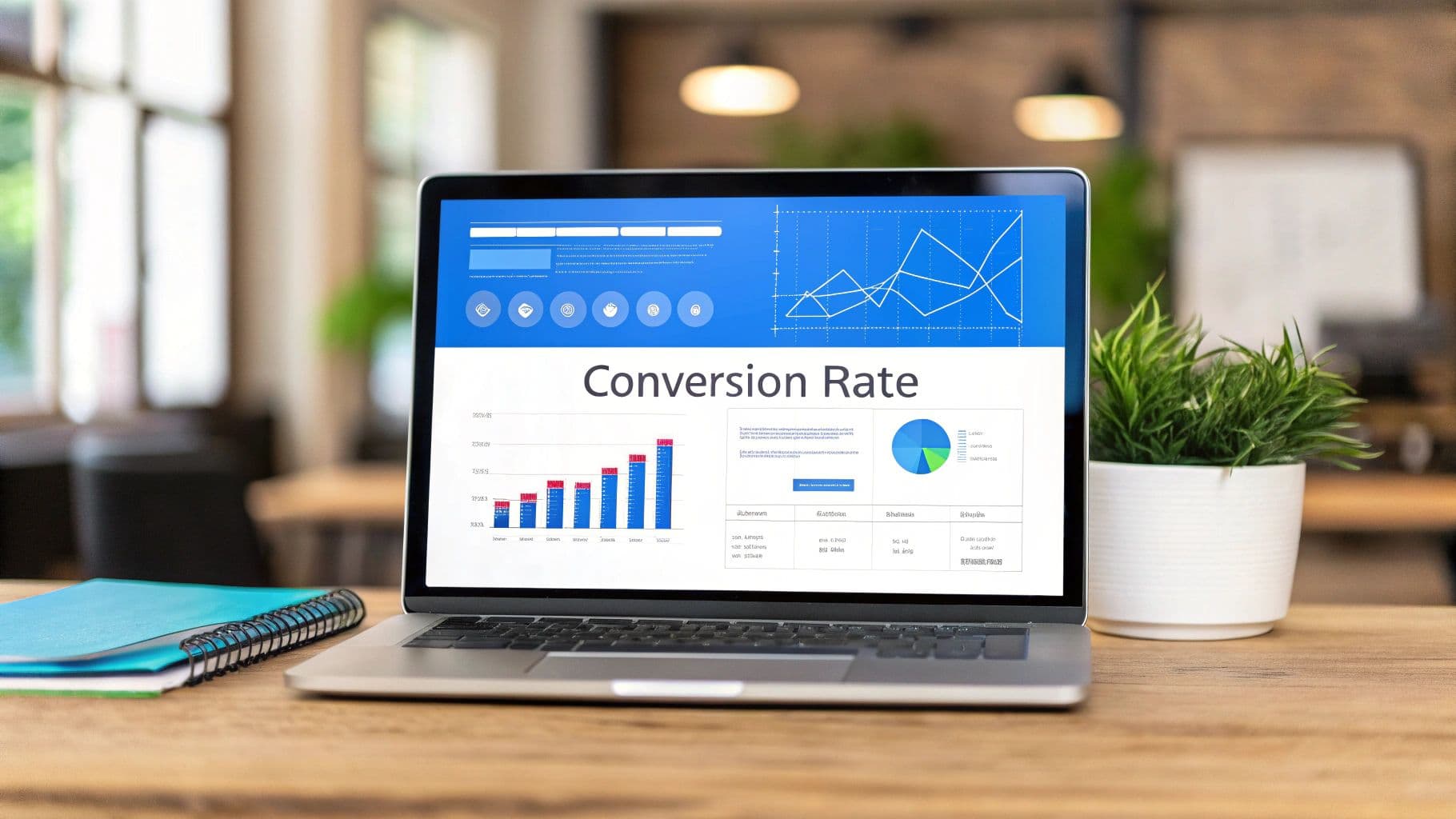
In marketing, the conversion rate is the percentage of users who complete a desired action out of the total number of people who visit your site. Think of it as your marketing report card; it tells you exactly how effective your message and website are at getting people to act.
What Is a Conversion Rate in Simple Terms
 What Is Conversion Rate in Marketing and How to Master It
Let's imagine your website is a real-world, brick-and-mortar store. Every single person who walks through the front door is a visitor. A conversion is what happens when one of those visitors does something valuable—like making a purchase, signing up for a loyalty card, or asking an employee for help.
Your conversion rate, then, is simply the percentage of visitors who took that specific action. It’s a direct measure of how well you turn casual browsers into engaged customers or leads.
The Basic Formula for Conversion Rate
At its core, calculating your conversion rate is refreshingly simple. The formula gives you a clear snapshot of how your marketing is performing:
Conversion Rate = (Total Conversions / Total Visitors) x 100%
So, if your landing page got 1,000 visitors last month and 50 of them signed up for your newsletter, your conversion rate for that goal is 5%. It's such a powerful metric because it looks past raw traffic numbers to measure the quality and effectiveness of that traffic.
Why This Metric Is So Important
Getting a ton of traffic but very few conversions is like having a store packed with people who never buy anything. It signals a major disconnect between attracting an audience and actually persuading them to do something.
Understanding your conversion rate is crucial because it helps you:
- Measure campaign success: See if your ads, emails, and content are truly working.
- Find friction points: A low rate can shine a spotlight on problems with your user experience, messaging, or offer.
- Optimize for better results: It gives you a clear baseline to A/B test and drive improvements.
Globally, the average website conversion rate hovers around 2.9%. That means for every 100 visitors, only about three will typically take the action you want them to. This stat really drives home how critical it is to understand and optimize every single step of the user journey.
To get a deeper understanding of what counts as a conversion, check out our guide on the different types of conversions.
Going Beyond the Sale with Different Conversion Types
 What Is Conversion Rate in Marketing and How to Master It
When marketers talk about "conversion rate," it’s easy for the conversation to get stuck on one thing: the final sale. But if you only focus on the purchase, you’re missing the bigger picture. It's like only watching the last two minutes of a championship game—you see the final score, but you miss all the critical plays that made it happen.
A smart marketing strategy looks at the full spectrum of user actions, not just the finish line. These actions fall into two key categories: macro-conversions and micro-conversions. Nailing the difference between them is how you get a complete view of your customer's journey and find out what’s really working.
Macro Conversions: The Ultimate Goal
Macro-conversions are the big wins. These are the primary, high-value actions you want users to take, the ones that are almost always tied directly to revenue. They're the reason your business exists.
Think of them as the main events your campaigns are built around:
We compare the leading options in our AI product video generator roundup.
- Making a purchase: The classic e-commerce conversion.
- Requesting a demo or quote: The finish line for most B2B and service businesses.
- Subscribing to a paid service: The primary goal for any SaaS platform.
These are the destinations. They're what keep the lights on and what you ultimately report to stakeholders. But nobody just appears at the destination—they have to take a journey to get there. That’s where micro-conversions come into play.
Micro Conversions: The Steps Along the Way
Micro-conversions are the smaller, yet essential, steps a user takes on their path toward a big macro-conversion. Think of them as signposts that signal interest and engagement, showing you that a user is moving in the right direction. Tracking them is how you diagnose what’s working and find the leaky spots in your funnel.
Micro-conversions are the breadcrumbs that lead to the final sale. Each one is a small "yes" from the user, signaling they are engaged and finding value in what you offer.
Common micro-conversions include:
- Signing up for a newsletter: Shows genuine interest in your brand and content.
- Adding a product to the cart: A powerful signal of purchase intent.
- Downloading a whitepaper or case study: A key step in building trust, especially in B2B. You can learn more about how these actions contribute to your lead generation strategy in our detailed guide.
- Watching a product video: A clear sign that someone is actively researching your solution.
By keeping an eye on these smaller actions, you can spot problems before they kill a sale. For instance, if you have tons of "add to cart" events but very few completed purchases, you know the problem isn’t your product page—it’s probably something in your checkout process. That’s an insight you’d completely miss if you only tracked the final sale.
We compare the leading options in our ecommerce product video generator roundup.
How to Accurately Track Your Conversion Rate
Knowing the definition of a conversion rate gets you in the door, but accurate tracking is the real game-changer. Without it, your conversion rate is just a guess—a vanity metric that can’t be trusted to make smart business decisions.
The bedrock of good tracking is simple: you have to tell your analytics platform what a “win” actually looks like for your business.
For most people, that process starts in a tool like Google Analytics 4 (GA4). Inside GA4, you can flag specific user actions—called events—as official conversions. This is you telling the platform, "Hey, when someone fills out this form or completes a checkout, that's a win. Count it."
This simple setup turns a vague marketing concept into a concrete number you can actually monitor and improve.
Setting Up Your Tracking Foundation
The very first step is making sure your analytics tool is even listening for the right signals. Every single conversion goal, whether it’s a simple email signup or a complex multi-step purchase, needs to be configured as an event that your platform can see.
Here's the basic play-by-play:
- Install a Tracking Tag: Think of this as the security camera for your website. You need to place your analytics code (like the GA4 tag) on every single page to monitor what visitors are doing.
- Define Key Events: Next, pinpoint the exact actions that matter. This might be a "generate_lead" event for a form submission or a "purchase" event when an order is completed.
- Mark Events as Conversions: Finally, you flip a switch inside your analytics tool to tell it that these specific events should be counted in your main conversion reports.
Once you’ve got this wired up, your tools will start gathering the data you need to calculate real conversion rates. If you want a more detailed guide on getting these systems in place, our post on effective conversion tracking is a great place to start.
The Challenge of Modern Tracking Accuracy
Unfortunately, the old way of tracking—relying on a user's browser—is becoming a huge liability. Ad blockers, cookie restrictions, and new privacy settings are constantly getting in the way, preventing your tracking tags from ever firing.
This isn't a small problem. Data loss from these issues can be as high as 20-30%, leaving a massive blind spot in your reporting. You're essentially flying with a broken instrument panel.
This is where more modern, robust methods come into play. Server-side tracking is a much better solution. Instead of relying on the user's browser, it sends conversion data directly from your website's server to your analytics tools. This bypasses all the browser-level roadblocks and gives you a far more complete picture of what’s really happening.
And if you're running paid ads, getting familiar with features like enhanced conversions in Google Ads is critical for making sure you’re not leaving money on the table due to bad data.
Understanding Attribution Models
Finally, how you give credit for a conversion is just as important as tracking it in the first place. An attribution model is simply the rulebook that decides which marketing touchpoint gets the credit when a sale or lead comes through.
Attribution isn't just about giving credit; it's about understanding the customer's journey. Your choice of model fundamentally changes how you value each marketing channel.
Here are a few of the most common models:
- Last-Click: This model gives 100% of the credit to the very last thing a person clicked before they converted. It's simple, but it’s like giving all the credit to the cashier and ignoring the window display that brought the customer into the store.
- First-Click: The opposite of last-click, this one assigns 100% of the credit to the very first touchpoint. It’s great for understanding which channels are good at creating initial awareness.
- Data-Driven: This is the smartest approach. It uses machine learning to analyze all the touchpoints and distribute credit based on how much influence each one actually had on the final decision.
Picking the right model is everything. A last-click model might tell you that your branded search ads are your best performer, completely ignoring the TikTok ad that introduced the customer to your brand in the first place. This could lead you to cut the budget for the very channel that's actually feeding your funnel.
Accurate tracking, combined with a smart attribution model, gives you the clarity you need to stop guessing and start investing your budget where it will actually make a difference.
What a Good Conversion Rate Looks Like
One of the first questions every marketer asks is, "Is my conversion rate any good?" The honest—and sometimes frustrating—answer is: it depends. A “good” conversion rate isn’t some magic number you can pull out of a hat. It's a moving target that shifts based on your industry, your audience, and where your traffic is coming from.
Trying to compare your performance against a universal average is a recipe for confusion. Think about it: an e-commerce store selling trendy, low-cost t-shirts is playing a completely different game than a B2B software company with a six-month sales cycle. The level of commitment, the price point, and the customer’s journey are worlds apart.
Benchmarks Vary by Industry
To set goals that actually make sense, you have to look at data from your specific sector. Industries that require a lot of consideration, like finance or B2B services, naturally have lower conversion rates because the decision-making process is so much longer.
On the other hand, sectors driven by lower-cost, impulse buys—like retail or beauty—tend to see higher averages. A 2% conversion rate might be phenomenal for a B2B manufacturer, but a fashion brand might be aiming for 4% or more. The real takeaway here is to use industry benchmarks as a starting point, not a strict report card.
Your most important benchmark is always your own past performance. The goal isn't to beat a generic industry average but to consistently improve upon your own numbers month over month.
This chart shows just how many things can throw off your tracking, making it tough to even know what your real conversion rate is.
 What Is Conversion Rate in Marketing and How to Master It
As you can see, things like ad blockers and new privacy settings can create huge gaps in your analytics, hiding what’s truly happening.
Traffic Source Matters Immensely
Where your visitors come from has a massive impact on whether they’ll convert. Not all traffic is created equal, and understanding this distinction is crucial for judging your campaign's success.
Just think about the different mindsets of these visitors:
- Search Engine Traffic: Someone Googling "buy red running shoes size 10" is on a mission. They have high intent and are probably ready to pull out their credit card. This traffic should convert at a high rate.
- Social Media Traffic: A person scrolling through Instagram might tap on your ad out of pure curiosity, not because they have an immediate need. Their conversion rate is naturally going to be lower.
- Email Marketing Traffic: These are your subscribers. They already know you, like you, and trust you. This group is often your highest-converting audience by a long shot.
This is why you absolutely have to break down your conversion rates by channel. If your Google Ads campaign is converting at 5% but your Facebook campaign is only at 1%, it doesn’t automatically mean Facebook is a failure. It just reflects the completely different intent of the audiences on each platform. The only way to get a true picture of what's working is to set separate, realistic benchmarks for each traffic source.
Average Conversion Rates by Industry and Traffic Source
To give you a clearer picture, here’s a look at some typical conversion rates broken down by both industry and the channel that brought the visitor to the site.
Industry / Traffic Source | Average Conversion Rate (%) |
|---|---|
E-commerce | 2.86 |
B2B Tech/SaaS | 2.10 |
Finance & Insurance | 5.01 |
Healthcare | 2.80 |
Legal | 7.40 |
- - - - - - - - - - | - - - - - - - - - - |
Organic Search | 2.80 |
Paid Search (Google Ads) | 4.40 |
Social Media (Paid) | 1.00 |
Email Marketing | 3.20 |
Referral | 4.10 |
Data sourced from multiple industry reports.
Remember, these numbers are just averages. Use them as a guide to see where you stand, but focus on improving your own metrics over time. Beating last month's numbers is always a more valuable goal than chasing a generic benchmark.
Proven Strategies to Improve Your Conversion Rate
 What Is Conversion Rate in Marketing and How to Master It
Knowing your conversion rate is the starting line. Actually improving it is where the real growth kicks in. This is the world of Conversion Rate Optimization (CRO), and it's less about guesswork and more about a scientific, repeatable process for getting more visitors to take the action you want.
Instead of just throwing random ideas at your website to see what sticks, effective CRO is a structured cycle. It’s a continuous loop of learning, testing, and refining that top marketers rely on to make data-driven decisions. This process stops you from wasting time on changes that feel right but don’t actually move the needle.
The Core CRO Cycle
The foundation of any solid optimization strategy is a repeatable process. Follow these steps, and you’ll methodically uncover weak spots in your funnel and find winning solutions that genuinely improve the user experience—and drive more conversions.
- Gather Data: Start by being a detective. Use analytics, heatmaps, and session recordings to see how people actually use your site. Look for the pages with high drop-off rates or spots where users seem to get stuck.
- Form a Hypothesis: Based on what you found, make an educated guess about a change that could improve things. For example: "Changing our CTA button text from 'Submit' to 'Get My Free Guide' will increase form submissions because it clarifies the value."
- Run an A/B Test: Time to test your theory. Create a new version of your page (Version B) with your proposed change and pit it against the original (Version A). You'll show each version to a different segment of your audience to see which one performs better.
- Analyze Results: Once you have enough data, see if your change led to a statistically significant improvement. If it won, awesome—implement the change. If not, take what you learned, form a new hypothesis, and start the cycle all over again.
This methodical approach is the secret sauce to smart optimization. For a deeper dive, check out these best practices for conversion rate optimization to help guide your strategy.
Actionable Tactics to Boost Conversions
While the CRO process is king, some tried-and-true tactics are fantastic starting points for your tests. These strategies are rooted in user psychology and are designed to build trust, slash friction, and make your value proposition crystal clear.
The goal of optimization isn't just to get more clicks; it's to make the user's journey so smooth and intuitive that converting feels like the natural next step.
Here are three powerful areas to focus your efforts:
- Redesign Your Call-to-Action (CTA): Your CTA is arguably the most important element on your page. Make it impossible to miss. Use contrasting colors and clear, action-oriented language. A vague CTA like "Click Here" is dead weight compared to something specific and compelling like "Start Your 14-Day Free Trial."
- Streamline Your Forms and Checkout: Every single field you ask a user to fill out is another hurdle. It’s another reason for them to give up. One study found that cutting form fields from 11 to just 4 can boost conversions by a staggering 120%. Be ruthless—eliminate any non-essential fields and make it painless to convert.
- Leverage Social Proof: People trust other people more than they'll ever trust a brand. Plaster your site with customer testimonials, reviews, case studies, and trust badges. Seeing that others have had a great experience makes potential customers feel much more confident in their decision.
One of the most powerful ways to identify these friction points is through web usability testing to boost UX conversions. Getting feedback directly from users tells you exactly where the roadblocks are. By continuously testing these elements and analyzing the results, you can turn your website into a highly effective conversion machine.
Common Questions About Marketing Conversion Rates
Even when you feel like you've got a handle on the basics, a few tricky questions always seem to pop up once you start digging into the data. Getting these right is key to building a solid strategy and avoiding some all-too-common analysis traps.
Let's walk through some of the most frequent questions I hear from marketers. Think of this as a quick reference guide to help you get confident in your numbers.
Conversion Rate vs. Click-Through Rate
This is probably the most common point of confusion. While conversion rate and click-through rate (CTR) sound similar, they measure two totally different stages of the customer journey.
Let's use a simple analogy. Imagine you're handing out flyers for a new coffee shop.
- Click-Through Rate (CTR) is the percentage of people who take a flyer from you. It tells you how good your initial pitch was at grabbing someone's attention.
- Conversion Rate is the percentage of people who took the flyer, walked over to your shop, and actually bought a coffee. It measures whether you delivered on the promise you made on that flyer.
A high CTR with a low conversion rate is a classic red flag for marketers. It usually means your ad was compelling enough to get the click, but the landing page didn't meet their expectations, so they bounced without taking action.
How Much Data Do I Need For a Meaningful Rate?
Making big business decisions on a small sliver of data is like trying to predict a whole season's weather after one cloudy morning. You need enough information to see a real pattern, not just random noise.
For general business reporting, you should be looking at a timeframe long enough to smooth out daily spikes and dips—a full week is good, but an entire month is even better. If your business has a long sales cycle, you'll need an even wider window to capture the complete journey from the first touch to the final sale.
For A/B testing, the stakes are much higher. A widely accepted best practice is to aim for a minimum of 100 conversions per variation you are testing. Anything less, and you risk making a decision based on statistical chance rather than a genuine user preference.
Can My Conversion Rate Be Too High?
It sounds a bit crazy, right? But yes, sometimes an astronomically high conversion rate can signal a problem. While it's usually a fantastic sign of a well-oiled marketing machine, a number that seems way out of line definitely warrants a closer look.
An out-of-place spike could point to a few potential issues:
- A Technical Glitch: Your tracking code might be firing twice on the confirmation page, which would lead to duplicate conversion counts for a single action.
- A Low-Value Goal: The action you've defined as a "conversion" might be too easy or insignificant, like just viewing a specific page instead of making a purchase.
- An Overly Narrow Audience: In some cases, it could mean your targeting is so specific that you're only reaching hyper-engaged users but are missing out on a much larger opportunity for growth.
If a number seems too good to be true, it’s always smart to investigate. A healthy dose of skepticism ensures your data is clean and reliable. For a deeper understanding of measuring improvements, you can explore our article on calculating lift in conversion rate.
Accurate conversion data is the backbone of smart marketing decisions. Cometly provides crystal-clear attribution, showing you exactly which campaigns drive real revenue so you can stop guessing and start scaling what works. Discover how Cometly can perfect your tracking and boost your ROI.