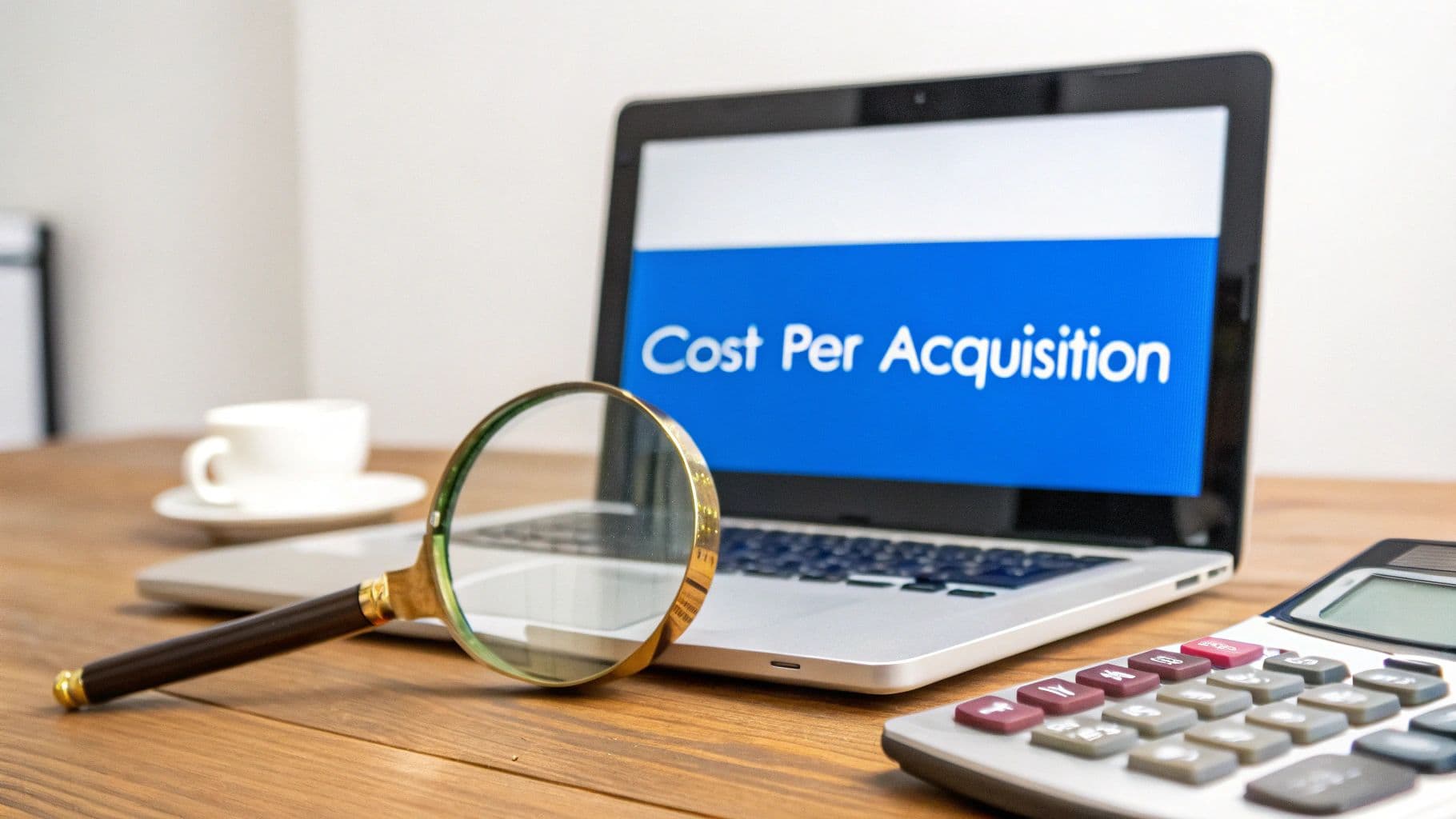
Cost Per Acquisition (CPA) is one of those metrics that cuts straight to the point. It tells you the total cost a business pays to get a single new customer from a specific ad campaign or channel.
Forget clicks, impressions, and all the other vanity metrics for a second. CPA answers the one question that really matters: Is my advertising actually making me money?
Think of it as the final price tag for each new sale you generate.
Decoding Your Marketing Price Tag
 What Is Cost Per Acquisition and Why It's Your Most Important Metric
Let's make this real. Imagine you own an e-commerce store and decide to run a Facebook ad campaign to attract new buyers. You spend $500 on ads, and by the end of the week, you've generated 50 brand-new customers from that specific campaign.
Your Cost Per Acquisition is $10 per customer. ($500 spent / 50 new customers).
That simple math is the heart and soul of CPA. It forces you to look past the noise and figure out exactly how much it costs to bring someone new through the door. Nailing this calculation is the first step toward building a marketing engine that’s actually profitable.
CPA at a Glance
For a quick reference, here’s a simple breakdown of the core concepts behind Cost Per Acquisition.
Concept | Description | Why It Matters |
|---|---|---|
Definition | The total cost to acquire one new customer from a specific marketing campaign. | Measures the direct financial efficiency of your advertising efforts. |
Calculation | Total Ad Spend / Number of New Customers Acquired = CPA. | Provides a clear, actionable number to evaluate campaign performance. |
Focus | Answers the question: "How much did it cost to get this customer?" | Cuts through vanity metrics to focus on bottom-line profitability. |
Understanding these basics is crucial before diving into more advanced strategies for tracking and optimization.
The CPA vs. CAC Distinction
You’ll often hear CPA used interchangeably with another key metric: Customer Acquisition Cost (CAC). They’re related, but they measure different things. Getting this right is key to having a clear conversation about performance.
- Cost Per Acquisition (CPA) is typically more granular and campaign-specific. It can measure the cost to acquire something that isn't a paying customer, like a lead, a free trial sign-up, or an app install.
- Customer Acquisition Cost (CAC) takes a much broader view. It’s the total cost to acquire a paying customer, often including all sales and marketing expenses over a period, divided by the number of new customers.
In short, CPA is a tactical, campaign-level metric for a specific action, while CAC is a higher-level business metric focused on the total cost of winning a paying customer.
Why This Metric Is Non-Negotiable
Knowing your CPA isn't just a "nice-to-have"—it's fundamental to sustainable growth. It’s the metric that tells you where to put your money.
A clear CPA helps you shift your budget from underperforming campaigns to the ones delivering real results. Without it, you're essentially marketing in the dark and just hoping for the best.
This number is also central to understanding your return on ad spend (ROAS) and overall profitability. If your CPA for a product is $30, but the profit from that sale is only $25, you're losing $5 on every single acquisition. This is the kind of simple math that instantly reveals which campaigns are burning cash and need immediate attention.
Of course, getting an accurate CPA depends entirely on knowing which touchpoints actually led to the conversion. This is where things get tricky, a concept we explore in our guide on what is marketing attribution.
In the sections ahead, we’ll break down how to calculate, track, and optimize this vital metric with precision.
Calculating Your True Cost Per Acquisition
Alright, let's move from theory to practice, because that's where the real insights are hiding. While the basic formula for Cost Per Acquisition seems simple enough, calculating your true CPA means looking way beyond just your ad spend. The accuracy of this number lives and dies by the quality of your inputs.
The fundamental equation is pretty straightforward:
Total Marketing & Sales Costs ÷ Total New Acquisitions = Cost Per Acquisition (CPA)
The real trick, though, is in defining "Total Marketing & Sales Costs." A dangerously common mistake is to only factor in direct ad spend. This gives you a skewed, overly optimistic CPA that can fool you into thinking a failing campaign is actually a winner, causing you to burn through a ton of cash.
For a deeper dive into this space, see our ad spend management software guide.
What to Include in Your Total Costs
To get a CPA you can actually trust, you need to account for all the associated expenses. Think of it like baking a cake; if you forget the sugar or flour, you're not going to get the result you wanted. Your CPA calculation is no different.
Your total cost should factor in everything that went into getting that customer:
- Direct Ad Spend: This is the obvious one—the money you pay directly to platforms like Google, Meta, or TikTok.
- Salaries & Labor: You have to include the salaries (or a percentage of them) for your marketing team, content creators, designers, and anyone else whose time went into the campaign.
- Agency or Contractor Fees: If you're working with external agencies, freelancers, or consultants, their fees are a direct cost of acquisition.
- Software & Tool Subscriptions: Don't forget the monthly costs for your marketing automation software, analytics tools, design programs, or an attribution platform like Cometly.
- Content & Creative Production: Any money spent on creating ad visuals, video production, or writing copy needs to be in there, too.
Bundling these expenses together gives you a much clearer picture of what it truly costs to bring a new customer in the door. For a deeper dive into the formula and the steps involved, check out this expert guide on how to calculate Cost Per Acquisition.
Putting the CPA Formula into Action
Let’s run through a real-world scenario to see how easily those "hidden" costs can completely change your CPA.
Imagine an eCommerce brand runs a month-long ad campaign. Here are the numbers:
For a deeper dive into this space, see our AI video ad creator guide.
- Ad Spend: $10,000
- New Customers Acquired: 500
A quick, surface-level calculation would put the CPA at $20 ($10,000 / 500). Looks pretty good, right? But now let's add the other essential costs for that month:
- Marketing Team Salaries (portion for this campaign): $2,500
- Agency Fee for Ad Management: $1,500
- Creative Production (video ads): $1,000
- Marketing Software Subscriptions: $500
Suddenly, the Total Campaign Cost jumps to $15,500 ($10,000 + $2,500 + $1,500 + $1,000 + $500).
The True CPA is now $31 ($15,500 / 500). That’s a 55% increase from the initial, inaccurate calculation. This is the number that gives you a realistic baseline for judging profitability and campaign performance.
This difference is everything. A $20 CPA might feel like a huge win, but a true CPA of $31 could mean the campaign is actually losing money on every single acquisition.
This is especially true when you start comparing your CPA against what a customer is actually worth over time. To do that effectively, you need a solid grasp of another vital metric, which you can learn about in our guide on how to calculate CLTV.
Understanding both metrics is fundamental to sustainable growth. Calculating your real cost per acquisition is the only way to make informed decisions that actually drive your business forward.
Why CPA Is the One Metric You Can't Afford to Ignore
Let’s be honest, Cost Per Acquisition isn't just another number to cram onto your dashboard. It’s the single most important metric that separates businesses that scale profitably from those that just burn cash. Think of it as the ultimate truth-teller for your marketing efforts. It shows you exactly what’s working and what’s silently draining your bank account.
In a perfect world, you'd throw money at ads and watch customers roll in. But we're not in a perfect world. The game has gotten way harder—and more expensive. Over the last eight years, the cost to acquire a new customer has shot up by a staggering 222%. If you're not surgically precise with your spending, you're falling behind. You can see the full breakdown in this analysis of cost per acquisition trends.
This isn't just about tracking spend. It's about making every single dollar accountable. The math itself is brutally simple, yet so many businesses get it wrong.
 What Is Cost Per Acquisition and Why It's Your Most Important Metric
As the diagram shows, you just divide your total campaign spend by the number of new customers you acquired. It’s a simple formula with profound implications for your bottom line.
The Profitability Equation LTV and CPA
Your entire business model boils down to the relationship between two numbers: Cost Per Acquisition (CPA) and Customer Lifetime Value (LTV). LTV is the total amount of money you expect a customer to spend with you over their entire relationship with your brand. When you place these two metrics side-by-side, the health of your business becomes painfully clear.
Think of it like a seesaw.
- If CPA > LTV: You're losing money on every sale. You’re paying more to get a customer than they will ever pay you. This is a one-way ticket to going out of business.
- If CPA = LTV: You're stuck on a hamster wheel, breaking even with each new customer. There’s no profit to reinvest, making real growth nearly impossible.
- If CPA < LTV: This is where the magic happens. Every new customer generates more value than they cost to acquire. You’ve built a profitable engine for growth.
A healthy, scalable business should aim for an LTV that's at least three times its CPA. This 3:1 ratio gives you enough margin to cover all your other costs—product, overhead, salaries—and still have profit left over to fuel more growth.
A Tale of Two Companies
Let's make this real. Imagine two e-commerce skincare brands, "Glow" and "Nova," selling nearly identical products.
Nova was obsessed with vanity metrics. They celebrated follower counts and viral videos, pouring their budget into flashy influencer campaigns. But they never bothered to calculate their true CPA. They were spending $80 to acquire a customer who, on average, only spent $60. Despite impressive sales numbers on paper, they were quietly bleeding cash with every order and eventually shut down.
For a deeper dive into this space, see our ecommerce video creator tool guide.
Glow, on the other hand, lived and breathed their CPA. They tracked every dollar spent on Google Ads and social media with fierce discipline. They quickly realized that while influencers created buzz, their search ads delivered a much healthier CPA of just $25 for customers who had an LTV of $90.
By obsessing over their cost per acquisition, Glow knew exactly where to put their money for maximum profit. They scaled back the expensive influencer campaigns, doubled down on what worked, and built a sustainable business that could actually scale.
This story isn't fiction; it happens every single day. The difference between winning and losing often comes down to this one metric. Your CPA isn't just a number—it’s the key that unlocks profitable growth, telling you where to invest, where to cut back, and how to build a business that lasts.
Understanding CPA Benchmarks Across Industries
Trying to define a "good" Cost Per Acquisition is a bit like asking, "What's a good price for a vehicle?" The answer is completely different if you're buying a scooter versus a freight truck. In the same way, a CPA that signals incredible efficiency in one industry could spell disaster in another.
Your target CPA doesn't exist in a vacuum; it’s shaped by the unique economics of your market. This is a critical concept to grasp before you ever launch a campaign.
Why CPA Varies So Drastically
Industries with high-ticket products, long sales cycles, and fierce competition will naturally have a much higher tolerance for acquisition costs. A marketing team in the legal services field isn't aiming for the same CPA as a direct-to-consumer brand selling t-shirts, and for good reason.
Understanding the "why" behind these differences is crucial for setting realistic goals for your own campaigns. It stops you from chasing an arbitrary number that just doesn't fit your business model.
Here are the main drivers of CPA variance:
- Average Customer Lifetime Value (LTV): This is the big one. A SaaS company with a $10,000 annual contract can stomach a much higher CPA than an eCommerce store where the average order value is $50.
- Sales Cycle Complexity: Acquiring a customer for a simple, low-cost product can happen in minutes. On the other hand, B2B software or high-end services might require months of demos, negotiations, and stakeholder buy-in, which dramatically inflates acquisition costs. You can find more detail in our article about key B2B marketing benchmarks.
- Market Saturation: The more competitors you have bidding on the same keywords and audiences, the higher your ad costs will climb. A crowded space like insurance or project management software forces everyone to spend more just to be seen.
- Purchase Intent and Urgency: Someone searching for an "emergency plumber" has an immediate, high-intent need, which can lead to lower acquisition costs. A brand selling a luxury watch first has to create the demand, which is a much more expensive game to play.
A Look at Average Industry CPAs
To put all of this into perspective, let's look at some real-world data. These numbers paint a clear picture of just how much acquisition costs can swing from one vertical to another.
The table below highlights some of the stark differences in average CPAs across various industries.
Industry | Average Cost Per Acquisition (CPA) |
|---|---|
Insurance | $1,280 |
Project Management Software | $891 |
Financial Services | $784 |
Legal Services | $749 |
eCommerce | $70 |
You can discover more insights about these customer acquisition cost statistics on amraandelma.com.
Seeing numbers like $1,280 for insurance versus just $70 for eCommerce really drives the point home.
These numbers show there is no "one-size-fits-all" CPA. Your target should be based on your industry's dynamics, not a generic best practice.
Ultimately, the goal isn't just to achieve a low CPA; it's to achieve a profitable CPA. The data makes it obvious that "expensive" is all relative.
A $1,000 CPA might seem alarming on the surface, but if it acquires a client worth $20,000 over their lifetime, it’s an incredibly smart investment. This is why knowing your own numbers is far more important than chasing someone else's benchmark.
The Hidden Pitfalls of Inaccurate CPA Tracking
You’ve calculated your Cost Per Acquisition, and the numbers look solid. But what if those numbers are lying to you?
Relying on inaccurate CPA data is like navigating a ship with a broken compass—you think you’re heading in the right direction, but you’re actually drifting toward disaster. Unfortunately, many marketers are making critical budget decisions based on flawed data without even realizing it.
The modern marketing world is filled with silent killers of accurate tracking that can completely distort your understanding of performance. The path a customer takes from discovery to purchase is rarely a straight line. If you don't account for the twists and turns, you risk cutting your best channels and doubling down on the wrong ones.
The Problem with Last-Click Attribution
The most common culprit behind misleading CPA data is last-click attribution. This model is simple but dangerously incomplete. It’s like watching a soccer game and giving all the credit to the player who scored the goal, completely ignoring the midfielder who made the perfect pass and the defender who started the play.
Imagine a typical customer’s journey:
- Day 1: They discover your brand through a Facebook ad (Top of Funnel).
- Day 5: They read a blog post they found via organic search (Middle of Funnel).
- Day 10: They click a retargeting ad on Google and finally make a purchase (Bottom of Funnel).
A last-click model would assign 100% of the credit to that Google ad. Your analytics dashboard would show a fantastic CPA for Google and a terrible one for Facebook. The logical—but totally wrong—decision would be to cut your Facebook budget and pour more money into Google.
By doing this, you’ve just eliminated the very channel that introduced new customers to your brand in the first place. Your Google CPA will eventually skyrocket because you’ve choked off the top of your funnel, and you’ll be left wondering why your "best" channel suddenly stopped performing.
This is a classic example of how a flawed attribution model can lead you to make precisely the wrong decision, sabotaging your own growth engine.
Modern Roadblocks to Accurate Tracking
Beyond simplistic attribution models, a handful of other factors are making it harder than ever to get a clear picture of your marketing performance. These aren't just minor inconveniences; they create significant blind spots in your data.
- Privacy Updates: Apple’s App Tracking Transparency (ATT) framework and other privacy-focused changes have severely limited the ability of platforms like Facebook and TikTok to track user behavior across apps and websites. The result is underreported conversions and artificially inflated CPAs.
- Ad Blockers: A huge percentage of internet users—nearly 43% in the United States—now use ad blockers. These tools can prevent tracking pixels from firing, meaning many of your conversions are never recorded, making your campaigns look less effective than they actually are.
- Cross-Device Journeys: Customers switch between their phones, laptops, and tablets seamlessly. If your tracking can't connect these touchpoints into a single user journey, you might see one person as three different visitors, making it impossible to attribute a conversion correctly.
These issues compound, creating a distorted view of your marketing ROI. Understanding the full scope of these difficulties is essential for any modern marketer, and you can explore more about the common attribution challenges in marketing analytics to see just how deep the problem runs.
The reality is that traditional, client-side tracking is no longer enough.
To truly understand what cost per acquisition means today, you need a more robust approach. Modern solutions like multi-touch attribution and server-side tracking have become essential tools for piecing together the complete customer journey, ensuring the CPA you see is a number you can actually trust to guide your strategy.
Proven Strategies to Lower Your Cost Per Acquisition
 What Is Cost Per Acquisition and Why It's Your Most Important Metric
Knowing your Cost Per Acquisition is the first step. But actually lowering it is how you build an efficient growth machine. A high CPA isn’t a dead end; it’s just a problem waiting for the right solution. By methodically optimizing your marketing funnel, you can turn wasted ad spend into profitable, scalable growth.
This isn’t about some magic bullet, either. It’s about making targeted improvements at every single stage of the customer journey—from the first ad they see to the moment they hit "buy." Each small win compounds, leading to a major drop in your overall CPA. Let's break down the most effective strategies to get you there.
Sharpen Your Audience Targeting
One of the fastest ways to torch your budget is by showing your ads to the wrong people. The more irrelevant the audience, the lower your click-through rates and the higher your CPA climbs. Precision targeting is your first line of defense against wasted spend.
Instead of aiming for broad, generic audiences, you need to get granular. Use the data you already have to build hyper-specific customer profiles.
- Lookalike Audiences: Take your existing customer list and let platforms like Facebook find new people who share similar traits. This is almost always more effective than targeting based on broad interests alone.
- Retargeting Segments: Don't just retarget everyone who visited your website. Create specific buckets, like users who abandoned their cart or viewed a particular product, then tailor your ads directly to their last action.
- Exclusion Lists: Be just as aggressive with who you exclude. This could mean blocking existing customers from seeing acquisition ads or anyone who has already taken the desired action.
By focusing your budget only on users with the highest intent, you stop paying to reach people who were never going to buy in the first place.
A/B Test Your Ad Creative Relentlessly
Your ad creative—the images, videos, and copy—is your digital handshake. A weak first impression gets you scrolled past, not clicked on. That's why continuous testing isn't just a good idea; it's non-negotiable for lowering your Cost Per Acquisition.
Even tiny tweaks can have a massive impact on performance. Just be sure to isolate one variable at a time so you get clean data on what’s actually working.
A common mistake is to "set and forget" your ads. What worked last month might fall flat today. Consistent A/B testing ensures your creative stays fresh and continues to connect with your audience, keeping your CPA under control.
Start by testing these key elements:
- Headlines: Pit a benefit-driven headline against a question or a direct call-to-action.
- Visuals: Test a static image against a short video or a user-generated photo.
- Calls-to-Action (CTAs): Compare "Shop Now" versus "Learn More" to see which one drives more qualified traffic.
Optimize Your Landing Page Experience
You can have the best ad in the world, but if it leads to a slow, confusing, or untrustworthy landing page, your conversion rate will crater and your CPA will skyrocket. The journey from ad to page needs to feel effortless.
Your landing page has one job: get the conversion. Cut out all the distractions and make the next step painfully obvious. Make sure your page loads fast—a delay of just a few seconds can slash conversion rates by over 40%.
And whatever you do, make sure the message on your landing page perfectly matches the promise made in your ad. If your ad offers a 20% discount, that offer better be front and center on the page. For a deeper look, check out these actionable strategies to reduce customer acquisition cost.
At the end of the day, a higher conversion rate means you get more customers from the same ad spend, which directly lowers your CPA. For more in-depth techniques, read our guide on how to reduce customer acquisition cost.
Answering Your Top Questions About Cost Per Acquisition
Even after you've got the basics down, a few questions always seem to pop up when you start applying CPA in the real world. Let's tackle some of the most common ones so you can start using this metric with confidence.
What Is the Difference Between CPA and CAC?
This one trips up a lot of people, but the distinction is pretty simple when you think about it. Cost Per Acquisition (CPA) is a tactical, campaign-level metric. It’s measuring the cost of a specific action—like a lead, an ebook download, or a free trial sign-up.
On the other hand, Customer Acquisition Cost (CAC) is a broader, strategic metric. It calculates the total cost to get an actual paying customer, factoring in all your sales and marketing costs over a given period. In short, CPA measures the cost of an action, while CAC measures the cost of a customer.
How Often Should I Calculate and Review My CPA?
The right cadence really depends on your business model and how fast your campaigns move. For a fast-paced eCommerce brand, you'll want to be checking your CPA daily or at least weekly. Things move quickly, and a bad ad can burn through your budget in hours if you're not paying attention.
But if you're in a business with a longer sales cycle, like B2B software, a monthly or quarterly review makes more sense. The goal is to check it often enough to catch problems before they become disasters, but not so often that you're overreacting to normal day-to-day fluctuations.
What Is a Good Starting CPA for a New Campaign?
There’s no magic number here. A "good" CPA is completely relative to your business's unique economics, specifically your Customer Lifetime Value (LTV) and profit margins.
A solid rule of thumb is to shoot for an LTV-to-CAC ratio of at least 3:1. This means that, over their lifetime, a customer should generate at least three times the revenue it cost you to acquire them. To find your starting point, work backward from your LTV to set a CPA target that keeps you profitable.
Ready to get a truly accurate picture of your cost per acquisition? Cometly provides the advanced attribution and server-side tracking you need to make every marketing dollar count. See how Cometly can lower your CPA and boost your ROI today.