
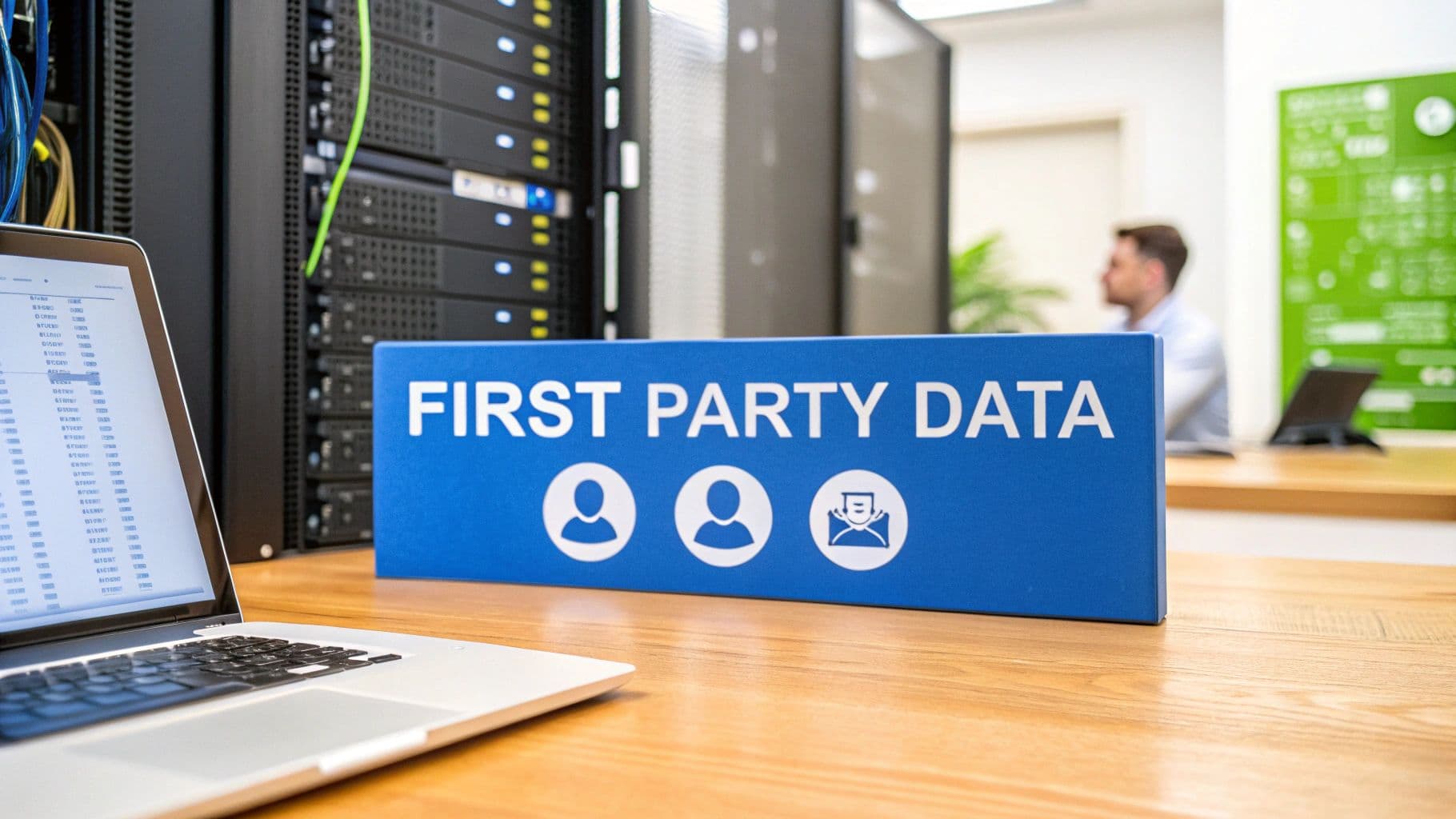
Let's cut right to it. First-party data is the information you collect directly from your audience, with their permission.
Think of it like having a one-on-one conversation with your customers. They’re willingly telling you what they like, what they’re looking for, and who they are. Because it comes straight from the source—your website, your app, your CRM—it’s the cleanest, most accurate, and most valuable data you can possibly own. You know where it came from, and you control it.
The Gold Standard of Customer Insight
In a marketing world scrambling to adapt to new privacy rules, understanding first-party data isn't just a "nice-to-have" anymore. It's a necessity. For years, we all leaned on third-party cookies, which were kind of like gathering intel based on internet rumors. They gave us scale, sure, but the accuracy was often questionable.
Now, with browsers like Chrome killing off third-party cookies and users demanding more control over their privacy, the old playbook is officially dead. The new game is all about building direct relationships and earning trust. This is exactly where first-party data becomes your biggest advantage.
What Counts as First-Party Data?
This isn’t some abstract concept. It's the tangible trail of interactions a person has with your brand on platforms you own.
Some of the most common examples include:
- Website Behavior: The pages someone visits, the products they look at, what they add to their cart, and how long they stick around.
- CRM Information: Contact details like names, email addresses, and phone numbers that people give you when they fill out a form or sign up for a newsletter.
- Purchase History: What a customer bought, when they bought it, and how much they spent. This comes straight from your e-commerce platform or POS system.
- App Usage: Every action taken inside your mobile app, from features they use most to preferences they save.
- Direct Feedback: Goldmines of information from customer support chats, survey responses, and loyalty program activity.
This isn't just a trend for small businesses; it's a massive strategic shift for the biggest players in the game. Look at giants like Gatorade and Frito-Lay—they boosted their first-party data records by an incredible 50% by 2023. That’s a clear signal they’re moving away from unreliable third-party sources. You can read more about this first-party data trend to see how major brands are making the switch.
When you focus on first-party data, you're not just collecting information. You're building a foundation of trust that lets you create marketing that actually resonates with people.
Having this direct line to your audience gives you a powerful understanding of what they actually want. Up next, we'll break down how this data stacks up against other types and show you how to start collecting and using it to fuel real growth.
To really get why first-party data is such a big deal, you have to see how it stacks up against the other types.
Think of it like getting a restaurant recommendation. The source of that recommendation completely changes how much you trust it. Is it coming from your best friend who knows your tastes inside and out, or from a random stranger on the internet? The quality of the data you use in your marketing works the same way.
Let's break down each type using that simple analogy.
First-Party Data: The Trusted Friend
First-party data is like asking your closest friend where you should go for dinner. They know you. They know what you like, what you hate, and what your budget is. The recommendation is coming directly from a source you trust, based on their firsthand knowledge of both the restaurant and you.
In marketing, this is the information you collect straight from your audience. It’s pure, direct, and incredibly valuable.
- Website Behavior: The pages a customer visited, products they added to their cart, or videos they watched.
- Purchase History: A direct record of what they bought and when, pulled from your own e-commerce system.
- CRM Information: Details like names and emails they willingly gave you through your sign-up or contact forms.
This is your data. You own it. Because it comes directly from your customers, it's the most accurate and reliable information you can possibly get your hands on.
Second-Party Data: The Friend of a Friend
Second-party data is like getting that dinner spot from your friend's coworker. You trust your friend, so there's an implied level of trust in the recommendation. It’s not a direct connection, but it's only one degree of separation from a source you know.
This is basically another company's first-party data that you acquire through a direct partnership. For instance, an airline might team up with a luxury hotel chain to share anonymized data about people who book first-class flights. It's high-quality data, but you don't own the original customer relationship.
Key Takeaway: Second-party data can be a great way to find new, relevant audiences, but its value completely depends on how trustworthy your partner's data collection practices are.
Third-Party Data: The Anonymous Online Review
Third-party data is like scrolling through a review site and reading comments from a thousand anonymous strangers. You get a massive amount of information, but you have no clue who these people are, what their real tastes are, or if their experiences are even legitimate. The scale is huge, but the reliability is a total crapshoot.
This data is gathered by large aggregators that have no direct relationship with the users. They scrape information from all over the web, package it into segments, and sell it to the highest bidder. While it offers massive scale for broad targeting, its accuracy is often questionable, and the collection methods can be murky, leading to major privacy headaches.
This is exactly why understanding the critical differences between first-party vs third-party cookies is non-negotiable for marketers today.
This diagram shows just how different these relationships are.
 What Is First Party Data? A Privacy-Friendly Marketing Guide For Ad Tracking
As you can see, first-party data is a direct handshake with your audience. The others rely on casting a much wider, more impersonal net.
First vs Second vs Third Party Data
To make it even clearer, here’s a head-to-head comparison of the three main data types marketers encounter.
Attribute | First Party Data | Second Party Data | Third Party Data |
|---|---|---|---|
Source | Collected directly from your own audience such as your website, app, or CRM | Acquired from a trusted partner’s first party data | Purchased from large data aggregators with no direct relationship |
Accuracy | Highest accuracy and reliability | High accuracy but dependent on partner data quality | Often low and may be outdated or inaccurate |
Transparency | Fully transparent with clear collection methods | Mostly transparent based on partnership terms | Opaque collection methods with limited visibility |
Cost | No direct cost though systems and infrastructure are required | Variable and typically negotiated between partners | Can be expensive especially for niche targeting |
Privacy Risk | Lowest risk when collected with proper user consent | Moderate risk relying on partner compliance | Highest risk and a frequent focus of privacy regulation |
Competitive Edge | High and unique to your business | Moderate and exclusive to the partnership | Low since competitors can purchase the same datasets |
Ultimately, the table tells the whole story. First-party data isn't just another asset; it’s your most reliable, compliant, and powerful tool for building real customer relationships and driving growth.
How to Collect High Quality First Party Data
 What Is First Party Data? A Privacy-Friendly Marketing Guide For Ad Tracking
Alright, so you get what first-party data is and why it's a game-changer. Now it's time to stop talking theory and start taking action. Building a rich, high-quality dataset doesn't just happen. It's the result of a deliberate strategy built around one core idea: the value exchange.
Let's be real—customers aren't going to hand over their information for nothing. They'll share it when they get something tangible in return, whether that’s a better user experience, exclusive content, personalized recommendations, or a sweet discount. Frame every collection method as a benefit to them, not just a data grab for you.
With that foundation in place, you can start using a few key tactics across your owned channels to ethically and effectively get the insights you need.
Digital Storefronts: Website and App Interactions
Your website and mobile app are absolute goldmines for behavioral first-party data. These are the digital spaces where your customers are actively telling you what they want and what they're interested in. Capturing these signals is the first step to truly understanding their journey.
Think beyond basic page views. Every click, scroll, search query, and abandoned cart tells a part of the story. You can collect this data by tracking everything from page visits and time on site to the specific products they view.
Here are the primary ways to capture this information:
- Tracking Pixels and Tags: Placing a pixel on your website lets you monitor key user actions, like adding an item to a cart, starting the checkout process, or making a purchase.
- Sign-Up Forms: Things like newsletter subscriptions, account creations, and webinar registrations are direct invitations for users to share their contact info and preferences with you.
- In-App Actions: For mobile apps, track how users engage with features, save items, and adjust their settings. This tells you exactly how they interact with your product.
To capture this behavioral data with the highest accuracy—especially as browsers crack down on client-side tracking—you need a robust solution. You can learn more about how server-side tracking improves data collection in our detailed guide.
Direct Communication Channels
Email, SMS, and even direct mail are incredible opportunities to gather first-party data straight from your most engaged audience. These aren't just one-way broadcast channels; they're platforms for a two-way conversation.
The key is to make interaction easy and rewarding. Asking for feedback should feel like you genuinely care about their opinion, not like you’re just filling a database.
Here are some effective strategies for these channels:
- Surveys and Quizzes: Ask customers about their preferences, their biggest challenges, or what new products they'd love to see. A simple, fun quiz can reveal powerful data for segmentation.
- Preference Centers: Let your subscribers choose the type of content they get and how often they get it. This not only makes their experience better but also gives you explicit data about what they're interested in.
- Customer Feedback Loops: Collect data from post-purchase follow-ups, support tickets, and product reviews to understand customer satisfaction and spot areas for improvement.
Offline and Loyalty-Based Programs
Your data collection strategy shouldn't be limited to the digital world. If you have a physical presence, your offline touchpoints are a treasure trove of valuable information that can be merged with your online customer profiles.
Loyalty programs are the perfect example of a clear value exchange. Customers give you their purchase data and personal details in return for points, rewards, and exclusive offers. Point-of-sale (POS) systems can also capture purchase history for both loyalty members and guest checkouts, giving you critical insights into buying habits.
But to really get the most out of this information, you need to bring it all together. Implementing smart customer data integration solutions allows you to unify all that scattered customer info into a single, reliable profile. This creates a complete view of each customer, blending their online browsing behavior with their in-store purchases for a truly holistic understanding.
Putting Your Data to Work in Marketing
 What Is First Party Data? A Privacy-Friendly Marketing Guide For Ad Tracking
Collecting first-party data is like mining for gold. The raw material is valuable, but it’s pretty useless until you process it and turn it into something real. The process of turning all those raw data points into impactful marketing campaigns is called data activation.
This is where your efforts actually start to pay off. Activation means you stop just having data and start using it to create smarter, more relevant, and more profitable customer experiences. Without a solid activation strategy, even the best dataset is just a collection of numbers sitting in a database.
The whole point is to translate what you know about your customers into actions that drive business results, transforming passive information into a powerful engine for growth.
Unifying Data for a Single Customer View
Before you can really use your data, you have to get it all in one place. Chances are, your customer information is scattered across different systems—your e-commerce platform, your CRM, your email service, and your website analytics. This fragmentation makes it nearly impossible to see the full picture of any single customer's journey.
This is where a Customer Data Platform (CDP) becomes essential. A CDP acts as a central hub, pulling in data from all your disconnected sources and stitching it together to create a single, unified profile for each customer. Think of it as creating a detailed dossier that combines every single interaction someone has had with your brand.
By creating a single source of truth, you eliminate data silos and gain a coherent, 360-degree view of your audience. This unified profile is the foundation for all effective data activation strategies.
Having a complete picture of your customers is a critical first step. You can explore how to achieve this through effective marketing data integration to ensure your systems work together seamlessly. This unified view is what allows you to move on to the most exciting part—using that insight to create truly personalized marketing.
Crafting Hyper-Personalized Experiences
With a unified customer profile in hand, you can finally stop marketing to generic audiences and start speaking to individuals. Personalization is no longer just about using a customer's first name in an email. It’s about tailoring the entire customer experience based on their specific behaviors, preferences, and purchase history.
This is exactly what first-party data empowers you to do. You can dynamically change website content for returning visitors, recommend products based on past purchases, or send emails triggered by specific actions, like abandoning a cart. In fact, brands that use first-party data for marketing have seen a 2.9x lift in revenue and a 1.5x increase in cost savings.
Here are a few powerful ways to activate data for personalization:
- Dynamic Website Content: Show a returning visitor who previously viewed running shoes a homepage banner featuring your latest running gear.
- Targeted Email Campaigns: Segment your email list based on purchase history. Send an exclusive offer for a new coffee blend only to customers who have previously bought coffee beans.
- Personalized Product Recommendations: Use an algorithm to suggest items that are frequently bought together or that complement a customer's past purchases.
To get the most out of your data, explore various customer segmentation strategies to tailor your marketing efforts with even more precision.
Building Powerful Custom Audiences
One of the most valuable ways to use first-party data is for building custom and lookalike audiences for your paid ad campaigns on platforms like Meta (Facebook and Instagram) and Google. Instead of relying on the broad, often inaccurate targeting options provided by the ad platforms themselves, you can use your own data to reach the people who matter most.
You can create highly specific audience segments to hit different goals:
- Re-engagement Audiences: Upload a list of customers who haven't purchased in the last 90 days and run a "we miss you" campaign with a special discount to bring them back.
- High-Value Customer Audiences: Create a segment of your top spenders and target them with ads for new premium products, maximizing your return on ad spend.
- Lookalike Audiences: Upload your list of best customers to Meta or Google, and their algorithms will find new users who share similar characteristics. This dramatically expands your reach to a highly relevant audience.
By syncing your first-party data directly with ad platforms, you improve targeting accuracy, lower your customer acquisition costs, and ensure your ad budget is spent reaching people who are actually likely to convert. This is how you turn customer insights into a direct and measurable competitive advantage.
Navigating Data Privacy and Building Trust
Collecting first-party data is about more than just gathering information—it’s about building a relationship. And like any good relationship, it has to be built on a foundation of trust.
When you ask customers for their data, you’re making a promise to protect it and use it responsibly. This isn’t just about dodging fines; it’s about proving to your audience that you value their privacy as much as they do.
Considering that 86% of people say they’re concerned about their data security, a privacy-first approach isn’t a limitation. It's your single most powerful tool for building real customer loyalty. When customers trust you, they’re far more willing to share the very data you need to create better experiences for them.
Understanding Key Privacy Regulations
You don't need to be a lawyer to grasp the basics of modern data privacy. Major regulations like GDPR in Europe and CCPA in California are all built on a few core principles that every marketer should know.
- Transparency: You have to be upfront about what data you're collecting and why. Vague, jargon-filled privacy policies just don’t cut it anymore.
- Consent: You need clear, informed permission from users before you start collecting their data. That means no more pre-checked boxes or confusing language designed to trick people into opting in.
- User Control: Your customers have the right to see, change, and delete the information you have on them. It’s on you to provide simple, accessible ways for them to manage their own data.
These rules aren’t just red tape; they shift the power back to the consumer, which ultimately makes your first-party data strategy stronger and more ethical by design.
The core idea is simple: Treat your customers' data with the same respect you'd expect for your own. A transparent, privacy-focused approach isn’t a hurdle—it’s a competitive advantage that builds unbreakable trust.
Practical Steps for Compliance and Trust
Putting these principles into action is more straightforward than it sounds. It all starts with being honest and open in every interaction you have with your audience. Your privacy policy shouldn't be buried in the footer of your website; it should be an easy-to-find, easy-to-understand resource that empowers your customers.
To make sure you’re respecting user privacy while still gathering the insights you need, focus on these key areas:
- Craft a Clear Privacy Policy: Write your policy in plain English, not legalese. Be direct about what you collect, how you use it, and how people can control their information.
- Implement a Consent Banner: Use a clear, simple cookie banner that gives users a genuine choice to opt-in or opt-out. No dark patterns.
- Create a Preference Center: Give users an easy way to manage their communication preferences and data settings, usually in their account dashboard. This puts them in the driver's seat and shows you respect their choices.
This privacy-centric mindset is non-negotiable as the internet continues its shift away from third-party cookies. Building a solid first-party data system now is the smartest way to future-proof your marketing. You can explore our guide to find the best cookieless tracking solution that honors user privacy while delivering the accurate data you need.
By making trust your top priority, you’ll build a sustainable marketing engine that will thrive for years to come.
Future Proofing Your Marketing with First Party Data
Let's be direct: the shift away from third-party cookies isn't just another industry update. It’s a fundamental change in the rules of the game. For years, marketers got comfortable relying on borrowed or purchased data, but that playbook is officially obsolete.
Building a solid first-party data strategy is no longer a "nice-to-have." It’s a business imperative for anyone who's serious about growing their brand for the long haul.
But this isn't bad news—it's actually a huge opportunity. Instead of chasing anonymous profiles across the web, you can finally focus on what really matters: building genuine, direct relationships with your audience. This privacy-first approach isn't a limitation; it's the most durable path forward.
By prioritizing direct customer connections, you create a marketing engine that is more ethical, more effective, and completely immune to the next big industry disruption. You own the relationships and the insights that come with them.
Your Path Forward
The journey begins with a simple commitment: provide real value in exchange for information. Every interaction, from a newsletter signup to a loyalty program, becomes a chance to build trust and deepen your understanding of who your customers are and what they need.
Your next steps should focus on creating a unified data ecosystem that you can actually use.
- Build Direct Relationships: Focus on creating channels that encourage people to engage directly with your brand. Think loyalty programs, interactive quizzes, or exclusive content.
- Prioritize Value Exchange: Make sure every data collection point offers a clear benefit to the customer. This could be a discount, personalized recommendations, or a better overall experience.
- Unify Your Data: Connect your various marketing tools and platforms to create a single, coherent view of each customer. You can learn more by reviewing our guide on data integration best practices to get started.
Ultimately, mastering what first-party data is and how to use it means you're investing in an asset that only gets more valuable over time. You're building a foundation that is not only compliant and respectful of user privacy but is also a powerful driver of predictable, sustainable growth that will stand the test of time.
A Few Lingering Questions
Even after you've got the basics down, a few practical questions almost always pop up. Let's tackle some of the most common ones so you can move forward with your data strategy, no second-guessing.
Is First-Party Data Secure?
That’s entirely up to you. While first-party data is inherently more secure because you're cutting out the middlemen, its safety ultimately depends on how well you protect it.
You're the guardian of that data. That means safeguarding your servers and databases from any unauthorized access and staying on top of all privacy regulations. A data breach doesn't just come with potential legal fines; it shatters the customer trust you’ve worked so hard to build.
How Does This Data Actually Improve the Customer Experience?
It boils down to two things: personalization and security.
Since you're collecting information directly from users with their permission, you can finally deliver content, product recommendations, and offers that are genuinely relevant to them. It creates a feeling of being understood, not just targeted. At the same time, customers feel safer knowing their data isn't being sold or passed around without their knowledge, which is a massive trust-builder for your brand.
By using what customers willingly share, you can stop shouting with generic marketing blasts and start having meaningful, one-on-one conversations that build real loyalty and drive conversions.
Is First-Party Data Still Effective with Ad Blockers?
Yes, and honestly, this is one of its biggest strengths in today's world. Most ad blockers and browser privacy features, like Apple's Intelligent Tracking Prevention (ITP), are built specifically to shut down third-party cookies and creepy cross-site tracking scripts.
First-party data collection, however, often relies on direct user interactions and server-side tracking, which are far less impacted by these blockers. For example:
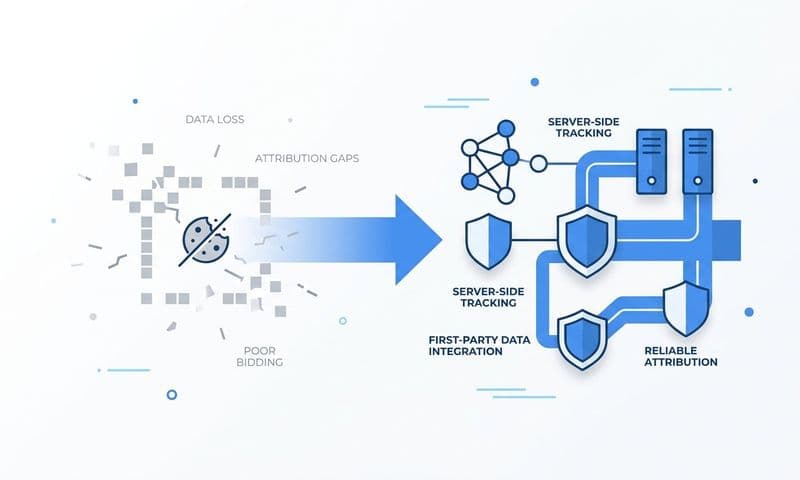
- Server-Side Tracking: This method sends data directly from your web server to your analytics or ad platform's server, completely bypassing the browser-level blockers that kill front-end scripts.
- CRM Data: Information you collect from forms (like an email signup or a demo request) is totally unaffected by ad blockers because the user is submitting it to you directly.
This resilience makes your first-party data strategy incredibly reliable and future-proof. You can maintain a clear view of how customers behave on your own properties, even as the walls close in on third-party tracking. You can keep building custom audiences and measuring performance accurately, giving you a serious competitive edge.
Ready to unify your first-party signals and get crystal-clear attribution? Cometly combines server-side tracking, a powerful CRM, and seamless ad platform integrations to give you a complete picture of your customer journey. Start your free trial today and see what truly drives your revenue.