Your Facebook Ads Manager shows a 3.2x ROAS. Google Analytics reports a 1.8x ROAS for the same campaign. Your CRM says those leads converted at 12%, but your sales team insists the number is closer to 8%. Meanwhile, iOS privacy updates have turned 40% of your mobile traffic into "unknown," and you're making million-dollar budget decisions based on incomplete data.
If this sounds familiar, you're experiencing the collapse of traditional marketing analytics in real time.
The measurement systems marketers have relied on for the past decade are breaking down. Privacy regulations, cookie deprecation, and increasingly complex customer journeys have created blind spots that make confident decision-making nearly impossible. But here's the thing: this disruption isn't just creating problems—it's forcing the evolution of marketing analytics into something far more powerful.
The future of marketing analytics isn't about patching old systems. It's about fundamentally rethinking how we capture, analyze, and act on marketing data. From AI-powered attribution that accounts for dozens of touchpoints to closed-loop systems that make ad platforms smarter with every conversion, the next generation of marketing measurement is already taking shape.
Let's explore the five trends that are reshaping how marketers measure success—and how you can position your team to capitalize on these changes rather than be disrupted by them.
The Privacy-First Revolution Changing Everything
Remember when tracking was simple? A pixel on your site, cookies in browsers, and clean conversion data flowing into your dashboards. Those days are over.
Apple's App Tracking Transparency framework fundamentally altered the game when it launched with iOS 14.5. Suddenly, the majority of iPhone users opted out of cross-app tracking, creating massive blind spots in mobile attribution. Facebook's own estimates suggested they lost visibility into 15-20% of conversions almost overnight. For marketers running significant mobile campaigns, this wasn't a minor inconvenience—it was an existential crisis.
But iOS privacy updates were just the beginning. Google's planned deprecation of third-party cookies in Chrome represents an even larger shift. When the world's most popular browser stops supporting the tracking technology that's powered digital advertising for two decades, every marketer needs a new playbook. Understanding the digital marketing strategy that tracks users across the web becomes essential for navigating these changes.
The solution isn't to fight privacy changes—it's to embrace first-party data strategies and server-side tracking as the new foundation of marketing measurement.
Here's what privacy-compliant measurement actually looks like in practice. Instead of relying on browser cookies that users can block or delete, marketers are implementing server-side tracking that captures data directly from their own infrastructure. This approach maintains measurement accuracy while respecting user privacy preferences because the data flows through systems you control rather than third-party tracking networks.
First-Party Data Becomes Your Competitive Advantage: Companies that own rich first-party data—email addresses, purchase history, CRM records—can still track customer journeys accurately. The challenge shifts from collecting data to connecting it across touchpoints.
Server-Side Tracking Replaces Pixel-Based Measurement: Traditional browser pixels miss conversions, get blocked by ad blockers, and fail when users switch devices. Server-side tracking captures events directly from your backend systems, creating a more complete and reliable dataset.
Consent Management Becomes Table Stakes: Privacy-first doesn't mean tracking-free. It means transparent data collection with proper consent mechanisms. Marketers who implement clear consent flows and respect user preferences will maintain measurement capabilities while building customer trust.
The marketers winning in this new environment aren't the ones with the most sophisticated tracking scripts. They're the ones who've rebuilt their measurement infrastructure around first-party data, server-side tracking, and privacy-compliant practices. This shift requires investment and technical expertise, but it's creating a significant competitive moat. Companies that adapt early gain measurement accuracy while competitors struggle with increasingly unreliable data.
Think of it like this: the old world rewarded whoever could deploy the most tracking pixels and cookies. The new world rewards whoever can capture, connect, and activate their own first-party data most effectively. That's a fundamentally different game—and one where technical sophistication matters more than ever.
AI-Powered Attribution: From Guesswork to Precision
Last-click attribution has always been a lie. It's just that for years, it was a convenient lie that made reporting simple.
Here's the reality: your customer saw a LinkedIn ad three weeks ago, clicked a Google search result last week, watched a YouTube video on their phone yesterday, and finally converted on their laptop this morning after receiving an email. Which touchpoint gets credit for the sale? Last-click says the email. Common sense says that's absurdly reductive.
This is where AI-powered attribution is transforming marketing analytics from guesswork into precision. The power of AI marketing analytics lies in its ability to process complexity that humans simply cannot handle manually.
Machine learning models can now analyze thousands of customer journeys simultaneously, identifying patterns that humans could never spot manually. These systems don't just assign credit based on position in the funnel—they calculate the actual incremental impact of each touchpoint based on how customers with similar profiles converted.
The evolution from last-click to predictive attribution represents one of the most significant advances in marketing measurement. Instead of arbitrary rules about which touchpoint gets credit, AI models consider the full context: time between touches, channel combinations, content types, and even external factors like seasonality or competitive activity. Understanding the purpose of attribution in digital marketing helps clarify why this evolution matters so much.
Real-Time Attribution Across Complex Journeys: Modern AI attribution systems process data continuously, updating attribution weights as new information arrives. This means you're not waiting until month-end to understand campaign performance—you're getting insights while campaigns are still running and budgets can be reallocated.
Accounting for Offline and Delayed Conversions: Traditional analytics struggle with attribution when conversions happen offline or weeks after the initial touchpoint. AI models can connect these delayed conversions back to their originating campaigns by analyzing patterns in customer behavior, CRM data, and historical conversion timelines.
Predictive Budget Allocation Recommendations: Here's where it gets really interesting. AI doesn't just tell you what happened—it recommends what to do next. Advanced systems analyze your attribution data and suggest specific budget shifts: "Move $5,000 from Campaign A to Campaign B for an estimated 23% improvement in conversions."
These aren't generic optimization tips. They're data-driven recommendations based on your actual performance patterns, customer journey data, and conversion probabilities. It's like having an analyst who's simultaneously monitoring every campaign, comparing performance across channels, and calculating the optimal budget allocation—except it happens in real time, not in a quarterly review meeting.
The practical impact is substantial. Marketers using AI-powered attribution typically discover that channels they thought were underperforming are actually crucial early-funnel touchpoints. They find that campaigns driving "low-quality" leads are actually introducing customers who convert later through different channels. They identify budget waste in channels getting last-click credit but minimal incremental impact. Exploring the impact of machine learning on marketing analytics reveals just how transformative these capabilities have become.
But here's the critical requirement: AI attribution only works when you have complete data. If you're missing touchpoints because of tracking gaps, the AI will optimize based on incomplete information. This is why unified tracking—which we'll cover next—is essential. You can't have precision attribution without comprehensive data capture.
The future isn't just better attribution models. It's attribution systems that continuously learn from your data, adapt to changing customer behavior, and provide actionable recommendations that directly improve campaign performance. That's the shift from analytics as reporting to analytics as competitive advantage.
Unified Customer Journey Tracking Across Every Channel
Open five browser tabs right now: Google Analytics, Facebook Ads Manager, Google Ads, your CRM, and your email platform. Now try to answer this simple question: which marketing channel drove the most revenue last month?
Good luck. Each platform will give you a different answer because each one only sees part of the story.
This fragmentation isn't just annoying—it's costing you real money. When you can't see the complete customer journey, you make budget decisions based on incomplete data. You cut spending on channels that are actually driving revenue because their impact shows up elsewhere. You double down on channels claiming credit they don't deserve. These are precisely the attribution challenges in marketing analytics that modern platforms are designed to solve.
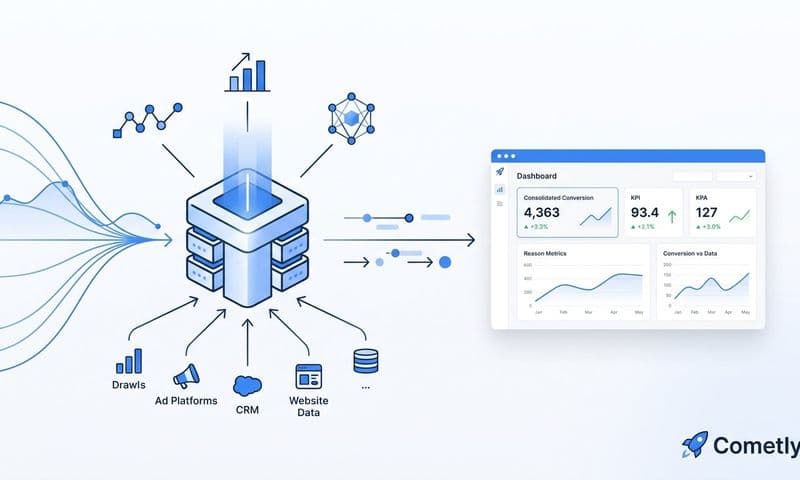
The emerging standard in marketing analytics is unified customer journey tracking: connecting every data source into a single-source-of-truth dashboard that shows the complete path from first touch to conversion and beyond.
Think of it like assembling a puzzle. Google Analytics shows you website behavior. Your ad platforms show you campaign performance. Your CRM shows you sales outcomes. But none of them show you how these pieces connect. Unified tracking puts the puzzle together so you can see the complete picture.
Why Siloed Data Creates Expensive Blind Spots: When your analytics are fragmented, you're essentially flying blind. A lead might click your Facebook ad, research on Google, download a resource from LinkedIn, and convert through a sales call. If these systems don't talk to each other, Facebook shows a click with no conversion, Google shows a conversion with no preceding awareness, and LinkedIn gets no credit at all. Your budget decisions reflect this incomplete view.
The Single-Source-of-Truth Approach: Modern marketing measurement platforms connect all your data sources—ad platforms, website analytics, CRM systems, email tools, even offline conversion data—into unified dashboards. This isn't about replacing Google Analytics or your ad platform dashboards. It's about creating a layer above them that connects the dots and shows complete customer journeys. A multi-channel marketing analytics dashboard provides exactly this kind of unified visibility.
Cross-Channel Visibility Reveals True Performance: When you can see complete journeys, patterns emerge that were invisible before. You discover that your "low-performing" display campaigns are actually crucial for warming up audiences who later convert through search. You find that customers who engage with multiple channels convert at 3x the rate of single-channel prospects. You identify which channel combinations drive the highest lifetime value customers.
This visibility fundamentally changes how you think about channel performance. Instead of asking "which channel drove this conversion," you start asking "which combination of touchpoints creates the highest-value customer journeys." That's a much more sophisticated—and profitable—question.
The practical implementation requires technical integration work. You need systems that can capture data from every channel, match it to individual users or accounts, and stitch together complete journey maps. This is where server-side tracking and first-party data strategies become essential infrastructure, not nice-to-have features.
But here's what makes this trend particularly powerful: unified tracking doesn't just improve reporting. It enables the next evolution in marketing analytics—feeding better data back to ad platforms to improve their algorithms. When you understand complete journeys, you can tell Facebook and Google which conversions are actually valuable, making their targeting smarter with every campaign.
Feeding Better Data Back to Ad Platforms
Here's something most marketers don't realize: your ad platforms are only as smart as the data you feed them.
When you tell Facebook that a conversion happened, their algorithm learns from that signal. It identifies patterns in who converted and uses that information to find similar people. But what if you're only reporting conversions that happened immediately on your website? What about the leads who converted three weeks later through a sales call? What about the high-value customers versus the one-time buyers?
If you're not feeding that context back to your ad platforms, their algorithms are optimizing for incomplete goals.
This is the concept of closed-loop data optimization, and it's becoming one of the most significant competitive advantages in paid advertising. The idea is simple: capture rich conversion data across all your systems, then send that enriched information back to ad platforms to make their machine learning algorithms smarter. Learning how to use data analytics in marketing effectively includes mastering this feedback loop.
Why Conversion Sync Matters: Ad platforms like Meta, Google, and TikTok use conversion data to train their algorithms. The more accurate and complete your conversion data, the better they can optimize targeting, bidding, and creative delivery. But most marketers only send basic conversion signals—someone filled out a form or made a purchase. They don't send the context that makes that data actionable.
Enhanced Conversions Create Algorithmic Advantages: Enhanced conversions mean sending additional first-party data along with conversion events. Instead of just telling Facebook "a conversion happened," you tell them "a conversion happened, and here's the customer's email, phone number, and CRM status." This additional data helps ad platforms match conversions more accurately, especially when cookies and pixels fail.
But it goes deeper than matching. When you send back data about which conversions turned into high-value customers, which leads actually closed, and what the revenue impact was, ad platforms can optimize for outcomes that actually matter to your business—not just form fills or add-to-cart events.
The Performance Gap Is Real: Marketers using basic pixel tracking are essentially asking ad platforms to optimize blind. They're saying "find more people like those who converted" without providing context about which conversions were actually valuable. Meanwhile, marketers using server-side tracking with conversion sync are saying "find more people like these specific high-value customers" and providing the data to make that targeting precise.
The performance difference shows up in cost per acquisition, customer quality, and long-term return on ad spend. When ad platforms have better data, they make better decisions about who to show your ads to, how much to bid, and which creative variations to prioritize.
Think of it like this: basic tracking is telling a salesperson "go find customers." Enhanced conversion tracking is telling them "go find customers like Sarah, who spent $5,000 in her first month and referred three friends." Which salesperson do you think performs better?
The implementation requires technical infrastructure—server-side tracking to capture complete conversion data, systems to enrich that data with CRM and customer value information, and APIs to send it back to ad platforms in formats they can use. But the investment pays off quickly when your cost per acquisition drops and customer quality improves because algorithms are optimizing for the right outcomes. Investing in the right marketing data analytics software makes this integration significantly easier.
This trend represents a fundamental shift from one-way advertising to closed-loop optimization. You're not just buying ads and hoping they work. You're creating a feedback system where every conversion makes your campaigns smarter. That compounding improvement is what separates scalable, profitable advertising from campaigns that plateau or decline over time.
Building Your Future-Proof Analytics Foundation
Understanding these trends is one thing. Actually preparing your marketing stack to capitalize on them is another.
The good news? You don't need to rebuild everything overnight. The key is understanding which capabilities matter most and creating a roadmap to implement them systematically. Let's break down what a future-proof marketing measurement system actually looks like.
Server-Side Tracking Infrastructure: This is foundational. If you're still relying entirely on browser pixels and client-side tracking, you're building on sand. Server-side tracking should handle your core conversion events, with client-side tracking as a supplement, not the primary system. Evaluate whether your current analytics platform supports robust server-side implementation.
First-Party Data Integration: Your analytics system needs to connect with your CRM, email platform, and any other source of customer data. The goal is creating unified customer profiles that persist across sessions and devices. Ask yourself: can my current setup connect a Facebook ad click to a CRM lead to a closed sale? If not, you have a critical gap. Understanding data analytics in digital marketing helps you identify and close these gaps systematically.
AI-Powered Attribution Capabilities: Basic last-click or first-click attribution won't cut it anymore. Your analytics platform should offer sophisticated multi-touch attribution that accounts for the complexity of modern customer journeys. Look for systems that provide AI-driven insights and recommendations, not just data visualization.
Conversion Sync and Enhanced Conversion Support: Can your analytics platform send enriched conversion data back to ad platforms? This capability is moving from advanced to essential. If your current system can't do this, you're leaving significant performance improvements on the table.
Cross-Channel Journey Visualization: You need to see complete customer paths across all touchpoints—paid ads, organic search, email, social, offline events. Siloed platform dashboards don't provide this view. Your analytics system should connect these dots automatically.
Real-Time Data Processing: Waiting 24-48 hours for conversion data to populate is too slow when budgets need to shift based on performance. Modern analytics systems process data in real time or near-real-time, enabling faster optimization decisions.
But here's the thing about technology: having the right tools means nothing if you don't have processes to act on the insights they provide. The most sophisticated analytics stack in the world won't improve performance if insights sit in dashboards without driving decisions. Knowing how to leverage analytics for marketing strategy ensures your investment translates into actual results.
Create Decision Frameworks Around Your Data: Define clear thresholds for when you'll pause campaigns, reallocate budget, or scale spending. Don't just review performance—have predetermined rules for what actions different performance signals should trigger.
Build Cross-Functional Alignment: Your analytics system should connect marketing, sales, and customer success data. That means these teams need shared definitions of success and regular communication about what the data reveals. Unified analytics only creates value when insights flow across organizational boundaries.
Invest in Analytics Literacy: The future of marketing analytics is more technical and sophisticated. Your team needs to understand attribution models, first-party data strategies, and how to interpret AI recommendations. Budget time and resources for ongoing education.
The marketers who thrive in this new environment won't necessarily be the ones with the biggest budgets or the most channels. They'll be the ones who built analytics infrastructure that captures complete data, connects it intelligently, and enables confident decision-making. That infrastructure becomes a competitive moat that's difficult to replicate quickly. When choosing a marketing analytics platform, prioritize these future-proof capabilities over flashy features.
Start by auditing your current capabilities against these standards. Identify your biggest gaps—whether that's server-side tracking, attribution sophistication, or conversion sync capabilities. Then create a prioritized roadmap for closing those gaps over the next 6-12 months. The marketers who start this work now will have significant advantages over those who wait until their current systems completely break down.
Your Next Move in the Analytics Revolution
The transformation of marketing analytics isn't coming—it's already here. Privacy-first measurement, AI-driven attribution, unified journey tracking, and closed-loop optimization aren't experimental concepts. They're the new baseline for competitive marketing performance.
Traditional analytics systems are breaking down because they were built for a different era. One where cookies were reliable, customer journeys were simpler, and platform-specific dashboards provided enough visibility to make smart decisions. That era is over.
The marketers who adapt to these changes now will gain compounding advantages. Better data means better attribution. Better attribution enables smarter budget allocation. Smarter budget allocation improves campaign performance. Improved performance generates more data to make algorithms even smarter. It's a flywheel that accelerates over time—but only if you have the infrastructure to power it.
Here's what this means practically: evaluate your current analytics capabilities against the standards we've covered. Can you track complete customer journeys across all touchpoints? Do you have server-side tracking protecting your measurement accuracy? Are you feeding enriched conversion data back to ad platforms? Can you see AI-powered attribution insights in real time?
If the answer to any of these questions is no, you have work to do. But you also have an opportunity. The gap between marketers with sophisticated, unified analytics and those relying on fragmented, cookie-based tracking is widening rapidly. The ones who close that gap will capture market share from competitors still flying blind.
This isn't about having perfect data or flawless attribution. It's about having measurement systems that are accurate enough, fast enough, and comprehensive enough to make confident decisions that compound into significant competitive advantages over time.
Ready to elevate your marketing game with precision and confidence? Discover how Cometly's AI-driven recommendations can transform your ad strategy—Get your free demo today and start capturing every touchpoint to maximize your conversions.