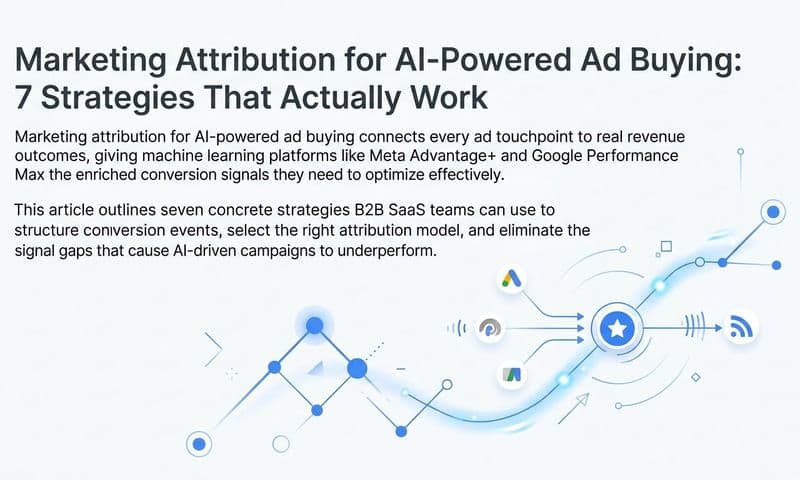
You're reviewing your dashboard on a Tuesday morning. Conversions are coming in. Revenue is up. But when your CEO asks which campaigns deserve more budget next quarter, you hesitate. Was it the Facebook ads? The Google search campaign? That LinkedIn sequence you launched last month? You have data, but you don't have answers.
This is the attribution gap—the space between knowing you're getting results and understanding exactly which marketing efforts are driving them. Attribution solves this problem by connecting every dollar you spend to the outcomes that matter. It's not just about tracking clicks or impressions. It's about building a clear, data-backed map from marketing activity to revenue.
In this guide, we'll break down what attribution actually does, why it's become essential for modern marketers, and how you can use it to make smarter, more confident decisions about where to invest your budget.
The Core Function: Connecting Marketing Spend to Revenue
At its foundation, attribution is the practice of identifying which marketing touchpoints influence conversions and assigning appropriate credit to each one. Think of it as building a bridge between your marketing activities and your business outcomes. When someone becomes a customer, attribution answers the question: which channels, campaigns, and messages played a role in getting them there?
This matters because marketing doesn't happen in isolation. A customer might see your Facebook ad on Monday, search for your brand on Wednesday, click a retargeting ad on Friday, and finally convert after receiving an email the following week. Without attribution, you're left guessing which of these touchpoints actually mattered.
The fundamental question attribution answers is deceptively simple: which channels actually drive results? But the implications of getting this right are massive. When you know what's working, you can double down on high-performers. When you identify what's not working, you can cut waste before it drains your budget.
Without attribution, marketers operate on assumptions rather than data. You might assume your Google Ads are performing well because you see conversions in the platform. But what if those conversions would have happened anyway through organic search? Or what if your Facebook ads are actually initiating most customer journeys, but last-touch attribution is giving all the credit to Google? Understanding what attribution means in marketing is the first step toward solving these challenges.
Attribution brings clarity to these questions. It tracks the customer journey from first awareness through purchase, capturing every interaction along the way. Then it uses that data to assign credit—whether that's giving all the credit to one touchpoint or distributing it across multiple interactions.
The result is a complete view of how your marketing ecosystem works together. You can see which channels introduce new customers to your brand, which ones nurture consideration, and which ones close the deal. This visibility transforms marketing from a cost center into a revenue engine you can optimize with precision.
Why Attribution Matters More Than Ever in 2026
The marketing landscape has fundamentally changed over the past few years, and attribution has evolved from a nice-to-have to an absolute necessity. Three major shifts have made accurate attribution critical for any serious marketing operation.
First, privacy changes have significantly reduced the reliability of platform-reported data. iOS privacy updates, browser tracking restrictions, and the ongoing deprecation of third-party cookies mean that the conversion numbers you see inside ad platforms are increasingly incomplete. Ad blockers prevent tracking pixels from firing. Users opt out of tracking. Browsers limit cross-site data sharing.
The consequence? Ad platforms often over-report conversions because their view of the customer journey is fragmented. They might claim credit for a conversion that happened through a different channel entirely. Or they might count the same conversion multiple times across different platforms. Without independent attribution tracking, you're making budget decisions based on inflated or inaccurate data. This is precisely why attribution is important in digital marketing today.
Second, customer journeys have become exponentially more complex. The average buyer now interacts with brands across multiple devices, channels, and platforms before making a purchase decision. They might discover you on mobile, research on desktop, and convert on tablet. They might see your ad on Instagram, visit your site through Google, and finally convert after clicking an email.
This cross-device, cross-channel behavior means that no single platform has a complete view of the customer journey. Facebook doesn't know about your Google Ads clicks. Google doesn't see your email engagement. Your CRM doesn't capture early-stage ad interactions. The digital marketing strategy that tracks users across the web stitches these fragmented pieces together into a coherent picture of how customers actually find and buy from you.
Third, rising ad costs have made precision optimization non-negotiable. What worked in 2023 or 2024—when you could afford to waste budget on underperforming channels—doesn't work anymore. Ad costs across major platforms have continued to climb, and profit margins are tighter than ever. Every dollar matters.
In this environment, guessing which campaigns to scale is expensive. Cutting a high-performing channel by mistake can crater your pipeline. Missing opportunities to shift budget toward hidden winners means leaving revenue on the table. Attribution gives you the visibility to make these decisions with confidence, ensuring every dollar goes toward channels that actually drive results.
The combination of these three factors—unreliable platform data, complex customer journeys, and tighter margins—has made attribution indispensable. Marketers who rely solely on platform-reported metrics are flying blind. Those who implement proper attribution gain a competitive advantage that compounds over time.
How Attribution Transforms Budget Decisions
The most immediate and tangible benefit of attribution is how it changes the way you allocate budget. Instead of distributing spend based on gut feel or platform-reported metrics, you can make decisions rooted in actual revenue impact.
Start with identifying underperforming channels that are draining your budget. These are the campaigns that look decent on the surface but fall apart when you examine their true contribution to revenue. Maybe your display ads show conversions in Google Ads, but attribution reveals those users would have converted anyway through organic search. Or perhaps a particular campaign generates clicks and engagement but rarely initiates journeys that actually lead to sales.
Without attribution, these budget drains are invisible. You keep funding them because the platform says they're working. With attribution, you can spot them immediately and redirect that spend toward channels that actually move the needle. The right digital marketing attribution software makes this process systematic rather than guesswork.
Just as important is discovering hidden high-performers that deserve more investment. These are often top-of-funnel channels that don't get credit in last-touch attribution but play a crucial role in initiating customer journeys. Think about brand awareness campaigns, educational content, or early-stage social media ads.
In a last-touch model, these channels look inefficient because they rarely get credit for the final conversion. But attribution that accounts for the full customer journey reveals their true value. You might discover that your LinkedIn content consistently introduces high-quality leads who eventually convert through other channels. Or that your YouTube ads create awareness that drives branded search volume weeks later.
These insights enable you to scale with confidence. Instead of wondering whether increasing budget will maintain performance, you have data showing which channels can handle additional spend while maintaining ROI. You can identify the campaigns that are working at capacity versus those with room to grow.
The shift from gut-feel allocation to data-driven scaling is transformative. You stop making budget decisions in quarterly planning meetings based on opinions and start making them continuously based on performance data. You can test new channels with clear success metrics. You can defend budget requests with revenue data rather than vanity metrics.
This approach also changes how you think about channel mix. Instead of treating each platform as independent, you understand how they work together. You might discover that your best-performing customer journeys involve multiple touchpoints across different channels—a Facebook ad followed by Google search followed by email. This insight allows you to optimize the entire journey rather than just individual channels.
Understanding Different Attribution Models and Their Purposes
Attribution isn't one-size-fits-all. Different models assign credit in different ways, and each reveals something unique about how your marketing performs. Understanding these models helps you choose the right perspective for your business goals and sales cycle.
First-touch attribution gives all the credit to the initial interaction that brought a customer into your funnel. If someone first discovered you through a Facebook ad, that ad gets 100% of the conversion credit—regardless of what happened afterward. This model is valuable for understanding which channels are best at generating awareness and bringing new prospects into your ecosystem.
The strength of first-touch is that it highlights top-of-funnel performance. It answers the question: where do my customers come from? If you're focused on building brand awareness or expanding into new markets, first-touch attribution shows which channels are most effective at introducing people to your brand.
Last-touch attribution does the opposite—it gives all the credit to the final touchpoint before conversion. If someone clicks an email and then purchases, the email gets 100% credit, even if that person had dozens of previous interactions with your brand. This is the default model in most ad platforms because it's simple and aligns with how platforms want to report their performance.
Last-touch is useful for understanding which channels are best at closing deals. It tells you what messaging and offers work when someone is ready to buy. But it completely ignores the journey that got them to that point, often undercrediting awareness and consideration channels. Learning what an attribution model is in digital marketing helps you understand these trade-offs.
Multi-touch attribution models distribute credit across the full customer journey. Linear attribution gives equal credit to every touchpoint. If someone had five interactions before converting, each one gets 20% credit. This approach acknowledges that multiple channels contribute to conversions, but it assumes all touchpoints are equally important—which is rarely true.
Time-decay attribution gives more credit to touchpoints closer to conversion. The logic is that recent interactions had more influence on the purchase decision than earlier ones. This model works well for businesses with shorter sales cycles where momentum matters more than initial awareness.
Position-based (or U-shaped) attribution emphasizes the first and last touchpoints while still crediting middle interactions. Typically, it might give 40% credit to first-touch, 40% to last-touch, and distribute the remaining 20% among everything in between. This model recognizes that both introducing someone to your brand and closing the sale are critical moments.
Data-driven attribution uses algorithms to analyze actual conversion patterns and assign credit based on what the data reveals. Instead of applying a predetermined rule, it looks at which touchpoints are most strongly associated with conversions in your specific business. Understanding what predetermined means in marketing attribution models clarifies why data-driven approaches often outperform static rules.
Choosing the right model depends on your sales cycle and goals. If you have a long, complex B2B sales cycle, multi-touch attribution in marketing provides more insight than first or last-touch. If you're running direct-response campaigns with short consideration periods, last-touch might be sufficient. The key is understanding what each model reveals—and what it hides—about your marketing performance.
Real-World Applications: Attribution in Action
Understanding attribution concepts is one thing. Applying them to improve your marketing is where the real value lives. Here's how attribution drives better outcomes across different areas of your marketing operation.
One of the most powerful applications is optimizing ad platform algorithms with accurate conversion data. Ad platforms like Meta and Google use machine learning to find people most likely to convert. But their algorithms are only as good as the conversion data you feed them. If your tracking is incomplete or inaccurate, the algorithm optimizes toward the wrong signals.
Server-side attribution tracking captures conversions that browser-based pixels miss—conversions from users with ad blockers, from cross-device journeys, or from sessions where tracking was blocked. When you send this complete, enriched conversion data back to ad platforms, their algorithms get a clearer picture of what success looks like. The result is better targeting, more efficient spending, and improved campaign performance over time.
Attribution also transforms how you prove marketing ROI to stakeholders. Instead of showing vanity metrics like impressions or clicks, you can connect marketing spend directly to revenue. You can walk into a board meeting and say, "We spent $50,000 on paid social last quarter, and attribution shows it generated $200,000 in revenue from new customers." Building a comprehensive digital marketing attribution report makes these conversations data-driven rather than speculative.
This clarity is especially valuable when defending budget requests or justifying marketing headcount. When leadership sees concrete revenue attribution, marketing shifts from a cost center to a growth driver. You're not asking for more budget—you're showing the return on investment that justifies increased spending.
Another practical application is identifying which creative and messaging resonates at each stage of the customer journey. Attribution doesn't just tell you which channels work—it reveals which specific ads, landing pages, and offers drive results at different funnel stages.
You might discover that educational content works best for first-touch, while product-focused ads perform better for retargeting. Or that certain value propositions resonate with cold traffic while others work better for warm audiences. These insights let you optimize not just where you advertise, but what you say and show at each stage.
Attribution also helps you understand lead quality, not just lead volume. By tracking which sources generate leads that actually convert to customers, you can shift budget toward channels that attract your ideal customer profile. A channel that generates fewer leads but higher conversion rates is often more valuable than one that floods your pipeline with unqualified prospects. Leveraging data analytics for digital marketing amplifies these insights across your entire funnel.
This application is particularly important for businesses with sales teams. When you can show that certain marketing channels consistently produce leads that close at higher rates or have higher lifetime value, you create alignment between marketing and sales. Both teams optimize toward the same goal: revenue, not just activity.
Putting Attribution to Work for Your Marketing Team
Implementing attribution doesn't require a complete overhaul of your marketing stack. The key is starting with the fundamentals and building from there. Here's how to put attribution to work in a practical, sustainable way.
Start by connecting your key data sources: ads, CRM, and website. Attribution only works when you can see the full customer journey, which means integrating the platforms where customer interactions happen. Connect your ad platforms so you can track which campaigns drive traffic. Integrate your CRM to capture lead and customer data. Implement tracking on your website to understand on-site behavior.
The goal is creating a unified view where you can follow a customer from first ad click through to closed deal. This doesn't mean you need to connect every tool on day one. Focus on the channels that drive the majority of your revenue and expand from there. A solid attribution marketing tracking foundation makes everything else possible.
Next, compare attribution models to understand different perspectives on performance. Don't just pick one model and call it done. Look at first-touch to understand awareness. Examine last-touch to see what closes deals. Review multi-touch models to understand the full journey. Each perspective reveals something different about how your marketing performs.
You'll often find that different channels look strong or weak depending on which model you use. A channel that looks inefficient in last-touch might be critical in first-touch. This doesn't mean one model is "right" and others are "wrong"—it means each channel serves different purposes in your funnel. Exploring the importance of attribution models in marketing helps you navigate these nuances.
Use these insights to make incremental improvements rather than dramatic overhauls. Attribution reveals opportunities to optimize, but you don't need to restructure your entire strategy overnight. Start by identifying one or two clear wins—maybe a channel that's obviously underperforming or an opportunity to scale a hidden winner—and act on those first.
As you build confidence in your attribution data, you can make larger strategic shifts. But beginning with small, data-backed changes builds momentum and proves the value of attribution to your team and leadership. It's easier to get buy-in for bigger changes once you've demonstrated results from smaller optimizations.
Moving Forward with Confidence
Attribution's purpose isn't just about tracking or reporting. It's fundamentally about confidence—confidence in knowing what works, where to invest, and how to scale. When you understand which channels drive revenue, budget decisions become straightforward. When you can prove ROI with data, stakeholder conversations shift from defending spend to planning growth.
The marketers who thrive in 2026 and beyond are those who replace assumptions with data, guesswork with attribution, and reactive decisions with proactive optimization. They don't wonder which campaigns deserve more budget—they know. They don't hope their marketing is working—they can prove it.
Take a moment to evaluate your current attribution approach. Do you have visibility into the full customer journey? Can you confidently answer which channels drive your best customers? Are you making budget decisions based on complete data or platform-reported metrics? If you're uncertain about any of these questions, it's time to strengthen your attribution foundation.
Ready to elevate your marketing game with precision and confidence? Discover how Cometly's AI-driven recommendations can transform your ad strategy—Get your free demo today and start capturing every touchpoint to maximize your conversions.