You're staring at your dashboard on Monday morning, coffee in hand, trying to make sense of the numbers. Facebook says it drove 47 conversions last week. Google Ads claims 52. Your email platform is taking credit for 31. But when you check your actual sales? Only 68 total conversions.
The math doesn't add up. It never does.
This is the attribution problem that keeps marketers up at night. Without a clear understanding of which marketing touchpoints actually drive conversions, you're essentially flying blind—making budget decisions based on incomplete data and conflicting reports from platforms that all want to claim credit for your success.
Marketing attribution is the process of identifying which interactions along the customer journey contribute to conversions and assigning appropriate credit to each touchpoint. It's the difference between knowing your Facebook ads generated clicks versus knowing they actually drove revenue. It's the framework that transforms scattered data points into a coherent story about what's working and what's burning budget.
Understanding attribution fundamentally changes how you allocate resources, scale campaigns, and measure success. Instead of optimizing for vanity metrics or trusting platform-reported numbers that don't match reality, you gain the clarity to invest confidently in the channels and campaigns that genuinely move the needle.
The Core Concept: Connecting Marketing Efforts to Business Results
At its essence, marketing attribution tracks the customer journey from first interaction to final conversion, then assigns credit to the channels, campaigns, and specific ads that influenced the purchase decision. Think of it as connecting the dots between every marketing dollar you spend and every dollar of revenue that comes back.
Attribution answers the critical question every marketer faces: "Which of my marketing investments are actually generating revenue?" Not which ones look impressive in a report. Not which ones your ad rep says are performing well. Which ones are genuinely driving business results.
This matters because customer journeys today are rarely straightforward. A potential customer might see your Instagram ad on Monday, click a Google search result on Tuesday, receive your email on Wednesday, and finally convert through a retargeting ad on Thursday. Without proper attribution, you might credit only that final retargeting ad—completely missing the three other touchpoints that warmed up the prospect and made that conversion possible.
The difference between vanity metrics and attribution-driven insights is profound. Impressions tell you how many times your ad appeared. Clicks tell you how many people were interested enough to visit. But attribution tells you which impressions and clicks actually led to revenue.
Consider two campaigns with identical click-through rates. Campaign A generates 1,000 clicks at $2 each. Campaign B generates 1,000 clicks at $2 each. From a vanity metrics perspective, they're performing identically. But proper attribution might reveal that Campaign A drove 50 conversions worth $10,000, while Campaign B drove only 10 conversions worth $2,000. That's the difference between a winning campaign and one that's quietly draining your budget.
Attribution also reveals your true cost per acquisition. Platform-reported numbers often show artificially low costs because they're counting assisted conversions, view-throughs, and other interactions that didn't actually drive the sale. When you implement accurate attribution, you see the real cost of acquiring a customer—which might be higher than you thought, but at least it's honest data you can use to make informed decisions.
This clarity transforms how marketing teams operate. Instead of endless debates about which channel "deserves" more budget, you have objective data showing which investments generate returns. Instead of celebrating surface-level wins like increased traffic, you focus on the metrics that actually matter to the business. Instead of guessing which creative resonates, you know which ads drive conversions.
How Attribution Models Assign Credit Differently
Not all attribution models are created equal, and the model you choose dramatically affects how you interpret your marketing performance. Each model represents a different philosophy about which touchpoints deserve credit for a conversion.
Single-touch models take the simplest approach by giving 100% credit to one interaction. First-touch attribution credits the initial touchpoint that brought someone into your funnel—whether that's a Facebook ad, a blog post, or a search result. This model appeals to teams focused on top-of-funnel awareness and lead generation. If you're trying to understand which channels introduce new prospects to your brand, first-touch attribution provides that answer.
Last-touch attribution does the opposite, giving all credit to the final interaction before conversion. This model resonates with performance marketers who care most about what closes the deal. If you're optimizing for immediate conversions and want to know which touchpoints seal the deal, last-touch attribution delivers that perspective.
But here's the problem with single-touch models: they're fundamentally incomplete. They ignore the reality that customer journeys involve multiple interactions. When you credit only the first or last touchpoint, you're essentially pretending the rest of the journey didn't happen. This leads to misallocated budgets, undervalued channels, and strategic blind spots.
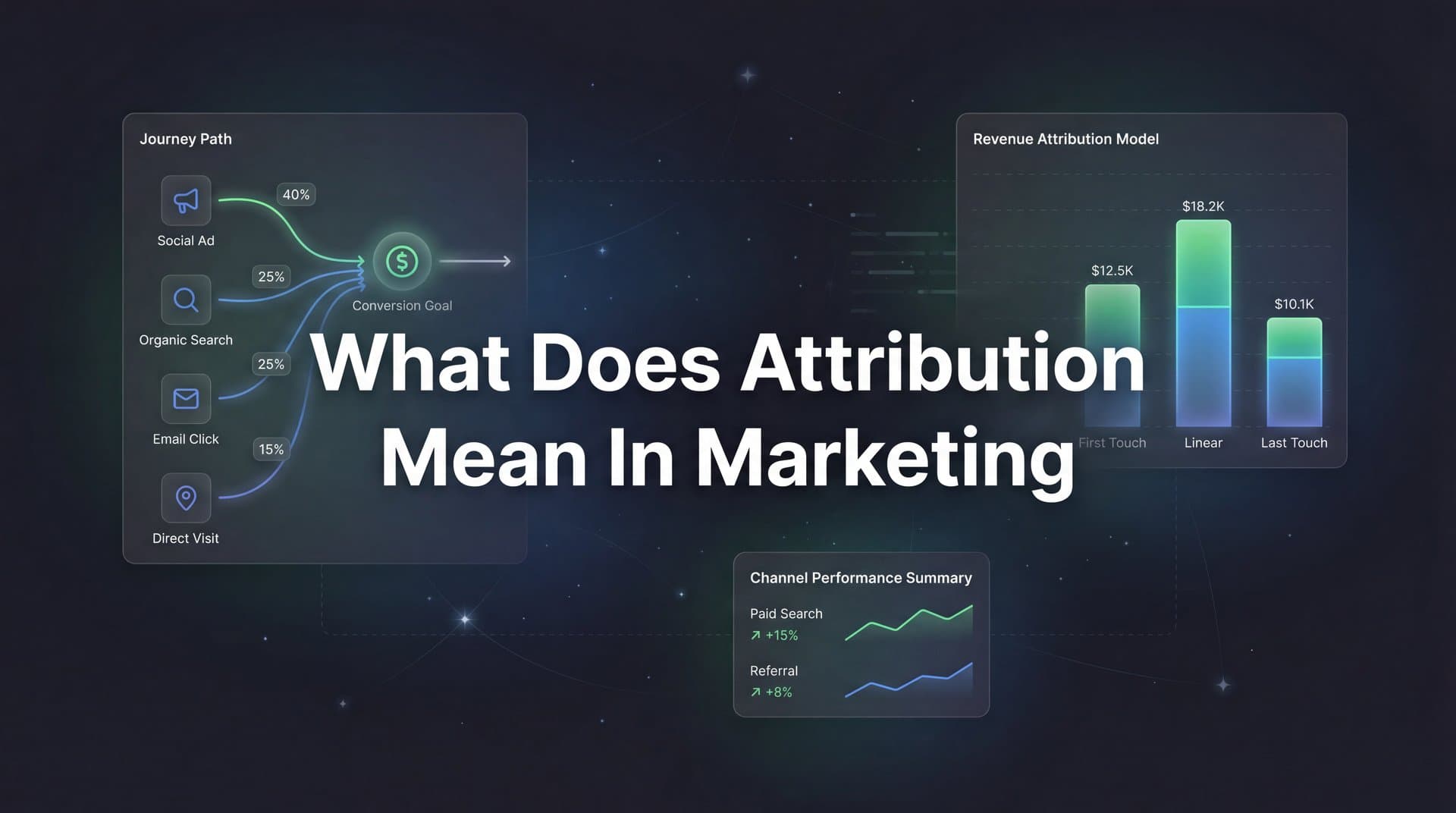
Multi-touch attribution models attempt to solve this by distributing credit across multiple interactions. Linear attribution takes the most egalitarian approach, dividing credit equally among all touchpoints. If a customer had five interactions before converting, each touchpoint gets 20% credit. This model works well when you believe every interaction contributes equally to the conversion.
Time-decay attribution recognizes that interactions closer to the conversion typically have more influence. It assigns increasing credit to touchpoints as they get closer to the final conversion. The logic makes intuitive sense: the retargeting ad someone saw an hour before purchasing probably mattered more than the blog post they read three months ago.
Position-based attribution (also called U-shaped) gives extra weight to the first and last touchpoints while distributing remaining credit among the interactions in between. Typically, this means 40% credit to the first touch, 40% to the last touch, and 20% split among everything else. This model appeals to teams who believe both awareness and conversion moments deserve special recognition.
Then there's data-driven attribution, which moves beyond predetermined rules to analyze your actual conversion data. Instead of assuming all first touches or last touches deserve equal credit, data-driven models examine thousands of conversion paths to identify which touchpoints statistically correlate with successful outcomes. If your data shows that customers who interact with both email and retargeting ads convert at 3x the rate of those who see only one channel, the model adjusts credit accordingly.
The model you choose shapes your entire marketing strategy. If you're using last-touch attribution and see that Google Ads drives most conversions, you might pour budget into search campaigns. But switch to a multi-touch model, and you might discover that Facebook ads are actually introducing the prospects who later convert through search—meaning your Facebook investment deserves more credit than last-touch attribution revealed.
Many sophisticated marketing teams don't choose just one model. They compare multiple attribution perspectives side-by-side to understand the full picture. This approach reveals which channels excel at awareness versus conversion, which combinations of touchpoints drive the highest conversion rates, and where budget shifts might unlock better performance.
Why Traditional Attribution Breaks Down in Modern Marketing
The attribution methods that worked five years ago are increasingly unreliable today. Privacy changes, cross-device journeys, and platform reporting conflicts have created a perfect storm of tracking challenges that make traditional pixel-based attribution less accurate than ever.
Apple's iOS updates fundamentally disrupted mobile tracking when they introduced App Tracking Transparency, requiring apps to ask explicit permission before tracking users across other apps and websites. The result? Most users opted out, creating massive blind spots in conversion tracking. Campaigns that previously showed clear attribution data suddenly went dark, leaving marketers unable to track significant portions of their mobile traffic.
Cookie deprecation compounds the problem. As browsers phase out third-party cookies, the tracking pixels that powered traditional attribution are losing their ability to follow users across websites. Chrome's planned cookie phase-out represents the final nail in the coffin for cookie-based tracking methods that have been the industry standard for years.
Cross-device journeys add another layer of complexity. Your customer might see your ad on their iPhone during their morning commute, research your product on their work laptop during lunch, and finally make a purchase on their iPad that evening. Traditional attribution struggles to connect these interactions as part of a single customer journey. Each device looks like a different person, fragmenting your data and making it nearly impossible to see the complete path to conversion.
Then there's the fundamental conflict of interest built into platform reporting. Facebook, Google, TikTok, and every other ad platform have strong incentives to make their performance look as good as possible. They're essentially grading their own homework, using attribution methodologies designed to maximize the credit they claim for conversions.
This leads to the scenario we opened with: platforms reporting more total conversions than you actually received. Facebook might count a conversion if someone viewed your ad and later purchased, even if they never clicked and converted through a completely different channel. Google Ads might claim credit using a 30-day attribution window while Facebook uses 28 days, creating overlapping claims on the same conversions.
Platform-reported numbers also suffer from view-through attribution inflation. Just because someone scrolled past your ad in their feed doesn't mean that ad drove their eventual conversion. But many platforms count these passive exposures as "assisted conversions," inflating their reported impact and making it appear they contributed more than they actually did.
The result is a crisis of confidence in marketing data. When your platforms collectively claim credit for 150 conversions but you only received 100, which 50 are real? When Facebook says your cost per acquisition is $45 but your actual revenue suggests it's closer to $75, which number should guide your budget decisions?
This breakdown in traditional attribution creates real business consequences. Teams over-invest in channels that look good in platform dashboards but don't actually drive profitable growth. They under-invest in channels that play crucial supporting roles but don't get credit in last-touch models. They make strategic decisions based on incomplete data, then wonder why scaling campaigns doesn't produce the results they expected.
Server-Side Tracking: The Foundation of Accurate Attribution
Server-side tracking represents a fundamental shift in how conversion data gets captured and connected. Instead of relying on browser pixels and cookies that can be blocked, deleted, or broken by privacy updates, server-side tracking captures conversion data directly from your systems—creating a reliable foundation for accurate attribution.
Here's how it works: when someone converts on your website or through your app, that conversion event gets sent directly from your server to your attribution platform and ad networks. This bypasses all the browser-level limitations that plague traditional pixel tracking. Ad blockers can't interfere. Cookie restrictions don't matter. iOS privacy settings become irrelevant. The conversion data flows reliably because it's happening at the infrastructure level rather than depending on client-side code running in someone's browser.
This approach creates a single source of truth by connecting your ad platforms, website, CRM, and any other conversion sources into one unified data stream. When a lead comes through your website form, that information flows to your attribution system. When they later convert into a paying customer in your CRM, that conversion also gets tracked and connected to their original marketing touchpoints. When they make additional purchases or upgrade their plan, those events feed back into your attribution model, giving you a complete view of customer lifetime value by acquisition source.
The accuracy improvement is substantial. Traditional pixel tracking might capture 60-70% of actual conversions due to ad blockers, cookie restrictions, and tracking prevention features. Server-side tracking captures nearly 100% because it's recording conversions at the source rather than trying to track them through browsers that actively resist tracking.
But server-side tracking does more than just improve your internal reporting. It also feeds better data back to your ad platforms, which dramatically improves their optimization algorithms. Facebook's algorithm learns which types of users actually convert. Google's smart bidding gets accurate signals about which clicks lead to sales. TikTok's targeting improves because it receives reliable conversion data rather than fragmented signals filtered through iOS restrictions.
This creates a powerful feedback loop. Better data flowing to ad platforms leads to better targeting. Better targeting leads to more conversions. More conversions provide even more data to train the algorithms. The platforms become more effective at finding your ideal customers because they're learning from accurate conversion signals rather than incomplete pixel data.
Implementation does require technical setup—connecting your website, CRM, and ad platforms through a server-side tracking infrastructure. But the investment pays dividends in attribution accuracy, data reliability, and campaign performance. Teams that implement server-side tracking consistently report that their ad platform performance improves within weeks as the algorithms start learning from clean, complete conversion data.
The shift to server-side tracking also future-proofs your attribution strategy. As browsers continue tightening privacy restrictions and third-party cookies disappear entirely, pixel-based tracking will become increasingly unreliable. Server-side tracking operates independently of these browser-level changes, ensuring your attribution remains accurate regardless of future privacy updates.
Putting Attribution Into Practice: From Data to Decisions
Understanding attribution concepts matters only if you actually use those insights to make better marketing decisions. The real value comes from translating attribution data into concrete actions that improve performance and drive growth.
Start by mapping your customer journey and identifying all potential touchpoints across channels. This means documenting every way a prospect might interact with your brand: paid ads on Facebook, Instagram, Google, TikTok, and LinkedIn; organic search results; email campaigns; retargeting ads; content marketing; webinars; sales calls. Create a visual map showing how these touchpoints connect and which combinations typically lead to conversions.
This mapping exercise often reveals surprising gaps. You might discover that your highest-value customers consistently interact with both your educational content and your retargeting ads, but you've been treating these as separate initiatives rather than coordinated touchpoints. Or you might find that prospects who engage with your email nurture sequence convert at 3x the rate of those who don't, suggesting email deserves more strategic emphasis than your current budget allocation reflects.
Next, compare attribution models side-by-side to understand how different approaches value your marketing mix. Run reports showing the same conversion data through first-touch, last-touch, and multi-touch models. The differences reveal which channels drive awareness versus conversions, which touchpoints get undervalued by single-touch models, and where your current strategy might be missing opportunities.
For example, you might see that first-touch attribution credits Facebook with 40% of conversions while last-touch gives it only 15%. This suggests Facebook excels at introducing new prospects but doesn't often close the deal directly. That's not a weakness—it's valuable intelligence about Facebook's role in your funnel. It means you should evaluate Facebook campaigns based on their ability to generate qualified prospects, not just direct conversions.
Use these attribution insights to reallocate budget toward channels that actually drive revenue. This is where attribution transforms from interesting data into business impact. If multi-touch attribution reveals that customers who see both your YouTube ads and your Google search ads convert at twice the rate of those who see only one channel, you have a clear directive: increase investment in the YouTube-plus-search combination.
Budget reallocation should be systematic, not impulsive. Start with small tests: shift 10-15% of budget from underperforming channels to those your attribution data identifies as undervalued. Monitor the results closely. If conversions increase and your cost per acquisition improves, continue the shift. If performance declines, investigate whether the attribution data was misleading or whether other factors changed.
Attribution also guides creative and messaging decisions. When you know which ads appear at which points in the customer journey, you can craft appropriate messaging for each stage. Awareness-stage ads should focus on problem identification and brand introduction. Consideration-stage content should address objections and demonstrate value. Conversion-stage ads should provide clear calls-to-action and urgency.
Don't forget to track assisted conversions alongside direct conversions. A channel might not get credit for many final conversions but could be playing a crucial supporting role. Your blog content might rarely close deals directly, but if attribution data shows that prospects who read your educational content convert at higher rates and have higher lifetime value, that content deserves continued investment even if it doesn't show up prominently in last-touch reports.
Review your attribution data regularly but not obsessively. Weekly reviews help you spot trends and catch problems early. Monthly deep dives let you identify strategic opportunities and evaluate whether budget shifts are working. Quarterly analyses should inform major strategic decisions about channel mix, campaign priorities, and resource allocation.
The Path Forward: Making Attribution Work for Your Business
Marketing attribution isn't just a technical exercise or a nice-to-have reporting feature. It's the difference between confident scaling and expensive guesswork. It's the foundation for every strategic decision about where to invest, what to test, and how to grow.
The marketers who master attribution gain an enormous competitive advantage. While their competitors argue about which platform "feels" more effective or make budget decisions based on incomplete data, attribution-savvy teams operate with clarity. They know which campaigns drive revenue. They understand which touchpoints matter most. They can scale winning strategies confidently because they're working from accurate data rather than platform-reported numbers that don't match reality.
Accurate attribution requires three core elements: capturing every touchpoint across your customer journey, connecting that data into a unified view that reveals the complete path to conversion, and using those insights to make real budget decisions rather than letting the data sit unused in dashboards.
The good news? The technology for achieving this level of attribution clarity has never been more accessible. AI-powered attribution platforms can now analyze thousands of conversion paths, identify patterns humans would miss, and provide specific recommendations about where to shift budget for maximum impact. Server-side tracking solves the data accuracy problems that plagued traditional pixel-based attribution. Multi-touch models reveal the full customer journey rather than crediting only the first or last interaction.
The shift toward first-party data and server-side tracking isn't just about compliance or keeping up with privacy changes. It's about building a sustainable attribution foundation that works regardless of browser updates, platform policy changes, or cookie restrictions. It's about owning your data and controlling your ability to measure what matters.
As customer journeys continue growing more complex and privacy regulations tighten further, the gap between teams with accurate attribution and those flying blind will only widen. The time to build proper attribution marketing tracking infrastructure is now, before you waste another month of budget on channels that look good in reports but don't actually drive growth.
Ready to elevate your marketing game with precision and confidence? Discover how Cometly's AI-driven recommendations can transform your ad strategy—Get your free demo today and start capturing every touchpoint to maximize your conversions.