You're running Facebook ads, Google campaigns, email sequences, and retargeting—spending thousands every month across multiple channels. Your dashboard shows conversions happening, but here's the question that keeps you up at night: which of these touchpoints actually drove those sales?
Most marketers are flying blind. They see the final click that converted, but they miss the five interactions that happened before it. They credit the last ad someone saw, ignoring the blog post that built trust or the email that answered objections. The result? Budgets get misallocated, winning channels get underfunded, and campaigns that look like failures are actually your silent MVPs.
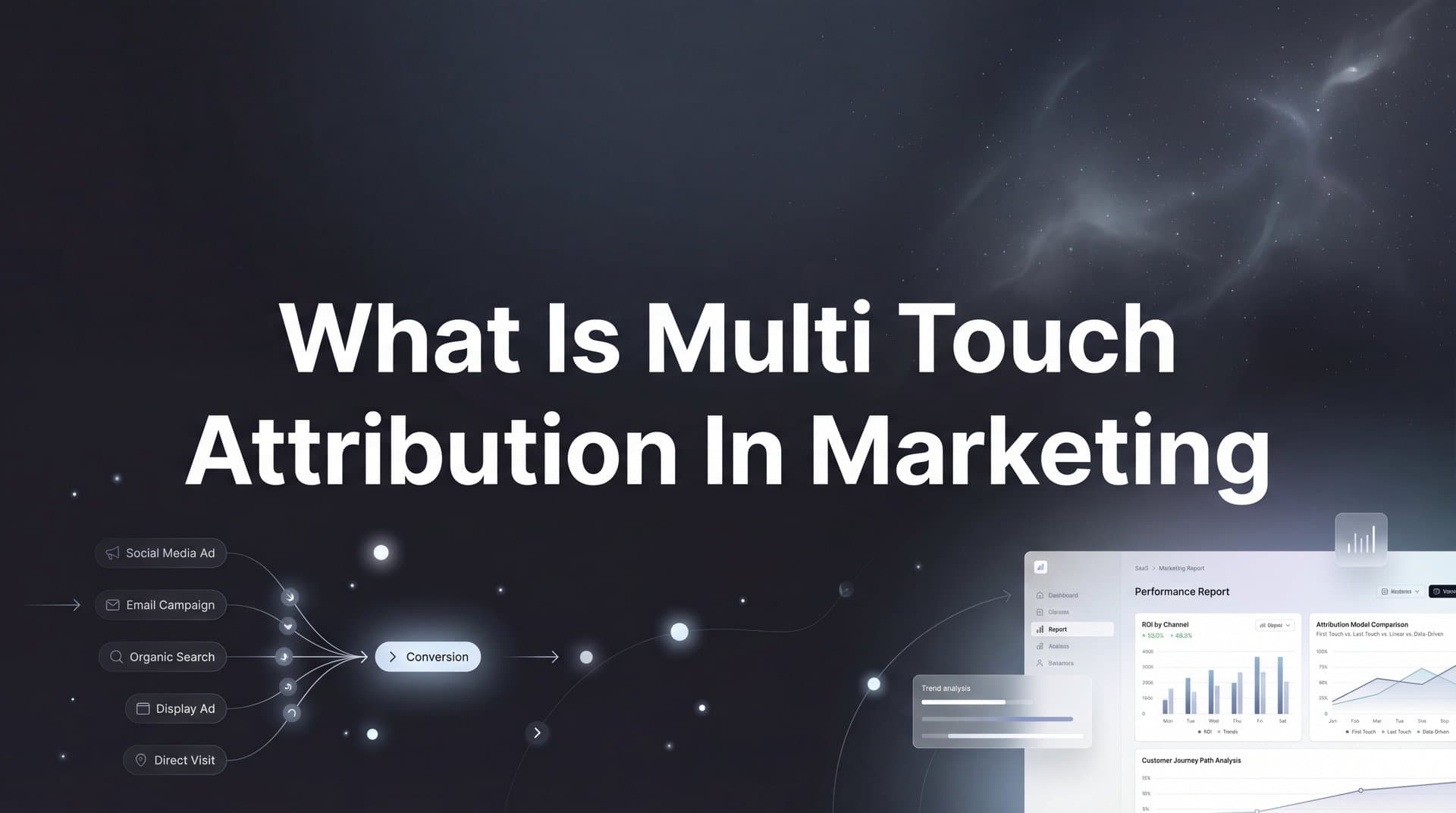
Multi-touch attribution solves this by revealing the complete customer journey. Instead of crediting just one interaction, it shows you every touchpoint that contributed to conversion—and assigns each one its proper weight. This guide breaks down exactly how multi-touch attribution works, why it matters for your marketing decisions, and what you need to implement it effectively.
Why Single-Touch Attribution Keeps You in the Dark
Let's start with the problem. Most marketing platforms default to single-touch attribution models—they credit either the first interaction a customer had with your brand or the last one before they converted.
First-touch attribution gives all the credit to whatever brought someone into your world initially. If a customer clicked your Facebook ad three weeks ago, then engaged with your email campaign, read two blog posts, and finally converted through a retargeting ad—Facebook gets 100% of the credit. This model makes your top-of-funnel channels look like heroes while completely ignoring everything that actually closed the deal.
Last-touch attribution does the opposite. It credits only the final interaction before conversion. In the same scenario, your retargeting ad gets all the glory while Facebook, email, and content marketing look like they contributed nothing. The channels that introduced your brand and built trust become invisible. Understanding the difference between single source attribution and multi touch attribution models is critical for making informed marketing decisions.
Here's why this matters: modern customer journeys aren't linear. People don't see one ad and immediately buy. They discover your brand through one channel, research you through another, compare options somewhere else, and convert when the timing finally aligns. The average B2B buyer interacts with a brand across multiple touchpoints before making a purchase decision. E-commerce customers often engage with brands through several channels before their first transaction.
When you credit only one touchpoint, you're making budget decisions based on incomplete data. You might cut spending on channels that are actually driving awareness and consideration—just because they're not getting credit for the final click. Or you might over-invest in bottom-funnel tactics that only work because your top-funnel efforts already did the heavy lifting.
Single-touch models create a distorted reality where some channels look like they're failing when they're actually essential to your conversions. That's the blind spot that costs marketers millions in misallocated budget every year.
How Multi-Touch Attribution Reveals the Complete Picture
Multi-touch attribution takes a fundamentally different approach: it distributes conversion credit across all the touchpoints that contributed to the customer journey. Instead of picking one interaction as "the winner," it acknowledges that multiple channels worked together to drive that conversion.
Think of it like a relay race. The runner who crosses the finish line gets the glory, but they only won because three other teammates ran their legs first. Multi-touch attribution gives credit to the entire team, not just the anchor.
Here's how it works in practice. Let's say a customer named Sarah discovers your SaaS product through a LinkedIn ad. She clicks through, reads a blog post about solving her specific problem, but doesn't convert. Three days later, she sees your brand mentioned in an industry newsletter and clicks through to your pricing page. Still not ready. A week after that, she searches for your product name on Google, clicks your ad, and finally signs up for a trial.
Last-touch attribution would credit that final Google ad with 100% of Sarah's conversion. But that's not the full story. The LinkedIn ad introduced her to your solution. The blog post educated her about your approach. The newsletter mention built credibility. The Google search showed intent—she was actively looking for you by name. Each touchpoint played a role.
Multi-touch attribution assigns weighted credit to each of these interactions. The exact distribution depends on which attribution model you use, but the principle remains the same: every touchpoint that influenced the decision gets recognized for its contribution. For a deeper dive into this concept, explore our comprehensive multi-touch attribution explained guide.
This approach requires connecting data from multiple sources. You need tracking that captures ad clicks from Facebook, Google, LinkedIn, and other platforms. You need website analytics that shows which pages Sarah visited and when. You need CRM data that ties all these interactions to an actual conversion and revenue outcome.
Without this unified view, you're still working with fragments. You might see that Sarah clicked your LinkedIn ad in one platform, visited your pricing page in Google Analytics, and converted in your CRM—but if these systems don't talk to each other, you can't connect the dots. Multi-touch attribution requires infrastructure that captures every interaction and links them to the same customer journey.
The payoff is clarity. Instead of guessing which channels matter, you see exactly how they work together. You understand which touchpoints introduce customers, which ones educate them, and which ones close the deal. That's the foundation for smarter budget decisions.
The Four Attribution Models That Distribute Credit Differently
Not all multi-touch attribution models are created equal. Each one distributes credit differently based on assumptions about which touchpoints matter most. Understanding these models helps you choose the approach that aligns with your business reality.
Linear Attribution: This is the most straightforward approach. Linear attribution gives equal credit to every touchpoint in the customer journey. If Sarah had four interactions before converting, each one gets 25% of the credit.
The advantage? It's simple and acknowledges that every interaction contributed. The limitation? It assumes all touchpoints are equally valuable, which often isn't true. The first brand awareness ad and the final retargeting ad that closed the deal probably didn't contribute the same amount—but linear attribution treats them identically.
Linear models work well when you're just starting with multi-touch attribution and want a baseline understanding of how channels interact. They're also useful for businesses with relatively short sales cycles where every touchpoint genuinely plays a similar role.
Time-Decay Attribution: This model operates on the principle that touchpoints closer to conversion matter more. It assigns increasing credit as you move through the customer journey, with the most recent interaction getting the highest weight.
Using Sarah's journey as an example, the LinkedIn ad that started everything might get 10% credit, the blog post visit gets 15%, the newsletter click gets 25%, and the final Google search gets 50%. The percentages increase as you approach the conversion moment.
Time-decay makes sense for businesses where the final touchpoints are genuinely more influential—like e-commerce where a retargeting ad with a discount code often tips the decision. It acknowledges that while early interactions matter, recent engagement shows higher intent and more direct influence on the conversion.
The trade-off is that time-decay can undervalue top-of-funnel efforts. If your awareness campaigns are critical for getting customers into your ecosystem, this model might make them look less important than they actually are.
Position-Based Attribution (U-Shaped): This model gives the most credit to the first and last touchpoints, with the remaining credit distributed among middle interactions. A common distribution is 40% to the first touch, 40% to the last touch, and 20% split among everything in between.
The logic here is that introducing someone to your brand and closing the deal are the two most critical moments. The first touchpoint creates awareness—without it, nothing else happens. The last touchpoint converts—it's the final push that turns interest into action. Middle interactions matter, but they're supporting actors rather than leads. Learn more about how to use multi-touch attribution models effectively for your specific business needs.
Position-based attribution works well for businesses with longer sales cycles where both brand introduction and conversion tactics are clearly important. It's popular in B2B marketing where the first touch might be a webinar or content download, and the last touch is often a sales call or demo request.
The challenge is that it still uses predetermined weights rather than learning from your actual data. It assumes 40/40/20 is the right split, but your business might have different dynamics. Understanding what is predetermined in marketing attribution models helps you recognize these limitations.
Data-Driven Attribution (Algorithmic): This is the most sophisticated approach. Instead of using predetermined rules about which touchpoints get what percentage, data-driven attribution uses machine learning to analyze your actual conversion patterns and assign credit based on what the data shows.
The algorithm looks at thousands of customer journeys—both those that converted and those that didn't—and identifies which touchpoints actually correlate with higher conversion rates. If customers who engage with your blog content are 30% more likely to convert than those who don't, the blog gets weighted accordingly. If a specific ad platform consistently appears in successful journeys, it gets more credit.
Data-driven models adapt to your unique business. They don't assume that first and last touches are most important—they let the data decide. This makes them more accurate than rule-based models, especially for businesses with complex customer journeys and sufficient data volume to train the algorithm effectively.
The limitation is that data-driven attribution requires significant data volume to work well. If you're only generating a few dozen conversions per month, you don't have enough signal for the algorithm to learn meaningful patterns. It's also more complex to implement and explain to stakeholders who want to understand exactly how credit is being assigned.
When Multi-Touch Attribution Becomes Essential
Multi-touch attribution isn't equally valuable for every business. There are specific scenarios where it makes the biggest impact—where the insights it provides directly translate into better marketing decisions and improved ROI.
The first scenario is running campaigns across multiple ad platforms simultaneously. If you're advertising on Facebook, Google, LinkedIn, and running display retargeting—all while maintaining email campaigns and content marketing—you need multi-touch attribution to understand how these channels work together. Single-touch models will make some channels look like stars and others like failures, when the reality is they're all playing complementary roles. Implementing multichannel marketing attribution shows you which channels drive awareness, which ones nurture consideration, and which ones close deals.
The second scenario is longer sales cycles. If your customers take weeks or months to convert, they're going to interact with your brand multiple times before making a decision. B2B companies, high-ticket e-commerce, and subscription businesses often see this pattern. Someone might discover you through organic search, attend a webinar, download a guide, engage with email nurture sequences, and finally convert after a retargeting campaign. Without multi-touch attribution, you're only seeing the final retargeting ad—missing all the touchpoints that built trust and moved them toward conversion.
The third scenario is when you need to justify channel spend and optimize budget allocation. If you're managing a significant marketing budget and stakeholders are asking which channels deserve more investment, multi-touch attribution gives you the data to answer confidently. Instead of defending a channel because "it feels important," you can show exactly how it contributes to conversions and revenue. This is especially valuable when you're advocating for top-of-funnel channels that don't get last-click credit but are essential for filling your pipeline.
Multi-touch attribution also becomes critical when you're trying to scale. If you want to double your ad spend, you need to know which channels can handle increased budget without diminishing returns. Attribution data shows you which touchpoints are consistently contributing to conversions at different stages of the funnel—giving you confidence about where to scale.
What You Need to Implement Multi-Touch Attribution
Understanding attribution models is one thing. Actually implementing multi-touch attribution requires specific infrastructure and data connections. Here's what you need to make it work.
First, you need unified tracking across all marketing channels and touchpoints. This means capturing data from every ad platform you use—Facebook, Google, LinkedIn, TikTok, display networks—as well as organic channels like search, social, email, and direct traffic. Each platform has its own tracking pixel or tag, but they all need to feed into a centralized system that can connect these interactions to individual customer journeys. Our attribution marketing tracking complete guide walks through this process in detail.
The challenge is that most platforms track in isolation. Facebook knows someone clicked your ad, but it doesn't know they also clicked your Google ad three days earlier. Google Analytics sees website visits but doesn't automatically connect them to specific ad clicks across platforms. Your email platform tracks opens and clicks but doesn't know if those same people are also engaging with your paid campaigns.
Unified tracking solves this by using a consistent identifier—typically a first-party cookie or user ID—that follows customers across touchpoints. When someone clicks your Facebook ad, the tracking system notes that interaction and associates it with their unique identifier. When they later click a Google ad, that interaction gets added to the same customer journey. When they finally convert, you can see the complete path they took.
Second, you need integration between your ad platforms and CRM. Multi-touch attribution isn't just about tracking clicks—it's about connecting those clicks to actual business outcomes. Did the customer who clicked your LinkedIn ad eventually become a paying customer? What was their lifetime value? How long did it take them to convert?
This requires syncing conversion data from your CRM back to your attribution system. When someone becomes a customer, that conversion event needs to be linked to all the marketing touchpoints that preceded it. This is how you move from tracking clicks to tracking revenue—and it's what makes attribution data actionable for budget decisions. Explore marketing attribution software for revenue attribution to understand how this connection works.
Third, you need real-time data collection that captures the complete customer journey without gaps. Attribution breaks down when you're missing interactions. If someone clicks your Facebook ad but that click doesn't get tracked, your attribution data will show they converted "out of nowhere" after clicking a Google ad. The Facebook touchpoint becomes invisible, and you make decisions based on incomplete information.
Real-time tracking is especially important in the current privacy landscape. Browser-based tracking is increasingly limited by privacy features, ad blockers, and cookie restrictions. Server-side tracking has become essential for maintaining accurate attribution data—it captures events on your server rather than relying on browser cookies that can be blocked or deleted.
Finally, you need a platform that can process all this data and apply attribution models to it. Collecting data is step one, but you also need the analytics layer that can take thousands of customer journeys, apply your chosen attribution model, and show you which channels are actually driving conversions. Reviewing multi-touch attribution software options helps you find the right solution for your needs.
Making Smarter Decisions With Attribution Insights
Having multi-touch attribution data is valuable, but the real impact comes from how you use it. Here's how attribution insights translate into better marketing decisions and improved campaign performance.
Start by identifying which channels assist conversions versus which ones close them. Attribution data reveals that some channels are excellent at introducing customers to your brand but rarely get the final click. Other channels almost never generate first interactions but consistently appear right before conversion. Both roles are valuable—they just serve different purposes in your funnel.
For example, you might discover that LinkedIn ads generate high-quality initial awareness but low direct conversions, while retargeting campaigns have a high conversion rate but only work on people who've already engaged with your brand multiple times. Without multi-touch attribution, you might cut LinkedIn because it's not driving last-click conversions. With attribution data, you see that LinkedIn is filling your funnel with qualified prospects who later convert through retargeting—so both channels are essential.
This insight changes budget allocation. Instead of judging channels solely on last-click performance, you fund them based on their actual contribution to the customer journey. Top-of-funnel channels that drive awareness get appropriate investment, even if they don't close deals directly. Bottom-funnel channels that convert get credit, but you also recognize they're only successful because earlier touchpoints did their job.
Another powerful application is optimizing ad platform algorithms by feeding them enriched conversion data. Most ad platforms use machine learning to optimize campaigns—they show your ads to people who are more likely to convert based on patterns they've learned. But the platform can only optimize based on the conversion data you send it. Understanding what attribution model is best for optimizing ad campaigns helps you make this decision strategically.
Here's the problem: if you're only sending last-click conversion data, the ad platform's algorithm is learning from incomplete information. It thinks certain audiences convert when in reality, those audiences were already primed by other channels. The algorithm optimizes for people who are ready to convert right now, but it misses opportunities to reach people earlier in their journey.
When you feed ad platforms enriched conversion data that includes multi-touch attribution insights, their algorithms get smarter. They learn which types of users eventually convert—even if they don't convert immediately from the first ad. This improves targeting, reduces cost per acquisition, and helps you reach customers at earlier stages of their journey when competition is lower and costs are more favorable.
Finally, attribution data gives you the confidence to scale campaigns. When you understand which touchpoints consistently contribute to conversions, you can increase budget on those channels knowing they're genuinely driving results—not just getting credit for conversions that other channels created.
You can also identify opportunities to test new channels. If attribution data shows that customers who engage with content marketing convert at higher rates, you might invest more in SEO and content creation. If webinar attendees consistently become customers, you can scale your webinar program. Attribution data removes the guesswork from these decisions.
Turning Attribution Into Your Competitive Advantage
Multi-touch attribution transforms marketing from guesswork into data-driven decision making. Instead of wondering which channels deserve credit, you see exactly how touchpoints work together to drive conversions. Instead of allocating budget based on last-click metrics, you fund channels based on their true contribution to revenue.
The marketers who win are the ones who understand the complete customer journey—not just the final click. They know which channels introduce customers, which ones build trust, and which ones close deals. They use this insight to optimize budget allocation, improve ad platform targeting, and scale campaigns with confidence.
The key is capturing every touchpoint and connecting it to actual business outcomes. That requires unified tracking across all your marketing channels, integration between ad platforms and your CRM, and real-time data collection that works despite privacy limitations. It requires infrastructure that turns fragmented data into cohesive customer journeys—and analytics that apply attribution models to reveal which touchpoints actually drive conversions.
Ready to elevate your marketing game with precision and confidence? Discover how Cometly's AI-driven recommendations can transform your ad strategy—Get your free demo today and start capturing every touchpoint to maximize your conversions.