You're running ads on Facebook, Google, LinkedIn, and TikTok. Your email campaigns are converting. Your SEO is driving organic traffic. But when a customer finally purchases, which channel actually deserves the credit?
Here's what really happens: Someone sees your Facebook ad during their morning scroll. Three days later, they Google your product and click through. A week passes, they open your email newsletter and browse your site. Two days after that, they type your URL directly and convert.
So who gets the credit? Most analytics platforms say "direct traffic." Your Google Ads dashboard claims the conversion. Facebook's pixel counts it too. Suddenly, you've got three channels claiming the same sale, and you're left wondering where to actually invest your budget.
This is the attribution puzzle that keeps marketers up at night. And it's costing you money—because when you can't see which channels truly drive revenue, you end up over-investing in bottom-funnel tactics while starving the awareness channels that actually started the journey.
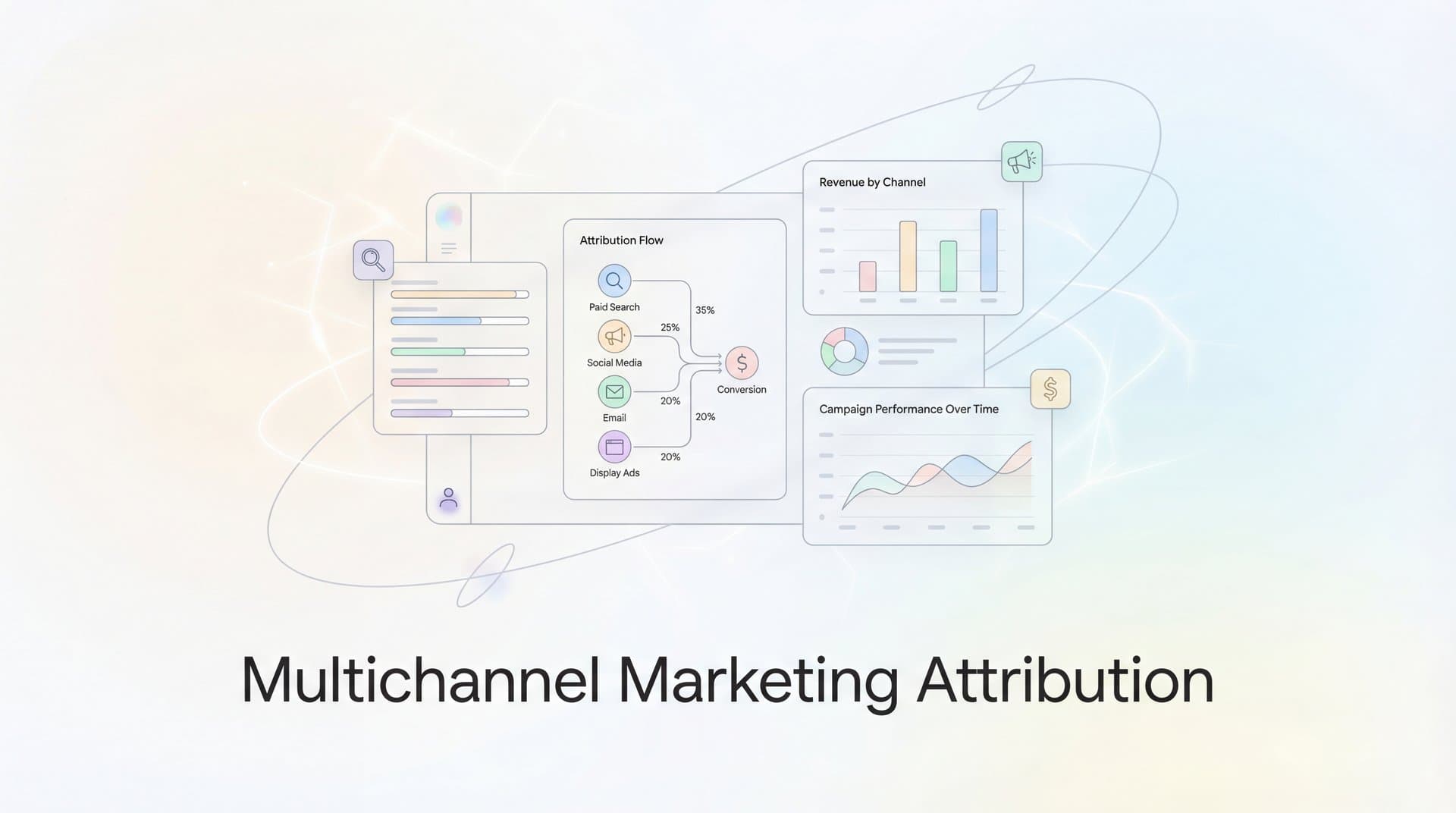
Multichannel marketing attribution solves this problem. It's the practice of tracking every touchpoint a customer encounters across their entire journey and assigning appropriate credit to each interaction. Done right, it transforms your marketing from guesswork into a data-driven revenue engine.
By the end of this guide, you'll understand how to implement attribution that reveals your true customer journey, choose the right model for your business, and use those insights to optimize your marketing spend with confidence.
Beyond Last-Click: Why Modern Marketing Demands Better Attribution
Multichannel marketing attribution is the practice of tracking and analyzing every marketing touchpoint a customer encounters before converting, then assigning credit to each interaction based on its influence in the decision-making process.
Think of it as connecting the dots across your entire marketing ecosystem. Instead of crediting just the last thing someone clicked before buying, you're mapping the complete journey—from that initial brand awareness moment through consideration, evaluation, and finally conversion.
The problem? Most marketers still rely on single-touch attribution models that only credit one interaction. Last-click attribution gives all the credit to the final touchpoint before conversion. First-click attributes everything to the initial interaction. Both approaches fundamentally misrepresent how modern customers actually buy.
Today's buyer journey is fragmented and complex. Customers interact with brands across an average of six to eight touchpoints before converting. They might discover you on social media, research you through organic search, compare you via review sites, engage with your content, receive retargeting ads, and finally convert through branded search or direct traffic.
When you only credit the last click, you're essentially saying that branded search or direct traffic "drove" the conversion—while completely ignoring the Facebook ad that introduced your brand, the blog post that educated the prospect, and the email that re-engaged them when they went cold.
The business impact of this blind spot is massive. You're likely over-investing in bottom-funnel channels that capture existing demand while under-funding the awareness and consideration channels that actually create that demand in the first place. Understanding what attribution in marketing truly means is the first step toward solving this problem.
Picture a marketing team that sees branded search driving 40% of conversions. They increase their branded search budget, expecting proportional growth. Instead, conversions plateau because they're not investing in the upper-funnel channels that make people aware of their brand and motivated to search for it.
This is the attribution trap: optimizing for the visible last click while starving the invisible touchpoints that made that last click possible. You're measuring the finish line instead of the race.
Multichannel attribution fixes this by revealing the complete picture. It shows you which channels initiate journeys, which ones nurture consideration, and which ones close deals. With this visibility, you can invest confidently across your entire funnel—not just at the bottom.
The Five Attribution Models Every Marketer Should Know
Not all attribution models are created equal. Each one distributes credit differently across your customer touchpoints, and choosing the right model depends on your sales cycle, marketing strategy, and what questions you're trying to answer.
Let's break down the five core models and when each makes sense for your business.
Linear Attribution: This model distributes credit equally across every touchpoint in the customer journey. If someone interacts with five channels before converting, each channel gets 20% of the credit.
Linear attribution works well when you have a relatively short sales cycle and want to understand the full scope of your marketing influence. It's democratic—every interaction matters equally. The downside? It doesn't account for the reality that some touchpoints are more influential than others in driving the actual decision. You can explore linear model marketing attribution software to see how this approach works in practice.
Time-Decay Attribution: This model gives more credit to touchpoints that happened closer to the conversion. The first interaction might get 10% credit, while the last one gets 40%, with middle touchpoints scaled proportionally.
Time-decay makes sense when you have a short consideration window and believe that recent interactions have more influence on the purchase decision. It's particularly useful for e-commerce or impulse-driven purchases where recency matters. However, it can undervalue the awareness channels that initiated interest weeks or months earlier.
Position-Based (U-Shaped) Attribution: This model assigns 40% credit to the first touchpoint, 40% to the last touchpoint, and distributes the remaining 20% among the middle interactions.
The U-shaped model acknowledges that both introducing a customer to your brand and closing the deal are critically important moments. It's ideal when you want to value both awareness and conversion channels without completely ignoring the nurturing that happens in between. Many B2B companies with longer sales cycles find this model strikes the right balance.
W-Shaped Attribution: Building on the U-shaped approach, this model assigns 30% credit to the first touch, 30% to the conversion, and 30% to the moment a lead becomes a qualified opportunity (like filling out a demo form), with the remaining 10% distributed across other touchpoints.
W-shaped attribution is powerful for businesses with defined conversion milestones. It recognizes three critical moments: initial awareness, the point where interest becomes intent, and the final conversion. If you have a clear lead qualification step in your funnel, this model reveals which channels drive awareness versus which ones push qualified prospects over the finish line.
Data-Driven (Algorithmic) Attribution: This is where attribution gets sophisticated. Instead of using predetermined rules, data-driven models analyze your actual conversion paths using machine learning to determine which touchpoints statistically correlate with conversions.
The algorithm looks at customers who converted versus those who didn't, identifies patterns in successful journeys, and assigns credit based on which interactions actually increased the likelihood of conversion. A touchpoint that appears in 80% of successful journeys but only 20% of unsuccessful ones gets weighted heavily. Understanding how machine learning can be used in marketing attribution reveals the power of this approach.
Data-driven attribution adapts to your specific business and customer behavior. It doesn't assume that first or last clicks matter most—it calculates what actually matters based on your data. The catch? You need sufficient conversion volume for the algorithm to identify meaningful patterns. Companies with fewer than 100 conversions per month often don't have enough data for algorithmic models to work reliably.
So which model should you choose? If you're just starting with multichannel attribution, begin with position-based or time-decay models to get immediate insights into your full-funnel performance. As you gather more data and refine your tracking, transition to data-driven attribution that learns from your actual customer behavior. For a deeper dive into your options, review the types of marketing attribution models available.
The key is understanding that no single model reveals absolute truth. Each one offers a different lens for viewing your marketing performance. Many sophisticated marketers compare multiple models side-by-side to understand how different perspectives change their channel valuation.
Building Your Cross-Channel Tracking Foundation
Great attribution starts with great tracking. If you can't capture the customer journey accurately, even the most sophisticated attribution model won't help you. Let's build the technical foundation that makes multichannel attribution possible.
UTM Parameters: Your Attribution Backbone
Every external link you share—in ads, emails, social posts, or partner content—needs consistent UTM parameters. These are the tags appended to your URLs that tell analytics platforms where traffic came from.
The five standard UTM parameters are: utm_source (the platform), utm_medium (the channel type), utm_campaign (the specific campaign), utm_term (for paid search keywords), and utm_content (to differentiate ad variations).
Consistency matters more than creativity here. Establish naming conventions and stick to them religiously. Use "facebook" not "Facebook" or "fb". Use "cpc" not "paid" or "ppc". Inconsistent tagging creates data chaos that makes attribution impossible.
Pixel Implementation Across Platforms
Install tracking pixels from your major ad platforms—Meta Pixel, Google Ads conversion tracking, LinkedIn Insight Tag, TikTok Pixel. These pixels fire when users visit your site, allowing platforms to track conversions and build retargeting audiences.
But here's where it gets complicated: each platform's pixel operates independently and claims credit for conversions it touched. This is why you'll see Facebook report 100 conversions, Google report 95, and LinkedIn report 30—when you only had 80 actual sales. They're all counting the same conversions.
This is normal. Platform-reported metrics are useful for optimization within each platform, but they're not your source of truth for attribution. That's why you need a unified tracking system that sits above your individual platforms.
Server-Side Tracking: The Modern Necessity
iOS privacy updates and browser restrictions have made client-side tracking (pixels that run in the user's browser) increasingly unreliable. When users opt out of tracking or use ad blockers, traditional pixels miss those interactions entirely.
Server-side tracking solves this by sending conversion data directly from your server to ad platforms, bypassing browser restrictions. When someone converts on your site, your server securely transmits that conversion event to Facebook, Google, and other platforms using their server-side APIs.
This approach captures conversions that browser-based tracking misses, improving your attribution accuracy by 20-40% in many cases. It also gives you more control over what data you share and how you share it, which matters increasingly as privacy regulations evolve.
CRM Integration: Connecting Marketing to Revenue
Attribution doesn't end at the website conversion. For B2B companies or businesses with sales teams, the real question is: which marketing channels drive closed revenue, not just leads?
Integrating your CRM with your attribution platform connects the dots from initial touchpoint through lead qualification, sales conversations, and closed deals. You can track that the lead came from a LinkedIn ad, was nurtured through three email touches, converted on a webinar registration, and eventually closed for $50,000 in annual contract value. Platforms focused on marketing attribution revenue tracking make this connection seamless.
This closed-loop attribution reveals which channels drive not just volume, but quality. You might discover that organic search generates more leads than paid social, but paid social leads close at 3x the rate and generate 5x the revenue per customer.
First-Party Data Strategy
With third-party cookies disappearing, your first-party data—information customers share directly with you—becomes your most valuable asset. This includes email addresses, account data, purchase history, and on-site behavior.
Build systems to capture and connect this data across touchpoints. When someone fills out a form, store their marketing source. When they create an account, link it to their previous anonymous sessions. When they purchase, connect that transaction to their entire journey history.
The goal is creating a persistent customer identity that follows them across sessions and devices, even when cookies don't. This is complex technically, but it's the foundation of accurate attribution in a privacy-first world.
Getting this infrastructure right takes effort, but it's non-negotiable. Without comprehensive tracking across every channel, your attribution is built on incomplete data—which means your optimization decisions are built on quicksand.
From Data to Decisions: Acting on Attribution Insights
Attribution data is only valuable if you act on it. The point isn't to create pretty dashboards—it's to make smarter budget decisions that drive more revenue per dollar spent.
Start by identifying your undervalued channels. Look at the difference between last-click attribution and your multichannel model. Channels that get significantly more credit in the multichannel view are likely underfunded.
For example, if display advertising gets 5% credit in last-click but 18% in position-based attribution, it's playing a much bigger role in initiating customer journeys than you're giving it credit for. That's a signal to test increasing display investment.
The key word there is "test." Don't make dramatic budget shifts based on attribution data alone. Start with 10-20% budget adjustments and measure the impact. If increasing spend in an undervalued channel drives proportional growth in conversions, you've validated the insight. If it doesn't, you've learned something about the difference between correlation and causation.
The Attribution Feedback Loop
Here's where attribution gets powerful: you can use your unified conversion data to improve how ad platforms optimize your campaigns.
Ad platforms like Facebook and Google use conversion signals to train their algorithms. The more accurate and complete your conversion data, the better they can identify and target high-intent audiences. But when you're only sending them browser-based conversions that miss 30% of your actual sales, their algorithms are optimizing on incomplete information.
By implementing server-side tracking and sending enriched conversion events back to ad platforms, you give their algorithms a complete picture. You're telling Facebook: "These are all the conversions you drove, including the ones browser tracking missed." You're sending Google: "Here's not just that someone converted, but their lifetime value and which product they bought."
This feedback loop improves targeting and optimization. Platforms can identify patterns in high-value customers and find more people like them. They can optimize for revenue, not just conversion volume. The result is better ad performance without changing your creative or targeting—just by feeding the algorithms better data.
Budget Reallocation Framework
When you're ready to shift budgets based on attribution insights, follow this framework to minimize risk.
First, calculate each channel's cost per attributed conversion using your chosen attribution model. This reveals your true customer acquisition cost across channels, accounting for their role in the full journey. Leveraging marketing attribution analytics helps you calculate these metrics accurately.
Second, identify channels with strong attribution performance but low investment. These are your growth opportunities—places where incremental spend is likely to drive efficient conversions.
Third, test incrementally. Increase budget in undervalued channels by 15-20% while slightly decreasing spend in over-credited channels. Monitor for 2-4 weeks to see if overall conversion volume and efficiency improve.
Fourth, iterate based on results. If the test succeeds, make another incremental shift. If it fails, you've learned that attribution correlation doesn't equal causation for that channel, and you can adjust your model or interpretation.
The goal isn't perfection—it's continuous improvement. Attribution gives you hypotheses about where to invest. Testing validates those hypotheses. Over time, you build a marketing mix that's truly optimized for your specific customer journey.
Common Attribution Pitfalls and How to Avoid Them
Even with solid tracking and the right model, attribution can lead you astray if you're not aware of common traps. Let's address the mistakes that derail even sophisticated marketing teams.
Data Silos That Create Blind Spots
Your ad platforms, website analytics, email system, and CRM each have their own data. If these systems don't talk to each other, you're seeing fragments of the customer journey, not the complete picture.
The customer who clicked your Facebook ad, visited your site three times, opened two emails, and then converted through organic search looks like four different people to four different platforms. Without connecting these data sources, your attribution assigns credit to four separate journeys instead of recognizing it as one person's path to purchase. These are common attribution challenges in marketing analytics that require deliberate solutions.
Fix this by implementing a unified tracking system that connects identities across platforms. When someone fills out a form, link that email address to their previous anonymous sessions. When they click an email, connect that activity to their CRM record. The technical term is "identity resolution," and it's essential for accurate attribution.
Over-Trusting Platform-Reported Metrics
Facebook says it drove 120 conversions. Google says 110. LinkedIn says 35. You only had 100 actual sales. What happened?
Each platform uses view-through and click-through attribution windows to claim credit for conversions. If someone saw your Facebook ad yesterday and converted today through Google search, both platforms might claim that conversion. This is called "attribution overlap," and it's completely normal.
Platform metrics are useful for optimization within each platform, but they're not your source of truth for cross-channel decisions. Don't add up platform-reported conversions and expect them to match your actual revenue—they'll always over-count.
Instead, use a unified attribution platform that sits above your individual channels and applies consistent logic across all touchpoints. This gives you an unduplicated view of which channels contributed to each conversion. Reviewing the best marketing attribution tools can help you find the right solution for your needs.
Inconsistent Tracking Across Touchpoints
If you're meticulously tracking paid channels but ignoring organic social, or tracking website conversions but not phone calls, your attribution is skewed toward the channels you measure well.
This creates a self-fulfilling prophecy: the channels you track look more valuable, so you invest more in them, while under-tracked channels appear to underperform and get defunded—even if they're actually driving significant value.
Audit your tracking comprehensively. Are you capturing email clicks? Organic social? Direct traffic sources? Offline conversions? Phone calls? In-person events? Every untracked touchpoint is a potential blind spot that distorts your attribution.
Ignoring the Time Lag
Attribution models need time to mature. If you're looking at this week's conversions and attributing them to this week's marketing, you're missing the touchpoints that happened weeks or months ago.
Set your attribution window appropriately for your sales cycle. If customers typically take 30 days to convert, you need to look at conversions from 30 days ago and attribute them to the marketing that ran 30-60 days ago. Analyzing too recent data gives you incomplete attribution.
Most attribution platforms let you set lookback windows—the period during which touchpoints are eligible for credit. Match this to your actual customer journey length, not an arbitrary default.
Attribution is complex, and these pitfalls are easy to fall into. The key is staying aware of what your data can and can't tell you, maintaining healthy skepticism about any single metric, and continuously validating your attribution insights against actual business results.
Your Attribution Action Plan: Getting Started Today
You've learned what multichannel marketing attribution is, why it matters, and how to implement it. Now let's turn that knowledge into action with a practical roadmap you can start executing today.
Step One: Audit Your Current Tracking
Before you can improve attribution, you need to know what you're already capturing. Review your tracking setup across all channels. Are UTM parameters consistent? Are pixels firing correctly? Is your CRM receiving conversion data? Document the gaps.
This audit reveals your blind spots. Maybe you're tracking paid channels well but missing organic social. Perhaps you're capturing website conversions but not phone calls. Knowing what you don't know is the first step toward comprehensive attribution.
Step Two: Choose Your Attribution Model
Based on your sales cycle and marketing strategy, select an attribution model that aligns with how customers actually buy from you. For most businesses, position-based attribution is a solid starting point that values both awareness and conversion.
Don't overthink this decision. You can always refine your model later as you gather more data and insights. The important thing is moving beyond last-click attribution to something that acknowledges the full customer journey. Understanding the importance of attribution models in marketing will help you make this decision confidently.
Step Three: Implement Unified Tracking
Connect your data sources so you can see the complete customer journey. This means integrating your ad platforms, website analytics, email system, and CRM into a unified attribution platform that tracks touchpoints across channels.
If you're dealing with iOS limitations and cookie restrictions, prioritize server-side tracking to capture conversions that browser-based pixels miss. This investment in infrastructure pays dividends in data accuracy.
Step Four: Analyze and Identify Opportunities
With attribution data flowing, start analyzing. Compare your multichannel attribution to last-click. Which channels are getting more credit? Which are getting less? These differences reveal where you're potentially over-investing or under-investing.
Look for channels with strong attribution performance but relatively low budget allocation. These are your testing opportunities—places where incremental investment might drive efficient growth.
Step Five: Test and Iterate
Make small budget adjustments based on your attribution insights. Test increasing spend in undervalued channels by 15-20% and monitor the impact on overall conversion volume and efficiency. Give tests at least 2-4 weeks to generate meaningful results.
Attribution is an ongoing practice, not a one-time project. As your marketing evolves, customer behavior changes, and new channels emerge, your attribution strategy needs to evolve too. Build a rhythm of monthly or quarterly attribution reviews where you analyze performance and adjust your approach.
Step Six: Close the Feedback Loop
Use your attribution insights to improve ad platform optimization. Send enriched conversion data back to Facebook, Google, and other platforms through server-side APIs. Give their algorithms complete, accurate signals so they can find and convert more high-value customers.
This creates a virtuous cycle: better attribution leads to better data, which improves ad targeting, which drives better results, which generates more attribution data to analyze.
The marketing teams winning today aren't necessarily the ones with bigger budgets—they're the ones with better data. They know which channels drive revenue, not just clicks. They invest confidently because they understand the complete customer journey. They optimize based on evidence, not assumptions.
That's the power of multichannel marketing attribution. It transforms marketing from an art into a science, from guesswork into a data-driven revenue engine. Ready to elevate your marketing game with precision and confidence? Discover how Cometly's AI-driven recommendations can transform your ad strategy—Get your free demo today and start capturing every touchpoint to maximize your conversions.
The Competitive Advantage of Knowing Your Numbers
Multichannel marketing attribution isn't just about knowing which ads work. It's about understanding the complete customer journey so you can invest confidently in what drives real revenue.
While your competitors are arguing about whether Facebook or Google is better, you'll know exactly how each channel contributes to conversions and revenue. While they're over-investing in branded search that captures existing demand, you'll be funding the awareness channels that create new demand.
The difference between good marketers and great ones isn't creativity or intuition—it's data. Specifically, it's having accurate attribution data that reveals the true performance of every channel, campaign, and touchpoint in your marketing ecosystem.
This clarity changes everything. You stop wasting budget on channels that look good in last-click metrics but don't actually drive incremental conversions. You start investing in the full-funnel strategy that builds awareness, nurtures consideration, and closes deals efficiently.
You move from reactive optimization—responding to whatever metric looks bad this week—to proactive strategy based on understanding your customer journey. You can forecast with confidence because you know which levers actually move revenue.
Most importantly, you can scale. When you know your true customer acquisition cost across channels and understand which touchpoints drive the highest lifetime value customers, you can invest aggressively in what works without fear of wasting budget.
That's the competitive advantage of multichannel marketing attribution. In a world where every company is fighting for attention across the same channels, the ones with better data win. They make smarter decisions faster. They optimize more effectively. They grow more efficiently.
The question isn't whether you need attribution—it's whether you can afford to keep flying blind while your competitors use data to outmaneuver you. The tools exist. The methodology is proven. The only thing standing between you and accurate attribution is the decision to prioritize it.
Start today. Audit your tracking. Choose a model. Connect your data. Test and learn. Every day you delay is another day of misallocated budget and missed opportunities.
Your customers are already taking complex journeys across multiple channels before they convert. The only question is whether you'll have the data to understand those journeys and optimize accordingly—or whether you'll keep crediting the last click and wondering why your marketing feels like guesswork.