You're staring at your dashboard at 11 PM, trying to figure out why your best-performing campaign suddenly stopped converting. The numbers don't add up. Facebook says you got 50 conversions. Google Analytics shows 32. Your CRM recorded 41. Which number is real? More importantly—which campaigns should you scale tomorrow?
This isn't just a reporting headache. It's a $50,000 mistake waiting to happen.
When your tracking system only captures 60% of actual conversions, you're not just missing data—you're making systematically wrong decisions. You're cutting budgets on campaigns that actually work. Scaling ads that barely break even. Optimizing toward the wrong audiences because your pixel can't see half the customer journey.
The stakes have never been higher. iOS privacy updates block conversion data. Ad blockers interfere with tracking scripts. Cookie deprecation eliminates cross-domain visibility. Meanwhile, your competitors with accurate tracking are making confident scaling decisions while you're second-guessing every budget allocation.
Server-side tracking changes this equation completely. Instead of relying on browsers to report conversions—where ad blockers, privacy settings, and JavaScript errors create data blind spots—server-side tracking captures every conversion directly from your server. No interference. No data loss. Just clean, accurate attribution that shows you exactly what's driving revenue.
Think of it like this: client-side tracking is watching a movie through a keyhole, catching glimpses when the camera angle is right. Server-side tracking is full-screen clarity, seeing every scene without obstruction.
By the end of this guide, you'll understand exactly why server-side tracking delivers 30-40% more accurate data than traditional pixel-based methods. You'll see how it eliminates the failure points that plague browser-based tracking. And you'll know precisely how to implement it for your business—whether you're running a small e-commerce store or managing millions in monthly ad spend.
Here's everything you need to know about why server-side tracking is more accurate, and how that accuracy translates into better marketing decisions and higher ROI.
You're staring at your dashboard at 11 PM, trying to figure out why your best-performing campaign suddenly stopped converting. The numbers don't add up. Facebook says you got 50 conversions. Google Analytics shows 32. Your CRM recorded 41. Which number is real? More importantly—which campaigns should you scale tomorrow?
This isn't just a reporting headache. It's a $50,000 mistake waiting to happen.
When your tracking system only captures 60% of actual conversions, you're not just missing data—you're making systematically wrong decisions. You're cutting budgets on campaigns that actually work. Scaling ads that barely break even. Optimizing toward the wrong audiences because your pixel can't see half the customer journey.
The stakes have never been higher. iOS privacy updates block conversion data. Ad blockers interfere with tracking scripts. Cookie deprecation eliminates cross-domain visibility. Meanwhile, your competitors with accurate tracking are making confident scaling decisions while you're second-guessing every budget allocation.
Server-side tracking changes this equation completely. Instead of relying on browsers to report conversions—where ad blockers, privacy settings, and JavaScript errors create data blind spots—server-side tracking captures every conversion directly from your server. No interference. No data loss. Just clean, accurate attribution that shows you exactly what's driving revenue.
Think of it like this: client-side tracking is watching a movie through a keyhole, catching glimpses when the camera angle is right. Server-side tracking is full-screen clarity, seeing every scene without obstruction.
By the end of this guide, you'll understand exactly why server-side tracking delivers 30-40% more accurate data than traditional pixel-based methods. You'll see how it eliminates the failure points that plague browser-based tracking. And you'll know precisely how to implement it for your business—whether you're running a small e-commerce store or managing millions in monthly ad spend.
Here's everything you need to know about why server-side tracking is more accurate, and how that accuracy translates into better marketing decisions and higher ROI.
Decoding Server-Side Tracking: Your Data Accuracy Foundation
Server-side tracking processes your conversion data on your server before sending it to analytics platforms. Instead of relying on a visitor's browser to report what happened, your server directly communicates with Facebook, Google, and other ad platforms—eliminating the interference that causes data loss.
Think of it like a restaurant taking orders. Client-side tracking is like customers calling in their orders through a noisy phone line where words get lost and connections drop. Server-side tracking is like orders taken directly by staff in person—every detail captured accurately, no miscommunication, no missing information.
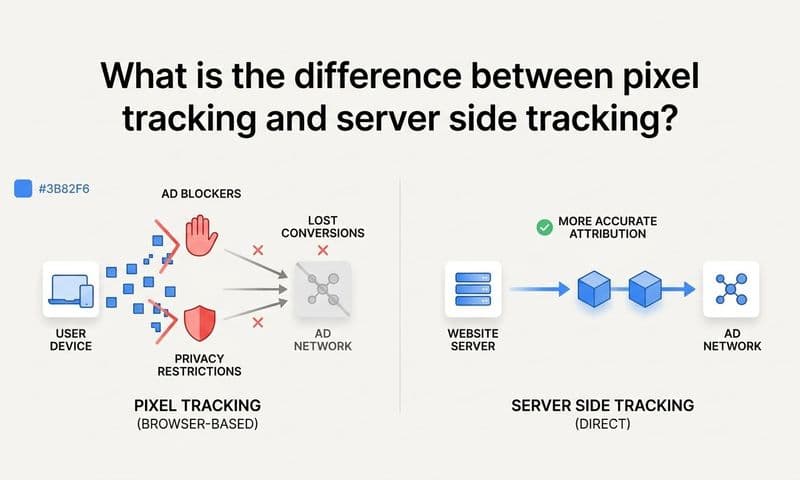
The fundamental difference is where data processing happens. Client-side tracking depends on JavaScript code running in your visitor's browser. If their ad blocker is active, the script doesn't load. If they navigate away quickly, the conversion might not fire. If their browser has JavaScript errors, nothing gets tracked.
Server-side tracking operates independently of these browser limitations. When someone converts on your site, your server captures that event and sends it directly to your analytics platforms through secure API connections. The visitor's browser settings, ad blockers, and device performance don't affect data collection at all.
The Technical Foundation Made Simple
Here's what actually happens with server-side tracking: A visitor completes a purchase on your site. Your server immediately logs this conversion with complete details—order value, product information, customer data. Then your server sends this information directly to Facebook's Conversions API, Google's server-side endpoint, and any other platforms you're using.
This direct server-to-server communication creates a controlled environment for data collection. Your server validates the data format, enriches it with additional context, and ensures successful transmission before considering the event tracked. Compare this to client-side tracking, where you're hoping the visitor's browser successfully executes your tracking code and transmits data before they close the tab.
The accuracy advantage becomes obvious: server-side tracking captures events in a predictable, controlled environment where you manage every variable. Client-side tracking operates in the unpredictable chaos of millions of different browsers, devices, and user configurations.
Server-Side vs Client-Side: The Accuracy Battle
Client-side tracking has inherent failure points that server-side tracking completely eliminates. Ad blockers can't interfere with server-to-server communication—they only block browser-based scripts. Privacy settings that prevent third-party cookies don't affect direct API calls from your server. JavaScript errors that break client-side tracking never touch server-side implementations.
The consistency difference is dramatic. Client-side tracking might capture 60-70% of actual conversions depending on your audience's technical sophistication and privacy preferences. Server-side tracking typically captures 95-98% of conversions because it operates independently of user-side variables.
This isn't just about volume—it's about systematic bias. Client-side tracking tends to under-report conversions from privacy-conscious users, mobile visitors, and people using ad blockers. These aren't random gaps; they're specific audience segments becoming invisible in your data. Server-side tracking sees everyone equally, giving you accurate performance data across your entire customer base.
The result is attribution you can actually trust. When your tracking system captures nearly every conversion regardless of browser, device, or privacy settings, you're making optimization decisions based on complete information rather than biased samples.
The Technical Foundation Made Simple
Server-side tracking processes conversion data on your servers before sending it to analytics platforms. That's the technical definition. Here's what it actually means for your marketing accuracy.
When someone converts on your website, that conversion data needs to travel from your site to platforms like Facebook, Google, and your analytics tools. With client-side tracking, this journey happens entirely in the visitor's browser—through JavaScript code that fires when specific actions occur.
Server-side tracking takes a fundamentally different approach. Instead of relying on the visitor's browser to report conversions, your server captures the conversion data first, processes it in a controlled environment, and then sends it directly to your analytics platforms through secure server-to-server connections.
Think of it like ordering at a restaurant. Client-side tracking is like customers calling in orders through a noisy phone line where words get lost, connections drop, and some calls never go through. Server-side tracking is like orders taken directly by staff in person—every word heard clearly, every detail captured accurately, no interference.
This architectural difference determines everything about data accuracy.
In a client-side setup, your tracking depends on the visitor's browser working perfectly. Their ad blocker can't be active. JavaScript must execute without errors. The page can't load too slowly. They can't navigate away too quickly. Privacy settings must allow tracking. Cookies must be enabled. Browser compatibility must be perfect.
That's a lot of things that need to go right. When any one fails, you lose data.
Server-side tracking eliminates this dependency chain. Your server captures the conversion regardless of browser conditions, ad blockers, privacy settings, or JavaScript errors. The data collection happens in an environment you control, where external factors can't interfere with accuracy.
The processing happens before transmission, too. Your server validates data formatting, enriches conversion information with additional context, and ensures everything meets platform requirements before sending. This means cleaner data, fewer errors, and higher acceptance rates from advertising platforms.
Here's the critical insight: where data processing occurs fundamentally determines how accurate that data can be. Browser-based processing introduces dozens of failure points. Server-based processing eliminates them.
This isn't about marginal improvements. It's the difference between capturing 60-70% of conversions versus 95%+ of actual events. That gap represents the invisible conversions that lead to wrong optimization decisions and misallocated budgets.
The accuracy advantage comes from control. When your server handles data collection and processing, you're not hoping the visitor's browser cooperates. You're not crossing your fingers that ad blockers won't interfere. You're not relying on third-party cookies that browsers increasingly block.
You're capturing conversion data in a controlled environment, validating it immediately, and transmitting it through direct connections that can't be interrupted by browser-based interference. That's why server-side tracking delivers consistently accurate data that client-side implementations simply can't match.
Server-Side vs Client-Side: The Accuracy Battle
Here's the fundamental difference: client-side tracking asks your visitor's browser to do the heavy lifting. Server-side tracking handles everything on your end, in a controlled environment where nothing can interfere.
Think about what happens with traditional client-side tracking. A visitor lands on your site. Their browser loads your tracking pixel. JavaScript fires. The pixel tries to send conversion data to Facebook or Google. Sounds simple—until you realize how many things can go wrong.
Ad blockers kill the pixel before it loads. Safari's Intelligent Tracking Prevention blocks third-party cookies. The visitor's browser has JavaScript disabled. Their internet connection drops mid-page load. They close the tab before the tracking script finishes executing. Any one of these scenarios means your conversion never gets recorded.
Server-side tracking eliminates every single one of these failure points.
When a conversion happens, your server captures it immediately—no browser involvement required. The data goes straight from your server to the ad platform's API through a direct, reliable connection. No ad blockers can interfere because the communication never touches the visitor's browser. No JavaScript errors can prevent data transmission because JavaScript isn't part of the equation.
The accuracy difference is dramatic. Client-side tracking typically captures 60-70% of actual conversions in today's privacy-first environment. Server-side implementations routinely achieve 95%+ capture rates because they operate independently of all the variables that plague browser-based tracking.
But here's what makes server-side tracking truly superior: consistency. Client-side tracking accuracy varies wildly based on your audience. Tech-savvy users with ad blockers? You might capture 40% of conversions. Mobile Safari users? iOS privacy restrictions cut your visibility significantly. Server-side tracking delivers the same high accuracy regardless of device, browser, or privacy settings.
The data quality advantage extends beyond just capture rates. Server-side tracking lets you validate and enrich data before sending it to platforms. You can confirm email addresses are properly formatted, verify purchase amounts match your database, and add customer lifetime value data that browsers never see. This pre-transmission validation ensures platforms receive clean, accurate data that improves their optimization algorithms.
Real-time processing capabilities separate server-side tracking from client-side limitations. Your server can instantly process conversion data and send it to multiple platforms simultaneously—Facebook, Google, TikTok—without depending on the visitor's device performance or connection speed. Client-side tracking often experiences delays as browsers struggle to execute multiple tracking scripts, leading to attribution timing issues that reduce accuracy.
The misconception that server-side tracking requires enterprise-level resources keeps many marketers stuck with inferior client-side solutions. Modern server-side tracking platforms have simplified implementation dramatically. You don't need a team of developers or massive infrastructure investments. The initial setup complexity pays for itself immediately through dramatically improved data accuracy and the confident scaling decisions that accurate data enables.
This accuracy advantage compounds over time. Every optimization decision you make—which audiences to target, which creatives to scale, which campaigns to pause—becomes more effective when based on complete data rather than the partial picture client-side tracking provides. Your competitors using client-side tracking are making decisions with 30-40% less information. That's not a small edge—it's the difference between profitable growth and expensive guesswork.
The Hidden Cost of Inaccurate Attribution
Here's what most marketing teams don't realize: the campaigns you're cutting might be your most profitable ones. The ads you're scaling could be barely breaking even. And that "winning" audience? It might be performing well only because your tracking can see it better than others.
When your tracking system captures 60-70% of actual conversions, you're not working with incomplete data—you're making systematically wrong decisions that compound over time.
The Real Cost of Data Loss on Marketing Performance
Let's say you're running campaigns across Facebook, Google, and email. Facebook's pixel captures 65% of conversions. Google's tracking catches 70%. Email conversions? Maybe 50% make it into your analytics because users often convert on different devices.
You look at your dashboard and see Facebook driving 100 conversions at $50 CPA. Google shows 80 conversions at $60 CPA. Email reports 30 conversions at $40 CPA. Based on these numbers, you'd naturally shift budget from Google to Facebook and email.
But here's the reality: Facebook actually drove 154 conversions ($32 CPA). Google delivered 114 conversions ($53 CPA). And email? It generated 60 conversions ($20 CPA)—making it your best channel by far.
The foundation of these budget allocation decisions rests on accurate conversion tracking, which becomes increasingly unreliable when dependent on browser-based client-side implementations affected by privacy updates and ad blockers.
This isn't a hypothetical problem. Marketing teams make these misallocations daily, systematically underinvesting in high-performing channels while scaling mediocre ones that just happen to have better tracking visibility.
Modern Privacy Challenges Amplifying Accuracy Problems
The tracking accuracy problem has accelerated dramatically since 2021. iOS 14.5 introduced App Tracking Transparency, immediately reducing mobile conversion visibility by 30-50% for many advertisers. Safari's Intelligent Tracking Prevention blocks third-party cookies by default. Chrome's planned cookie deprecation will eliminate cross-domain tracking for billions of users.
These aren't minor technical adjustments—they're fundamental shifts that make client-side tracking increasingly unreliable for business-critical decisions.
Facebook conversion tracking has been particularly affected by these privacy changes, with many advertisers seeing 30-50% data loss that makes campaign optimization and scaling decisions unreliable without server-side solutions.
The competitive implications are stark. While you're making budget decisions based on 60% data visibility, competitors with accurate server-side tracking are seeing the complete picture. They know which campaigns actually drive revenue. They can confidently scale winners and cut losers. They're optimizing toward real performance while you're optimizing toward tracking visibility.
Every day you operate with inaccurate attribution, you're making decisions that move budget away from what works and toward what's merely visible. The cost isn't just wasted ad spend—it's the opportunity cost of not scaling your actual best performers.
This is where server-side tracking changes everything
The Hidden Cost of Inaccurate Attribution
Here's what most marketing teams don't realize: the biggest budget drain isn't the campaigns that fail—it's the ones you think are working but aren't.
When your tracking system only captures 60-70% of conversions, you're not just missing data points. You're systematically making wrong decisions about where to invest your budget. That "top-performing" Facebook campaign? It might be breaking even while your undertracked email sequences are actually driving 40% more revenue than your dashboard shows.
The math is brutal. If you're spending $100,000 monthly on paid ads and your tracking accuracy is 65%, you're making optimization decisions based on $65,000 worth of visible results while $35,000 of actual performance is invisible. The foundation of these budget allocation decisions rests on accurate conversion tracking, which becomes increasingly unreliable when dependent on browser-based client-side implementations affected by privacy updates and ad blockers.
This creates a dangerous feedback loop. Channels with better tracking visibility appear to perform better, so you shift more budget toward them. Meanwhile, high-performing channels with tracking challenges get starved of investment because you can't see their true impact.
The result? You're scaling campaigns that barely break even while cutting budgets on your most profitable channels.
How Privacy Changes Amplified the Accuracy Crisis
iOS 14.5 didn't just change mobile tracking—it exposed how fragile client-side measurement had become. Overnight, mobile app install campaigns showed 30-50% fewer conversions. Not because performance dropped, but because the tracking system went blind.
Safari's Intelligent Tracking Prevention blocks third-party cookies by default. Chrome's planned cookie phase-out will eliminate cross-domain tracking for millions of users. Firefox already blocks tracking scripts aggressively. Each privacy update shrinks the percentage of your customer journey that's actually visible.
Facebook conversion tracking has been particularly affected by these privacy changes, with many advertisers seeing 30-50% data loss that makes campaign optimization and scaling decisions unreliable without server-side solutions.
GDPR and CCPA add another layer of complexity. Cookie consent requirements mean even when tracking works technically, you're only measuring users who opted in—creating a skewed sample that doesn't represent your full customer base.
The competitive implications are stark. While you're making decisions on partial data, competitors with accurate server-side tracking see the complete picture. They know which campaigns actually drive revenue. They scale with confidence. They optimize based on reality, not guesswork.
Every day you operate with inaccurate tracking, you're falling further behind competitors who can see what you can't. The question isn't whether you can afford to implement server-side tracking—it's whether you can afford not to.
Modern Privacy Challenges Amplifying Accuracy Problems
The tracking landscape changed overnight when Apple released iOS 14.5 in April 2021. Suddenly, mobile users could opt out of app tracking with a single tap. The result? Marketing teams watched their conversion visibility drop by 30-50% within weeks.
But iOS wasn't the only culprit reshaping digital marketing measurement.
Safari's Intelligent Tracking Prevention (ITP) had already been blocking third-party cookies since 2017, progressively tightening restrictions with each update. Firefox followed suit with Enhanced Tracking Protection. Then Chrome announced plans to phase out third-party cookies entirely—a move that affects 65% of global browser traffic.
Each privacy update compounds the accuracy problem for client-side tracking. When your tracking pixel depends on cookies and browser permissions to function, every new privacy control creates another failure point. It's like trying to measure water flow through a pipe that keeps developing new leaks.
GDPR and CCPA added another layer of complexity. These regulations didn't just require consent banners—they fundamentally limited what data you could collect and how long you could store it. Marketing teams found themselves choosing between compliance and comprehensive tracking, often sacrificing data accuracy to avoid regulatory risk.
The mobile app ecosystem took the hardest hit. Before iOS 14.5, Facebook's pixel could track app installs and in-app conversions with reasonable accuracy. After the update, advertisers running mobile app campaigns saw their reported conversions plummet—not because campaigns stopped working, but because the tracking system went blind.
Here's where it gets expensive: many marketing teams responded by cutting budgets on campaigns that appeared to stop performing. In reality, those campaigns were still driving conversions—the tracking system just couldn't see them anymore. Multiple case studies demonstrate how improved tracking accuracy directly correlates with marketing ROI improvements, with some businesses seeing 20-30% better budget allocation efficiency after implementing server-side solutions that bypass these privacy-related blind spots.
The privacy-first world isn't going away. Browser makers continue tightening restrictions. Regulations expand to new jurisdictions. Users become more privacy-conscious with each data breach headline.
Client-side tracking can't adapt to this reality because it fundamentally depends on the browser environment—the exact environment that privacy controls target. Server-side tracking sidesteps this entire problem by processing data on your servers before privacy controls can interfere, maintaining accuracy while respecting user privacy preferences.
This isn't about finding workarounds or gaming the system. It's about implementing tracking architecture that works within the new privacy landscape rather than fighting against it. Server-side tracking provides privacy-compliant accuracy because it doesn't rely on the mechanisms that privacy updates restrict.
Making the Right Choice for Your Marketing Future
Server-side tracking isn't just a technical upgrade—it's a competitive advantage. While your competitors struggle with 60-70% data visibility, you'll have the complete picture. While they second-guess every budget decision, you'll scale with confidence.
The accuracy difference is measurable: server-side tracking eliminates browser-based interference, bypasses ad blockers, and captures conversions that client-side pixels miss entirely. You get direct server-to-platform communication, real-time data validation, and consistent tracking regardless of user behavior or device limitations.
Start with your highest-value conversion events. Implement parallel tracking to validate improvements. Build monitoring systems that catch issues before they compound. The businesses winning in 2026 aren't the ones with the biggest budgets—they're the ones with the most accurate data.
If you're ready to stop guessing and start knowing exactly what's driving revenue, Cometly's AI-powered attribution platform makes server-side tracking simple. Track every touchpoint, analyze every customer journey, and feed your ad platforms the accurate data they need to optimize effectively. Get your free demo and see what 95%+ tracking accuracy does for your marketing ROI.