

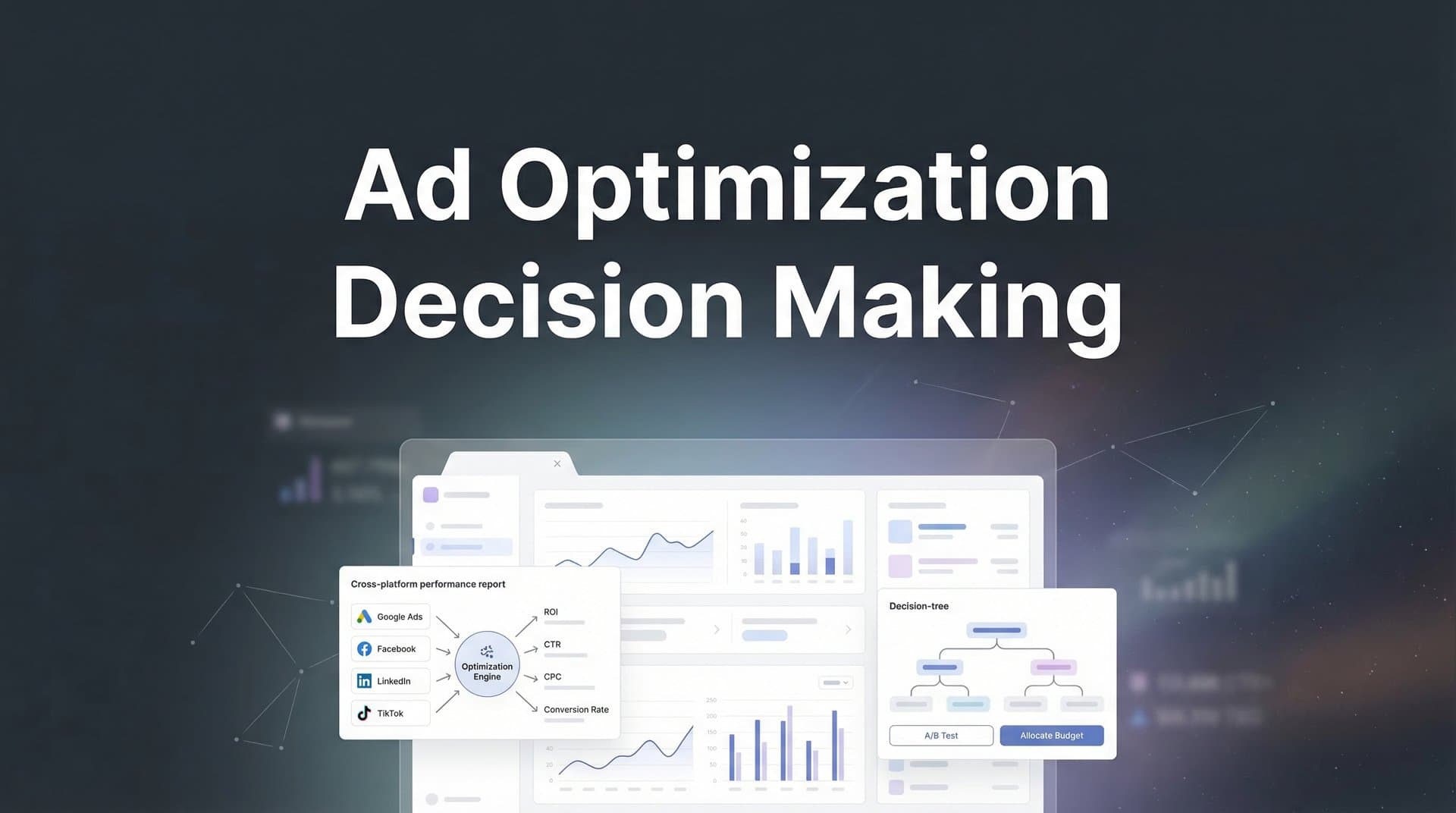
You're staring at your ad dashboard at 11 PM, trying to decide whether to pause that underperforming campaign or give it another day. Your Meta ads are crushing it, but Google seems sluggish. TikTok just started spending, but the conversions haven't rolled in yet. Should you shift budget? Change targeting? Kill the creative and start fresh?
Sound familiar?
Every digital marketer faces this reality: dozens of optimization decisions every single day, each one potentially worth thousands of dollars. Yet most of these choices get made on incomplete data, gut instinct, or whatever metric happens to be flashing red in the moment.
The marketers who consistently hit their targets aren't necessarily smarter or more experienced. They've simply built a systematic approach to decision making that removes guesswork and grounds every choice in accurate data.
This guide walks you through a proven 6-step framework for making confident, data-backed ad optimization decisions. You'll learn how to establish clear decision criteria, gather the right data, analyze performance accurately, and execute changes that actually move the needle.
Whether you're managing campaigns across Meta, Google, TikTok, or juggling multiple platforms simultaneously, this framework will help you cut through the noise and make optimization decisions you can stand behind.
Step 1: Define Your Optimization Goals and Success Metrics
Before you can optimize anything, you need to know what success actually looks like. This sounds obvious, but most marketers skip this step and jump straight into tweaking campaigns based on whatever metric catches their attention first.
Start by identifying your primary KPIs that align directly with business objectives. For e-commerce, this might be ROAS (Return on Ad Spend) or total revenue. For lead generation, it could be cost per qualified lead or lead-to-customer conversion rate. For SaaS, you might focus on customer acquisition cost relative to lifetime value.
The key is specificity. Don't just say "improve ROAS"—set a concrete threshold. What ROAS makes a campaign worth continuing? What number triggers a pause? For example, you might decide that any campaign consistently delivering below 2.5x ROAS gets paused, while anything above 4x gets scaled.
But primary metrics don't tell the whole story. Establish secondary metrics that provide essential context. A campaign might have a stellar ROAS but a frequency of 8, suggesting creative fatigue is imminent. Another might show a high cost per acquisition but exceptional lead quality that closes at twice the rate of other sources.
Your secondary metrics might include click-through rate, conversion rate, cost per click, frequency, and engagement metrics. These indicators help you understand the "why" behind your primary numbers and catch problems before they tank performance. Understanding how to improve data-driven decision making starts with selecting the right metrics to track.
Here's the critical part: document everything. Create a simple spreadsheet or document that outlines your decision criteria. When Campaign A hits X threshold, you do Y. When Campaign B shows Z pattern, you test this specific change.
This documentation transforms optimization from an art into a repeatable science. It prevents you from making contradictory decisions based on your mood or stress level. It creates consistency across your team if multiple people manage campaigns. Most importantly, it gives you a baseline to improve over time.
Your decision criteria should evolve as you gather more data, but having a documented starting point is infinitely better than winging it every single day.
Step 2: Build a Unified Data Foundation Across Platforms
You can't make smart optimization decisions when your data lives in five different dashboards that don't talk to each other. Meta says one thing, Google says another, and your CRM shows completely different conversion numbers. Which one do you trust?
The answer is: you need a single source of truth that connects all your ad platforms to actual business outcomes.
Start by connecting every ad platform you use to a unified tracking system. This means going beyond each platform's native tracking and implementing a solution that captures the full customer journey across all touchpoints. When someone clicks a Meta ad, then searches your brand on Google, then converts three days later, you need to see that entire path—not just the last click.
Server-side tracking has become essential for accurate data collection. Browser-based tracking alone misses conversions due to ad blockers, cookie restrictions, and iOS App Tracking Transparency limitations. Many marketers have seen their reported conversions drop by 20-30% or more, not because performance actually declined, but because browser tracking simply can't see what's happening anymore.
Implementing server-side tracking means your server sends conversion data directly to ad platforms, bypassing browser limitations entirely. This gives you a more complete picture of what's actually working. Many marketers overlook these ad performance optimization blind spots until their data accuracy suffers.
But tracking clicks and conversions isn't enough. Map the full customer journey from first click all the way to closed revenue in your CRM. This is especially critical for businesses with longer sales cycles or multiple touchpoints before purchase. You need to know not just that someone converted, but what they bought, how much they spent, and whether they became a repeat customer.
This connection between ad platforms and revenue data reveals the true value of your campaigns. That Google campaign with a mediocre CPA might actually drive customers who spend 3x more than average. That Meta campaign with stellar click-through rates might attract tire-kickers who never buy.
Finally, verify your data accuracy regularly. Compare what your ad platforms report against what actually shows up in your bank account. If Meta says you generated 100 conversions but your CRM only shows 75 new customers, something's broken. Track down the discrepancy before you make major budget decisions based on inflated numbers.
A unified data foundation takes effort to build, but it's the bedrock of every optimization decision you'll make. Without it, you're essentially flying blind.
Step 3: Analyze Performance Using Multi-Touch Attribution
Last-click attribution is a lie. Well, not exactly a lie—but it's definitely not the whole truth.
When you only credit the last touchpoint before conversion, you're ignoring the entire journey that got the customer there. That Facebook ad that introduced them to your brand? Ignored. The YouTube video that educated them about the problem you solve? Doesn't count. The retargeting campaign that reminded them to come back? Invisible.
Multi-touch attribution changes the game by showing how channels work together to drive conversions. Instead of giving 100% credit to the final click, it distributes credit across all the touchpoints that contributed to the customer journey. Understanding marketing attribution and optimization is essential for accurate performance analysis.
Start by comparing different attribution models to see how they change your understanding of campaign performance. Linear attribution gives equal credit to every touchpoint. Time-decay attribution gives more weight to interactions closer to conversion. Position-based attribution emphasizes both the first and last touch while still crediting middle interactions.
Each model tells a different story about your campaigns. A brand awareness campaign might look terrible in last-click attribution but shine in first-click or linear models. A retargeting campaign might dominate last-click but show diminishing importance in time-decay analysis.
The goal isn't to find the "right" attribution model—it's to use multiple models to understand the full picture. When you see a campaign performing well across multiple attribution views, you've found a true winner. When a campaign only looks good in one specific model, you need to dig deeper before making major decisions.
Pay special attention to assist conversions. These are touchpoints that didn't close the deal but played a supporting role. A campaign might have a high cost per last-click conversion but generate hundreds of valuable assists that help other campaigns convert. Without multi-touch attribution, you might pause this campaign and watch your overall conversion rate mysteriously drop.
Use attribution insights to identify undervalued campaigns that deserve more budget. That top-of-funnel YouTube campaign might look expensive on a last-click basis, but when you see it assisting 60% of your conversions, suddenly it's one of your most valuable channels.
Multi-touch attribution also reveals channel synergies. You might discover that customers who see both a Facebook ad and a Google search ad convert at twice the rate of those who only see one. This insight might lead you to intentionally run coordinated campaigns across platforms rather than treating each channel in isolation.
The complexity of modern customer journeys demands more sophisticated analysis than last-click can provide. Multi-touch attribution gives you that sophistication.
Step 4: Establish Decision Rules for Common Optimization Scenarios
Decision fatigue is real. When you're making dozens of optimization calls every day, the quality of your decisions degrades. You start making reactive choices based on the most recent data point rather than systematic analysis.
The solution is creating decision rules that remove the mental burden from common scenarios. Think of these as if-then statements that guide your actions.
For pausing campaigns, you might establish: If a campaign spends $500 without generating a conversion, pause it. If ROAS drops below 2.0x for three consecutive days, reduce budget by 50%. If frequency exceeds 5 with declining CTR, pause and refresh creative.
For scaling, your rules might be: If a campaign maintains 4x ROAS or higher with at least 20 conversions, increase budget by 20%. If a new campaign achieves target CPA within the first $200 spend, accelerate to full budget. If an ad set shows improving performance three days in a row, test a 30% budget increase. Implementing automated ad budget optimization can help enforce these rules consistently.
If you're evaluating vendors, our automated ad optimization tools breakdown can help.
Budget reallocation decisions benefit from clear frameworks too. You might decide to review budget distribution weekly, moving money from campaigns performing below 3x ROAS to those above 5x ROAS. Or you could set rules for cross-platform shifts: if Google campaigns collectively outperform Meta by 25% or more for two weeks, shift 15% of total budget from Meta to Google.
Here's the critical element: set minimum data requirements before making changes. Don't pause a campaign after $50 spend and zero conversions if your average cost per conversion is $200. Don't scale a campaign after one lucky day. Require statistical significance before acting.
A good rule of thumb is requiring at least 3-5x your target CPA in spend before making pause decisions, and at least 10-15 conversions before making major scaling moves. These thresholds prevent you from reacting to normal variance.
Document exceptions and edge cases too. Maybe you normally require $500 spend before pausing, but if a campaign burns through $200 with zero clicks, something's clearly broken and you pause immediately. Maybe you normally wait for 15 conversions before scaling, but if a campaign hits 8 conversions in the first day at 6x ROAS, you make an exception.
The goal isn't rigid inflexibility—it's preventing reactive, emotional decisions while still allowing for obvious opportunities or problems.
Step 5: Execute Changes and Feed Better Data Back to Ad Platforms
You've defined your goals, unified your data, analyzed with attribution, and established decision rules. Now it's time to actually optimize—but execution matters just as much as analysis.
Make changes methodically. When possible, adjust one variable at a time so you can clearly identify what drove any performance change. If you simultaneously change budget, targeting, and creative, you'll never know which adjustment actually moved the needle.
This doesn't mean you can't make multiple changes—it means being strategic about it. Maybe you test new creative in one ad set while adjusting budget in another. Maybe you change targeting in Campaign A while Campaign B serves as a control. The key is maintaining some ability to isolate cause and effect. Following conversion rate optimization best practices ensures your changes drive measurable improvements.
But here's where most marketers stop short: they optimize their side of the equation but forget about the ad platform's side. Meta, Google, TikTok—they all use machine learning algorithms to optimize delivery. But those algorithms are only as good as the data you feed them.
Send enriched conversion data back to ad platforms through their conversion APIs. Don't just tell Meta that a conversion happened—tell them the conversion value, the product purchased, the customer lifetime value prediction, whether it was a new or returning customer. This enriched data helps the platform's AI optimize toward your most valuable conversions, not just any conversion.
Conversion sync is especially powerful for businesses with longer sales cycles or multiple conversion events. You might track newsletter signups, demo requests, and purchases as separate events. By sending all of these back to your ad platforms with appropriate values, you help their algorithms understand the full funnel and optimize accordingly. Mastering ad platform algorithm optimization techniques can significantly boost your campaign performance.
When you feed better data to ad platform AI, you're essentially giving them a clearer target. Instead of optimizing blindly toward "conversions," they can optimize toward "high-value conversions from qualified buyers." The result is better targeting, more efficient delivery, and improved performance over time.
Finally, log every optimization change you make. Record the date, time, what you changed, and why you changed it. This documentation becomes invaluable when you're reviewing performance later and trying to understand what drove a spike or drop. It also helps you avoid making the same mistake twice or forgetting a successful test you ran months ago.
Step 6: Review, Learn, and Refine Your Decision Framework
Your optimization framework isn't set in stone—it's a living system that should improve over time as you gather more data and learn what works for your specific business.
Schedule regular review cycles to assess whether your optimization decisions achieved expected results. Weekly reviews work well for most businesses, though high-spend accounts might benefit from daily check-ins while slower-moving campaigns might only need monthly reviews.
During these reviews, compare your predictions against outcomes. When you scaled that campaign because it hit your decision rules, did it maintain performance or regress to the mean? When you paused that underperforming ad set, did overall account performance improve or did you lose valuable assist conversions?
Identify patterns in successful versus unsuccessful decisions. Maybe you notice that campaigns scaled on weekends consistently underperform compared to those scaled on Tuesdays. Maybe you discover that your pause threshold is too aggressive and you're killing campaigns right before they would have converted. Maybe you find that your scaling increments are too conservative and you're leaving money on the table.
These patterns become the basis for refining your decision rules. Update your thresholds, adjust your minimum data requirements, add new rules for scenarios you've encountered. Your framework should be noticeably better six months from now than it is today. Leveraging AI ads optimization recommendations can accelerate this learning process.
Leverage AI-powered recommendations to surface optimization opportunities you might miss. Modern attribution platforms can analyze patterns across thousands of data points and identify opportunities that would take hours of manual analysis to spot. Maybe there's a specific audience segment consistently outperforming others. Maybe there's a time-of-day pattern you haven't noticed. Maybe there's a cross-channel synergy you could exploit.
AI recommendations aren't about replacing your judgment—they're about augmenting it. The AI surfaces the opportunity, you evaluate it against your business context and decision framework, then you make the final call.
As market conditions change, your decision criteria should evolve too. During peak season, your scaling thresholds might be more aggressive because you have more volume to work with. During slow periods, you might tighten your pause criteria to preserve budget. If iOS privacy changes impact your tracking, you might adjust your minimum data requirements upward.
The marketers who excel at optimization aren't the ones who found the perfect framework once and stuck with it forever. They're the ones who continuously test, learn, and refine their approach based on real results.
Putting It All Together
Mastering ad optimization decision making isn't about developing perfect instincts or having some innate gift for reading data. It's about building a repeatable system that removes guesswork and grounds every choice in accurate, complete information.
By defining clear goals and success metrics, you establish the foundation for every decision that follows. By unifying your data across platforms with server-side tracking, you ensure you're working with accurate information rather than fragmented half-truths. By analyzing performance through multi-touch attribution, you understand the full customer journey instead of just the last click. By establishing decision rules, you eliminate decision fatigue and maintain consistency. By executing changes methodically and feeding enriched data back to ad platforms, you optimize both your strategy and the platforms' AI targeting. By reviewing and refining continuously, you ensure your framework improves over time.
This isn't a theoretical exercise. This is the difference between marketers who confidently scale campaigns knowing they'll maintain performance, and those who nervously make changes hoping they don't tank everything.
Your action checklist starts here: Define 2-3 primary KPIs with specific success thresholds—write them down today. Connect all your ad platforms to unified tracking that captures the full customer journey. Implement multi-touch attribution analysis to see how channels work together. Create written decision rules for your most common optimization scenarios—pause, scale, and test. Set up conversion sync to send enriched data back to ad platforms and improve their AI targeting. Schedule weekly optimization reviews to assess decision outcomes and refine your approach.
Start with step one today. You don't need to implement everything at once. Build your framework incrementally, and each improvement will compound over time. The optimization decisions you make next month will be noticeably better than the ones you're making today.
Ready to elevate your marketing game with precision and confidence? Discover how Cometly's AI-driven recommendations can transform your ad strategy—Get your free demo today and start capturing every touchpoint to maximize your conversions.


