You're spending thousands on Meta ads, Google campaigns, LinkedIn promotions, and maybe TikTok or email marketing. The money goes out every day. But when your CEO asks which campaigns actually drive revenue, you're left piecing together reports from five different dashboards that don't agree with each other.
This is the reality for most marketing teams today. You know your ads are working—leads are coming in, sales are closing—but connecting specific ad dollars to actual revenue feels like solving a puzzle with missing pieces. Platform analytics show one set of numbers, your CRM shows another, and your finance team is asking questions you can't confidently answer.
Marketing attribution and optimization solves this problem by creating a unified view of how prospects interact with your campaigns across every touchpoint, then connecting those interactions to real business outcomes. It's the difference between guessing which channels deserve more budget and knowing with certainty which campaigns are driving qualified leads and closed deals. This guide will show you how attribution works, why it matters for your bottom line, and how to build a system that turns marketing data into confident, profitable decisions.
Why Marketers Struggle to Connect Ads to Revenue
The modern customer journey is messy. A prospect might first see your Facebook ad on their phone during their morning commute, search for your brand on Google later that day, click an email you sent last week, visit your website multiple times, and finally convert after seeing a retargeting ad. Which touchpoint deserves credit for that conversion?
This fragmented journey creates immediate problems for marketers trying to understand what's working. When you're running campaigns across Meta, Google Ads, LinkedIn, and other channels simultaneously, each platform wants to claim credit for the same conversion. The result? Your platform dashboards might report 150 conversions combined while your CRM shows only 100 actual customers. This isn't just a reporting quirk—it fundamentally breaks your ability to make smart budget decisions.
The tracking landscape has become even more complicated in recent years. Apple's App Tracking Transparency framework changed everything for mobile attribution, requiring apps to ask permission before tracking users across other apps and websites. Many users opt out, creating blind spots in your data. Browser-based tracking faces similar challenges as Safari and Firefox block third-party cookies by default, and Chrome is moving in the same direction.
These privacy changes aren't theoretical concerns. Many marketing teams report significantly reduced visibility into which ads drive conversions, especially on iOS devices. The pixel-based tracking that marketers relied on for years simply doesn't capture the complete picture anymore.
Then there's the fundamental disconnect between what ad platforms measure and what your business actually cares about. Meta might report 200 "conversions" based on people who clicked your ad and later visited your website. But how many of those became qualified leads? How many closed as paying customers? What was the actual revenue generated?
Ad platforms excel at measuring their own performance—clicks, impressions, cost per click—but they can't see what happens after someone leaves their ecosystem. They don't know if that website visitor filled out a form, if that lead was qualified by your sales team, or if that prospect eventually became a $50,000 annual contract. Without connecting ad interactions to these downstream outcomes, you're optimizing for metrics that might not correlate with revenue at all.
How Marketing Attribution Works: From Click to Conversion
Marketing attribution is fundamentally about creating a complete record of every interaction a prospect has with your marketing, then connecting those interactions to conversion events that matter to your business. Think of it as building a timeline for each customer that shows every touchpoint—from their first ad click to their final purchase—so you can understand which marketing efforts actually contributed to the outcome.
The foundation of any attribution system starts with tracking. When someone clicks your Facebook ad, visits your website from a Google search, or opens your marketing email, the system needs to capture that interaction and associate it with that specific person. This is where tracking pixels, UTM parameters, and cookies traditionally came into play—they create a digital trail of user behavior across different platforms and touchpoints.
But browser-based tracking has significant limitations in the current privacy landscape. Server-side tracking offers a more reliable alternative by capturing conversion data directly on your server rather than relying on browser cookies or device identifiers that users can block. When someone completes a form on your website or makes a purchase, server-side tracking sends that information directly to your attribution platform and ad networks, bypassing the limitations of browser-based pixels.
The real power of attribution emerges when you integrate your marketing data with your CRM and sales systems. This is where clicks and impressions transform into qualified leads, opportunities, and closed revenue. Your attribution platform needs to know that the person who clicked your LinkedIn ad last Tuesday is the same person who filled out a demo request form on Wednesday and became a $10,000 customer three weeks later.
This integration creates what's called "closed-loop attribution"—a complete view from first touch to final revenue. You're not just tracking website visits or form fills anymore. You're connecting every marketing touchpoint to actual business outcomes that appear in your CRM, allowing you to attribute revenue back to specific campaigns, ad sets, and even individual ads.
Here's where things get interesting: there's often a substantial gap between what ad platforms report and what actually happened. Meta might claim your campaign generated 50 conversions based on their view-through attribution window. But when you look at your CRM data, you might find that only 30 of those people actually became leads, and only 15 eventually closed as customers. This discrepancy isn't necessarily because the platform is lying—they're just measuring different things with different attribution rules.
Platform-reported conversions typically use generous attribution windows and may count conversions that happened to occur after someone saw your ad, even if the ad wasn't the primary driver. True marketing revenue attribution, on the other hand, considers the full customer journey and applies consistent attribution logic across all channels. This distinction matters enormously when you're deciding whether to increase your Meta budget or shift dollars to Google Ads.
The technical components working together include your website tracking code capturing user interactions, UTM parameters in your ad URLs identifying traffic sources, server-side events sending conversion data reliably, and CRM integration connecting marketing touches to sales outcomes. When these pieces work in harmony, you get a unified view of marketing performance that transcends individual platform reporting.
Attribution Models Explained: Choosing the Right Lens for Your Data
Once you're capturing the complete customer journey, you face a fundamental question: which touchpoints deserve credit for the conversion? This is where attribution models come in—they're the rules that determine how to distribute credit across the various marketing interactions that led to a sale.
First-touch attribution gives all the credit to the initial interaction that brought a prospect into your ecosystem. If someone first discovered your company through a Facebook ad, then later searched for your brand on Google and clicked an email before converting, first-touch would attribute 100% of that conversion to Facebook. This model is popular with marketers focused on top-of-funnel performance and customer acquisition, as it highlights which channels are best at generating new awareness.
The strength of first-touch attribution is its simplicity and its focus on discovery. It answers the question: "Where did this customer originally come from?" For businesses with short sales cycles or straightforward customer journeys, this perspective can be valuable. The weakness? It completely ignores everything that happened after that first interaction, potentially undervaluing the nurturing campaigns and retargeting efforts that actually convinced the prospect to convert.
Last-touch attribution takes the opposite approach, giving all credit to the final touchpoint before conversion. If someone clicked your retargeting ad right before purchasing, last-touch attributes the entire sale to that retargeting campaign—even if they first discovered you through organic search months ago and engaged with multiple other touchpoints along the way. This model appeals to marketers who want to know what finally pushed prospects over the finish line.
Last-touch makes intuitive sense for certain scenarios. If you're running a flash sale and want to measure which promotional campaign drove immediate conversions, last-touch shows you exactly that. But it creates a blind spot for all the awareness and consideration-stage marketing that made that final conversion possible. Your brand awareness campaigns might be doing heavy lifting that last-touch attribution completely misses.
Multi-touch attribution models recognize that multiple touchpoints typically contribute to a conversion and distribute credit accordingly. Linear attribution splits credit evenly across all touchpoints in the journey. If someone had five interactions with your marketing before converting, each touchpoint gets 20% of the credit. This model acknowledges that every interaction played a role, though it treats a quick social media like as equal to a high-intent demo request.
Time-decay attribution gives more credit to touchpoints that happened closer to the conversion event. The logic here is that recent interactions had more influence on the decision to convert than interactions from weeks or months ago. This model often resonates with marketers who believe that bottom-of-funnel activities deserve more credit than early awareness touches.
Position-based attribution (sometimes called U-shaped) gives the most credit to the first and last touchpoints—typically 40% each—while distributing the remaining 20% among the middle interactions. This model recognizes that both discovery and conversion moments are crucial, while still acknowledging that nurturing touches in between played a supporting role. Understanding the difference between single source attribution and multi touch attribution models helps you choose the right approach for your business.
So which model should you use? The answer depends on your business context and what questions you're trying to answer. Companies with longer B2B sales cycles often find multi-touch models more valuable because prospects genuinely do interact with many touchpoints over weeks or months before converting. Giving credit only to the first or last touch would miss important parts of the story.
E-commerce businesses with shorter purchase cycles might find simpler models sufficient for many decisions. If most customers convert within a few days of first discovering your brand, the difference between attribution models becomes less dramatic. That said, even e-commerce marketers benefit from understanding the full journey, especially for higher-value products where customers research before buying.
The sophisticated approach is to use multiple attribution models simultaneously. Look at your data through different lenses to understand various aspects of performance. First-touch shows you which channels excel at generating new prospects. Last-touch reveals which campaigns are best at closing deals. Multi-touch models give you the complete picture of how different channels work together throughout the journey. For a deeper dive, explore the various types of marketing attribution models available.
From Attribution Insights to Campaign Optimization
Attribution data is only valuable if you actually use it to make better marketing decisions. This is where optimization comes in—the process of continuously improving your campaigns based on what the data reveals about true performance. The goal isn't just to understand what happened, but to use those insights to drive more revenue with the same budget or achieve the same results with less spend.
The first optimization opportunity is identifying your true high-performers. When you can see which campaigns, ad sets, and individual creatives actually drive qualified leads and revenue—not just clicks or platform-reported conversions—you can make confident decisions about where to invest more. You might discover that a campaign with a high cost-per-click is actually your most efficient revenue generator because it attracts highly qualified prospects who close at higher rates.
If you're evaluating vendors, our AI advertising generator breakdown can help.
This insight allows for intelligent budget reallocation. Instead of spreading your budget evenly across channels or relying on each platform's self-reported performance, you can shift dollars from underperforming campaigns to proven revenue drivers. If your attribution data shows that LinkedIn campaigns generate leads that close at twice the rate of Facebook leads, you have clear justification for adjusting your budget allocation accordingly.
The optimization process extends to creative and messaging decisions as well. When you know which ad creatives and landing pages are associated with customers who actually convert and generate revenue, you can double down on what works and eliminate what doesn't. This goes beyond traditional A/B testing—you're optimizing for business outcomes rather than just click-through rates or form submissions.
One of the most powerful optimization strategies involves the feedback loop between your attribution system and your ad platforms. Meta, Google, and other advertising platforms use machine learning algorithms to optimize campaign delivery. These algorithms get smarter when you feed them better data about what constitutes a valuable conversion.
This is where conversion sync becomes crucial. By sending enriched conversion data back to your ad platforms—including information about lead quality, deal size, and customer lifetime value—you help their algorithms optimize for the outcomes you actually care about. Instead of optimizing for any website visitor or form fill, the platform can learn to target people more likely to become high-value customers.
The result is a virtuous cycle: better attribution data leads to better optimization decisions, which improves campaign performance, which generates more data to inform future optimizations. Your campaigns become progressively more efficient over time as you eliminate waste and focus spending on proven strategies.
Regular optimization reviews should become part of your marketing rhythm. Many teams find value in weekly or bi-weekly sessions where they examine attribution data, identify trends, and make tactical adjustments. These reviews might reveal that certain audience segments consistently outperform others, that specific times of day drive better-quality leads, or that particular messaging angles resonate more strongly with prospects who actually convert.
The key is moving from reactive to proactive optimization. Instead of waiting for campaigns to underperform before making changes, you're continuously refining based on real performance data. You catch problems early and scale successes quickly, creating a more efficient and effective marketing operation.
Building Your Attribution and Optimization Stack
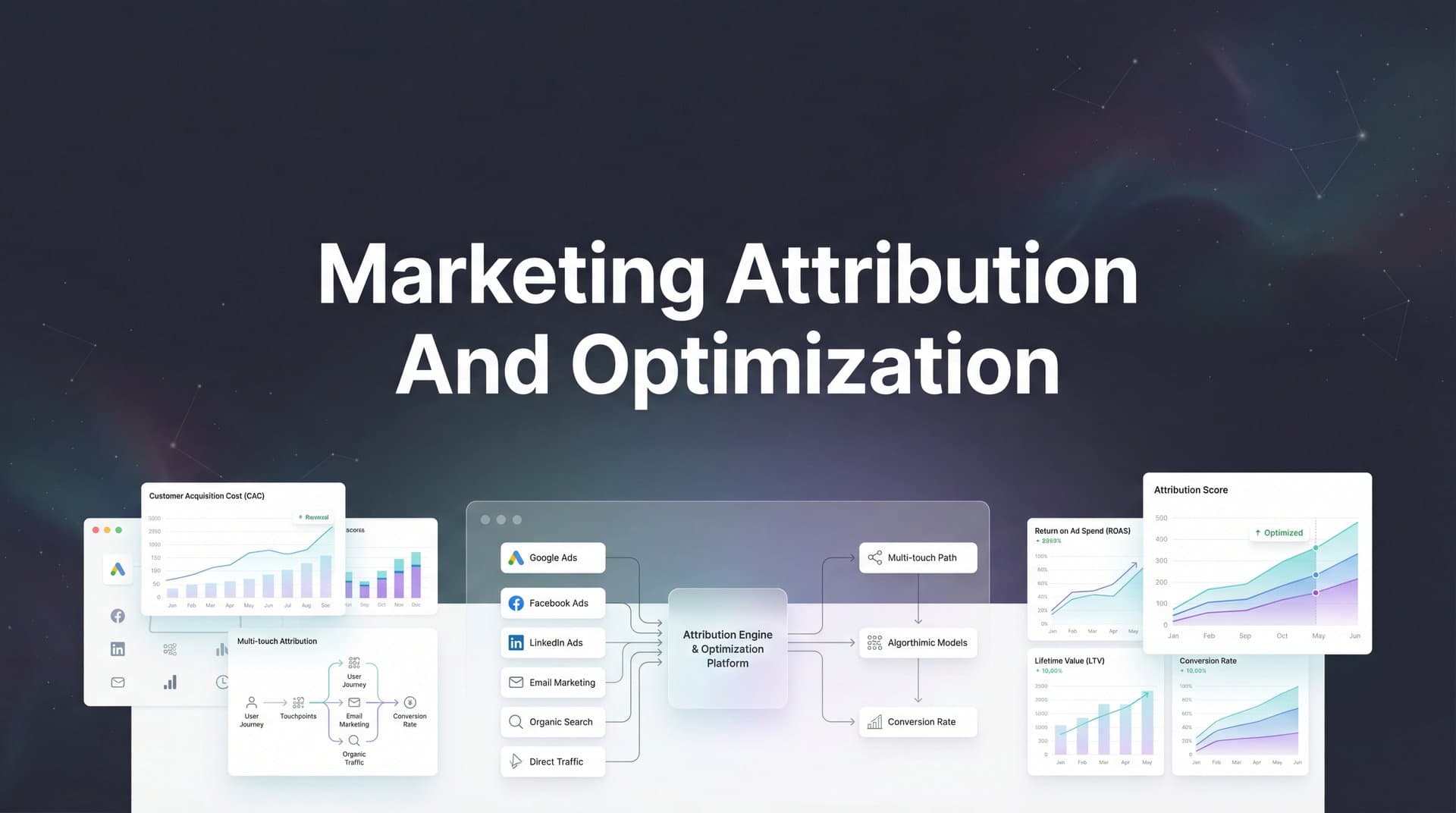
Creating an effective attribution and optimization system requires connecting several key components into a unified stack. The goal is seamless data flow from ad platforms through your website and into your CRM, with attribution insights flowing back to inform campaign decisions. Getting this infrastructure right is essential for accurate tracking and actionable insights.
The foundation starts with your ad platform integrations. Your attribution system needs direct connections to Meta, Google Ads, LinkedIn, and any other channels where you're running campaigns. These integrations allow the platform to pull in campaign data, match ad interactions to user journeys, and send conversion data back to improve ad platform optimization. Without these connections, you're stuck with fragmented data across multiple dashboards.
Website tracking is the next critical piece. You need reliable tracking code on your website that captures user interactions—page views, form submissions, button clicks, and other conversion events. This is where server-side tracking becomes especially valuable. Unlike browser-based pixels that users can block, server-side tracking captures conversion data directly from your server, providing more complete and accurate information about user behavior.
Server-side tracking solves several problems simultaneously. It bypasses browser-based tracking limitations created by privacy features and ad blockers. It provides more accurate conversion data to ad platforms, improving their optimization algorithms. And it gives you a more complete view of the customer journey, even when traditional tracking methods fail. For marketers dealing with iOS attribution challenges or cookie restrictions, server-side tracking is increasingly essential.
CRM integration is where attribution transforms from interesting data to actionable business intelligence. By connecting your attribution platform to your CRM system, you create that closed-loop view from first touch to final revenue. The system can see when a lead becomes an opportunity, when an opportunity closes, and what the actual deal value was. This connection allows you to attribute revenue—not just conversions—back to specific marketing efforts.
The integration requirements extend beyond just technical connections. You need consistent tracking parameters across all campaigns—properly formatted UTM tags that follow a naming convention, conversion events defined consistently across platforms, and clear processes for how marketing data flows into your CRM. Many attribution challenges in marketing analytics stem not from technology limitations but from inconsistent implementation and data hygiene issues.
When evaluating attribution solutions, several capabilities should be non-negotiable. Real-time data access ensures you can make timely optimization decisions rather than waiting for yesterday's reports. Multi-touch marketing attribution software capabilities let you view performance through different attribution models to understand the full customer journey. Integration breadth determines whether the platform can connect to all your marketing channels and business systems.
AI-powered recommendations represent the next evolution of attribution platforms. Rather than just presenting data and leaving you to figure out what it means, advanced platforms analyze patterns and surface actionable insights. They might identify that certain audience segments consistently outperform others, recommend budget shifts based on revenue attribution, or highlight creative elements that correlate with higher conversion rates. This intelligence layer helps you move faster from insight to action.
The technical implementation doesn't have to be overwhelming. Modern attribution platforms are designed for marketers, not just data engineers. The setup typically involves installing tracking code on your website, connecting your ad accounts through OAuth integrations, linking your CRM, and configuring your conversion events. Many platforms offer guided setup processes and support teams to help ensure everything is configured correctly from day one.
Putting Attribution Into Action: A Practical Framework
Implementing marketing attribution and optimization doesn't happen overnight, but you can break the process into manageable phases that build toward a complete system. This framework gives you a roadmap for moving from fragmented data to unified attribution insights that drive better marketing decisions.
Week 1-2: Audit Your Current State. Start by documenting your existing tracking setup across all marketing channels. What tracking pixels are installed on your website? Which UTM parameters are you using consistently? How are conversions currently being reported in each ad platform? What data lives in your CRM? This audit reveals gaps in your current attribution capabilities and helps prioritize what to fix first.
Week 1-2: Identify Data Gaps. Look for the blind spots in your current setup. Are there customer journey stages you can't track? Marketing channels that aren't properly tagged? Conversions happening in your CRM that ad platforms don't know about? These gaps represent opportunities where better attribution will provide the most value. Document them clearly so you can address them systematically.
Week 3-4: Implement Unified Tracking. This is where you deploy your attribution solution and ensure consistent tracking across all channels. Install server-side tracking code on your website. Set up proper UTM parameter structures for all campaigns. Configure conversion events that matter to your business. Connect your ad platforms and CRM through the attribution platform. The goal is creating a single source of truth for marketing performance data. A comprehensive attribution marketing tracking guide can help you navigate this process.
Week 3-4: Establish Baseline Metrics. Once tracking is in place, let data accumulate for at least a few weeks to establish baseline performance metrics for each channel. What's your current cost per lead? What's the conversion rate from lead to opportunity? What's the average deal size by channel? These baselines become the benchmarks against which you'll measure optimization improvements.
Ongoing: Regular Attribution Reviews. Schedule weekly or bi-weekly sessions to review attribution data and identify optimization opportunities. Look for campaigns that are outperforming or underperforming expectations. Examine which touchpoints consistently appear in high-value customer journeys. Use these insights to make tactical adjustments to targeting, creative, or budget allocation. Learn how to leverage marketing analytics and reporting to turn data into revenue-driving decisions.
Ongoing: Budget Optimization Cycles. Based on your attribution insights, implement regular budget optimization cycles—perhaps monthly or quarterly depending on your campaign velocity. Shift spending from channels or campaigns with poor revenue attribution to those with proven ROI. Understanding cross channel attribution marketing ROI helps you make smarter allocation decisions. These adjustments should be data-driven and documented so you can measure the impact of optimization decisions over time.
Ongoing: Improve Ad Platform Data Quality. Continuously refine the conversion data you're sending back to ad platforms. As you learn more about what makes a valuable lead or customer, update your conversion events to reflect that knowledge. Feed ad platforms information about lead quality, deal size, and customer lifetime value so their algorithms can optimize for the outcomes that matter most to your business.
The key to successful implementation is starting with a solid foundation and building incrementally. You don't need perfect attribution on day one. Begin with accurate tracking and basic attribution models, then layer on more sophisticated capabilities as your team becomes comfortable with the data and processes. The goal is continuous improvement, not instant perfection.
Your Path to Confident Marketing Decisions
Marketing attribution and optimization isn't just about collecting more data or generating prettier reports. It's about fundamentally changing how you make marketing decisions—moving from intuition and platform-reported metrics to a clear, unified view of what actually drives revenue for your business.
When you can confidently answer which campaigns generate qualified leads, which channels produce customers with the highest lifetime value, and which creative approaches resonate with your most valuable prospects, you gain a competitive advantage that compounds over time. Your marketing becomes more efficient with every optimization cycle. Your budget allocation improves as you shift dollars to proven performers. Your campaigns get smarter as you feed better data back to ad platform algorithms.
The alternative—continuing to rely on fragmented platform reports and educated guesses—means leaving money on the table every day. You're likely overspending on channels that look good on paper but don't drive real business outcomes. You're probably underfunding campaigns that generate high-value customers because their full contribution isn't visible in platform dashboards. And you're missing optimization opportunities that could significantly improve your marketing ROI.
The marketers who win in the current landscape are those who build systems that capture every touchpoint, connect marketing efforts to revenue outcomes, and continuously optimize based on what the data reveals. They're not guessing which campaigns work—they know with certainty. They're not debating budget allocation based on opinions—they're making decisions backed by attribution data that connects ad spend to closed revenue.
Start by evaluating your current attribution capabilities honestly. Can you track the complete customer journey across all your marketing channels? Can you attribute revenue back to specific campaigns and touchpoints? Can you feed enriched conversion data back to ad platforms to improve their optimization? If the answer to any of these questions is no, you have an opportunity to transform your marketing effectiveness.
Ready to elevate your marketing game with precision and confidence? Discover how Cometly's AI-driven recommendations can transform your ad strategy—Get your free demo today and start capturing every touchpoint to maximize your conversions.