You're staring at three browser tabs—Meta Ads Manager, Google Ads, and TikTok Ads—trying to figure out where to move $500 before the day ends. Campaign A is crushing it this morning, but Campaign B was the winner yesterday. Your LinkedIn ads just started getting traction, but you're not sure if it's real momentum or a fluke. By the time you pull the data into a spreadsheet, compare yesterday's numbers, and make a decision, the opportunity window has already shifted.
This is the daily grind of manual budget management. And while you're juggling these decisions, your competitors with automated systems are already three steps ahead—reallocating spend in real-time based on actual conversion signals, not yesterday's guesswork.
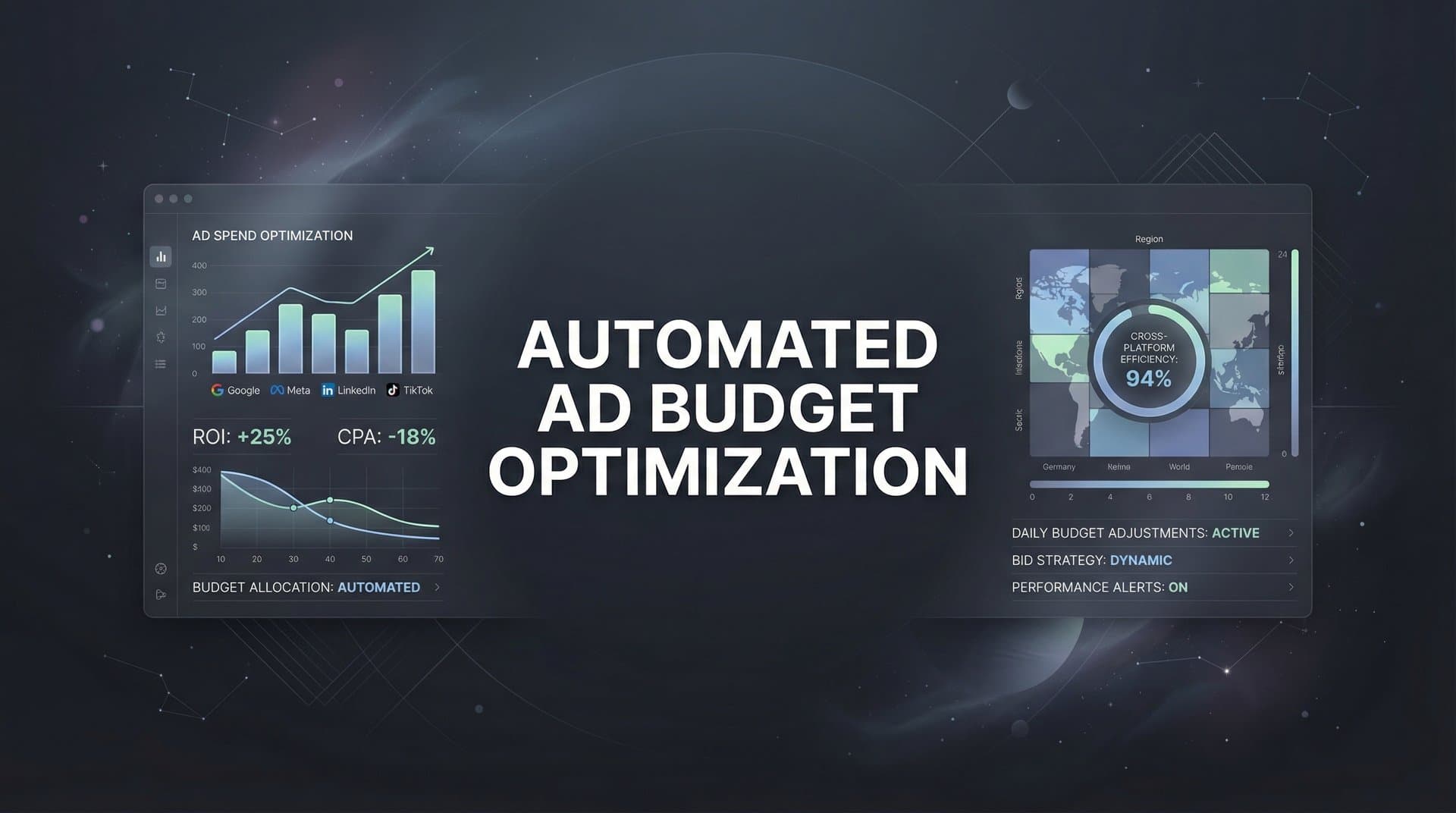
Automated ad budget optimization changes the game entirely. Instead of reacting to what happened hours or days ago, you're proactively directing spend toward what's converting right now. This isn't about handing over control to a black box algorithm—it's about using machine learning and real-time data to make smarter decisions faster than any human possibly could. In this guide, we'll break down exactly how automated budget optimization works, why manual management can't keep pace at scale, and how to implement automation that actually improves your results without sacrificing strategic oversight.
The Mechanics Behind Smart Budget Allocation
Automated budget optimization operates on a fundamentally different timeline than human decision-making. While you might review campaign performance once or twice daily, automated systems analyze thousands of performance signals every few minutes—sometimes every few seconds. They're constantly asking: which campaigns are converting right now, which audiences are responding, and where should the next dollar go to generate the best return?
Here's what's actually happening under the hood. The system pulls real-time performance data from your campaigns: click-through rates, conversion rates, cost per acquisition, return on ad spend, and dozens of other metrics. Machine learning models then compare this incoming data against historical patterns to identify trends before they become obvious to the human eye. The algorithm might notice that your retargeting campaign always performs better between 2pm and 5pm, or that certain ad creatives consistently drive higher-value customers even if they have slightly lower click rates.
The prediction layer is where automation gets powerful. Instead of simply reacting to what's already happened, these systems forecast future performance based on current trajectories. If a campaign is showing early signals of strong conversion momentum—maybe the first three conversions of the day came in faster than usual—the system can increase budget allocation before the trend becomes obvious in your dashboard. Conversely, if performance is degrading, it can pull back spend before you waste money on a declining campaign. Understanding automated budget allocation software capabilities helps you evaluate which solutions fit your needs.
The feedback loop makes everything smarter over time. Every conversion that happens feeds back into the model, teaching it which signals actually matter for your specific business. Maybe your B2B SaaS company sees better results from LinkedIn ads during business hours, while your e-commerce brand gets peak performance from Instagram in the evenings. The system learns these patterns automatically and adjusts accordingly.
What makes this different from simple rules-based automation is the learning component. A basic rule might say "pause any campaign with CPA above $100." But machine learning considers context: Is this campaign new and still in the learning phase? Did it just get fresh creative that needs time to optimize? Is the higher CPA coming from higher-value customers who have better lifetime value? Smart automation weighs all these factors simultaneously.
The real magic happens when automation works across multiple campaigns and platforms simultaneously. While you're sleeping, the system might notice that your Google Search campaign is converting exceptionally well, your Meta retargeting is underperforming, and your TikTok prospecting just hit a sweet spot with a new audience segment. It can shift budget from Meta to Google and TikTok in real-time, capturing opportunities that would have been completely missed with daily manual reviews.
Why Manual Budget Management Falls Short at Scale
Let's talk about the lag problem. When you manually review campaign performance, you're making decisions based on historical data—sometimes data that's already 24 hours old. You log into your ad platforms, pull yesterday's numbers, analyze the trends, and adjust budgets for today. But by the time you implement those changes, the market conditions that created yesterday's performance have already shifted.
Think about it like steering a car while only looking in the rearview mirror. You're constantly reacting to where you've been, not where you're going. If a competitor launches a promotion, if a news event impacts search behavior, if your audience's attention shifts to a different platform during the day—all of these changes are already affecting your campaigns before you even notice them in your reporting.
The cross-platform blind spot creates even bigger problems. Most marketers manage each ad platform in its own silo. You optimize Meta campaigns based on Meta's reporting, Google campaigns based on Google's data, and TikTok in its own universe. But your customers don't think in platforms—they interact with your brand across multiple touchpoints before converting. Someone might see your TikTok ad in the morning, click a Google search ad at lunch, and finally convert through a Meta retargeting ad in the evening.
When you're optimizing each platform separately, you miss the full picture. You might see that your Meta retargeting has a great ROAS and decide to increase its budget, not realizing that those conversions are actually coming from customers who first discovered you through TikTok. Without understanding the complete customer journey, you risk over-investing in bottom-funnel tactics while starving the top-of-funnel campaigns that are actually driving discovery. Implementing customer journey optimization helps you see the full path to conversion across all channels.
Human cognitive limits hit hard when you're managing serious campaign complexity. A mid-sized marketing team might be running 50+ campaigns across five platforms, each with multiple ad sets, hundreds of ads, and thousands of possible optimization decisions. Even if you could review all that data manually, your brain simply can't process that many variables simultaneously while identifying meaningful patterns.
You end up relying on shortcuts and rules of thumb: "This campaign always performs well, so keep the budget high." But what if it's actually declining and you're missing better opportunities elsewhere? Or you focus on the campaigns with the biggest spend, ignoring smaller tests that might be showing promising early signals. Manual management forces you to simplify, and simplification means missed opportunities.
The timing problem compounds everything else. Markets move fast, especially in competitive industries. A campaign might hit peak performance for a 3-hour window when your target audience is most active and receptive. If you're checking in once or twice a day, you'll completely miss that window. By the time you notice the strong performance in your end-of-day review, the opportunity has passed. Automated systems can identify and capitalize on these micro-opportunities in real-time, shifting budget when it matters most. Following best practices for real-time marketing optimization ensures you're capturing these fleeting windows of opportunity.
Core Components of Effective Budget Automation
Here's the uncomfortable truth: automated budget optimization is only as good as the data feeding it. You can have the most sophisticated machine learning system in the world, but if it's making decisions based on incomplete or inaccurate conversion data, it will confidently optimize your campaigns in the wrong direction. This is the "garbage in, garbage out" principle, and it's why accurate attribution is the foundation of everything else.
Most marketers rely primarily on platform-reported conversions—the data that Meta, Google, and TikTok show you in their native dashboards. But here's what many don't realize: these platforms are increasingly blind to conversions happening outside their tracking capabilities. iOS privacy changes have created significant blind spots in mobile tracking. Cookie deprecation is doing the same for web tracking. If your attribution system isn't capturing these "invisible" conversions, your automation will systematically under-invest in campaigns that are actually working. Understanding marketing attribution and optimization together is essential for building effective automation.
This is where server-side tracking becomes critical. Instead of relying solely on browser-based tracking pixels that can be blocked or restricted, server-side tracking captures conversion events directly from your server. When someone converts, your server sends that event to your attribution platform, which then connects it back to the ad touchpoints that drove it. This creates a more complete picture of what's actually converting, giving your automation system accurate signals to optimize against.
Real-time performance thresholds and rules form the decision-making framework. These are the conditions that trigger budget shifts: "If a campaign's CPA drops below $80, increase budget by 20%." Or "If ROAS exceeds 4x for three consecutive hours, reallocate budget from lower-performing campaigns." The sophistication of these rules varies widely—basic automation might use simple if-then logic, while advanced systems use machine learning to dynamically adjust thresholds based on historical patterns and current context.
The key is setting thresholds that match your business goals. A brand awareness campaign should be evaluated differently than a direct response campaign. Your automation rules need to account for campaign objectives, customer lifetime value, acceptable payback periods, and seasonal variations. Generic rules rarely work well—effective automation is customized to your specific business model and marketing strategy. Leveraging AI-powered budget allocation recommendations can help you set smarter thresholds based on your unique data patterns.
Integration requirements determine what's actually possible with automation. At minimum, you need connections between your ad platforms, your conversion tracking system, and your attribution platform. But deeper integrations unlock more powerful optimization. If your CRM is connected, automation can optimize toward customer quality, not just conversion quantity. If your analytics platform is integrated, you can optimize for post-purchase behavior like repeat purchases or subscription renewals.
The technical architecture matters more than most marketers realize. Some automation tools require you to route all your ad spend through their platform. Others work as an overlay, making recommendations that you implement manually or through API connections. The best systems sync conversion data bidirectionally—not only tracking which ads drove conversions, but also feeding that conversion data back to the ad platforms themselves. This improves the platforms' native algorithms, creating a compounding effect where both your automation and the platforms' own optimization systems get smarter simultaneously.
We break down the leading options in our ad spend optimization software guide.
Data freshness is another critical component. Automation that works on yesterday's data is only marginally better than manual management. Real-time automation requires infrastructure that can ingest, process, and act on conversion data within minutes—not hours or days. This is technically challenging but essential for capturing time-sensitive opportunities.
Implementing Automation Without Losing Control
The biggest fear marketers have about automation is losing control—waking up to find that an algorithm spent your entire monthly budget on a campaign that suddenly went sideways. This fear is legitimate, which is why smart automation implementation always starts with guardrails.
Minimum and maximum spend limits are your first line of defense. You might tell the system: "This campaign can receive anywhere from $500 to $5,000 per day, but never go outside that range." Or "Never allocate more than 40% of total budget to any single campaign." These hard limits prevent runaway spending while still giving the system room to optimize within acceptable boundaries. The specific limits depend on your risk tolerance, budget size, and campaign structure. Exploring budget optimization software options helps you find tools with the right guardrail capabilities.
Approval workflows add another layer of control, especially when you're first getting started. Instead of implementing budget changes automatically, the system generates recommendations that a human reviews and approves before execution. This "recommendation-first" approach lets you build trust in the system's decision-making while maintaining final authority. You'll quickly learn which recommendations consistently make sense and which need adjustment.
Many marketers start with a hybrid approach: automate budget allocation within campaigns while keeping manual control over campaign-level budgets. For example, you might let automation shift budget between ad sets within your Meta campaign, but you still decide manually how much total budget Meta gets versus Google. As you gain confidence, you can expand automation to higher-level decisions.
Starting small is almost always the right move. Pick one platform or one campaign type to automate first—maybe your Meta prospecting campaigns or your Google Search brand campaigns. Run automation alongside your normal manual management for a few weeks, comparing results. This parallel testing shows you exactly how automation performs before you fully commit. Reviewing automated budget reallocation for campaigns strategies gives you a framework for phased implementation.
Monitoring becomes even more important with automation, not less. You're not checking in to manually adjust budgets anymore, but you absolutely need to monitor how the automation is performing. Set up daily or weekly reporting that shows you: Which budget shifts did the system make? What was the performance impact? Are there any anomalies or unexpected patterns? This oversight catches problems early and helps you refine your automation rules over time.
Adjustment cycles keep automation aligned with your evolving strategy. Your campaigns change—you launch new products, test new audiences, shift your messaging. Your automation rules need to evolve with these changes. Schedule monthly or quarterly reviews where you evaluate whether your current thresholds, limits, and optimization targets still make sense. Maybe your acceptable CPA has changed because you improved your backend conversion rates. Maybe seasonal patterns require different rules for different times of year.
The goal isn't to set up automation and forget it. The goal is to shift your time from tactical budget shuffling to strategic oversight. Instead of spending hours moving money between campaigns, you're spending that time analyzing why certain campaigns perform better, testing new creative approaches, and making higher-level strategic decisions that automation can't handle.
Measuring Success: KPIs That Actually Matter
ROAS is the metric everyone watches, but it's often the wrong metric for evaluating automation success. Return on ad spend tells you efficiency—dollars returned per dollar spent—but it doesn't tell you if you're actually growing your business. A campaign with 5x ROAS spending $1,000 a day generates less revenue than a campaign with 3x ROAS spending $10,000 a day. Automation that maximizes ROAS might actually minimize total revenue by being overly conservative with budget allocation.
Incremental revenue is a better north star. This measures the total additional revenue your automation is generating compared to your baseline. If you were generating $100,000 in monthly revenue with manual management and you're now generating $130,000 with automation at similar efficiency, that $30,000 increase is your real success metric. You're not just optimizing what you were already doing—you're actually growing.
Customer acquisition cost trends reveal whether your automation is finding sustainable efficiency or just cherry-picking easy wins. CAC should ideally stay stable or decrease over time as your automation learns and improves. If CAC is creeping up, it might mean you're exhausting your best audiences and need to adjust your strategy, not just your automation rules. Track CAC by channel, by campaign type, and by customer segment to understand where your automation is truly adding value. Implementing ad spend optimization strategies alongside automation helps maintain healthy CAC trends.
Comparing automated versus manual periods gives you the clearest picture of impact. Take a campaign or channel and run it manually for 30 days, then run it with automation for the next 30 days, keeping everything else constant. Compare not just efficiency metrics but also total conversions, revenue, and how much time you spent managing it. The time savings alone can be significant—hours per week that you can redirect to strategy and creative development.
Attribution model alignment is critical for meaningful measurement. If your automation is optimizing for last-click conversions but your business actually relies on multi-touch customer journeys, you're measuring the wrong thing. Your optimization targets need to match your attribution model, which needs to match your actual customer behavior. A B2B company with 3-month sales cycles needs different optimization targets than an e-commerce brand with same-day purchases. Understanding attribution window optimization ensures your measurement aligns with your actual sales cycle.
Budget efficiency metrics show you how well automation is allocating across your portfolio. Are you maintaining spend levels on your best-performing campaigns? Are underperforming campaigns getting reduced budget quickly? Is the system finding and scaling new opportunities? Track what percentage of budget is going to campaigns above your target ROAS or CPA thresholds versus below. Effective automation should progressively shift more budget toward winners over time.
Speed of optimization is an underrated metric. How quickly does your automation identify and respond to performance changes? If a campaign starts converting better, how long until it receives more budget? If performance drops, how fast does the system reduce spend? Faster response times mean you capture more upside and limit more downside. Compare this to how quickly you were making these adjustments manually—you'll likely find automation responds hours or even days faster.
The ultimate success metric is whether automation frees you to focus on higher-value work. Are you spending less time in spreadsheets and more time on strategy? Are you testing more creative variations because you're not bogged down in daily budget management? Are you able to scale to more platforms or campaigns because automation handles the complexity? If automation isn't giving you time back to focus on the things only humans can do—creative strategy, audience insights, competitive positioning—then you're not getting the full value.
Putting It All Together
Automated ad budget optimization isn't about removing marketers from the equation—it's about elevating you from spreadsheet manager to strategic decision-maker. The tedious work of monitoring hundreds of campaigns, spotting performance shifts, and manually reallocating budget gets handled by systems that can process more data, move faster, and operate 24/7 without fatigue. This frees you to focus on the work that actually moves the needle: understanding your customers, crafting compelling creative, and making strategic bets that algorithms can't make for you.
But here's the non-negotiable foundation: automation is only as intelligent as the data feeding it. If your attribution is incomplete, if you're missing conversions because of tracking limitations, if your conversion data isn't syncing back to your ad platforms—your automation will confidently optimize toward incomplete signals. The difference between automation that transforms your results and automation that wastes budget comes down to data quality.
This is why the most sophisticated marketing teams have moved beyond platform-reported conversions to comprehensive attribution systems that capture every touchpoint. They're using server-side tracking to see conversions that browser-based pixels miss. They're feeding enriched conversion data back to ad platforms to improve native algorithms. They're making optimization decisions based on the complete customer journey, not just the last click before purchase.
The competitive landscape is shifting rapidly. While some marketers are still manually managing budgets in spreadsheets, others are leveraging AI-powered recommendations that identify opportunities in real-time and optimize across their entire marketing portfolio. The efficiency gap between these approaches is widening every quarter. Automation isn't the future of paid media—it's the present reality for any marketing program that wants to scale profitably.
Ready to elevate your marketing game with precision and confidence? Discover how Cometly's AI-driven recommendations can transform your ad strategy—Get your free demo today and start capturing every touchpoint to maximize your conversions.