You've just wrapped another weekly budget review. You stare at the spreadsheet—Meta's ROAS looks solid, Google's conversion rate dipped, and TikTok... well, TikTok's numbers are all over the place. You shift $2,000 from Google to Meta because last month that worked. You bookmark a few underperforming campaigns to revisit next week. Then you close the tab and hope you made the right call.
Sound familiar?
Here's the problem: by the time you've analyzed last week's performance and adjusted budgets, the market has already moved. Customer behavior shifted. Ad auction dynamics changed. Your competitors increased their spend. And your carefully considered budget decision? It's already outdated.
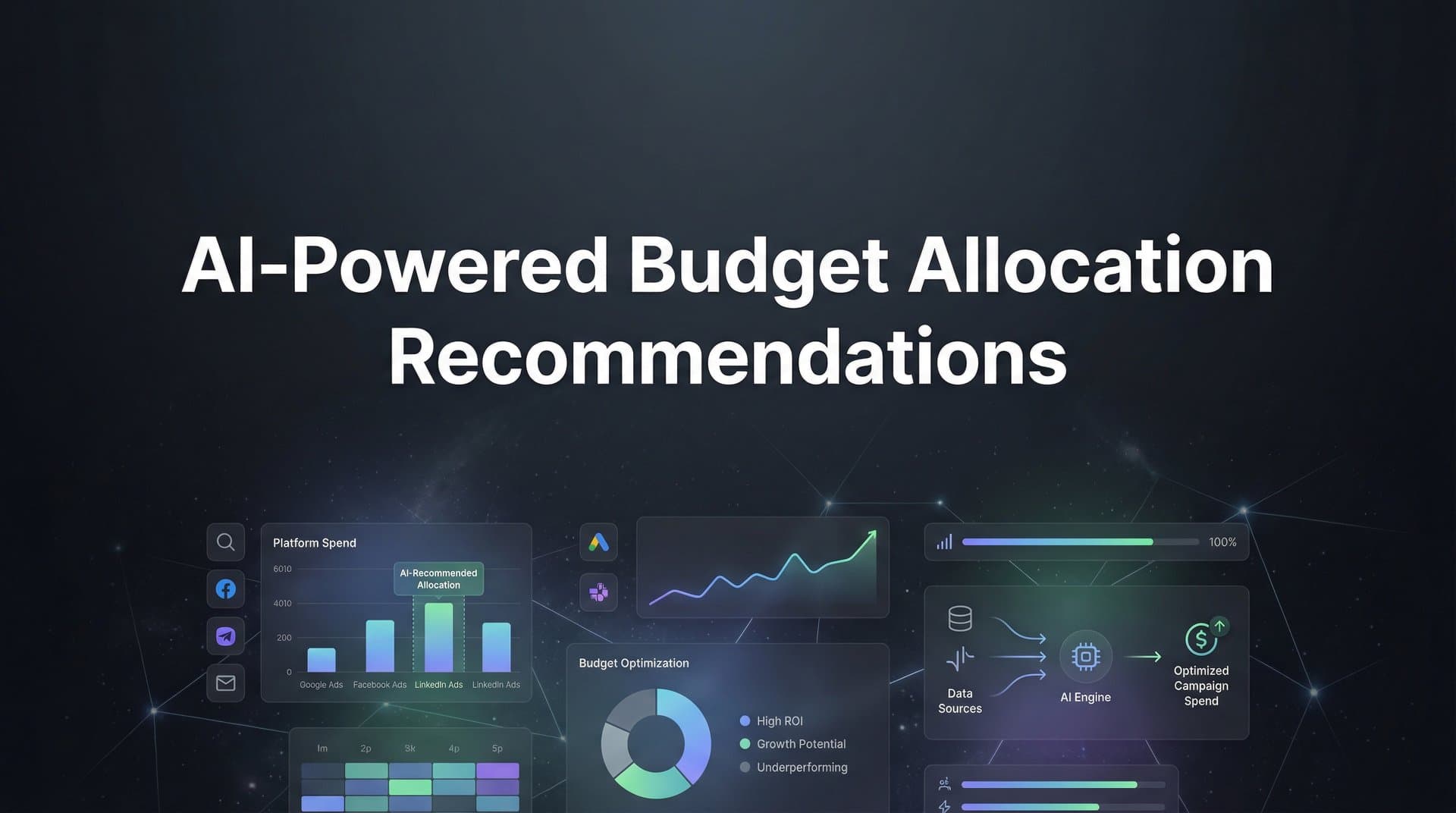
This is where AI-powered budget allocation recommendations change everything. Instead of reacting to stale data with educated guesses, you get real-time intelligence that analyzes performance across every channel, identifies patterns you'd never spot manually, and tells you exactly where to shift spend for maximum impact. Not next week. Right now.
Think of it like having a data scientist who never sleeps, constantly monitoring every ad platform, every customer touchpoint, every conversion signal—then translating all that complexity into clear, actionable recommendations: "Move $500 from Campaign A to Campaign B. Confidence level: 87%."
This isn't science fiction. It's how sophisticated marketers are optimizing ad spend in 2026. And if you're still making budget decisions based on weekly reports and gut instinct, you're leaving serious money on the table.
In this guide, we'll break down exactly how AI-powered budget allocation works, why it outperforms manual optimization, what components make recommendations accurate versus misleading, and how to implement this technology in your marketing workflow. Whether you're managing $10,000 or $10 million in monthly ad spend, understanding intelligent budget allocation is no longer optional—it's the baseline for staying competitive.
The Science Behind Intelligent Spend Optimization
Let's start with what's actually happening under the hood when AI analyzes your marketing performance.
AI-powered budget allocation systems ingest data from every touchpoint in your marketing ecosystem. That means ad impressions and clicks from Meta, Google, TikTok, and LinkedIn. CRM events like demo bookings, trial signups, and closed deals. Website interactions including page views, form submissions, and product interactions. Payment processor data showing actual revenue. The AI connects all these dots to build a complete picture of how customers move through your funnel.
Here's where it gets interesting: the system doesn't just track what happened. It identifies patterns in what drives conversions.
For example, the AI might discover that customers who interact with both a Meta ad and a Google search ad within 72 hours convert at 3x the rate of single-touchpoint customers. Or that TikTok ads generate low immediate conversions but significantly boost conversion rates for Google search traffic seven days later. These are insights you'd never spot in platform-specific dashboards because each platform only shows you its own data.
The machine learning models analyze conversion rates, customer journey patterns, time-to-conversion, revenue attribution across channels, and dozens of other variables simultaneously. They're looking for signals: which combinations of touchpoints drive the highest-value customers? Which channels show diminishing returns past certain spend thresholds? Where is additional budget most likely to generate incremental revenue?
This is fundamentally different from rule-based automation. A simple rule might say "increase budget by 10% if ROAS exceeds 3x." That's helpful, but it's static. It doesn't learn. It doesn't adapt to changing market conditions or account for cross-channel effects.
True AI recommendations evolve. The models continuously retrain on new data, adjusting their understanding of what works based on the most recent performance. If customer behavior shifts—maybe people start converting faster, or a new competitor enters the market—the AI adapts its recommendations accordingly. It's not following predetermined rules. It's learning from patterns.
But here's the critical foundation: AI recommendations are only as good as the data feeding them.
If your attribution data is incomplete or inaccurate—if you're missing touchpoints because of browser privacy restrictions, or if your platforms aren't properly connected—the AI will make flawed recommendations. Think of it like asking a financial advisor to optimize your portfolio but only showing them half your investments. The advice might sound smart, but it's based on an incomplete picture.
This is why accurate, comprehensive attribution data is non-negotiable. The AI needs to see the full customer journey. It needs to know which touchpoints actually contributed to conversions. Without that foundation, even the most sophisticated algorithms will point you in the wrong direction.
Why Manual Budget Decisions Fall Short
Let's be honest about the limitations of human budget optimization.
The first problem is timing. Most marketers review performance weekly, maybe daily if they're particularly diligent. You pull reports, analyze trends, make decisions, implement changes. But by the time you've completed this process, the data you're analyzing is already historical. Market conditions have shifted. Auction dynamics have changed. Your competitors adjusted their strategies.
You're essentially driving while looking in the rearview mirror.
The second problem is cognitive bias. We're all susceptible to it. Maybe Meta has been your best-performing channel for six months, so when performance dips, you assume it's temporary and keep the budget high. Or maybe you personally don't like TikTok ads, so you underfund that channel even when the data suggests it's working. Or you get excited about a new platform and overallocate budget before you have enough data to justify it.
Human decision-making is influenced by recent experiences, personal preferences, and emotional reactions. That's not a criticism—it's just how our brains work. But it's not ideal for optimizing six-figure ad budgets.
The third problem is complexity at scale. Let's say you're running campaigns across five platforms. Each platform has multiple campaigns. Each campaign has multiple ad sets. Each ad set has different targeting, creative, and bidding strategies. Now multiply all those variables by the fact that customer journeys typically include 3-7 touchpoints before conversion.
How do you manually track which combination of touchpoints drives the best results? How do you account for the fact that a TikTok ad view might not generate a direct conversion but significantly increases the likelihood that a Google search ad converts three days later? How do you identify that customers who interact with both LinkedIn and Meta ads have 40% higher lifetime value?
You can't. Not manually. Not at scale.
Even the most analytical marketers are limited by the number of variables they can process simultaneously. You might notice that Meta ROAS improved after increasing budget, but did you account for the fact that you also launched a new email campaign that week? Or that a competitor paused their ads? Or that search volume for your product category increased seasonally?
The human brain excels at creative thinking, strategic planning, and understanding nuanced context. It's not designed to process thousands of data points across multiple dimensions while accounting for complex interdependencies. That's where AI shines.
Key Components of Effective AI Budget Recommendations
Not all AI budget recommendation systems are created equal. Here's what separates effective solutions from glorified spreadsheet automation.
Real-Time Data Ingestion: The system must pull data continuously from all your marketing sources. That means direct integrations with ad platforms like Meta, Google, TikTok, and LinkedIn. Connections to your CRM to track leads, opportunities, and closed deals. Website tracking that captures every interaction. Payment processor data showing actual revenue. The fresher the data, the more relevant the recommendations.
Many marketers assume their ad platform dashboards provide complete data, but each platform only shows you what happens within its own ecosystem. Meta doesn't know what happened on Google. Google doesn't know what happened in your CRM. Without unified data ingestion, you're optimizing based on fragments of the truth.
Multi-Touch Attribution Modeling: This is the engine that makes everything else possible. Multi-touch attribution connects every touchpoint in the customer journey to the final conversion and revenue. It answers the question: which channels and campaigns actually contributed to this sale?
Single-touch attribution—like last-click or first-click models—oversimplifies reality. Customer journeys are messy. Someone might see a TikTok ad, click a Meta ad three days later, Google your brand name a week after that, visit your website directly two days later, then finally convert through a Google search ad. Which channel deserves credit? All of them played a role.
Multi-touch attribution distributes credit across the journey based on each touchpoint's contribution. This gives the AI an accurate understanding of how channels work together. Without it, you might defund TikTok because it shows low direct conversions, not realizing it's driving significant assisted conversions across other channels.
Confidence Scoring: Here's a component many marketers overlook but shouldn't. Effective AI systems don't just make recommendations—they tell you how confident they are in each suggestion.
A recommendation might say: "Increase Meta budget by $1,000. Confidence: 92%." That high confidence score means the AI has strong historical data supporting this recommendation. The pattern is clear and consistent.
Compare that to: "Shift $500 from LinkedIn to TikTok. Confidence: 54%." That lower confidence score is a signal. Maybe there's not enough TikTok data yet. Maybe the pattern is less consistent. Maybe external factors are creating noise. This doesn't mean ignore the recommendation, but it does mean investigate further before making a major budget shift.
Confidence scoring transforms AI from a black box into a collaborative tool. You're not blindly following recommendations—you're making informed decisions based on both the suggestion and the system's certainty level.
Cross-Channel Awareness: The AI must understand how channels influence each other. This is where most rule-based automation fails. A simple automation might see that Google ROAS dropped and recommend decreasing budget. But what if Google performance dropped because you paused Meta ads, and Meta was driving top-of-funnel awareness that fed into Google search conversions?
Effective AI budget recommendations account for these interdependencies. The system recognizes that channels don't operate in isolation—they work together as an ecosystem. Adjusting one channel affects the others.
Adaptive Learning: The models must continuously retrain on new data. Market conditions change. Customer behavior evolves. Competitive dynamics shift. An AI system that worked perfectly three months ago might be making outdated recommendations today if it hasn't adapted.
Look for systems that explicitly update their models based on recent performance. The AI should get smarter over time, not stagnate with static algorithms.
Implementing AI Recommendations in Your Workflow
Understanding how AI budget recommendations work is one thing. Actually implementing them in your day-to-day marketing operations is another. Here's how to do it right.
Start With Clean, Unified Data: Before you trust any AI recommendation, audit your data foundation. Are all your ad platforms properly connected? Is your CRM sending conversion events? Is your website tracking configured correctly? Are you using server-side tracking to capture data that browser-based tracking misses due to privacy restrictions?
This isn't glamorous work, but it's essential. Spend the time upfront to ensure your attribution system is capturing the full customer journey across every touchpoint. Connect your ad platforms, CRM, website analytics, and payment processor into a unified view.
We compare the leading options in our ad spend optimization software roundup.
If you're missing significant chunks of data—like mobile app conversions, phone call tracking, or offline sales—the AI will optimize based on an incomplete picture. That's worse than not using AI at all because you'll have false confidence in flawed recommendations.
Set Thresholds and Guardrails: AI recommendations should align with your risk tolerance and business constraints. Most systems let you configure parameters like maximum budget change per recommendation, minimum confidence score to act on, channels that require manual approval before changes, and maximum spend limits per platform.
For example, you might configure the system to automatically implement recommendations under $500 with 80%+ confidence, but flag larger changes for manual review. Or you might set a rule that budget can never decrease by more than 20% in a single day, even if the AI recommends it, to avoid overreacting to short-term fluctuations.
These guardrails don't limit the AI—they ensure recommendations align with your operational reality. Maybe you have contractual commitments with certain platforms. Maybe you're testing a new channel and want to maintain minimum spend regardless of short-term performance. Maybe you have budget approval processes that require sign-off for changes above certain thresholds.
Configure the system to work within your constraints rather than fighting against them.
Embrace Human-AI Collaboration: The most effective approach isn't full automation or pure manual control—it's collaboration. Let the AI handle what it does best: processing massive amounts of data, identifying patterns, and surfacing opportunities. You handle what you do best: strategic thinking, creative direction, and contextual decision-making.
When the AI recommends a budget shift, ask yourself: does this align with what I know about the market? Are there external factors the AI might not account for, like an upcoming product launch or seasonal trend? Does the confidence score warrant immediate action or further investigation?
Sometimes you'll trust the recommendation and implement it immediately. Other times you'll dig deeper, run additional analysis, or test the recommendation on a smaller scale first. Both approaches are valid. The goal isn't to blindly follow AI—it's to make better-informed decisions faster.
Start Small and Scale: Don't overhaul your entire budget allocation strategy on day one. Begin by implementing AI recommendations on your highest-spend campaigns where the impact is most visible and the data is most robust. Monitor the results closely. Learn how the system thinks. Build confidence in the recommendations.
As you see positive results and develop trust in the AI's judgment, expand to more campaigns and platforms. Eventually, you'll reach a state where the AI continuously optimizes budget allocation while you focus on higher-level strategy, creative development, and growth initiatives.
Measuring the Impact on Campaign Performance
How do you know if AI-powered budget allocation is actually working? Here are the metrics that matter and how to track them effectively.
ROAS Improvements: This is the most direct measure of success. Compare your overall return on ad spend before and after implementing AI recommendations. Look at both blended ROAS across all channels and platform-specific ROAS. You should see improvement in overall efficiency—getting more revenue per dollar spent.
But don't just look at the top-line number. Dig into the trends. Is ROAS improving consistently, or are there volatile swings? Are certain channels improving while others decline? Understanding the nuances helps you refine your approach.
Cost Per Acquisition Changes: Track how much you're paying to acquire customers across different channels and customer segments. AI budget allocation should drive down CPA by shifting spend toward more efficient channels and away from underperforming ones.
Pay attention to CPA by customer quality, not just volume. If your CPA decreases but customer lifetime value also drops, that's not a win. The goal is acquiring valuable customers efficiently, not just acquiring more customers cheaply.
Revenue Per Channel: Monitor how much revenue each channel generates, not just how much you're spending. AI recommendations might increase spend on a channel that previously had lower budget but higher efficiency. That's a good thing—you're capturing more revenue from your best-performing sources.
Look for changes in revenue mix. If AI recommendations are working, you should see revenue shifting toward channels with better unit economics and away from channels with diminishing returns.
Budget Utilization Efficiency: Are you consistently spending your full budget, or are you leaving money on the table? AI allocation should help you deploy capital more efficiently—spending up to your limits on high-performing channels while pulling back from underperformers. Understanding what is budget utilization and tracking it closely reveals how effectively your capital is working.
Track what percentage of your budget is actively deployed versus sitting idle. Better allocation means more of your budget is working for you at any given time.
Time to Optimization: How quickly are you identifying and acting on performance changes? Before AI, you might have spotted an opportunity in your weekly review and implemented changes three days later. With AI recommendations, that cycle compresses to hours or even minutes. The faster you optimize, the less money you waste on underperforming spend.
Compare Before and After: Establish a clear baseline before implementing AI recommendations. Document your performance metrics for at least 30 days prior to making the switch. Then track the same metrics for 30-60 days after implementation. This gives you a clean comparison and helps you isolate the impact of AI-driven allocation from other variables.
Be patient with the data. Some improvements show up immediately—like shifting budget away from obviously underperforming campaigns. Other benefits emerge over time as the AI learns patterns and refines its recommendations. Give the system at least 60 days before making definitive judgments about effectiveness.
Iterate on Your Approach: Use AI insights to refine your overall marketing strategy, not just budget allocation. If the AI consistently recommends increasing budget on certain audience segments, maybe you should develop more creative specifically for those segments. If certain channels show strong assisted conversion rates but weak last-click attribution, adjust your attribution model to better reflect their value.
The goal isn't just better budget allocation—it's smarter marketing overall. Let AI recommendations inform your creative strategy, targeting decisions, and channel selection.
Putting AI Budget Intelligence Into Action
You now understand how AI-powered budget allocation works, why it outperforms manual optimization, and what components make recommendations accurate. Here's your roadmap for implementation.
Audit Your Attribution Setup: This is step one, and it's non-negotiable. Before you trust any AI recommendation, ensure your attribution data is accurate and complete. Verify that all ad platforms are properly connected. Confirm your CRM is sending conversion events. Check that your website tracking captures the full customer journey. Implement server-side tracking if you haven't already—browser-based tracking alone won't cut it in 2026 with privacy restrictions and iOS limitations.
If you discover gaps in your data—missing touchpoints, incomplete conversion tracking, disconnected platforms—fix them before moving forward. AI recommendations based on incomplete data will lead you astray.
Start With High-Impact Campaigns: Don't try to optimize everything at once. Identify your highest-spend campaigns where AI recommendations will have the most visible impact. These are your testing grounds. Implement AI-driven allocation here first, monitor results closely, and learn how the system performs before expanding to your entire marketing portfolio.
High-spend campaigns also tend to have more robust data, which means the AI can make more confident recommendations. You'll see results faster and build trust in the system more quickly.
Build Toward Continuous Optimization: The end goal is a marketing operation where AI continuously analyzes performance, identifies opportunities, and optimizes budget allocation while you focus on creative development, strategic planning, and growth initiatives. You're not removed from the process—you're elevated above tactical execution to focus on higher-value decisions.
This doesn't happen overnight. It's a progression from manual optimization to AI-assisted decisions to AI-driven allocation with human oversight. Move through these stages at a pace that matches your comfort level and data quality.
Invest in Your Data Infrastructure: AI-powered budget allocation is only as good as the data feeding it. That means investing in proper tracking, attribution modeling, and data integration. It means choosing platforms that prioritize accurate data capture over vanity metrics. It means building systems that connect every touchpoint in the customer journey.
This isn't just about budget allocation—it's about building a data foundation that powers every aspect of your marketing. Better attribution data improves creative decisions, targeting strategies, channel selection, and overall marketing effectiveness. AI budget recommendations are just one application of that foundation.
The Future of Ad Spend Management
AI-powered budget allocation recommendations represent a fundamental shift in how sophisticated marketers manage ad spend. We've moved from reactive monthly reviews to proactive real-time marketing budget allocation strategies. From gut-feeling decisions to data-driven recommendations. From single-channel thinking to cross-platform intelligence.
The marketers who thrive in this environment aren't the ones who can build the best spreadsheets or spend the most time analyzing reports. They're the ones who build robust data foundations, implement intelligent systems, and use AI to make better decisions faster.
But here's what separates effective AI budget allocation from expensive experimentation: the quality of your attribution data. You can have the most sophisticated AI algorithms in the world, but if they're analyzing incomplete or inaccurate data, the recommendations will be flawed. Garbage in, garbage out.
This is why platforms that combine accurate multi-touch attribution with AI-driven marketing recommendations are becoming essential infrastructure for serious marketers. You need systems that capture every touchpoint across every channel, connect those touchpoints to actual revenue, and use that complete picture to drive intelligent budget decisions.
The good news? You don't have to build this infrastructure from scratch. Modern budget optimization software handles the complexity of data ingestion, multi-touch modeling, and AI-powered recommendations so you can focus on strategy and execution.
Ready to elevate your marketing game with precision and confidence? Discover how Cometly's AI-driven recommendations can transform your ad strategy—Get your free demo today and start capturing every touchpoint to maximize your conversions.
The question isn't whether AI will power budget allocation decisions in the future. It already does for leading marketers. The question is whether you'll adopt this technology while you still have a competitive advantage, or wait until it becomes table stakes and you're playing catch-up.
Your competitors are already making this shift. The market rewards speed and efficiency. And every day you're making budget decisions based on last week's data instead of real-time intelligence, you're leaving money on the table.
Start with your attribution foundation. Build from there. And let AI handle the optimization so you can focus on what humans do best: creative thinking, strategic planning, and driving growth.