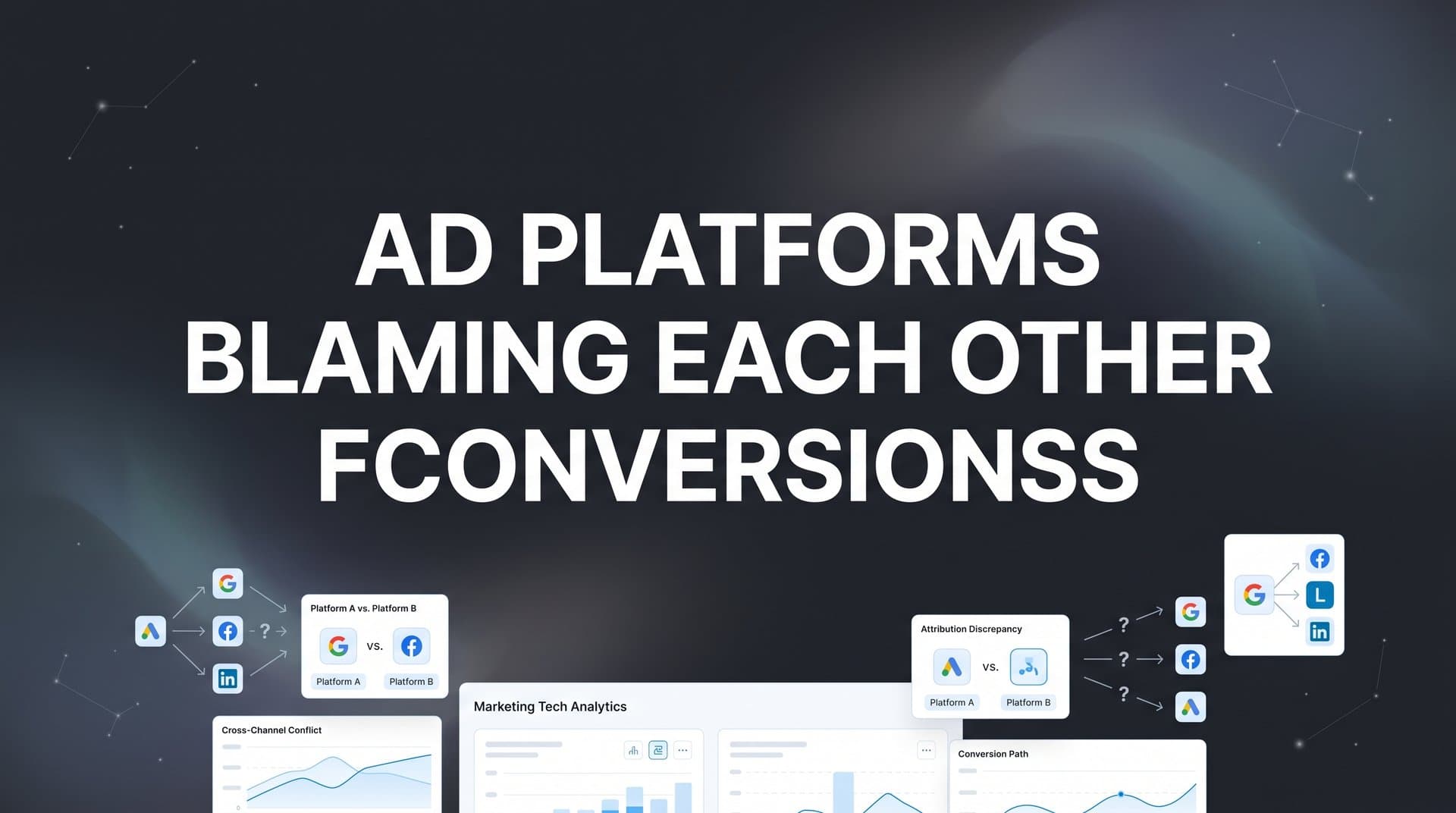
You open your dashboards on a Monday morning, coffee in hand, ready to review last week's campaign performance. Meta is reporting 120 conversions. Google claims 95. TikTok says it drove 60. You add those up and get 275 conversions claimed across your platforms. Then you open your CRM. You have 150 actual sales.
Something is very wrong. And yet, every platform is confident it deserves the credit.
This is the reality of ad platforms blaming each other for conversions, a problem that is far more common and far more expensive than most marketers realize. Each platform operates its own tracking system, uses its own attribution logic, and reports its own version of the truth. When a single customer interacts with your ads on multiple platforms before buying, every platform that touched that journey claims the win. The result is a reporting landscape full of overlapping claims, inflated ROAS numbers, and budget decisions built on shaky ground.
Understanding why this happens is the first step toward fixing it. This article breaks down the mechanics behind overlapping conversion claims, explains what it actually costs your business, and shows you how independent attribution can give you the clarity you need to allocate budget with confidence.
Why Every Ad Platform Thinks It Deserves the Credit
To understand why ad platforms over-claim conversions, you need to understand how they measure them in the first place. Each platform deploys its own tracking mechanism: a pixel on your website, an SDK in your app, or a tag fired through a tag manager. When a user clicks your ad and later converts, that platform's pixel fires and records the win. Simple enough in isolation. The problem starts when that same user has also interacted with your ads on two other platforms.
Attribution windows are at the heart of this conflict. Meta's default attribution setting credits conversions that happen within 7 days of a click or 1 day of a view. That means if someone saw your Meta ad on Monday, clicked a Google ad on Wednesday, and bought on Friday, Meta still counts that as its conversion. Google's data-driven attribution model spreads credit across touchpoints within its own ecosystem, but it still claims the conversion as a Google-driven outcome. TikTok has its own click and view windows, and it will similarly record the purchase as evidence of its impact. All three platforms are technically following their own rules. All three are also technically wrong about being the sole driver of that sale. This is a core reason why ad platforms show different numbers for the same campaigns.
Here's where it gets uncomfortable: ad platforms are not neutral measurement tools. They are businesses that sell advertising inventory, and their attribution models are designed to maximize the credit they can claim. This is not a conspiracy; it is just an incentive structure. When a platform reports higher ROAS and more conversions, you are more likely to increase your spend with them. Their measurement methodology directly serves their revenue goals.
This conflict of interest is baked into the system. A platform has every reason to use a generous attribution window, count view-through conversions liberally, and model conversions when direct data is unavailable. None of these choices are inherently dishonest in isolation, but collectively they create a reporting environment where the sum of claimed conversions routinely exceeds actual outcomes by a wide margin.
The result is that every dashboard tells a different story, and none of them tells the complete truth. Marketers who rely solely on platform-reported data are essentially letting the seller grade their own homework.
The Real Cost of Double-Counted Conversions
Inflated conversion numbers might feel like a good problem to have, but the downstream consequences are serious. When your reported ROAS is artificially high because three platforms are each claiming the same sale, your budget decisions become unreliable. You might look at a channel and see a strong return, decide to scale it aggressively, and later wonder why revenue did not follow. The channel was not actually performing as well as the dashboard suggested. You were just seeing its share of a conversion that was also claimed by two other platforms.
The opposite scenario is equally damaging. A channel that plays an important early role in the customer journey, introducing your brand to new audiences, might show modest conversion numbers because it rarely gets the last click. Based on platform reporting alone, you might cut that channel to reallocate budget. But if that channel was consistently initiating journeys that later closed on other platforms, cutting it quietly damages your pipeline without an obvious cause-and-effect signal. The ability to track marketing ROI across platforms is essential to avoiding this kind of mistake.
There is also a compounding problem that many marketers overlook. Platform algorithms like Meta's Advantage+ and Google's Smart Bidding optimize based on the conversion signals they receive. When you feed those algorithms data from a standard pixel that is double-counting conversions, you are training them on inflated, inaccurate signals. The algorithm thinks it is finding high-converting audiences and placements, but it is partially optimizing toward noise. Over time, this degrades the quality of your targeting and makes your campaigns less efficient, not more.
Consider what this looks like in practice. A marketer running campaigns across Meta, Google, and TikTok sees a combined 275 conversions reported across platforms. Their CRM shows 150 actual sales. That gap represents roughly 125 phantom conversions. Every budget decision made using the platform numbers is operating on a distorted picture of reality. Channels get scaled or cut based on who claims the most credit rather than who actually drives revenue.
The financial impact is not just about wasted ad spend. It is about the opportunity cost of never knowing which channels genuinely move the needle. That clarity has real value, and the absence of it is an ongoing tax on every marketing decision you make.
How Cross-Platform Customer Journeys Make Things Worse
Modern buyers rarely follow a straight line from ad click to purchase. A prospect might discover your brand through a Meta video ad, search for your product name on Google a few days later, get retargeted on TikTok, and then convert after clicking a link in a promotional email. That is four touchpoints across four different channels, and each one played a role in the eventual sale.
The problem is that each platform only sees its own piece of this journey. Meta knows about the video view and maybe the website visit that followed. Google sees the branded search click. TikTok records the retargeting click. None of them can see the full path, and none of them has access to the email click that triggered the final conversion. Effectively tracking the customer journey across platforms requires a system that sits above all of these individual views.
Apple's App Tracking Transparency framework, which launched in 2021, made this problem significantly worse for mobile advertising. When users opt out of tracking across apps, platforms like Meta lose the ability to observe cross-app behavior directly. To compensate, they rely increasingly on modeled or estimated conversions, using statistical inference to fill in the gaps they can no longer see directly. This means a portion of what platforms report as conversions are not actually observed events; they are educated guesses. And those guesses are made with a self-serving bias built into the model.
Cookie deprecation adds another layer of uncertainty. As browsers continue restricting third-party cookies, browser-based pixel tracking becomes less reliable. Platforms respond by modeling more, and the gap between reported conversions and real outcomes widens further. This is a key driver behind the growing issue of underreporting conversions in ad platforms, where some channels lose visibility while others over-claim.
Without a unified view that connects all touchpoints to actual CRM outcomes, marketers are left trying to reconcile conflicting stories from platforms that each have incomplete information and strong incentives to put their own performance in the best possible light. The customer journey is a single continuous experience. Platform reporting treats it like five separate stories, each with a different hero.
Attribution Models That Cut Through the Noise
Not all attribution is created equal. There is a fundamental difference between platform-reported attribution and independent multi-touch attribution, and understanding that difference is what separates marketers who make confident budget decisions from those who are constantly second-guessing their data.
Platform-reported attribution is self-reported and self-serving. Each platform applies its own model to its own data and hands you a number. Independent multi-touch attribution, by contrast, collects data across all platforms and channels, connects it to real CRM outcomes, and applies a neutral model to the full customer journey. Exploring the top attribution modeling platforms can help you find the right independent solution for your business.
The model you choose matters because each one tells a different story about where credit belongs. Last-touch attribution gives all credit to the final interaction before conversion, which tends to favor retargeting and branded search. First-touch attribution credits the channel that initiated the journey, which tends to highlight prospecting and awareness campaigns. Linear attribution spreads credit equally across all touchpoints. Data-driven attribution uses statistical modeling to weight touchpoints based on their actual influence on conversion outcomes, and it requires enough data volume to produce reliable results.
None of these models is universally correct. The right choice depends on your business, your sales cycle, and what decisions you are trying to make. But any of them, applied independently and connected to real revenue data, is more trustworthy than what any single platform reports on its own.
Server-side tracking has become increasingly important in this context. Traditional pixel-based tracking relies on the browser to fire events, which means it is vulnerable to ad blockers, browser privacy restrictions, and cookie limitations. Reviewing the top server-side tracking platforms is a smart move for any marketer serious about data accuracy. Server-side tracking sends conversion events directly from your backend systems to the platforms and your attribution tool, bypassing those browser-level obstacles. The result is more complete, more accurate conversion data that better reflects what is actually happening.
Connecting attribution to CRM data is the final piece. Pixel fires and form submissions tell you that something happened on your website. CRM data tells you whether that something turned into a real sale, how much revenue it generated, and how long the deal took to close. When you can trace ad spend all the way to closed revenue rather than just to a form fill, your attribution becomes genuinely useful for business decisions rather than just marketing vanity metrics.
Building a Single Source of Truth for Your Ad Spend
The antidote to the platform blame game is a unified attribution system that sits above all your ad platforms and connects them to your actual business outcomes. Building this requires connecting your ad platforms, your website, and your CRM into a single system that tracks the complete customer journey from first click to closed revenue.
The starting point is data collection. Every touchpoint across every channel needs to be captured in one place. That means integrating Meta, Google, TikTok, and any other ad platforms you run, alongside your website behavior data and your CRM events. UTM parameters play a critical role here, ensuring that traffic from every source is tagged and traceable back to a specific campaign, ad set, and creative. Adopting a unified marketing reporting approach eliminates the confusion of reconciling separate dashboards.
This is exactly the problem Cometly is built to solve. Cometly captures every touchpoint across platforms and connects them to real CRM outcomes, giving you a complete view of the customer journey that no single ad platform can provide. Its server-side tracking captures conversion data at the backend level, so it is not affected by ad blockers, browser restrictions, or cookie limitations. You get accurate, complete conversion data rather than the partial, modeled picture that browser pixels provide.
The AI-powered analytics layer then lets you analyze performance across every channel in one place, compare attribution models, and identify which ads and campaigns are actually driving revenue. Instead of reconciling conflicting dashboards, you have one source of truth that reflects real outcomes.
There is also a feedback loop advantage that compounds over time. When you send accurate, enriched conversion events back to Meta, Google, and other platforms through Cometly's Conversion Sync, you are giving their algorithms better data to learn from. Meta's Advantage+ and Google's Smart Bidding optimize based on the signals they receive. When those signals reflect real, de-duplicated conversions connected to actual revenue rather than inflated, overlapping pixel fires, the algorithms improve their targeting and optimization. Better input data produces better algorithmic output, which means your campaigns become more efficient over time rather than drifting toward noise.
This is the compounding benefit of accurate attribution: it does not just help you understand the past. It actively improves your future campaign performance by feeding better data into the systems that drive your targeting and bidding decisions.
Practical Steps to Stop the Platform Blame Game Today
Understanding the problem is one thing. Taking action is another. Here is a practical approach to getting your attribution under control and making decisions based on reality rather than platform spin.
Start with an attribution audit. Pull your total reported conversions from every ad platform for the past 30 days and add them up. Then compare that number to your actual CRM sales or leads for the same period. The gap between those two numbers is your overlap problem. Quantifying it gives you a concrete starting point and makes the case internally for investing in better attribution infrastructure.
Stop relying on any single platform's pixel as your source of truth. This does not mean removing your pixels; you still need them for platform optimization and retargeting. But your budget decisions should never be based solely on what those pixels report. Implement UTM parameters consistently across every ad and every platform so that traffic is traceable regardless of which pixel fires. Dedicated tracking software for performance marketing can automate much of this process and ensure nothing falls through the cracks.
Implement server-side tracking and CRM integration. Move your conversion tracking to the server level where possible, and connect your attribution system directly to your CRM. This gives you conversion data that is not filtered through browser limitations and that reflects real business outcomes rather than just website events.
Establish a regular comparison cadence. Set up a weekly or monthly review where you compare platform-reported data against your independent attribution data. Over time, you will develop a clear picture of how much each platform over-reports and which channels are genuinely driving results. Investing in real-time marketing performance monitoring tools makes this review process faster and more actionable. Use the independent data to guide budget allocation decisions, and treat platform-reported numbers as one input among many rather than the final word.
Use your independent attribution data to inform platform optimization. Feed accurate, enriched conversion events back to your ad platforms so their algorithms are learning from real outcomes. This closes the loop between accurate measurement and better algorithmic performance.
The Bottom Line on Attribution Clarity
Ad platforms will always claim as much credit as they can. That is not a flaw in their design; it is a feature of their business model. They sell advertising, and the more conversions they can credibly claim, the more budget flows their way. Expecting them to self-report conservatively is like expecting a salesperson to understate their own results. It is not going to happen.
The solution is not to distrust your ad platforms entirely. It is to stop letting them be the sole judge of their own performance. Independent, multi-touch attribution connected to real CRM revenue data gives you a neutral view of the customer journey that no single platform can provide. It shows you which channels are genuinely driving results, which are playing a supporting role, and which are collecting credit for work done by others.
Cometly gives marketers exactly this kind of clarity. By capturing every touchpoint, applying server-side tracking for accuracy, and syncing enriched conversion data back to ad platforms, Cometly helps you see what is actually driving revenue, optimize your budget with confidence, and improve your algorithmic performance over time. The platform blame game stops when you have a single source of truth that sits above all the competing claims.
If you are ready to stop reconciling conflicting dashboards and start making budget decisions based on real data, Get your free demo today and discover how Cometly can unify your attribution and give you the clarity your campaigns deserve.