

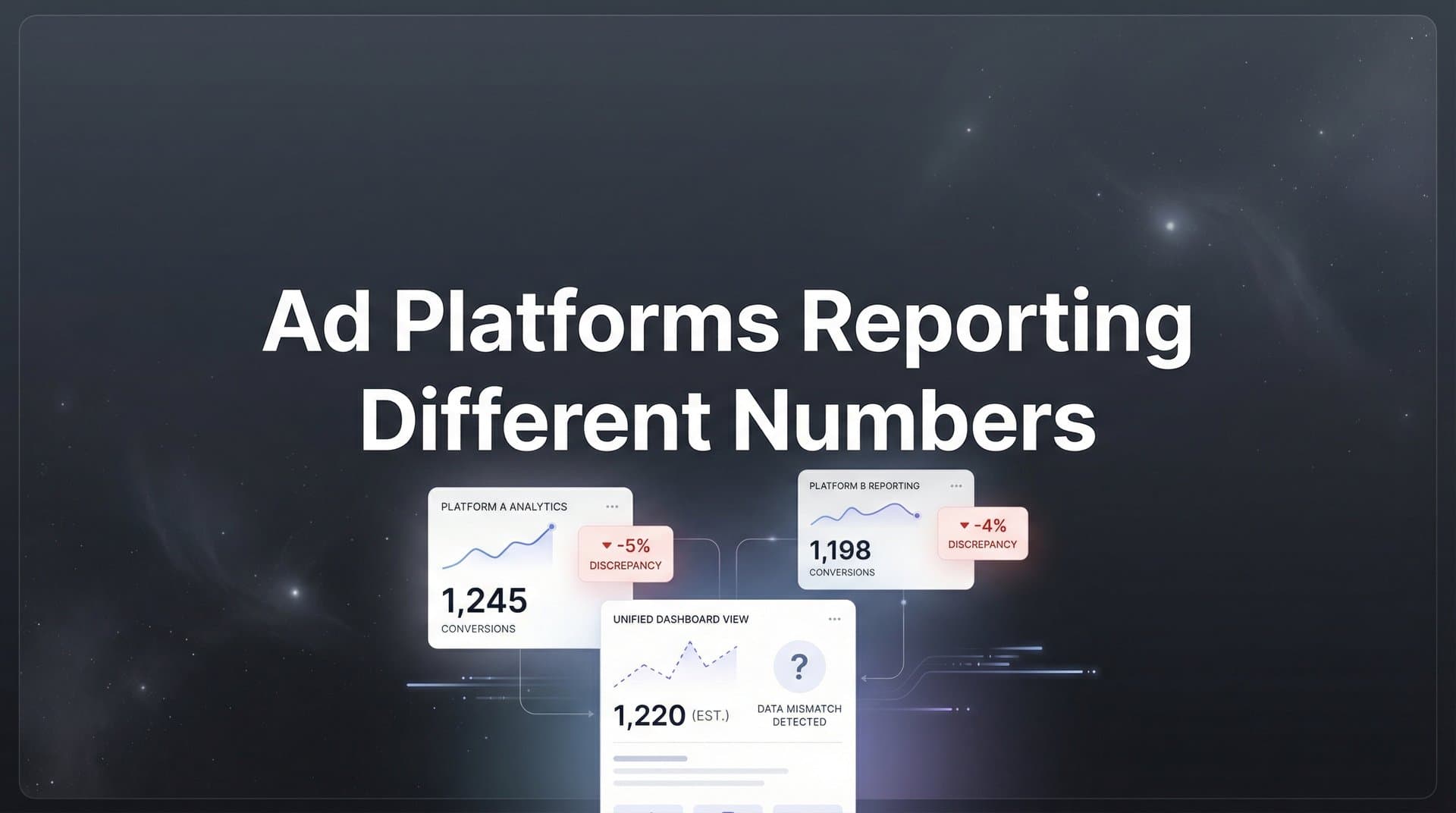
You're staring at your marketing dashboard, and the numbers don't add up. Meta Ads Manager shows 50 conversions from yesterday's campaign. Google Ads claims 35. But when you check your CRM, only 28 actual sales came through. Your stomach sinks. Is something broken? Are you wasting ad spend? Did someone mess up the tracking setup?
Take a breath. This isn't a crisis, and you're not alone. Every marketer who runs campaigns across multiple platforms faces this exact frustration. The truth is, your ad platforms aren't malfunctioning—they're just telling different versions of the same story.
Understanding why these discrepancies happen is the first step toward making confident, data-driven decisions. This guide will walk you through the real reasons ad platforms report different numbers and show you how to cut through the confusion to find the truth about what's actually driving your results.
The Attribution Model Problem: Everyone Takes Credit
Here's the fundamental issue: every ad platform measures success from its own perspective, using its own rules. It's like asking three witnesses to describe the same event—they'll all tell you something different based on where they were standing.
Meta Ads uses a default attribution window of 7 days after someone clicks your ad and 1 day after someone views it. That means if someone clicks your Meta ad today and converts six days later, Meta takes full credit for that conversion. Google Ads, on the other hand, offers multiple attribution models. Many accounts default to last-click attribution or use data-driven attribution, which distributes credit across multiple touchpoints based on machine learning analysis.
Let's walk through a real customer journey to see how this plays out. Imagine Sarah sees your Meta ad on Monday morning while scrolling Instagram. She clicks through to your site, browses for a few minutes, then leaves. On Wednesday, she searches for your product category on Google, clicks your Google Ad, and again leaves without converting. On Friday, she receives your email newsletter, clicks the link, and finally makes a purchase.
Who gets credit? Meta says it does—Sarah clicked their ad within the 7-day window. Google also claims the conversion because she clicked their ad before converting. Your email platform reports it as an email-driven sale. They're all technically correct based on their own measurement standards. This is a classic case of ad platforms taking credit for the same conversion.
This isn't dishonesty or manipulation. Each platform is simply applying its attribution model consistently. The problem is that these models were designed to measure each platform's contribution in isolation, not to work together as part of a unified view. When you add up the conversions each platform claims, you get a number far higher than your actual sales because the same conversion gets counted multiple times.
The situation gets even more complex when you consider that different teams within your organization might be using different attribution models. Your paid social team might look at Meta's 7-day click window, while your paid search team analyzes Google's data-driven attribution. Neither is wrong, but they're measuring different things, which makes it nearly impossible to compare performance accurately or allocate budget effectively.
Tracking Gaps: When Data Gets Lost in Transit
Even if every platform used identical attribution models, you'd still see discrepancies. Why? Because a significant portion of conversions never get tracked in the first place.
The biggest culprit is Apple's App Tracking Transparency framework, introduced with iOS 14.5 in April 2021. This feature requires apps to ask users for permission before tracking their activity across other apps and websites. The result? Most users decline. Industry data shows that opt-in rates typically hover between 15-25%, meaning 75-85% of iOS users are now invisible to traditional pixel-based tracking.
That's a massive blind spot. If your audience skews toward iPhone users—and statistically, higher-income consumers often do—you could be missing the majority of your mobile conversions from a tracking perspective. The ad platforms know this, which is why they've increasingly relied on modeled conversions.
Modeled conversions are estimates. When a platform can't directly track a conversion due to privacy restrictions, it uses machine learning to predict which conversions likely came from its ads based on patterns in the data it can see. These models can be sophisticated, but they're still educated guesses, not actual tracked events. This means the conversion numbers you see in your ad platform dashboard include a mix of real, verified conversions and statistical estimates. Understanding these ad platform reporting inaccuracies is essential for interpreting your data correctly.
Browser privacy features add another layer of complexity. Safari's Intelligent Tracking Prevention, Firefox's Enhanced Tracking Protection, and Chrome's upcoming Privacy Sandbox all restrict how long cookies persist and how they can be used for tracking. Ad blockers, which millions of users run by default, prevent tracking pixels from firing altogether.
The practical impact is straightforward: your ad platforms are working with incomplete information. They're trying to measure performance while wearing a blindfold, filling in the gaps with their best algorithmic guesses. This is why you'll often see discrepancies between what your ad platforms report and what actually shows up in your CRM or analytics platform—the platforms are reporting a combination of tracked and modeled data, while your CRM only records what actually happened.
Conversion Windows and Timing Mismatches
Even when conversions are tracked accurately, they don't always appear in the same reporting period across platforms. This timing issue creates confusion that can make it look like your numbers don't match when they actually do—just on different days.
Think about how attribution windows work in practice. If someone clicks your Meta ad on March 1st and converts on March 8th, that conversion will appear in Meta's reporting because it falls within the default 7-day click window. But if your Google Ads account uses a 7-day click window that only counts conversions through March 7th, that same conversion won't show up in Google's numbers for the same campaign period.
This gets particularly messy at month-end. A conversion that happens on the first day of the new month might be attributed back to an ad click from the previous month. Your monthly reports will show different totals depending on which platform you're looking at, not because of tracking errors, but simply because of when each platform decides to count the conversion. These timing issues are a common cause of ad platform reporting not matching analytics.
Reporting delays compound the problem. Most ad platforms don't show real-time conversion data. Google Ads typically has a delay of a few hours. Meta can take up to 48 hours to fully process and report conversions, especially for events tracked through the Conversions API. Your analytics platform might process data on a different schedule entirely.
Timezone settings add yet another variable. If your ad account is set to Pacific Time but your analytics platform uses Eastern Time, the same conversion can appear to happen on different days depending on where you're looking. A conversion at 11 PM Pacific on March 15th is actually 2 AM Eastern on March 16th—same event, different date in your reports.
The takeaway here is that timing mismatches are often mistaken for tracking problems. Before you panic about discrepancies, check whether you're comparing the same time periods with the same attribution windows across all platforms. Many apparent conflicts disappear when you account for these timing differences.
Cross-Device and Cross-Channel Blind Spots
Modern customer journeys rarely happen on a single device or through a single channel. This reality creates fundamental measurement challenges that even perfect tracking implementation can't fully solve.
Consider the typical path to purchase for a considered buy. Someone sees your ad on their phone during their morning commute. They click through, browse your product pages, maybe add something to cart. But they don't complete the purchase on that tiny screen. Later that evening, they're on their laptop, they search for your brand name, click through from organic search, and complete the transaction.
From a tracking perspective, this looks like two completely different users unless you have sophisticated identity resolution in place. The mobile session has one set of cookies and device identifiers. The desktop session has another. Most ad platforms struggle to connect these dots, which means the conversion might get attributed to the organic search visit on desktop while the original ad click on mobile goes unrecognized. This is why multiple ad platforms tracking issues are so prevalent in modern marketing.
The cross-channel challenge is even more fundamental. Meta can't see what happens on Google. Google can't see what happens on Meta. Each platform operates in its own walled garden with limited visibility into the customer journey beyond its own touchpoints. When someone interacts with your ads on multiple platforms before converting, each platform only sees its piece of the puzzle.
This creates a situation where platforms systematically over-report their contribution because they lack the context to understand they're part of a longer journey. It's not intentional deception—it's a structural limitation of how digital advertising works today.
Offline conversions present another major blind spot. Phone calls, in-store purchases, sales closed by your team after a demo—these conversions often start with digital advertising but finish through channels that ad platforms can't directly track. Unless you have systems in place to feed this data back to your ad platforms, these conversions simply vanish from your digital attribution, making your campaigns look less effective than they actually are.
The cross-device and cross-channel reality means that no single ad platform can give you a complete picture of your marketing performance. They're all reporting accurately from their limited vantage point, but none of them can see the full customer journey. This is why discrepancies aren't just common—they're inevitable without a more comprehensive tracking approach.
Building a Single Source of Truth for Your Marketing Data
The solution to attribution chaos isn't trying to make all your platforms agree—it's establishing an independent system that tracks the complete customer journey from first touch to final conversion and beyond.
This is where the concept of a single source of truth becomes critical. Instead of relying on each ad platform's self-reported numbers, you need a unified tracking system that captures every touchpoint across all channels and devices, then connects them to actual business outcomes like CRM records and revenue. A centralized marketing reporting platform can help you achieve this unified view.
Server-side tracking forms the foundation of this approach. Unlike browser-based pixels that can be blocked by privacy features and ad blockers, server-side tracking sends conversion data directly from your server to ad platforms. This bypasses many of the tracking limitations that create gaps in platform reporting.
When someone converts on your website, your server immediately sends that conversion event to your tracking system. From there, it can be distributed to all relevant ad platforms with consistent data. This means Meta, Google, and any other platform you're using all receive the same conversion information at the same time, reducing discrepancies caused by different tracking implementations.
But server-side tracking is just the technical foundation. The real power comes from connecting every ad click, view, and interaction to actual customer records. This creates a complete attribution map showing how each marketing touchpoint contributed to each conversion, regardless of device switching or cross-platform journeys. Implementing conversion tracking software for multiple ad platforms is essential for this level of visibility.
With this unified view, you can compare what each ad platform claims against what actually happened. If Meta reports 50 conversions but your single source of truth shows that only 35 of those people actually completed purchases, you have the data you need to make informed decisions about where to allocate budget.
This approach also solves the cross-device problem. When your tracking system can identify that the person who clicked your mobile ad is the same person who later converted on desktop, you get accurate attribution even across device switches. You're no longer guessing—you're measuring the actual customer journey.
Perhaps most importantly, feeding this enriched conversion data back to ad platforms improves their optimization algorithms. When you send complete, accurate conversion information through the Conversions API or similar tools, you're training the platform's machine learning with better data. This helps the algorithms identify and target users who are more likely to convert, improving your campaign performance over time.
Platforms like Cometly are built specifically to solve this problem. By capturing every touchpoint across all your marketing channels and connecting them to actual revenue outcomes, you create a complete view of what's driving results. The AI-powered insights help you identify which campaigns and channels are truly performing, not just which ones claim credit.
Practical Steps to Reconcile Your Reporting Today
While building a comprehensive attribution system is the long-term solution, there are immediate steps you can take to reduce confusion and make better decisions with the data you have right now.
Start by aligning attribution windows across platforms where possible. If Meta uses a 7-day click window and Google uses a 30-day click window, you're comparing apples to oranges. Standardize these settings so you're at least measuring similar timeframes. This won't eliminate discrepancies, but it will make your data more comparable. Learning how to improve ad platform reporting accuracy starts with these foundational adjustments.
Audit your tracking implementation regularly. Check that your pixels, tags, and conversion events are firing correctly. Use browser developer tools or tag management debugging features to verify that conversion data is being captured and sent to your platforms. Many discrepancies come from simple implementation errors that are easy to fix once identified.
Compare platform data against your CRM and revenue records weekly. This habit keeps you grounded in business reality rather than platform-reported metrics. If your ad platforms collectively report 200 conversions but only 100 actual sales appeared in your system, you know there's significant over-counting happening. Use this ratio to calibrate your interpretation of platform data.
Establish a primary source of truth for decision-making. This might be your CRM, your analytics platform, or a dedicated attribution tool. Whatever you choose, make it clear to your team that this is the number that matters. Platform data becomes directional information that informs optimization, not the ultimate measure of success. Consider exploring marketing attribution platforms with revenue tracking capabilities for this purpose.
Focus on trends rather than absolute numbers when looking at individual platforms. If Meta shows a 20% increase in conversions week-over-week, that trend is probably real even if the absolute number includes modeled conversions and attribution overlap. Use platform data to identify what's improving or declining, then validate those trends against your source of truth.
Connect ad data to actual revenue outcomes, not just conversion counts. A conversion is only valuable if it generates revenue. Track metrics like cost per acquisition based on actual CRM records, return on ad spend calculated from real revenue, and customer lifetime value by acquisition channel. These business metrics cut through attribution confusion because they're based on money in and money out.
Document your measurement methodology and share it with stakeholders. When everyone understands why numbers differ between platforms and which metrics you're using to make decisions, you eliminate confusion and misaligned expectations. This transparency also helps prevent the common problem of different teams optimizing toward different, conflicting goals.
Making Confident Decisions with Imperfect Data
The reality is that discrepancies between ad platforms are normal, expected, and in many cases, unavoidable. Attribution models differ by design. Tracking gaps exist due to privacy protections. Timing mismatches happen because of how windows and reporting delays work. Cross-device and cross-channel journeys create blind spots that no single platform can fully see.
None of this means your data is useless or that you can't make confident scaling decisions. It simply means you need to approach measurement with the right framework and tools.
The key causes of reporting discrepancies—attribution models, tracking limitations, timing differences, and cross-platform blind spots—aren't going away. If anything, privacy regulations and browser restrictions will make pixel-based tracking even less reliable in the coming years. Adapting to this reality now positions you ahead of competitors who are still trying to force old measurement approaches to work in a new privacy-first environment.
The solution lies in adopting a unified tracking approach that captures every touchpoint independently, connects them to actual business outcomes, and feeds enriched data back to ad platforms to improve their optimization. This creates a virtuous cycle where better data leads to better targeting, which leads to better results, which generates even better data for future optimization.
When you can trust your numbers because they're based on complete customer journey data rather than fragmented platform reports, you make better decisions. You allocate budget to channels that actually drive revenue, not just those that claim credit. You scale campaigns with confidence because you know what's working. You stop second-guessing your strategy every time platform numbers don't align.
Ready to elevate your marketing game with precision and confidence? Discover how Cometly's AI-driven recommendations can transform your ad strategy—Get your free demo today and start capturing every touchpoint to maximize your conversions.



