

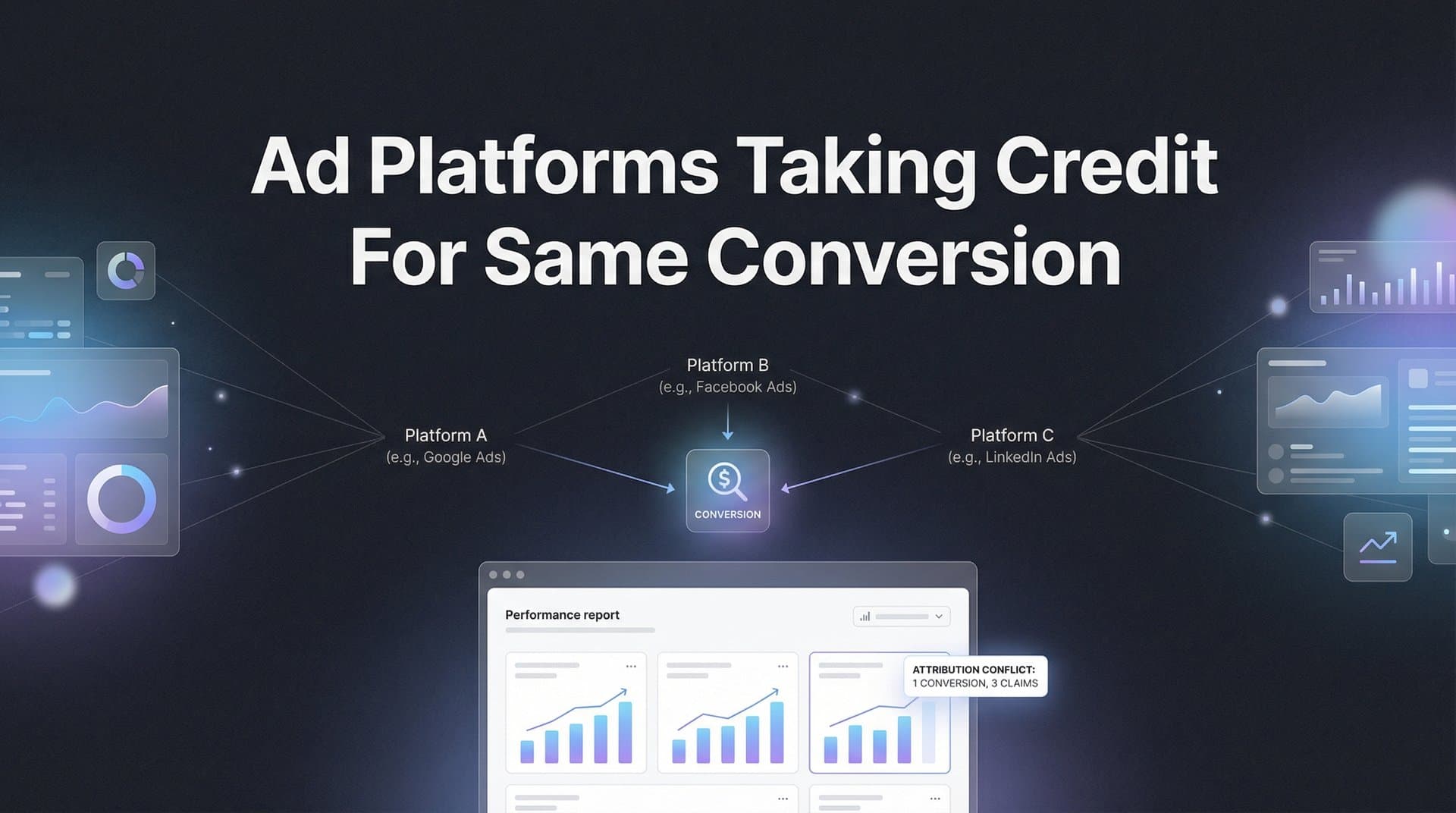
You pull up your monthly marketing dashboard, coffee in hand, ready to celebrate another strong month. Meta Ads Manager shows 200 conversions. Impressive. Google Ads reports 180 conversions. Even better. TikTok claims 150 conversions. You're crushing it.
Then you check your CRM.
Total sales for the month: 300.
The math doesn't add up. According to your ad platforms, you generated 530 conversions. But your business only closed 300 deals. Where did the other 230 conversions go? Did they vanish? Were they never real?
Welcome to the duplicate attribution problem, one of the most expensive blind spots in digital marketing. When multiple ad platforms take credit for the same conversion, your performance data becomes fiction. Your ROAS calculations become meaningless. And worst of all, you start making budget decisions based on inflated numbers that don't reflect reality.
This isn't a minor reporting quirk. It's a systemic issue that affects nearly every marketer running campaigns across multiple platforms. And it's costing you real money every single day.
The Hidden Math Problem Inflating Your Marketing Results
Here's what's actually happening behind the scenes. Every ad platform operates as its own isolated tracking system. Meta has its pixel. Google has its tag. TikTok has its SDK. Each one monitors user behavior independently, applying its own attribution rules without any awareness of what other platforms are doing.
Think of it like three different security cameras watching the same store entrance, each operated by a different company. When a customer walks through the door, all three cameras record the event. All three companies claim they captured the visitor. But there was only one visitor.
The same thing happens with conversions. A potential customer clicks your Meta ad on Monday morning while scrolling Instagram. They don't buy yet. Wednesday afternoon, they see your Google search ad and click through to your site. Still browsing. Friday evening, they finally make a purchase after seeing a retargeting ad.
Meta's tracking pixel sees the Monday click and the Friday conversion within its attribution window. It claims credit. Google's tracking tag sees the Wednesday click and the Friday conversion within its attribution window. It claims credit too. Both platforms report the conversion as their success, even though only one conversion actually occurred.
This creates a mathematical impossibility where the sum of platform-reported conversions exceeds your actual sales. In many cases, marketers discover their platforms collectively claim 30% to 50% more conversions than actually happened. Some businesses see even larger discrepancies, especially when running aggressive multi-platform campaigns with overlapping audiences.
The problem compounds when you're running campaigns on three, four, or five platforms simultaneously. Each additional platform adds another layer of potential overlap. Each one operates in its own bubble, unaware that other platforms are also taking credit for the same customer actions. Understanding why ad platforms show different numbers is the first step toward solving this attribution chaos.
How Attribution Windows Create Overlapping Credit
Attribution windows are the time periods during which platforms can claim credit for conversions. And they vary dramatically across platforms, creating natural opportunities for duplicate attribution.
Meta's default attribution window is 7 days for clicks and 1 day for views. That means if someone clicks your Meta ad, Meta can claim credit for any conversion that happens within the next seven days. Google Ads uses a 30-day click attribution window by default. TikTok, LinkedIn, Twitter, Pinterest—each platform has its own attribution window settings.
When these windows overlap, duplicate attribution becomes inevitable. A customer might click your Meta ad on day one, your Google ad on day ten, and convert on day fifteen. Google claims the conversion because it falls within its 30-day window. Meta doesn't claim it because it falls outside its 7-day window. But if the conversion happened on day five instead, both platforms would claim it.
View-through conversions make this problem significantly worse. These are conversions that platforms attribute to ad impressions, even when the user never clicked. Meta's 1-day view window means that if someone simply sees your ad in their feed and converts within 24 hours, Meta takes credit—regardless of whether they actually engaged with the ad.
Consider how many ads your target audience sees daily across all platforms. Hundreds, easily. If even a small fraction of those impressions fall within attribution windows, and those users eventually convert through any channel, multiple platforms will claim credit for conversions they didn't actually influence. This attribution confusion across multiple ad platforms is why marketers struggle to understand true performance.
The definition of "conversion" itself varies between platforms, adding another layer of complexity. One platform might count a form submission as a conversion. Another might only count completed purchases. A third might include email signups. When platforms define success differently but all report "conversions," comparing performance becomes an exercise in comparing apples to oranges to bananas.
The Real Cost of Duplicate Attribution to Your Budget
Inflated conversion numbers aren't just a reporting annoyance. They directly impact your budget allocation decisions, and those decisions compound over time into significant wasted spend.
When Meta reports a 5:1 ROAS based on 200 conversions, but 80 of those conversions are duplicates also claimed by other platforms, the real ROAS is closer to 3:1. You think you've found a winning channel and increase Meta's budget by 50%. But you're scaling based on phantom performance that doesn't exist.
Meanwhile, another channel might be genuinely driving incremental revenue but appears to underperform because other platforms are stealing credit for its conversions. You cut its budget or pause it entirely, eliminating a channel that was actually profitable.
Over months and quarters, these misguided decisions compound. You pour more money into channels that look like rock stars but are actually taking credit for other channels' work. You starve channels that are genuinely driving growth but don't get proper attribution. Your overall marketing efficiency declines even as individual platform dashboards show improving metrics.
The trust problem might be even more damaging than the budget problem. When your team realizes that platform data doesn't match reality, they stop trusting the numbers entirely. Marketing becomes driven by gut feelings, personal biases, and whoever argues most convincingly in meetings. Data-driven decision making gives way to politics and guesswork.
CFOs and executives start questioning marketing's credibility. When you report 530 conversions but finance only sees 300 sales, you lose the ability to make a compelling case for increased marketing investment. The disconnect between marketing's reported success and the company's actual revenue creates organizational friction that undermines marketing's strategic value. This is why marketing attribution platforms with revenue tracking have become essential for modern marketing teams.
Why Platform-Native Reporting Cannot Solve This Problem
You might wonder why ad platforms don't simply fix this problem themselves. The answer is simple: they can't, and they're not particularly motivated to try.
Each ad platform only sees its own touchpoints. Meta has no visibility into Google's clicks. Google can't see TikTok's impressions. LinkedIn doesn't know about your Meta retargeting campaigns. They operate as walled gardens by design, with no data sharing between competitors.
This technical limitation makes cross-platform deduplication impossible from within any single platform. Meta can't remove conversions that Google also claimed because Meta doesn't know Google claimed them. No platform has the complete picture of the customer journey across all marketing touchpoints. This is the core reason why marketers can't track conversions across multiple platforms using native tools alone.
There's also an incentive problem. Ad platforms make money when advertisers spend more. Showing favorable attribution results encourages continued and increased spending. While platforms aren't deliberately deceiving advertisers, they're not incentivized to deflate their reported performance by accounting for conversions other platforms might have influenced.
Some marketers attempt manual reconciliation, exporting data from each platform and trying to deduplicate conversions in spreadsheets. This approach is time-consuming, error-prone, and ultimately futile. Without a unified tracking system that captures all touchpoints with consistent user identification, you're just making educated guesses about which platform really deserves credit.
The post-iOS 14.5 privacy changes have made platform reporting even less reliable. With limited pixel tracking, platforms increasingly rely on modeled conversions and probabilistic matching. These statistical estimates can inflate numbers further, as platforms use algorithms to guess at conversions they can't directly measure. Understanding these tracking issues across multiple ad platforms helps explain why discrepancies have grown worse in recent years.
Building a Single Source of Truth for Conversion Data
The solution to duplicate attribution requires stepping outside the walled gardens entirely. You need an independent system that captures all marketing touchpoints across every platform, connects them to actual revenue data, and applies consistent attribution logic to determine what really drove each conversion.
This starts with unified tracking that monitors the complete customer journey. Instead of relying on each platform's isolated pixel, you implement a tracking system that captures every ad click, every impression, every email open, every website visit, and every conversion in one centralized database. This gives you a complete view of how customers actually interact with your marketing across all channels. Learning how to track conversions across multiple ad platforms is fundamental to solving the duplicate attribution problem.
Server-side tracking has become essential for accuracy in the post-iOS era. Unlike pixel-based tracking that runs in the user's browser and can be blocked by privacy settings or ad blockers, server-side tracking captures data directly from your server. This provides more reliable, complete data that isn't affected by browser restrictions or user privacy settings.
The critical piece is connecting your marketing data to your actual source of truth: your CRM, your order database, your subscription system—wherever your real conversions live. When you can match marketing touchpoints to actual revenue events in your business systems, you can finally see which marketing activities truly drove which sales.
This unified view enables true deduplication. When you see that a customer clicked a Meta ad, then a Google ad, then converted, you can apply a consistent attribution model to determine credit allocation. Maybe you use first-click attribution to credit Meta. Maybe you use last-click to credit Google. Maybe you use a multi-touch model to split credit proportionally. The key is that you're making one decision based on complete data, not accepting multiple platforms' conflicting claims.
Platforms like Cometly capture every touchpoint across all your marketing channels and connect them to your actual revenue data. This provides the complete, accurate view that platform-native reporting can never deliver. You see the real customer journey, understand which channels genuinely drive conversions, and can make budget decisions based on truth rather than inflated platform claims.
Putting Accurate Attribution Into Practice
Start by quantifying the problem in your own marketing. Export conversion data from each platform for the past month. Add up the total conversions reported. Compare that number to your actual sales or leads from your CRM. The gap between these numbers is your duplicate attribution problem.
For many businesses, this exercise is eye-opening. Seeing that platforms collectively claim 40% or 50% more conversions than actually occurred makes the problem concrete and urgent. It also gives you a baseline to measure improvement against as you implement better tracking. A marketing analytics dashboard for multiple platforms can help you visualize these discrepancies clearly.
Implement multi-touch attribution to understand the real customer journey. Most conversions don't happen from a single touchpoint. Customers typically interact with multiple ads across multiple platforms before converting. Multi-touch attribution models—whether linear, time-decay, or position-based—provide a more nuanced view of how different channels work together to drive conversions. Reviewing a multi-touch attribution platforms comparison can help you choose the right approach for your business.
The goal isn't to pick the "perfect" attribution model. Different models serve different strategic purposes. The goal is to have one consistent model applied to complete data, rather than accepting each platform's self-serving attribution claims.
Use your accurate conversion data to improve ad platform performance. Modern ad platforms use conversion data to optimize their algorithms. When you feed conversion data back to ad platforms through Conversion API or similar server-side integrations, their AI gets better training data. This improves targeting, bidding, and creative optimization, actually increasing your real ROAS over time.
Make budget allocation decisions based on incremental impact rather than last-click credit. The channel that gets the last click before conversion isn't necessarily the channel that made the conversion happen. Understanding the full journey helps you invest in channels that genuinely drive new customers, not just channels that happen to be present when customers were already ready to buy.
Moving Forward with Clarity and Confidence
Duplicate attribution isn't a minor reporting quirk you can ignore. It's a systemic problem that inflates your performance data, distorts your budget decisions, and ultimately wastes your marketing spend. Every day you operate with inaccurate attribution is another day you're potentially investing in the wrong channels and missing opportunities to scale what actually works.
The good news is that this problem is completely solvable. With independent tracking that captures all touchpoints, server-side data collection that isn't affected by browser restrictions, and integration with your actual revenue data, you can finally see the truth about what's driving your business growth.
Accurate attribution transforms marketing from guesswork into science. You know which channels deserve more budget. You can confidently scale campaigns that drive real revenue. You make decisions based on data you trust. And you can prove marketing's value to executives with numbers that match the company's actual results.
The duplicate attribution problem has been hiding in plain sight for years, accepted as an unavoidable reality of multi-platform marketing. But it doesn't have to be. With the right tools and approach, you can cut through the noise, eliminate the duplicates, and finally understand what's really working in your marketing.
Ready to elevate your marketing game with precision and confidence? Discover how Cometly's AI-driven recommendations can transform your ad strategy. Get your free demo today and start capturing every touchpoint to maximize your conversions.


