You open Meta Ads Manager and see 247 conversions this month. Google Ads reports 312 conversions. TikTok claims 189. You pull up your actual sales data: 285 total orders. The math doesn't work. You're not losing your mind—you're experiencing the attribution chaos that plagues every marketer running campaigns across multiple platforms.
This isn't a reflection of your skills or a sign that something's broken in your setup. It's a fundamental problem with how ad platforms measure success. Each platform operates in its own bubble, applying different rules to claim credit for conversions. The result? Inflated numbers, conflicting data, and budget decisions based on incomplete information.
Here's the truth: when platforms grade their own homework, everyone gets an A+. But behind those impressive dashboards lies a messy reality where the same customer journey gets counted multiple times, channels compete for credit they may not deserve, and your actual return on ad spend remains frustratingly unclear.
This guide cuts through the confusion. We'll explore why attribution breaks down across multiple platforms, what it's costing you in wasted budget and missed opportunities, and most importantly, how to build a single source of truth that shows what's really driving revenue.
The Attribution Tug-of-War: Why Every Platform Claims the Win
Picture a customer's journey to purchase. They see your Meta ad on Monday morning, click through but don't buy. Tuesday evening, they search your brand name on Google and click that ad. Wednesday, they see a TikTok video about your product. Friday, they return directly to your site and make a purchase.
Who gets credit for that sale?
According to Meta: they do. Their default 7-day click attribution window means that Monday click still counts. According to Google: they do. That Tuesday brand search falls well within their 30-day click window. According to TikTok: they might claim it too, depending on when that video view happened and their 7-day click, 1-day view attribution model.
Three platforms, one conversion, three claims of victory. This isn't a bug—it's exactly how attribution windows are designed to work.
Each ad platform uses different measurement rules that determine which touchpoints earn credit. Meta's default 7-day click, 1-day view window means any click within the past week or view within the past day can claim the conversion. Google Ads stretches that to 30 days for clicks. LinkedIn uses a 30-day click window. Pinterest offers 30-day click, 1-day view. These aren't arbitrary numbers—they're business decisions.
Think about the incentives at play. Ad platforms want you to keep spending with them. Their reported metrics directly influence your budget allocation decisions. When a platform shows strong conversion numbers, you're more likely to increase spend. When numbers look weak, you might pause campaigns or shift budget elsewhere.
This creates a fundamental conflict of interest. The same entity running your ads is also measuring their effectiveness. It's like asking a student to grade their own test—you're going to see generous scoring.
The technical reality makes this worse. When a conversion happens, each platform's tracking pixel or SDK fires independently. Meta's pixel sees the conversion and checks: did this user click or view one of our ads recently? If yes, conversion claimed. Google's tag does the same check with its own attribution rules. TikTok's pixel runs its own calculation. Nobody's comparing notes or coordinating credit.
The result is systematic overcounting. When you add up conversions across all your ad platforms, the total often exceeds your actual sales by significant margins. Some marketers report platform-claimed conversions running 150% to 200% of actual orders. Every platform is telling the truth according to their own measurement rules—but collectively, they're painting a distorted picture of reality. Understanding the multiple ad platforms tracking problem is the first step toward solving it.
The Real Cost of Attribution Confusion on Your Marketing Budget
Attribution confusion isn't just an annoyance—it's actively costing you money and undermining your marketing effectiveness.
The most immediate impact hits your budget allocation. When you can't trust which channels actually drive revenue, you can't confidently decide where to invest more or pull back. You might be pouring thousands into a channel that looks like a star performer because it has a favorable attribution window, while the channel that actually initiated most of those customer journeys gets starved of budget.
Consider a common scenario: Google brand search campaigns typically show excellent conversion rates and low cost per acquisition. They look like your best performing channel. But many of those conversions started with discovery on Meta, TikTok, or another platform. The customer learned about you elsewhere, then searched your brand name when they were ready to buy. Google gets the last click and claims the conversion, but did it really drive that sale, or just capture demand created by other channels?
Without accurate attribution, you can't answer that question. So you might dramatically increase Google brand search spend, only to find that conversions don't scale proportionally. You were optimizing for a channel that was mostly harvesting demand rather than creating it.
Customer acquisition cost becomes impossible to calculate accurately when conversions are double or triple-counted. If you spent $10,000 on ads this month and platforms report 500 total conversions, your CAC looks like $20. But if you actually got 300 conversions, your true CAC is $33—a 65% difference. That gap completely changes your unit economics and profitability calculations. Implementing proper revenue tracking through attribution platforms eliminates this guesswork.
This uncertainty creates decision paralysis. When your Meta dashboard, Google Ads interface, and analytics platform all tell different stories about what's working, how do you decide what to do next? Some marketers freeze, maintaining status quo budgets because they lack confidence to make changes. Others revert to gut feelings and assumptions, essentially throwing away the data-driven approach they invested in building.
The strategic cost runs even deeper. Attribution confusion prevents you from understanding which marketing tactics actually work for your business. You can't identify your most valuable customer segments if you don't know which channels reached them first. You can't optimize your funnel if you can't see how customers move through it across platforms. You can't test new channels confidently if you can't measure their true impact.
Over time, this compounds. While competitors with accurate attribution continuously refine their strategy and improve efficiency, you're stuck making decisions based on fragmented, conflicting data. The performance gap widens month after month.
iOS Privacy Changes and the Tracking Breakdown
Just when marketers were getting comfortable with pixel-based tracking and platform attribution, Apple fundamentally changed the game.
iOS 14.5, released in April 2021, introduced App Tracking Transparency—a requirement that apps explicitly ask permission before tracking users across other apps and websites. The result? Most iOS users opted out of tracking. Estimates suggest that over 70% of iOS users have denied tracking permission, creating massive blind spots in platform-reported data.
For Meta in particular, this was devastating. A huge portion of their ad delivery and conversion tracking relied on the Facebook and Instagram iOS apps being able to track user behavior across the web. When that capability vanished overnight, conversion tracking accuracy plummeted.
Platforms responded by introducing modeled conversions—statistical estimates of conversions they can't directly measure. When Meta can't track whether an iOS user converted after seeing your ad, their models attempt to infer conversions based on patterns from users they can track. Google uses similar modeling approaches to fill data gaps.
The problem? These models vary widely in accuracy. They work reasonably well for large campaigns with substantial conversion volume, where statistical patterns are clear. But for smaller advertisers or campaigns with lower conversion counts, modeled data becomes increasingly unreliable. You might see estimated conversions that never actually happened, or miss real conversions that the model failed to infer.
This modeling introduces another layer of discrepancy between platforms. Not only do Meta and Google use different attribution windows—they're now also using different statistical models to estimate the conversions they can't measure directly. Two platforms looking at the same campaign can produce wildly different conversion counts based on how their models interpret incomplete data. Learning how to fix attribution discrepancies becomes essential in this environment.
Browser restrictions compound these challenges beyond iOS. Safari's Intelligent Tracking Prevention limits cookie lifespans and restricts cross-site tracking. Firefox Enhanced Tracking Protection blocks many third-party cookies by default. Chrome is gradually phasing out third-party cookies entirely, though the timeline keeps shifting.
Each new privacy restriction creates additional gaps in platform tracking. The cookie-based tracking that powered digital advertising for two decades is crumbling. Platforms are adapting with server-side solutions and privacy-preserving measurement approaches, but the transition period has left attribution in chaos.
The practical impact for marketers is straightforward: you can't trust platform-reported conversions as much as you used to. The numbers you see in Meta Ads Manager or Google Ads likely undercount actual conversions, but by how much varies unpredictably. This uncertainty makes attribution confusion even worse—not only are platforms using different measurement rules, they're also working with incomplete data and filling gaps with estimates.
Attribution Models Explained: Finding the Right Lens for Your Data
Understanding attribution models is essential to making sense of cross-platform data. Each model applies different rules for distributing credit across touchpoints in a customer journey.
Last-click attribution gives 100% credit to the final touchpoint before conversion. This is the simplest model and what many platforms default to. If a customer clicks a Google ad and immediately purchases, Google gets full credit. The appeal is clarity—one touchpoint, one conversion, easy to understand.
The downside? Last-click systematically undervalues awareness and consideration channels. The Meta ad that introduced your brand, the YouTube video that built interest, the email that kept you top of mind—none of those get credit under last-click. Only the final interaction counts, which typically favors bottom-funnel channels like brand search and retargeting.
First-click attribution flips this logic, giving 100% credit to the initial touchpoint that started the customer journey. This model values discovery and awareness channels, making it useful for understanding what drives new customer acquisition. But it ignores everything that happened between first touch and purchase—all the nurturing, remarketing, and consideration-stage content that moved the customer toward buying.
Linear attribution distributes credit equally across all touchpoints. If a customer had five interactions before converting, each gets 20% credit. This model acknowledges that multiple channels contribute to conversions, but assumes all contributions are equal—which often doesn't reflect reality. The initial awareness ad and the final retargeting click probably didn't have the same impact.
Time-decay attribution gives more credit to touchpoints closer to the conversion. An interaction that happened yesterday gets more weight than one from last week. This model reflects the intuition that recent touchpoints are more influential in the final purchase decision, while still acknowledging earlier interactions played a role.
Position-based attribution (also called U-shaped) gives 40% credit to the first touchpoint, 40% to the last, and distributes the remaining 20% across middle interactions. This model values both discovery and conversion while acknowledging the journey in between. Exploring multi-touch attribution models helps you determine which approach fits your business.
So which model is right? It depends on your business, sales cycle, and what you're trying to optimize.
For businesses with short sales cycles where customers typically buy immediately after discovering you, last-click might be sufficient. Most conversions happen in a single session, so there aren't many multi-touch journeys to account for.
For businesses with longer consideration periods and multiple touchpoints before purchase, multi-touch attribution becomes essential. You need to understand how awareness channels, mid-funnel content, and conversion tactics work together. A position-based or time-decay model better reflects how customers actually move through your funnel.
The key insight: there's no single "correct" attribution model. Each one is a lens that reveals certain truths while obscuring others. Last-click shows you what closes deals. First-click shows you what starts them. Multi-touch models attempt to show the full journey. The model you choose shapes what you see—and therefore what you optimize.
This is why attribution confusion intensifies across multiple platforms. Not only is each platform using different attribution windows, they might also be using different attribution models. Meta might use last-click, Google might use data-driven attribution (their algorithmic model), and your analytics platform might use linear. Same customer journey, three different credit distributions, three different stories about what worked. Understanding the differences between Google Analytics and attribution platforms clarifies why these discrepancies occur.
Building a Single Source of Truth Across All Channels
The solution to attribution confusion isn't trying to reconcile conflicting platform reports—it's building an independent measurement system that tracks the complete customer journey across all channels.
Server-side tracking forms the foundation. Instead of relying on browser-based pixels and cookies that get blocked by privacy settings, server-side tracking captures conversion events on your server before sending them to ad platforms and analytics tools. When a customer completes a purchase, your server records that conversion and forwards the data to Meta, Google, and other platforms through their server-side APIs.
This approach bypasses browser restrictions and ad blockers. Even if a customer has disabled tracking in their iOS settings or uses a browser that blocks third-party cookies, your server still captures the conversion because it happens on the backend. This dramatically improves tracking accuracy compared to pixel-only approaches.
Server-side tracking also gives you control over what data gets shared with each platform and how it's attributed. Instead of letting each platform independently claim conversions based on their own rules, you become the source of truth. You decide which touchpoint gets credit and send that information consistently to all platforms.
The next step is connecting all your data sources—ad platforms, website analytics, CRM, and any other systems that touch the customer journey. When these systems operate in silos, you get fragmented views of customer behavior. Connecting them creates a unified customer journey map that shows every interaction from first ad impression through purchase and beyond.
This means integrating your Meta Ads account, Google Ads, TikTok Ads, LinkedIn, and any other advertising platforms with your website tracking and CRM. When someone clicks a Meta ad, that interaction gets logged. When they later fill out a form on your website, that connects to the same customer profile. When they convert, you can see the complete path they took. A cross-platform attribution tool makes this integration seamless.
Unified attribution platforms make this connection possible at scale. Rather than manually trying to stitch together data from multiple sources, these platforms automatically collect touchpoint data from all your marketing channels and apply consistent attribution logic across everything.
With a unified view, you can finally compare apples to apples. Instead of seeing that Meta reported 150 conversions while Google reported 200, you see that 180 actual customers converted, and you can analyze which touchpoints each customer interacted with before purchasing. Some conversions involved only Meta ads. Others touched Meta, then Google, then converted. Others started with organic search, moved to Meta, then converted via email.
This level of visibility transforms how you understand marketing performance. You're no longer asking "which platform performed best?" based on each platform's self-reported metrics. You're asking "which channels and touchpoints contributed most to actual revenue?" based on complete customer journey data. Implementing unified marketing reporting gives you this comprehensive perspective.
The technical implementation requires some setup, but it's more accessible than many marketers assume. Modern attribution platforms handle most of the complexity—connecting to ad platform APIs, implementing server-side tracking, and building unified reporting dashboards. The investment in getting this infrastructure right pays dividends in every budget decision you make going forward.
Putting Accurate Attribution Data to Work
Having accurate attribution data is valuable—but only if you actually use it to make better decisions.
The first application is budget reallocation. When you see which channels truly drive revenue versus which ones just claim credit for conversions others initiated, you can shift spending toward genuine performance. You might discover that your TikTok campaigns, which looked mediocre in last-click attribution, actually play a crucial role in starting customer journeys that convert days later through other channels. Or you might find that a channel with impressive platform-reported numbers is mostly taking credit for conversions it didn't really influence.
This reallocation should be gradual and test-driven. Don't immediately slash budget from channels that appear overvalued—they might still play important supporting roles. Instead, run controlled tests where you adjust spend levels and measure impact on total conversions, not just platform-reported metrics. Let actual revenue results guide your optimization.
The second application is feeding better data back to ad platforms. This might seem counterintuitive—if platforms inflate their metrics, why send them more data? Because ad platform algorithms need accurate conversion signals to optimize effectively.
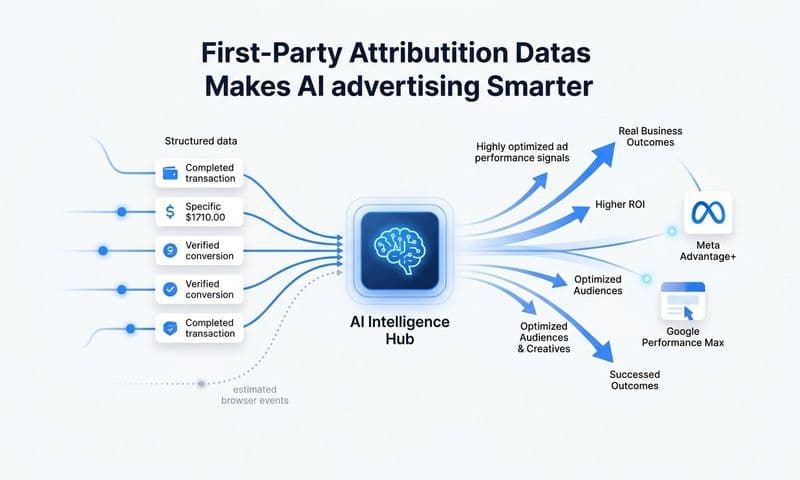
When you use server-side tracking to send complete, accurate conversion data to Meta and Google, their machine learning systems get clearer feedback about what's working. They can identify which audiences, creatives, and placements actually drive conversions rather than which ones happen to get last-click credit. This improves automated bidding, audience targeting, and creative optimization.
Conversion sync—sending enriched conversion events from your attribution platform back to ad platforms—closes this loop. You're not just collecting better data for your own analysis. You're using that data to make ad platform algorithms smarter, which improves campaign performance. Mastering how to track conversions across multiple ad platforms enables this optimization cycle.
The third application is building confidence in scaling decisions. When you know with certainty which campaigns drive profitable growth, you can scale aggressively without the nagging worry that your data might be misleading you. You're not gambling on whether a channel will continue performing at higher spend levels—you're making calculated decisions based on complete attribution data.
This confidence extends to testing new channels and tactics. With accurate attribution, you can measure the true impact of launching on a new platform or trying a new campaign strategy. You'll see not just whether it generates conversions, but how it affects the entire customer journey and whether those conversions are incremental or cannibalized from existing channels.
Accurate attribution also enables more sophisticated optimization. You can analyze which combinations of channels work best together, identify optimal budget ratios between awareness and conversion campaigns, and understand how changes in one channel ripple through your entire marketing mix. This systems-level thinking is impossible when you're stuck reconciling conflicting platform reports. Investing in attribution tracking tools makes this level of analysis possible.
Moving Beyond Platform Reports to Marketing Clarity
Attribution confusion across multiple ad platforms isn't a problem you have to live with. It's a solvable challenge that comes down to moving beyond platform-reported metrics to a unified view of customer journeys.
The core issue—platforms using different attribution windows and models while grading their own performance—won't change. Meta, Google, and TikTok will continue optimizing for their own reporting. But you don't have to accept their fragmented, inflated numbers as truth.
Building accurate attribution requires three fundamental shifts. First, implement server-side tracking to capture conversions that browser-based pixels miss. Second, connect all your marketing data sources to create a complete view of customer journeys across channels. Third, apply consistent attribution logic across all touchpoints so you're comparing performance on equal terms.
This isn't just about cleaner reports or satisfying data curiosity. Accurate attribution directly impacts revenue. It prevents budget waste on channels that look good but don't perform. It identifies high-value channels you're underinvesting in. It gives you confidence to scale what works and cut what doesn't.
When you can see which ads and channels truly drive results, every marketing decision becomes clearer. You stop second-guessing budget allocations because platform numbers conflict. You stop leaving money on the table by undervaluing channels that play crucial early-stage roles. You stop scaling campaigns based on inflated metrics that don't reflect reality.
The marketers winning in this multi-platform landscape aren't the ones with the biggest budgets—they're the ones with the clearest view of what's actually working. They've built systems that track the complete customer journey, apply consistent attribution across channels, and use that insight to optimize relentlessly.
That clarity is within reach. The technology exists. The methodologies are proven. What's required is the decision to stop accepting attribution confusion as inevitable and start building the measurement infrastructure your marketing deserves.
Ready to elevate your marketing game with precision and confidence? Discover how Cometly's AI-driven recommendations can transform your ad strategy—Get your free demo today and start capturing every touchpoint to maximize your conversions.