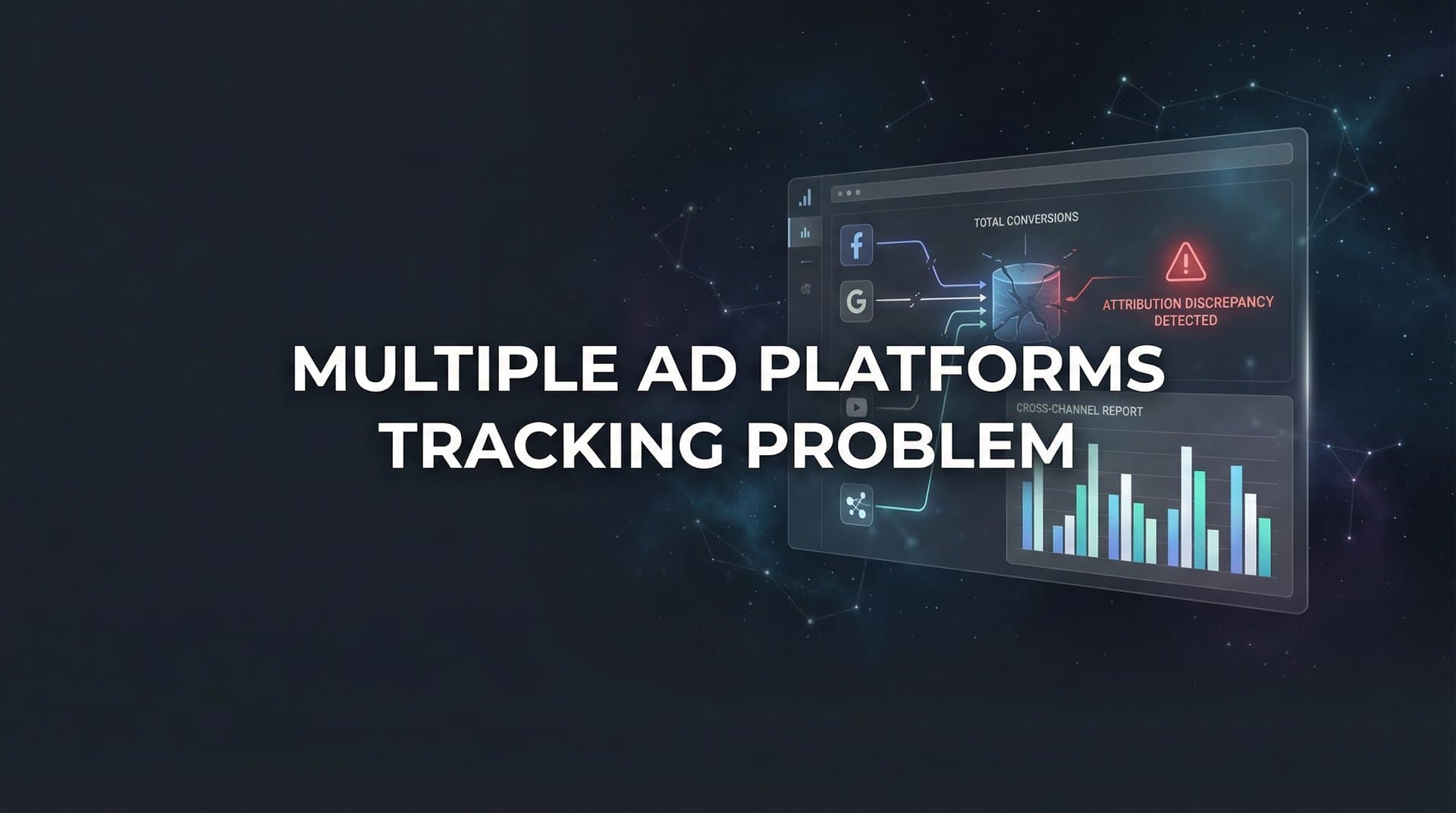
You're staring at three dashboards, and none of them agree. Meta Ads Manager says you drove 47 conversions this week. Google Ads claims 52. TikTok insists it delivered 38. Your Shopify backend? It shows exactly 41 actual sales.
The math doesn't just fail to add up—it actively contradicts reality. You're looking at 137 reported conversions across platforms for 41 real purchases. That's a 234% inflation rate on your success metrics.
Welcome to the multiple ad platforms tracking problem, the silent budget killer plaguing modern digital marketing. It's not a technical glitch or a temporary issue—it's the inevitable result of running campaigns across platforms that were never designed to share credit or tell a unified story. Each platform operates as its own walled garden, using attribution rules engineered to make itself look good, not to reflect marketing reality.
This isn't just an analytics headache. When your tracking data doesn't align with actual revenue, every strategic decision becomes a gamble. You're scaling campaigns that might not deserve more budget. You're cutting channels that could be essential supporting players. You're feeding optimization algorithms with inflated success signals that corrupt their targeting over time.
The stakes have never been higher. With CPMs climbing and privacy regulations tightening, marketers can't afford to operate on unreliable data. Yet most teams still rely on platform-native reporting that fundamentally misrepresents how their marketing actually performs.
This article breaks down exactly why the multiple ad platforms tracking problem happens, what it's costing you beyond wasted ad spend, and how modern attribution approaches finally solve it. You'll understand the mechanics behind attribution overlap, recognize the hidden costs in your current setup, and learn the technical foundation that makes accurate cross-platform tracking possible in 2026.
When Every Platform Claims the Win: Understanding Attribution Overlap
The core issue is deceptively simple: every ad platform uses different rules to decide when it deserves credit for a conversion. Meta counts conversions within a 7-day click or 1-day view window. Google Ads defaults to 30 days for clicks. TikTok uses 7-day click and 1-day view. LinkedIn operates on a 30-day click window.
These aren't just arbitrary timeframes—they're strategic choices. Longer attribution windows capture more conversions. More lenient view-through attribution (counting conversions after someone merely saw an ad without clicking) inflates numbers further. Each platform calibrates its methodology to maximize reported performance.
Here's what happens in practice. A potential customer sees your Meta ad on Monday but doesn't click. Tuesday, they search for your brand on Google and click your ad. Wednesday, they return directly to your site and purchase. Meta claims that conversion because the purchase happened within their 1-day view window. Google claims it because the customer clicked their ad within 30 days of converting. Your analytics might attribute it to direct traffic since that was the final touchpoint.
Three platforms, one conversion, three claims of credit. Multiply this across dozens of customer journeys per day, and you understand why reported conversions routinely exceed actual sales by 200-300%.
Platform-native tracking isn't designed to be objective. Meta's pixel exists to prove Meta's value. Google's conversion tracking exists to justify Google's ROI. Neither platform has incentive to acknowledge that other channels contributed to the same sale. They're measuring their own performance in isolation, not your marketing performance holistically.
The attribution window differences create particularly absurd scenarios. A customer who clicks a Google ad on Day 1, sees a Meta ad on Day 15, and converts on Day 20 will be counted by Google (within 30 days) but not Meta (beyond 7 days). Change the timeline slightly—click Google on Day 1, see Meta on Day 25, convert on Day 28—and suddenly Meta counts it while Google doesn't.
These overlaps aren't edge cases. They're the norm for any business running multi-platform campaigns. The typical customer journey involves multiple touchpoints across several days or weeks. Every touchpoint becomes a potential attribution claim.
The math will never add up when you're adding platform totals. You're not measuring discrete sets of conversions—you're counting the same conversions multiple times through different attribution lenses. It's like three people each claiming they drove the entire distance on a road trip because they each took a turn at the wheel.
Understanding this overlap is the first step toward fixing it. The problem isn't that platforms are lying—they're accurately reporting their own attribution rules. The problem is treating those self-serving attribution reports as objective measures of marketing performance. Learning how to track conversions across multiple ad platforms requires moving beyond these siloed reports.
The Hidden Costs of Fragmented Tracking Data
The multiple ad platforms tracking problem doesn't just create confusing dashboards—it actively damages your marketing effectiveness in ways that compound over time.
Start with budget misallocation. When you're making spending decisions based on inflated conversion numbers, you're optimizing toward a fiction. That Meta campaign showing a 3.2 ROAS might actually be delivering 1.8 ROAS when you account for attribution overlap with other channels. You scale it aggressively, shifting budget from genuinely high-performing channels, and your overall efficiency drops.
Many marketing teams pour money into channels that appear to perform well in isolation but aren't actually driving incremental conversions. They're claiming credit for sales that would have happened anyway through other channels. Without accurate attribution, you can't distinguish between channels that create demand and channels that capture existing demand.
The optimization blindness runs deeper. Ad platform algorithms learn from the conversion data you feed them. When you're sending inflated conversion signals—counting the same sale multiple times across platforms—you're teaching algorithms that certain targeting parameters and creative approaches work better than they actually do.
Meta's algorithm thinks it's crushing performance, so it doubles down on lookalike audiences and placements that are actually just capturing bottom-funnel demand from other channels. Google's Smart Bidding optimizes toward conversion patterns that include significant attribution overlap. The algorithms become increasingly confident in strategies built on bad data.
This creates a downward spiral. As algorithms optimize toward inflated success metrics, they drift further from genuinely effective targeting. Real performance degrades, but platform reporting still looks strong because attribution overlap continues. You don't realize efficiency is dropping until you notice revenue isn't scaling proportionally with ad spend.
Then there's decision paralysis. When your data contradicts itself, you can't move with confidence. Should you scale that TikTok campaign that's showing strong conversions? Or is it just stealing credit from your Google campaigns? Should you cut that LinkedIn campaign with weak reported performance? Or is it an essential upper-funnel touchpoint that other platforms are taking credit for?
Teams spend hours in meetings debating which platform's numbers to trust. They build elaborate spreadsheets trying to reconcile conflicting data. They delay strategic decisions because they can't confidently answer basic questions about what's working.
The opportunity cost is enormous. While you're stuck in analysis paralysis, competitors with better attribution are scaling winners and cutting losers decisively. They're feeding their ad algorithms accurate conversion data that improves targeting. They're allocating budget based on actual incremental performance rather than self-reported platform metrics.
Perhaps most insidiously, fragmented tracking erodes trust in your marketing data entirely. When the numbers never add up, teams start making decisions based on gut feel rather than analytics. The entire promise of data-driven marketing collapses when you can't trust the data. Understanding why you need ad tracking management software becomes clear when you see these compounding costs.
Why Traditional Tracking Methods Fall Short in 2026
The multiple ad platforms tracking problem has always existed, but it's dramatically worse now than it was five years ago. Privacy changes and browser restrictions have fundamentally broken the tracking methods most marketers still rely on.
iOS 14.5, released in 2021, marked the inflection point. Apple's App Tracking Transparency framework forced apps to ask permission before tracking users across other apps and websites. The majority of users opted out. Overnight, Meta lost visibility into a massive portion of iOS conversions that its pixel previously tracked.
The impact was immediate and severe. Many advertisers reported 20-30% drops in tracked conversions on Meta, not because performance actually declined, but because the tracking mechanism could no longer see those conversions happening. The conversions were real—the pixel just couldn't attribute them anymore.
Cookie deprecation compounds the problem. Safari and Firefox already block third-party cookies by default. Google Chrome plans full deprecation of third-party cookies, though the timeline keeps shifting. As cookies disappear, traditional pixel-based tracking loses its ability to follow users across websites and connect ad clicks to eventual conversions.
This creates a visibility gap. Your ads are still influencing purchases. Customers are still seeing your Meta ad, clicking your Google ad, and converting on your website. But your tracking pixels can't connect those dots anymore because the browser blocks the mechanisms they rely on.
Many marketers turned to UTM parameters and Google Analytics as a solution. Tag your ad URLs with campaign parameters, track them in Analytics, and you'll know which campaigns drive conversions, right?
Not quite. UTM tracking only captures the last click before someone lands on your site. It can't tell you about the Meta ad they saw three days ago or the TikTok video they engaged with last week. You're still measuring in isolation, just through a different tool. And you're still not connecting website conversions to downstream revenue in your CRM.
A customer might click your ad, browse your site, leave without converting, then return days later via organic search and make a purchase. Your CRM records the sale. Google Analytics attributes it to organic search. Your ad platform has no idea it happened. You're missing the connection between ad spend and actual revenue. This is why Google Ads conversion tracking problems persist even with proper pixel implementation.
Manual spreadsheet reconciliation is the desperate fallback. Export data from each platform, pull revenue from your CRM, try to deduplicate conversions, allocate credit based on assumptions about how channels interact. It's time-consuming, error-prone, and still fundamentally guessing at attribution.
You might spend hours each week building reconciliation models, but you're still working with incomplete data. You can see that platform-reported conversions exceed actual sales, but you can't definitively say which specific conversions were duplicates or which channels truly drove which sales.
The gap between what traditional tracking can measure and what's actually happening in customer journeys has never been wider. Browser restrictions and privacy changes aren't temporary obstacles—they're the new permanent reality. Tracking methods built for the cookie-based web of 2015 simply don't function in 2026. Implementing first-party data tracking setup has become essential for maintaining visibility.
Server-Side Tracking: The Foundation for Accurate Multi-Platform Data
Server-side tracking represents a fundamental shift in how conversion data gets captured and shared. Instead of relying on browser-based pixels that can be blocked or restricted, server-side tracking sends conversion data directly from your server to ad platforms.
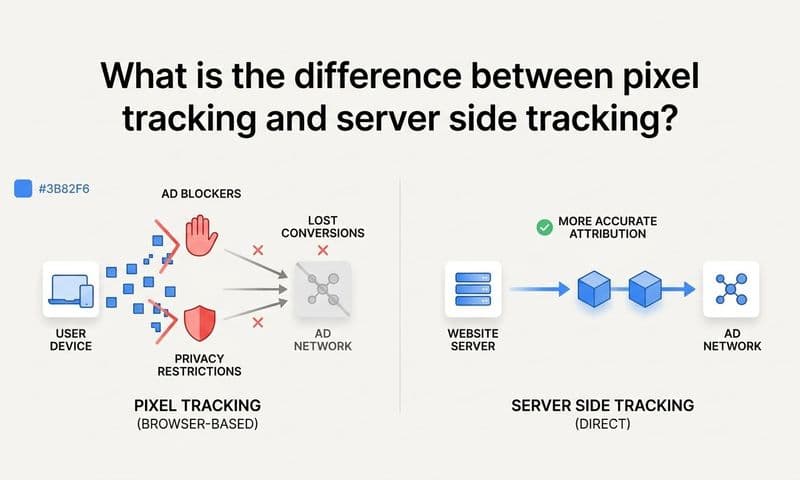
Here's the technical difference. Traditional client-side tracking works like this: a customer clicks your ad, lands on your website, and a JavaScript pixel fires in their browser. That pixel sends data back to the ad platform saying "this person visited." When they convert, another pixel fires saying "this person purchased."
But if the browser blocks third-party cookies, or if the user has tracking prevention enabled, or if they're on iOS with ATT restrictions, those pixels might not fire. The conversion happens, but the ad platform never hears about it.
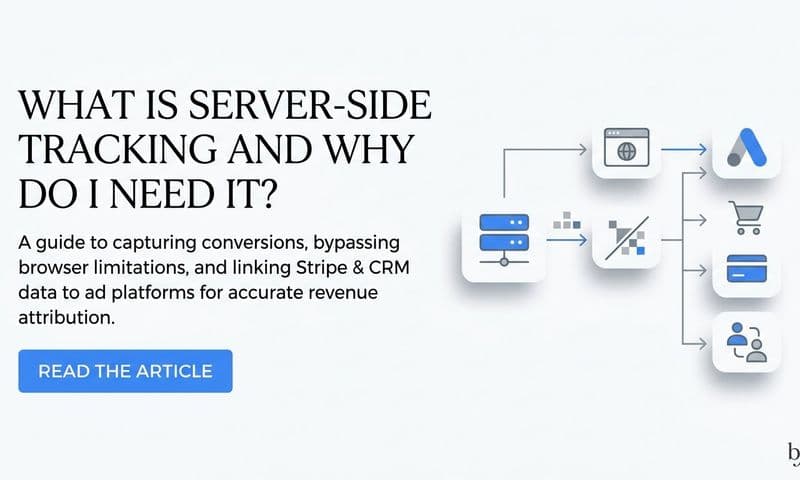
Server-side tracking bypasses the browser entirely. When a conversion happens on your website or in your CRM, your server sends that conversion data directly to ad platforms through their APIs. No browser involvement means no browser restrictions can interfere.
This approach captures conversions that client-side pixels miss entirely. A customer who opts out of tracking on iOS, converts on your site, and enters your CRM won't trigger Meta's pixel. But your server can still send that conversion data to Meta's Conversions API, giving Meta visibility into performance that its pixel alone would miss.
The accuracy improvement is substantial. Many businesses implementing server-side tracking report 20-40% increases in tracked conversions—not because performance improved, but because they're finally seeing conversions that were always happening but going untracked. Comparing server-side tracking tools helps identify the right solution for your tech stack.
Better tracking accuracy isn't just about reporting. When you feed more complete conversion data back to ad platforms, their optimization algorithms improve dramatically. Meta's algorithm can't optimize toward conversions it doesn't know about. When server-side tracking reveals previously invisible conversions, the algorithm learns more accurate patterns about which audiences and creative approaches actually drive results.
This creates a positive feedback loop. More accurate conversion data leads to better algorithmic optimization, which improves actual performance, which generates more conversions to track and learn from. Your campaigns become more efficient because the platforms finally have reliable signals to optimize against.
Server-side tracking also enables more sophisticated attribution because you control the data flow. Your server knows the complete customer journey—every ad click, every website visit, every CRM event. You can implement custom attribution logic that accounts for the full journey rather than accepting whatever attribution window each platform uses by default.
The implementation requires technical setup. You need server infrastructure that can receive conversion events from your website and CRM, then forward them to ad platform APIs. You need to handle user matching so platforms can connect conversion data to the right ad clicks. You need to ensure data security and privacy compliance.
But the payoff is transformative. Server-side tracking is the technical foundation that makes accurate multi-platform attribution possible. It's not optional anymore—it's the baseline requirement for understanding performance in a privacy-first tracking environment. The top server-side tracking platforms handle much of this complexity automatically.
Building a Single Source of Truth Across All Channels
Server-side tracking solves the data capture problem, but you still need a unified system that connects ad platforms, website analytics, and CRM data into one coherent view. This is where marketing attribution platforms with revenue tracking become essential.
The goal is creating a single source of truth—one system that tracks the complete customer journey from first ad impression through final purchase and beyond. Instead of jumping between Meta Ads Manager, Google Ads, TikTok Analytics, and your CRM, you see all touchpoints in one place, connected to actual revenue.
Start by connecting your ad platforms. Modern attribution platforms integrate directly with Meta, Google, TikTok, LinkedIn, and other channels through APIs. They pull in ad spend, impressions, clicks, and platform-reported conversions automatically. No more manual data exports or spreadsheet reconciliation.
Then connect your website tracking. This captures non-ad touchpoints like organic search, direct traffic, email clicks, and referral sources. You're building a complete picture of every way customers interact with your brand, not just paid channels.
The critical piece is CRM integration. This is where actual revenue lives. A unified attribution system connects ad clicks and website visits to specific customers in your CRM, then tracks those customers through to purchase, subscription, or whatever conversion matters for your business.
Now you can answer questions that were impossible before. Which ad campaign generated this specific $5,000 deal in your CRM? What was the complete journey this customer took from first touchpoint to closed sale? How many touchpoints did high-value customers interact with before converting compared to low-value customers? Customer journey tracking software makes these insights accessible.
Multi-touch attribution models become possible when you have this unified data. Instead of arguing about whether Meta or Google deserves credit for a conversion, you can apply attribution models that distribute credit across all touchpoints in the journey.
Linear attribution gives equal credit to every touchpoint. Time-decay attribution gives more credit to touchpoints closer to conversion. Position-based attribution emphasizes first and last touch while still acknowledging middle touchpoints. Each model offers different insights into how channels work together.
The power is comparing models side-by-side. You might see that Google looks strong in last-click attribution but weak in first-click, suggesting it's good at capturing existing demand but not creating new demand. Meta might show the opposite pattern—strong in first-click, weaker in last-click—indicating it's effective at top-of-funnel awareness that other channels convert later.
This reveals how channels complement each other rather than compete. Your TikTok campaigns might not show many last-click conversions, but first-click and time-decay models reveal they're initiating customer journeys that Google and Meta later convert. Without multi-touch attribution, you might cut TikTok for weak performance and watch your overall conversions drop because you eliminated a crucial awareness driver. Using the best tools for tracking TikTok ads ensures you capture this upper-funnel value.
A single source of truth also enables accurate ROAS calculations. When you know actual revenue attributed to each channel (not inflated platform-reported conversions), you can calculate true return on ad spend. That Meta campaign might report 4.2 ROAS in Ads Manager but deliver 2.8 ROAS when you account for attribution overlap and connect to actual revenue. The difference between those numbers is the difference between scaling a winner and scaling a mediocre performer.
The unified view transforms daily operations. Instead of stitching together data from multiple sources, your team works from one dashboard that shows cross-platform performance, accurate attribution, and real revenue impact. Decisions become faster and more confident because the data is trustworthy. Implementing unified marketing reporting for multiple platforms eliminates the dashboard chaos.
Putting Unified Tracking Into Action
Understanding the multiple ad platforms tracking problem is one thing. Fixing it requires methodical implementation. Here's how to move from fragmented platform reporting to unified attribution that actually reflects reality.
Start with an audit of current tracking discrepancies. Document exactly how much your platform-reported conversions exceed actual sales or leads. Pull last month's data from Meta, Google, TikTok, and any other platforms you're running. Add up their reported conversions. Compare that total to actual conversions in your CRM or e-commerce platform. Calculate the inflation rate.
This baseline matters. When you implement unified tracking, you'll want to measure the improvement. Knowing you were operating with 180% inflated conversion numbers makes the subsequent accuracy gains tangible and justifies the implementation effort.
Prioritize connecting your highest-spend platforms first. If you're spending $50,000 monthly on Meta and Google but only $5,000 on LinkedIn, start with Meta and Google. You'll see the biggest ROI clarity from the channels consuming most of your budget. You can expand to additional platforms once the core infrastructure is working.
Implement server-side tracking as the technical foundation. This typically means setting up conversion tracking through platforms' server-side APIs—Meta's Conversions API, Google's Enhanced Conversions, TikTok's Events API. You'll need technical resources or a platform that handles this infrastructure for you, but it's non-negotiable for accurate tracking in 2026. A detailed cross-platform tracking setup guide can walk you through the process.
Connect your CRM to close the loop between ad spend and revenue. This is where attribution moves from tracking conversions to tracking actual business outcomes. You're no longer just measuring that someone filled out a form—you're measuring that they became a customer, generated revenue, and delivered specific ROI.
Choose attribution models that match your business reality. If you run long sales cycles with multiple touchpoints, time-decay or position-based models might reflect your customer journey better than last-click. If you're e-commerce with shorter journeys, linear attribution might be sufficient. The key is applying consistent methodology across all channels rather than accepting each platform's self-serving default. Exploring attribution tracking tools helps you find the right model for your business.
Once your unified tracking is operational, use AI-powered recommendations to identify scaling opportunities. When you trust your data, you can confidently act on insights about which campaigns, audiences, and creative approaches genuinely drive revenue. Modern attribution platforms analyze patterns across your entire marketing ecosystem and surface recommendations like "Scale this Meta campaign—it's driving 3.4 ROAS with strong first-touch attribution" or "This Google campaign shows weak incremental performance—consider reducing budget."
The transition from fragmented to unified tracking isn't instantaneous, but the impact compounds quickly. In month one, you gain clarity on which channels actually perform. In month two, you reallocate budget based on accurate data and see efficiency improve. In month three, ad platform algorithms start optimizing better because you're feeding them accurate conversion data. By month six, you're operating with confidence that was impossible under fragmented tracking.
Moving Forward With Confidence
The multiple ad platforms tracking problem isn't a minor analytics inconvenience—it's a fundamental barrier to effective marketing in 2026. When your conversion data inflates actual sales by 200-300%, when every platform claims credit for the same conversions, when privacy restrictions blind traditional pixels to real performance, you can't make sound strategic decisions. You're flying blind while pretending you can see.
The cost isn't just wasted ad spend on underperforming channels. It's the opportunity cost of not scaling genuine winners. It's the algorithmic degradation from feeding platforms bad conversion data. It's the team hours lost reconciling contradictory reports. It's the strategic paralysis from not knowing what's actually working.
The path forward is clear: server-side tracking to capture accurate conversion data despite browser restrictions, unified attribution to connect ad platforms with CRM revenue, and multi-touch models to understand how channels work together rather than compete for credit. This isn't bleeding-edge innovation—it's the baseline requirement for understanding marketing performance in a privacy-first, multi-platform world.
You don't need to accept inflated platform reporting as the best available data. You don't need to spend hours manually reconciling spreadsheets. You don't need to make budget decisions based on metrics you don't trust. Modern attribution infrastructure solves the multiple ad platforms tracking problem by creating a single source of truth that reflects actual customer journeys and real revenue.
The marketers who solve this now gain compounding advantages. They allocate budget more efficiently. They feed ad algorithms better data that improves targeting. They scale confidently because they trust their metrics. Meanwhile, competitors still operating on fragmented platform reporting continue wasting budget on attribution overlap and missing genuine opportunities.
Ready to elevate your marketing game with precision and confidence? Discover how Cometly's AI-driven recommendations can transform your ad strategy—Get your free demo today and start capturing every touchpoint to maximize your conversions.