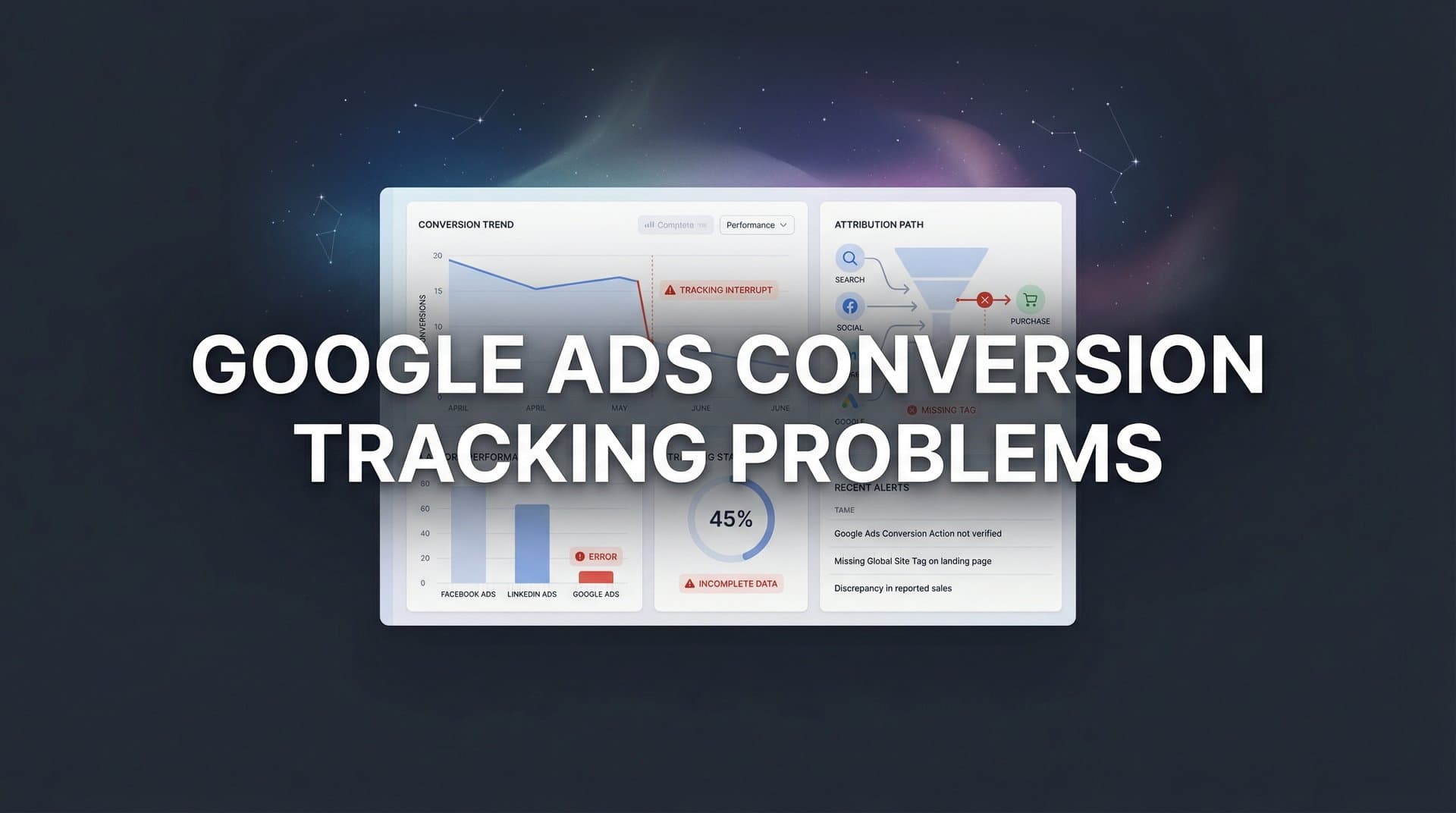
You're checking your Google Ads dashboard and something doesn't add up. Your CRM shows 47 leads from last week, but Google Ads reports only 23 conversions. Or worse—conversions are showing up days late, duplicating randomly, or not appearing at all.
Google Ads conversion tracking problems aren't just annoying; they're actively sabotaging your campaign performance. When your conversion data is inaccurate, Google's Smart Bidding algorithms optimize toward the wrong signals, your budget flows to underperforming campaigns, and you lose visibility into what's actually driving revenue.
Think of conversion tracking as the foundation of your entire Google Ads strategy. Every optimization decision, budget allocation, and performance insight depends on this data being accurate. When that foundation cracks, everything built on top of it becomes unreliable.
Many marketers experience significant discrepancies between their actual business results and what Google Ads reports. These tracking gaps can substantially impact Smart Bidding performance, causing the platform to optimize campaigns based on incomplete or incorrect signals. The result? You might be pausing profitable campaigns or scaling ones that don't actually drive revenue.
This guide walks you through a systematic troubleshooting process to identify and fix the most common conversion tracking issues. Whether you're dealing with missing conversions, duplicate counts, delayed reporting, or cross-device tracking gaps, you'll find actionable solutions to restore accurate data and regain confidence in your campaign decisions.
The key is approaching this methodically rather than randomly adjusting settings and hoping something works. By following these steps in order, you'll diagnose the root cause and implement the right fix the first time.
Step 1: Diagnose Your Specific Tracking Problem
Before you can fix anything, you need to understand exactly what's broken. Conversion tracking problems typically fall into four categories: missing conversions, duplicate conversions, delayed reporting, or misattribution.
Start by comparing your Google Ads conversion data against your source of truth—your CRM, e-commerce platform, or analytics system. Pull reports for the same date range and conversion type. Look for patterns in the discrepancy.
If Google Ads shows fewer conversions than your CRM, you're likely dealing with missing conversions. This often happens when tags fail to fire, privacy settings block tracking, or technical implementation issues prevent data from reaching Google. Understanding why Google Analytics reports missing conversions can help you identify similar patterns in your Google Ads data.
If Google Ads shows more conversions than actually occurred, you've got duplicate counting. This typically results from tags firing multiple times per conversion or incorrect counting settings that record every page view instead of unique conversions.
Delayed conversions appear when there's a time lag between when a conversion happens and when it shows up in your reports. Some delay is normal—Google Ads can take up to three hours to process conversions—but consistent multi-day delays signal a deeper problem.
Next, check your conversion action status in Google Ads. Navigate to Tools & Settings, then Conversions. Look at the Status column for each conversion action. You'll see one of three indicators: "Recording conversions" means it's working normally, "No recent conversions" suggests it's set up but not firing, and "Inactive" means it's not currently tracking.
Document the specific pattern you're seeing. Is the discrepancy consistent across all campaigns or isolated to specific ones? Does it affect all conversion types or just certain actions? Do the numbers match perfectly some days but diverge on others?
These patterns provide crucial diagnostic clues. A problem affecting all conversions points to a site-wide tag issue or account-level setting. Issues isolated to specific campaigns might indicate problems with campaign-level tracking parameters or landing page configurations.
Take screenshots of your comparison data and note the exact numbers. You'll need this baseline to verify whether your fixes actually work. Many marketers skip this step and can't tell later whether their troubleshooting efforts made any difference.
One more critical check: verify that you're comparing apples to apples. Make sure you're looking at the same conversion window in both systems. Google Ads defaults to a 30-day click window and 1-day view window, but your CRM might attribute conversions differently. Mismatched attribution windows often explain discrepancies that aren't actually tracking problems.
Step 2: Verify Your Conversion Tag Implementation
Now that you've identified your specific problem, it's time to check whether your tags are actually firing correctly. This is where most conversion tracking problems originate.
Open Google Tag Assistant, a free Chrome extension that shows you exactly which Google tags fire on any page. Navigate to your conversion page—the thank you page, order confirmation page, or wherever your conversion completes. Tag Assistant will display all Google tags detected on that page.
You should see your Google Ads conversion tracking tag fire once and only once when the page loads. If it's missing entirely, the tag isn't installed correctly. If it fires multiple times, you've found your duplicate conversion problem. For a comprehensive overview of proper implementation, review our guide on Google Ads conversion tracking fundamentals.
For a deeper dive into this space, see our Facebook ads software guide.
The conversion linker tag is equally critical but often overlooked. This tag must be present and firing on every page of your website, not just conversion pages. It stores click information in first-party cookies, enabling Google to match ad clicks to conversions even when third-party cookies are blocked.
Check multiple pages across your site with Tag Assistant. The conversion linker should fire consistently everywhere. If it's missing on some pages, especially pages in your conversion funnel, you'll lose attribution data for users who visit those pages.
Here's where things get tricky: verify the tag fires only once per conversion. Some marketers accidentally install the conversion tag in multiple places—once through Google Tag Manager, once hardcoded in the page, and once through a third-party integration. Each installation fires independently, creating duplicate conversions.
Test the complete user journey from ad click to conversion. Click one of your actual Google Ads, navigate through your site naturally, and complete a conversion. Watch Tag Assistant at each step to confirm tags fire in the correct sequence.
Pay special attention to the conversion page load. The conversion tag should fire after the page fully loads, not during redirects or before the user reaches the final confirmation page. If the tag fires too early in the process, you might count conversions that never actually complete.
If you're using Google Tag Manager, open the Preview mode and walk through the same test conversion. GTM's debug console shows you exactly when each tag fires, what data it sends, and whether it encounters any errors. Understanding event tracking in Google Analytics can help you better interpret these debug results.
Common implementation mistakes include: placing the conversion tag on multiple pages instead of just the conversion page, forgetting to install the conversion linker tag, wrapping tags in conditional code that prevents them from firing, and installing tags that reference deleted or inactive conversion actions.
Document everything you find. Take screenshots of Tag Assistant results, note which pages have which tags, and record any error messages. This documentation becomes your troubleshooting roadmap.
If your tags aren't firing at all, you'll need to reinstall them following Google's current implementation guidelines. If they're firing multiple times, identify and remove the duplicate installations. If they're firing but conversions still aren't recording, the problem lies elsewhere—likely in your conversion action settings or privacy-related restrictions.
Step 3: Audit Your Conversion Action Settings
Even when tags fire perfectly, incorrect conversion action settings can cause tracking problems. These settings control how Google processes and attributes the conversion data it receives.
Start with your attribution model. Navigate to your conversion action settings and check which model you've selected. Data-driven attribution, last click, first click, linear, time decay, and position-based models each distribute conversion credit differently across touchpoints.
The attribution model directly impacts your reported conversion numbers. If you recently changed models, that might explain sudden discrepancies. Data-driven attribution typically shows more conversions distributed across more campaigns than last-click attribution, which gives all credit to the final interaction.
Next, examine your conversion window settings. This determines how long after an ad interaction Google can attribute a conversion. The default is 30 days for clicks and 1 day for views, but your actual sales cycle might be longer or shorter.
If your conversion window is too short, you'll miss conversions that happen after the window closes. This is especially problematic for high-consideration purchases or B2B lead generation where the sales cycle extends beyond 30 days. Conversely, an unnecessarily long window might attribute conversions to ad clicks that had minimal influence.
The counting method setting often causes confusion. You can choose "One" to count only one conversion per ad click, or "Every" to count all conversions. For lead generation, you almost always want "One"—counting every form submission would inflate your numbers if someone submits multiple times. For e-commerce transactions, "Every" makes sense since each purchase represents real revenue.
Check your conversion value settings if you're tracking value-based conversions. Incorrect values throw off your ROAS calculations and cause Smart Bidding to optimize toward the wrong goals. Verify that values match your actual business metrics—use the actual purchase amount for transactions, not arbitrary placeholder numbers.
Look at your conversion category assignment. Google uses this to understand your business goal and apply appropriate optimization strategies. Misclassifying a purchase as a signup, or a lead as a page view, can impact how Smart Bidding interprets and optimizes for these conversions.
The "Include in Conversions" toggle is another frequent culprit. When enabled, the conversion action counts toward your "Conversions" column and influences Smart Bidding. When disabled, it still tracks but appears only in the "All Conversions" column. If you've accidentally disabled this for your primary conversion actions, Smart Bidding isn't seeing the data it needs. This is a common cause when Google Ads shows wrong conversions in your reports.
Related reading: our complete guide to track programmatic ads conversions.
Review your conversion action status. Even if the tag fires correctly, an inactive or removed conversion action won't record data. Check that all your important conversion actions show "Recording conversions" status and have recorded conversions recently.
Make changes deliberately and one at a time. Changing multiple settings simultaneously makes it impossible to identify which adjustment actually fixed the problem. After each change, wait at least 24 hours to see the impact on your conversion data.
Step 4: Address Browser and Privacy-Related Tracking Gaps
Privacy restrictions have fundamentally changed how conversion tracking works. iOS privacy changes, browser cookie blocking, and privacy regulations create tracking gaps that standard tag implementations can't overcome.
Safari's Intelligent Tracking Prevention, Firefox's Enhanced Tracking Protection, and similar browser features now block or severely limit third-party cookies by default. This affects a substantial portion of your traffic—Safari alone represents a significant share of mobile browsing.
When these privacy features block cookies, Google Ads loses the ability to match ad clicks to conversions using traditional methods. The user clicks your ad, but by the time they convert, the tracking cookie has expired or been deleted. The conversion happens, but Google can't attribute it to your ad.
Enhanced conversions for Google Ads help recover this lost attribution by sending hashed first-party data directly to Google. When a user converts, you send hashed email addresses, phone numbers, or other identifiers that Google can match to signed-in users across devices.
Setting up enhanced conversions requires modifying your conversion tag to capture and hash user data at the moment of conversion. You can implement this through Google Tag Manager, the global site tag, or the Google Ads API. The key is collecting data users willingly provide—email addresses from form submissions, for example—and sending it securely to Google.
Server-side tracking offers an even more robust solution. Instead of relying on browser-based tags that users can block, you send conversion data directly from your server to Google's servers. This bypasses client-side restrictions entirely and provides more reliable tracking. Learn more about the differences between Google Analytics vs server-side tracking to determine the best approach for your setup.
The tradeoff is complexity. Server-side tracking requires backend development work to capture conversion events and send them to Google's Measurement Protocol. You'll need to store click identifiers, match them to conversions, and handle the server-to-server communication. For many marketers, this requires developer resources.
Google Consent Mode provides a middle ground for privacy-compliant conversion tracking. It adjusts how Google tags behave based on user consent choices. When users decline cookies, tags switch to cookieless pings that provide aggregated, privacy-safe signals to Google.
Implementing Consent Mode requires integrating a Consent Management Platform with your Google tags. The CMP collects user consent preferences, and Google tags automatically adapt their behavior accordingly. You maintain privacy compliance while still gathering useful conversion signals.
The reality is that no single solution eliminates all privacy-related tracking gaps. Enhanced conversions help but only for signed-in or identified users. Server-side tracking is powerful but requires technical resources. Consent Mode maintains compliance but accepts some data loss from users who decline cookies.
Many marketers implement multiple approaches simultaneously—enhanced conversions for identified users, Consent Mode for privacy compliance, and server-side tracking for critical conversion points. This layered strategy maximizes data capture while respecting user privacy.
Document your current privacy compliance setup and identify gaps. Are you losing conversions from Safari users? Do you have enhanced conversions configured? Have you implemented a consent management solution? Each gap represents lost attribution data.
Step 5: Fix Cross-Domain and Cross-Device Tracking Issues
Conversion paths that span multiple domains or devices create unique tracking challenges. If your checkout process moves to a different domain, or users research on mobile but convert on desktop, standard tracking often breaks down.
Cross-domain tracking becomes necessary when your conversion path includes multiple domains. This commonly happens with third-party checkout systems, separate subdomains, or payment processors on different domains. When a user clicks your ad, lands on your domain, then moves to another domain to complete the purchase, you need special configuration to maintain attribution.
The key is ensuring the GCLID parameter—Google's click identifier—passes from one domain to the next. Configure cross-domain tracking in Google Tag Manager or your global site tag by specifying which domains should share tracking data. This tells Google to preserve the GCLID as users move between domains.
Auto-tagging must be enabled for this to work. Check your Google Ads account settings under Account Settings > Auto-tagging. When enabled, Google automatically appends the GCLID parameter to your destination URLs. This parameter is what connects ad clicks to conversions.
Verify that redirects preserve tracking parameters. Some redirect methods strip URL parameters, breaking the attribution chain. Test your complete conversion path and watch the URL bar—the GCLID should persist through each redirect and appear in the final conversion page URL.
Common redirect problems include: server-side redirects that don't preserve query parameters, JavaScript redirects that reload the page without parameters, and redirect chains where parameters get lost somewhere in the sequence. Each redirect point is a potential failure point for tracking.
Cross-device conversion tracking presents a different challenge. A user might click your ad on their phone during their commute, research more on their tablet at home, then finally convert on their desktop at work. Traditional cookie-based tracking can't follow this journey across devices.
Google uses cross-device conversion modeling to estimate these conversions. By analyzing signed-in user behavior patterns across devices, Google can probabilistically attribute conversions even when they happen on a different device than the original ad click.
The limitation is that modeling works only for users signed into Google services. Users who aren't signed in, or who use different browsers on different devices, fall outside the model. This means you're still missing some cross-device conversions.
Enhanced conversions help here too. By sending hashed user identifiers, you give Google additional signals to match users across devices. If someone provides the same email address on mobile and desktop, Google can connect those interactions even without cookie tracking.
Check your cross-device conversion reporting in Google Ads. Navigate to Tools & Settings > Measurement > Conversions, then click on any conversion action and select "Cross-device conversions" from the report options. This shows how many conversions Google attributes to cross-device journeys.
If you see significant cross-device activity but your primary conversion tracking seems low, you might be losing conversions to cross-device gaps. This is especially common for businesses with long consideration cycles where users research extensively before converting.
Document your complete conversion path. Map every domain, redirect, and device transition users might encounter. Test the entire journey multiple times, watching for where tracking parameters disappear or attribution breaks. Each break point needs a specific fix—cross-domain configuration, redirect preservation, or enhanced conversion implementation.
Step 6: Validate Fixes and Establish Ongoing Monitoring
You've made changes, but how do you know they actually worked? Validation and ongoing monitoring are critical to maintaining accurate conversion tracking over time.
Start by running test conversions. Use Google Ads' conversion tracking test mode if available, or perform real conversions using test accounts or minimal-value transactions. Click your own ads from different devices and browsers, complete the conversion process, and verify that conversions appear in Google Ads within a few hours.
Compare your new conversion data against the baseline you documented in Step 1. Has the discrepancy between Google Ads and your CRM narrowed? Are conversions appearing faster? Have duplicate conversions stopped?
Give your fixes adequate time to show results. Some changes, like enhanced conversions, need several days of data to demonstrate impact. Don't panic if you don't see immediate improvement—tracking data takes time to accumulate and stabilize.
Set up conversion tracking alerts in Google Ads to catch future problems early. Navigate to Tools & Settings > Alerts, then create custom alerts for significant drops in conversion volume, changes in conversion rate, or periods with no recorded conversions.
These automated alerts act as an early warning system. If a tag breaks, a conversion action gets accidentally disabled, or a technical change disrupts tracking, you'll know immediately rather than discovering the problem weeks later when you review performance reports.
Create a regular audit schedule to proactively check tracking health. Monthly audits catch issues before they significantly impact performance. Your audit checklist should include: comparing Google Ads conversions to CRM data, checking conversion action status, testing tags with Google Tag Assistant, reviewing recent conversion trends for anomalies, and verifying that new pages or site changes include proper tracking. Following best practices for tracking conversions accurately will help you maintain data integrity long-term.
For a deeper dive into this space, see our AI creative testing platform guide.
Teams looking to reduce manual reporting work should also explore marketing reporting automation software that schedules and delivers performance reports without manual effort.
Consider implementing third-party attribution tools for independent verification. Platforms that track conversions independently from Google Ads provide a reality check on your data accuracy. When both systems report similar numbers, you can trust your tracking. When they diverge significantly, you know something needs investigation.
Tools like Cometly capture every touchpoint from ad clicks to CRM events, giving you a complete view of the customer journey independent of any single ad platform. This enriched data helps identify tracking discrepancies before they impact campaign performance and provides the AI with better signals for optimization recommendations.
Document your tracking configuration thoroughly. Create a reference document that lists all conversion actions, their settings, where tags are installed, and any special configurations like cross-domain tracking or enhanced conversions. When something breaks in the future—or when a team member needs to understand the setup—this documentation is invaluable.
Stay current with Google's tracking updates. Google regularly releases new features, deprecates old methods, and adjusts how tracking works in response to privacy changes. Subscribe to Google Ads updates and review release notes to understand how changes might affect your tracking.
Your Tracking Troubleshooting Roadmap
Fixing Google Ads conversion tracking problems requires systematic diagnosis rather than random troubleshooting. You've now got a complete process: identify your specific symptom, verify tag implementation, audit conversion settings, address privacy-related gaps, fix cross-domain issues, and establish ongoing monitoring.
Here's your quick checklist to verify everything is working correctly. Your conversion tracking tag fires correctly on conversion pages only—check with Google Tag Assistant. The conversion linker tag is present and firing site-wide, not just on conversion pages. Your attribution model and counting method match your actual business goals and conversion types.
Enhanced conversions or server-side tracking is configured to address privacy-related tracking gaps from browser restrictions. Cross-domain tracking is properly set up if your conversion path spans multiple domains. Regular audits are scheduled to catch issues before they impact performance.
When your conversion data is accurate, Google's Smart Bidding algorithms can optimize effectively toward real business outcomes. You can make confident decisions about budget allocation, campaign strategy, and creative testing because you trust the data you're seeing. Proper Google Ads optimization depends entirely on having reliable conversion data to guide your decisions.
The alternative—operating with broken tracking—is far worse than the effort required to fix it. Inaccurate conversion data leads to poor optimization decisions, wasted budget on underperforming campaigns, and missed opportunities to scale what's actually working.
For marketers managing campaigns across multiple platforms, independent attribution verification becomes even more critical. When you're running Google Ads, Meta, LinkedIn, and other channels simultaneously, you need a unified view of what's truly driving conversions across all touchpoints. Understanding Facebook Ads vs Google Ads tracking differences helps you reconcile data across platforms.
Ready to elevate your marketing game with precision and confidence? Discover how Cometly's AI-driven recommendations can transform your ad strategy—Get your free demo today and start capturing every touchpoint to maximize your conversions. From ad clicks to CRM events, Cometly tracks it all, providing AI with a complete, enriched view of every customer journey so you know what's really driving revenue and can feed ad platform algorithms better data for improved targeting and optimization.