You just closed three deals this week. Your sales team is celebrating. Your CRM shows the revenue rolling in. But when you pull up Google Analytics to see which campaigns drove those conversions, the data tells a completely different story—or worse, no story at all.
This isn't a rare glitch. It's a daily reality for marketers running campaigns in 2026. You're making budget decisions based on incomplete data, optimizing campaigns that might already be working, and trying to explain to stakeholders why the numbers don't add up.
The frustrating part? Those conversions didn't actually vanish. They happened. Real people clicked your ads, visited your site, and became customers. The problem is that your tracking system can't see the full picture anymore. Understanding why this happens—and knowing how to fix it—is what separates marketers who scale confidently from those who guess and hope.
The Hidden Culprits Behind Vanishing Conversion Data
The web has fundamentally changed since the early days of analytics. What used to be straightforward tracking has become a maze of privacy features, user preferences, and technical restrictions that silently block your data collection.
Browser privacy features are now aggressive by default. Safari's Intelligent Tracking Prevention strips away tracking parameters and limits cookie lifespans to just seven days for cross-site tracking. Firefox Enhanced Tracking Protection blocks third-party cookies entirely. Even Chrome, which delayed its cookie deprecation plans, has introduced privacy features that restrict how long tracking data persists.
Think about what this means for your attribution. A user clicks your ad on Monday, browses your site, leaves, and returns directly to purchase on Friday. Safari might have already wiped the original referral data. Your analytics shows a direct conversion with no credit to the campaign that actually started the journey. This is one of the core attribution challenges in marketing analytics that modern marketers face.
Ad blockers create even bigger blind spots. These browser extensions don't just block ads—they prevent analytics scripts from loading at all. When someone visits your site with an ad blocker active, it's like they're invisible. The page loads, they convert, but Google Analytics never fires. Your conversion happened in a tracking dead zone.
The mobile landscape compounds these challenges. Since Apple introduced App Tracking Transparency with iOS 14.5, users must explicitly opt in to cross-app tracking. Many don't. When someone sees your ad in a social media app, clicks through to Safari, and later converts, that journey often appears fragmented or completely disconnected in your analytics.
Cross-device behavior creates natural attribution gaps. Someone discovers your brand on their phone during their commute, researches on their work laptop, and purchases on their home tablet. Without persistent identifiers across these devices, each interaction looks like a different user. Your analytics might show three separate sessions with no clear conversion path.
Cookie consent requirements have added another layer of complexity. GDPR and CCPA mandate that you ask permission before tracking users in many regions. When visitors decline cookies or simply close the consent banner, you're legally required to respect that choice. Those users browse and convert, but you capture nothing about their journey.
The reality is stark: a meaningful portion of your actual conversions happen in these tracking blind spots. You're not just missing a few data points—you're making strategic decisions based on an incomplete view of what's actually working.
Technical Misconfigurations That Silently Kill Your Tracking
Even when browsers and users cooperate, technical setup errors can sabotage your conversion tracking. These misconfigurations are insidious because everything appears to be working until you compare your analytics against reality.
Google Tag Manager trigger conditions are a common culprit. You set up a conversion event to fire when users reach your thank-you page, but the trigger looks for an exact URL match. Your actual thank-you page includes dynamic parameters like order IDs or session tokens. The URLs don't match. The event never fires. Conversions go untracked. Understanding event tracking in Google Analytics is essential to avoiding these pitfalls.
Or consider timing issues. Your conversion event is configured to fire on page load, but your thank-you page redirects immediately to a customer portal. The page loads, triggers the redirect, and unloads before the analytics script has time to send data. The conversion happened, but the tracking request never completed.
Duplicate event tracking creates a different problem. You implement conversion tracking through both Google Tag Manager and a direct GA4 implementation. Both fire on the same action. Google Analytics sees duplicate events from the same user and applies deduplication logic—but sometimes overcorrects and filters out legitimate conversions in the process.
Form submission tracking often breaks in subtle ways. Your event fires when someone clicks the submit button, but if the form has validation errors, no actual conversion occurred. Your analytics shows the event, but no sale happened. You're counting failures as successes, inflating your conversion data and making campaigns appear more effective than they are.
Attribution windows in GA4 create invisible boundaries around your data. The default setting is 30 days for acquisition conversions and 90 days for engagement. If your average sales cycle is 45 days, conversions that happen after day 30 won't be attributed back to the original campaign. Your analytics shows them as direct traffic or organic search instead.
This becomes especially problematic for B2B companies with longer consideration periods. Someone clicks your LinkedIn ad, downloads a whitepaper, nurtures through email for two months, and finally requests a demo. By the time they convert, GA4's attribution window has expired. The LinkedIn campaign that started everything gets zero credit.
Cross-domain tracking misconfiguration is another silent killer. Your marketing site is on www.example.com, but checkout happens on shop.example.com. Without proper cross-domain configuration, GA4 treats these as separate sites. Users appear to leave your marketing site and arrive at checkout as new direct visitors. The entire funnel breaks.
Even small configuration errors compound over time. A single misconfigured trigger might cause you to miss 15% of conversions. Combine that with browser privacy features blocking another 20%, cookie consent declining from 30% of visitors, and ad blockers affecting 10% more. Suddenly, you're only seeing half the picture—or less.
How to Audit Your Current Conversion Tracking Setup
Before you can fix missing conversions, you need to understand where and why they're disappearing. A systematic audit reveals the gaps between what should be tracked and what actually is. Start by conducting a Google Analytics audit to establish your baseline.
Start with GA4 DebugView, which shows you real-time event data as it fires. Open DebugView, then browse your own site and complete a test conversion. Watch which events fire, when they fire, and what parameters they include. If your conversion event doesn't appear, you've confirmed a technical problem. If it appears with incorrect parameters, you know what needs fixing.
Google Tag Assistant provides another verification layer. Install the Chrome extension and navigate through your conversion funnel. Tag Assistant highlights which tags fire on each page, shows you any errors, and validates that data is being sent correctly. Pay special attention to pages where conversions happen—if tags aren't firing there, you've found your problem.
The real test comes from comparing GA4 against your source-of-truth systems. Pull your conversion data from GA4 for the last month. Then pull actual sales data from your CRM, payment processor, or e-commerce platform for the same period. Calculate the discrepancy percentage. If GA4 shows 100 conversions but you actually had 150 sales, you're missing 33% of your conversion data.
Look for patterns in the missing data. Filter your source-of-truth conversions by traffic source and compare against GA4. You might discover that conversions from paid social are tracked accurately, but organic search conversions are 40% underreported. This pattern suggests browser-level blocking or cross-domain issues affecting specific channels.
Device and browser analysis often reveals telling patterns. If mobile Safari conversions are dramatically underreported compared to desktop Chrome, you're seeing the impact of iOS privacy features. If Firefox shows lower conversion rates than other browsers despite similar traffic quality, Enhanced Tracking Protection is likely blocking your scripts.
Time-based patterns matter too. Check if conversion tracking accuracy degrades over time within individual user journeys. If same-day conversions track well but conversions after a week are mostly missing, your attribution window might be too short or cookie persistence is breaking down.
Create a simple tracking validation routine. Every week, manually complete a test conversion from different devices, browsers, and traffic sources. Use private browsing, normal browsing, and sessions with ad blockers enabled. Document which scenarios successfully track and which don't. This ongoing testing catches new issues before they accumulate into major data gaps.
Quick Fixes You Can Implement Today
While comprehensive solutions take time to implement, several immediate adjustments can recover meaningful conversion data starting now.
Extending your attribution windows in GA4 addresses one of the most common causes of missing conversions. Navigate to Admin > Data display > Attribution settings and increase the lookback window. For B2B companies with longer sales cycles, consider extending acquisition attribution to 90 days and engagement to 90 days as well. This ensures conversions get credited to the campaigns that initiated them, even if the purchase happens weeks later.
Google Consent Mode deserves immediate attention if you're collecting cookie consent. This feature allows GA4 to use cookieless pings and behavioral modeling when users decline tracking. Implement Consent Mode through Google Tag Manager, and GA4 will still receive aggregated, privacy-safe signals even from users who opted out. You won't get individual-level data, but you'll recover directional insights about campaign performance.
Enhanced conversions improve match rates by sending hashed first-party data directly to Google. When someone converts, you send their email address (hashed), phone number (hashed), and name (hashed) along with the conversion event. Google matches this against signed-in user data to attribute conversions more accurately, even when cookies are blocked or deleted. Set this up through Google Tag Manager or directly in your GA4 configuration.
Review and fix your conversion event configurations. Check that events fire on the correct pages, with the right triggers, and include all necessary parameters. If you're tracking form submissions, make sure the event only fires on successful submissions, not failed attempts. If you're tracking page views on thank-you pages, verify the URL matching logic accounts for dynamic parameters. Learning how to track event count in Google Analytics properly ensures you capture accurate data.
Implement redundant tracking methods for critical conversions. Set up the same conversion event through multiple mechanisms—GTM tag, GA4 measurement protocol, and direct event code. If one method fails due to ad blockers or browser restrictions, another might succeed. This redundancy creates a safety net that captures more conversions.
Configure cross-domain tracking properly if your conversion funnel spans multiple domains. Add all relevant domains to your GA4 configuration, implement the same measurement ID across all domains, and ensure the GA4 cookie can persist across domain boundaries. This prevents the funnel from breaking when users move from your marketing site to checkout.
Server-Side Tracking: The Long-Term Solution
Client-side tracking—where JavaScript runs in users' browsers—faces fundamental limitations in today's privacy landscape. Server-side tracking represents a paradigm shift that addresses these limitations at their root.
Here's the core difference: client-side tracking depends on code running in the user's browser. Browsers can block it. Ad blockers can prevent it. Privacy features can restrict it. Server-side tracking processes data on your server before sending it to analytics platforms. The user's browser never directly contacts Google Analytics. Instead, your server acts as an intermediary, collecting data and forwarding it through channels that can't be blocked.
This architecture bypasses ad blockers entirely. When an ad blocker prevents a Google Analytics script from loading, client-side tracking fails. But with server-side tracking, the user's interaction with your site triggers a server request. Your server processes that data and sends it to GA4. The ad blocker never sees the analytics request because it happens server-to-server, not browser-to-analytics-platform.
Browser privacy features lose their tracking-blocking power against server-side implementations. Safari can't strip tracking parameters from server requests. Firefox can't block cookies that your server manages. The browser sees normal website functionality, while your server handles all the measurement and data forwarding behind the scenes.
Server-side tracking also enables you to enrich conversion data before sending it to analytics. When a conversion happens, your server can append CRM data, customer lifetime value, subscription tier, or any other business context. This enriched data flows into GA4, giving you conversion tracking that reflects actual business value, not just event counts.
The implementation requires technical setup but delivers substantial improvements. You configure a server-side tagging container, typically using Google Tag Manager Server-Side or a custom server endpoint. If you're running an e-commerce store, following a guide for setting up Google Tag Manager for WooCommerce can help you establish the foundation for server-side implementation.
This approach creates a foundation for complete journey visibility. Your server becomes the hub that connects your website, CRM, ad platforms, and analytics tools. When someone converts, the server knows their entire history—every ad click, website visit, email open, and sales interaction. It sends complete, accurate conversion data to every platform that needs it.
For paid advertising, server-side tracking solves another critical problem: feeding better data back to ad platforms. Meta, Google Ads, and other platforms use conversion data to optimize targeting and bidding. When client-side tracking misses conversions, these algorithms optimize based on incomplete information. Proper Google Ads conversion tracking ensures platforms receive accurate conversion signals, improving their optimization and your campaign performance.
Building a Conversion Tracking System You Can Trust
Reliable conversion tracking isn't a one-time setup—it's a system of redundant methods, regular validation, and unified data that gives you confidence in your decisions.
Start by implementing multiple tracking methods that cross-validate each other. Use GA4 for web analytics, but also track conversions through your CRM, payment processor, and ad platform pixels. When all methods report similar numbers, you know your tracking is accurate. When they diverge, you've identified a problem to investigate.
Create a weekly tracking audit routine. Every Monday, compare last week's GA4 conversions against your CRM data. Calculate the match rate. If it drops below your baseline, investigate immediately. Check for tag configuration changes, website updates that might have broken tracking, or new browser privacy features affecting data collection.
Document your tracking architecture. Maintain a simple spreadsheet that lists every conversion event, where it fires, what triggers it, which platforms receive it, and what parameters it includes. When something breaks, this documentation helps you diagnose issues quickly instead of reverse-engineering your entire setup.
Establish clear data hierarchies. Decide which system is your source of truth for different metrics. Your payment processor is the definitive source for revenue. Your CRM is authoritative for lead conversions. Your analytics platform shows traffic patterns and user behavior. When numbers conflict, you know which to trust for each decision. Understanding the difference between Google Analytics vs attribution platforms helps you determine which tool serves each purpose best.
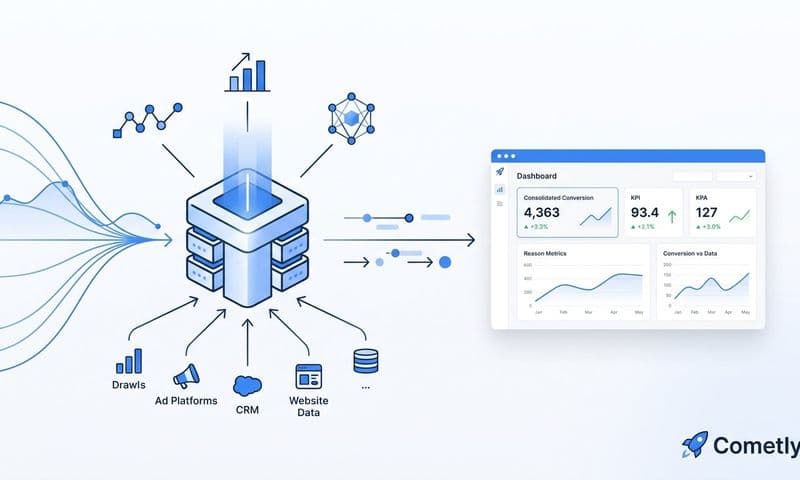
Marketing attribution analytics platforms unify data across all touchpoints and channels, creating a single view of the customer journey. Instead of reconciling data from GA4, Meta Ads Manager, Google Ads, your CRM, and your email platform, an attribution platform connects them all. You see complete journeys from first touch to conversion, regardless of where each interaction happened.
These platforms also solve the attribution window problem. While GA4 might cut off attribution after 30 days, attribution platforms track the entire journey—whether it's 30 days or 180 days. You finally see which campaigns initiated long sales cycles, even when the conversion happens months later.
The goal is confidence. When you review campaign performance, you should trust the data enough to make budget decisions without second-guessing. When stakeholders ask about ROI, you should have numbers that match reality. When you scale a winning campaign, you should know it's actually winning, not just appearing to win because of tracking gaps.
Moving Forward with Complete Conversion Visibility
Missing conversions aren't just a reporting inconvenience. They lead to underfunding campaigns that actually work, overspending on channels that appear successful but aren't, and strategic decisions based on incomplete information. Every conversion you miss is a signal you needed to optimize effectively.
The path forward starts with understanding why conversions go missing—browser privacy features, technical misconfigurations, attribution window limitations, and tracking restrictions. From there, you implement immediate fixes: extending attribution windows, enabling Consent Mode, and configuring enhanced conversions. These adjustments recover meaningful data starting today.
Longer-term solutions address the fundamental limitations of client-side tracking. Server-side implementations bypass browser restrictions and ad blockers while enabling data enrichment that makes your conversion tracking reflect actual business value. Combined with attribution platforms that unify data across all touchpoints, you build a system that captures complete customer journeys regardless of how fragmented they appear in individual tools.
The marketers who win in 2026 and beyond aren't the ones with the biggest budgets—they're the ones with the most accurate data. They know which campaigns drive revenue, which channels initiate valuable journeys, and where to invest for maximum return. They make decisions with confidence because their tracking systems show them reality, not fragments.
Ready to elevate your marketing game with precision and confidence? Discover how Cometly's AI-driven recommendations can transform your ad strategy—Get your free demo today and start capturing every touchpoint to maximize your conversions.