

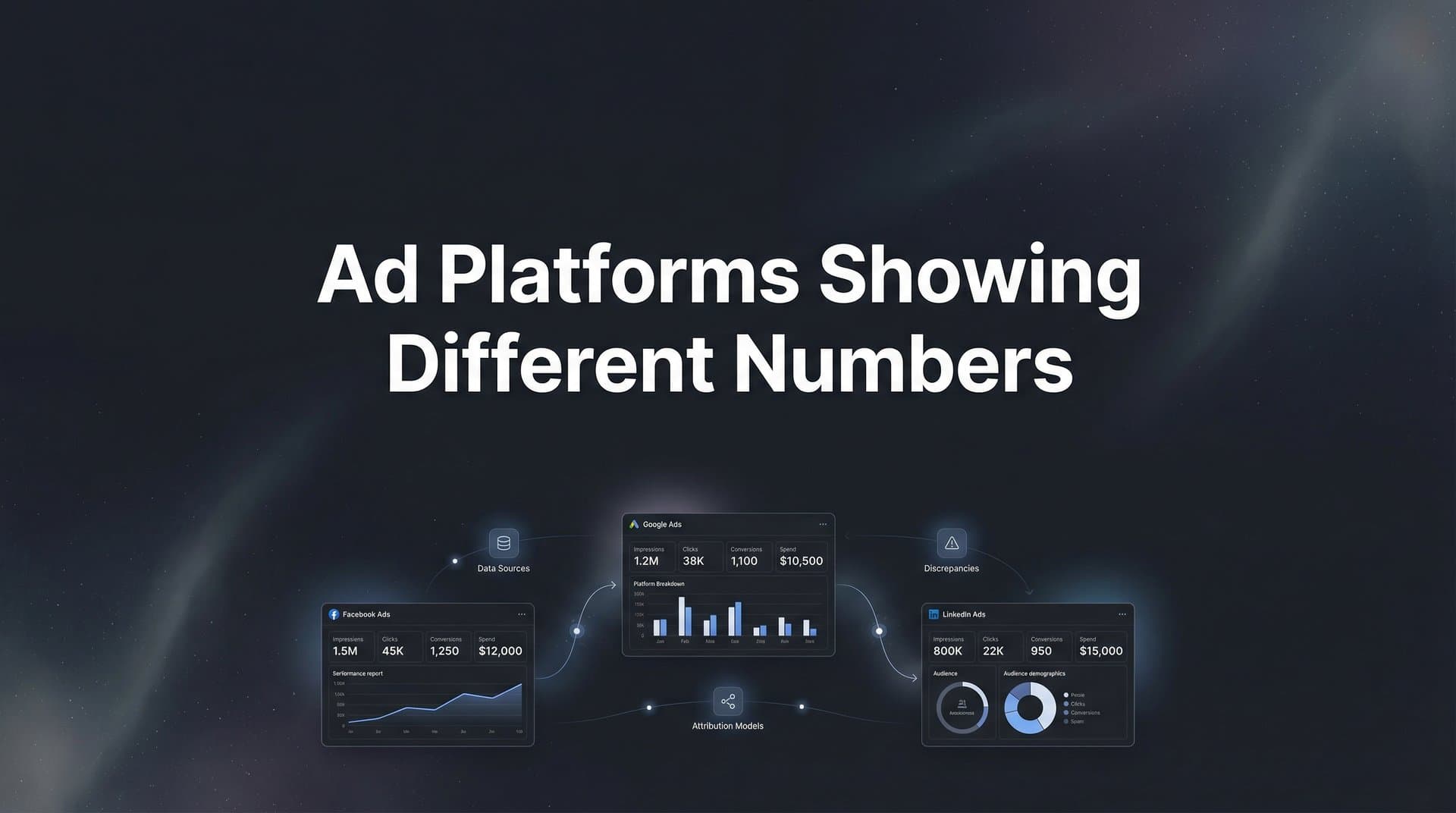
You open Facebook Ads Manager and see 47 conversions from yesterday's campaigns. Feeling good about those numbers, you switch over to Google Ads—32 conversions for the same day. Then you check your CRM to reconcile the actual sales, and there are only 28 new customers. Wait, what?
If you've ever experienced this head-spinning moment, you're not alone. This mismatch between what your ad platforms report and what actually happened in your business is one of the most frustrating challenges in digital marketing. It turns budget allocation into guesswork and makes it nearly impossible to know which campaigns are truly driving results.
The good news? These discrepancies aren't random errors or platform glitches. They happen for specific, understandable reasons rooted in how attribution, tracking, and reporting fundamentally work. Once you understand why your numbers don't match, you can implement solutions that give you accurate, actionable data to guide your marketing decisions with confidence.
The Attribution Model Puzzle: How Each Platform Claims Credit
Think of attribution models as the rules each platform uses to decide whether it gets credit for a conversion. The problem? Every platform plays by different rules, and they all want to claim the win.
Meta Ads uses a default attribution window of 7 days for clicks and 1 day for views. This means if someone clicks your Facebook ad and converts within the next week, Meta counts that as a conversion. If they just saw your ad without clicking and converted within 24 hours, Meta still claims credit.
Google Ads, on the other hand, defaults to a 30-day click attribution window. That's more than four times longer than Meta's click window. If someone clicked your Google ad three weeks ago and finally converted today, Google counts it. Meta wouldn't.
Here's where it gets interesting: both platforms can legitimately claim the same conversion because the customer touched each one during their journey. Let's say someone sees your Facebook ad on Monday, clicks your Google search ad on Wednesday, and purchases on Friday. Facebook claims it because the purchase happened within 7 days of the ad view. Google claims it because the purchase happened within 30 days of the click. Your CRM just records one sale.
This isn't double-counting in the traditional sense. Each platform is accurately reporting based on its own attribution rules. The customer journey involved both touchpoints, and from each platform's perspective, it contributed to the conversion. The challenge is that when you add up all the conversions each platform reports, you get a number that's higher than your actual sales. This is a common scenario when ad platforms taking credit for same conversion creates confusion in your reporting.
The situation becomes even more complex with multi-touch attribution scenarios. Picture this: a customer sees your Instagram ad, clicks a retargeting ad on Facebook two days later, searches for your brand name and clicks a Google ad, then returns directly to your site and purchases. How many platforms claim this conversion? Potentially three, all accurately according to their respective attribution windows.
This is why looking at platform-reported conversions in isolation creates a distorted picture. You're not seeing how channels work together—you're seeing each channel's most favorable interpretation of its contribution. Without understanding these attribution differences, you might think you're generating 150 conversions when you actually closed 80 sales.
Tracking Gaps: Why Data Gets Lost Along the Way
Even when attribution windows align perfectly, your platforms still can't track what they can't see. And in today's privacy-focused digital landscape, there's a lot they can't see.
Apple's App Tracking Transparency framework, introduced with iOS 14.5 in April 2021, fundamentally changed mobile advertising measurement. Now when someone opens an app, they see a prompt asking permission to track their activity. Many users tap "Ask App Not to Track," and suddenly that entire segment of your audience becomes invisible to traditional tracking methods. For many advertisers, this means 40-60% of their iOS traffic can't be accurately tracked through standard methods.
Browser privacy features compound this challenge. Safari's Intelligent Tracking Prevention limits cookie lifespans to just 7 days for third-party cookies and even restricts first-party cookies in certain scenarios. Firefox blocks third-party cookies by default. Chrome is phasing out third-party cookie support entirely. Each of these privacy measures, while beneficial for users, creates blind spots in your marketing data. Understanding multiple ad platforms tracking problems is essential for modern marketers.
Ad blockers add another layer of invisibility. Someone might click your ad, visit your site with an ad blocker enabled, and complete a purchase—but your tracking pixel never fires because the blocker prevented it from loading. From your ad platform's perspective, that click never converted. From your bank account's perspective, you just made a sale.
Cross-device journeys represent one of the most significant tracking gaps. Someone scrolls through Instagram on their phone during lunch, clicks your ad, browses your product pages, but doesn't purchase. That evening, they're on their laptop, remember your brand, search for it directly, and buy. Unless you have sophisticated cross-device tracking infrastructure, that conversion appears as direct traffic or organic search in your analytics, while Facebook shows an unconverted click.
The reality is that browser-based tracking, which most platforms rely on, has inherent limitations. Cookies can be deleted, blocked, or restricted. Pixels can fail to fire. Users can browse in incognito mode. Each of these scenarios creates data loss that makes your reported numbers lower than actual performance.
Platform Self-Reporting Bias: The Fox Guarding the Henhouse
Here's an uncomfortable truth about digital advertising: the platforms selling you ads are the same ones measuring whether those ads worked. That's like asking a salesperson how good their product is—you're probably not getting the most objective assessment.
This isn't to suggest platforms are lying or manipulating data maliciously. But they do have business incentives to attribute as many conversions as possible to their platform. The better their numbers look, the more confident you feel spending money with them. This inherent conflict of interest is why platform-reported metrics should always be validated against independent sources.
Modeled conversions exemplify this dynamic. When platforms can't directly observe a conversion due to tracking limitations, they use statistical models to estimate how many conversions probably occurred. Meta, for instance, openly uses conversion modeling to account for iOS 14.5+ measurement gaps. These models are based on observable patterns and can provide directional accuracy, but they're still estimates filling in gaps with educated guesses.
The challenge is distinguishing between conversions the platform actually tracked and conversions it modeled. From your dashboard's perspective, they look identical. You see a conversion count, but you don't know how much of that number represents real, tracked events versus statistical estimates designed to approximate reality. This is why multiple ad platforms conflicting data is such a persistent challenge.
Different platforms also define conversions differently. One platform might count a conversion when someone adds a product to their cart. Another only counts completed purchases. A third might count newsletter signups. If you're comparing "conversion" numbers across platforms without understanding these definitional differences, you're comparing apples to oranges.
There's also the timing of what gets reported. Some platforms are faster to claim conversions than they are to remove conversions from refunded purchases or canceled subscriptions. This can inflate short-term performance numbers while the true picture only emerges over time.
The bottom line: platform self-reporting creates an optimistic bias in the data you see. Each platform naturally presents itself in the best possible light. Without independent verification, you're making budget decisions based on each platform's most favorable interpretation of its own performance.
Timing and Data Processing: When Numbers Refresh Matters
Even if attribution models aligned perfectly and tracking worked flawlessly, you'd still see discrepancies based purely on when and how platforms process data.
Different platforms update their dashboards at different intervals. Some refresh data hourly, others every few hours, and some only update once daily. If you're checking multiple platforms at 10 AM, you might be looking at data that was last updated at different times, creating apparent discrepancies that are really just timing differences.
Data processing delays add another layer of complexity. When someone converts, that information doesn't instantly appear in every connected platform. The conversion needs to be tracked, processed, attributed, and reported—each step takes time. One platform might show the conversion within minutes, while another takes hours or even days to process and display the same event. Learning how to connect ad platforms to analytics properly can help minimize these timing issues.
Timezone mismatches create surprisingly common confusion. Your business operates in Eastern Time, but your ad account is set to Pacific Time, and your analytics platform defaults to UTC. A conversion that happened at 11 PM Eastern on Tuesday shows up as Wednesday in one platform but Tuesday in another. When you pull daily reports, that single conversion appears on different dates, making your numbers look mismatched when they're actually just time-shifted.
Conversion windows also affect when conversions appear in reporting. Remember that 30-day attribution window in Google Ads? A conversion that happens today might be attributed to a click that happened three weeks ago. That means the conversion appears in today's report, but it's attributed to a campaign from weeks earlier. If you're comparing today's spend to today's conversions, you're not seeing the full picture of how recent campaigns are performing.
Attribution can also change retroactively. If someone clicks your ad today but doesn't convert until next week, that conversion won't appear in today's numbers. But next week, when you look back at today's performance, that delayed conversion will now be attributed to today's campaign. Your historical reports can actually change as delayed conversions roll in, making it difficult to know if a campaign truly underperformed or if conversions just haven't materialized yet.
Building a Single Source of Truth for Your Marketing Data
Understanding why your numbers don't match is valuable, but it doesn't solve the fundamental problem: you still need accurate data to make smart marketing decisions. This is where moving beyond platform-reported metrics becomes essential.
Server-side tracking represents a major advancement in addressing browser-based tracking limitations. Instead of relying on cookies and pixels that can be blocked or restricted, server-side tracking sends data directly from your server to your analytics platform. When someone converts, your server communicates that information regardless of browser settings, ad blockers, or privacy restrictions. This approach captures significantly more complete data than traditional client-side tracking methods. Explore the best server-side tracking platforms to find the right solution for your business.
The key is connecting all your marketing touchpoints into a unified system. When your ad platforms, website, CRM, and analytics all feed into a central attribution platform, you can see the complete customer journey regardless of which individual platform tracked which piece. Someone might click a Facebook ad, visit your site, leave without converting, then return via Google search and purchase. A unified tracking system connects all those dots into one coherent journey.
This comprehensive view enables true multi-touch attribution. Instead of each platform claiming full credit for the conversion, you can see how each touchpoint contributed to the final sale. Maybe Facebook introduced the customer to your brand, Google captured them during the consideration phase, and email marketing closed the deal. Understanding this sequence helps you allocate budget based on how channels actually work together rather than how each claims to perform in isolation. Review the best multi-touch attribution platforms to find the right fit for your needs.
Feeding accurate conversion data back to ad platforms creates a powerful optimization loop. When platforms receive complete, accurate information about which clicks truly converted, their machine learning algorithms can better identify high-value audiences and optimize delivery. This is particularly valuable in the post-iOS 14.5 landscape, where platforms have less native visibility into conversion outcomes. By sending enriched conversion data back to Meta, Google, and other platforms, you're essentially teaching their algorithms to perform better on your behalf.
Cometly's approach captures every touchpoint from ad clicks to CRM events, creating that complete, enriched view of each customer journey. Instead of piecing together fragmented data from multiple platforms, you get a unified picture that shows what's really driving revenue. The platform's AI analyzes this comprehensive data to identify high-performing ads and campaigns across every channel, giving you recommendations you can actually trust because they're based on complete information rather than partial platform reporting.
This unified tracking also enables conversion sync, where accurate, enriched events flow back to your ad platforms. Meta, Google, and other platforms receive better data about conversion outcomes, which improves their targeting and optimization. The result is ad performance that gets better over time as platforms learn from complete conversion data rather than the fragmented signals they'd otherwise receive.
Making Confident Budget Decisions with Accurate Data
Once you have a single source of truth for your marketing data, the real value comes from putting that information to work. Accurate attribution transforms budget allocation from educated guessing into strategic decision-making.
Comparing attribution models side-by-side reveals how different approaches change your understanding of channel performance. First-click attribution shows which channels are best at introducing new customers to your brand. Last-click highlights which channels close the deal. Linear attribution distributes credit evenly across all touchpoints. By examining the same data through multiple attribution lenses, you develop a nuanced understanding of how each channel contributes to your overall marketing ecosystem. A thorough multi-touch attribution platforms comparison can help you choose the right approach.
This multi-model perspective is particularly valuable for channels that excel at different stages of the customer journey. Top-of-funnel awareness campaigns might look terrible under last-click attribution because they rarely get credit for the final conversion. But under first-click or linear models, their true value in initiating customer relationships becomes clear. Without this context, you might cut a channel that's actually essential to your acquisition funnel.
Accurate data enables confident scaling decisions. When you know which campaigns are truly driving profitable conversions—not just which platforms claim they are—you can increase spend on winners with confidence. If a campaign shows strong performance across multiple attribution models and that performance is verified against actual CRM revenue, you have solid evidence to justify scaling investment. Understanding ad budget allocation between platforms becomes much clearer with accurate data.
Conversely, accurate attribution helps you identify underperformers worth cutting. A campaign might show decent conversion numbers in its native platform but contribute minimally when viewed through multi-touch attribution. That's a clear signal to reallocate budget elsewhere. Without this clarity, you might continue funding campaigns that look good in isolation but add little incremental value to your overall marketing mix.
Establishing a regular reconciliation process between platform data and actual revenue creates accountability and catches issues early. Weekly or monthly reviews comparing total platform-reported conversions to actual CRM sales help you spot tracking problems, understand typical variance, and maintain realistic expectations about what your data is telling you. This discipline prevents the nasty surprise of discovering months later that your reported performance was significantly overstated.
Moving Forward with Clarity
Discrepancies between ad platforms aren't anomalies or errors you can fix by tweaking a setting. They're the natural result of how attribution, tracking, and reporting fundamentally work in digital marketing. Different attribution windows, tracking limitations, platform self-reporting, and timing differences all contribute to the numbers mismatch that frustrates marketers daily.
The solution isn't to pick one platform's numbers as gospel truth or to average everything together and hope for the best. It's to implement independent tracking infrastructure that captures the complete customer journey across all touchpoints. When you have a unified view of how customers actually interact with your marketing, you can make budget decisions based on reality rather than each platform's most favorable interpretation of its performance.
Server-side tracking, unified attribution platforms, and conversion sync capabilities have made this comprehensive measurement accessible to businesses of all sizes. You no longer need enterprise-level resources to understand which marketing investments truly drive revenue. The technology exists to connect ad platforms, website activity, and CRM data into one coherent picture that shows exactly what's working and what's not.
With complete data flowing through your marketing stack, you can compare attribution models, identify true channel performance, scale winning campaigns with confidence, and cut underperformers backed by evidence. Your marketing becomes more efficient, your budget allocation becomes more strategic, and your results become more predictable.
Ready to elevate your marketing game with precision and confidence? Discover how Cometly's AI-driven recommendations can transform your ad strategy. Get your free demo today and start capturing every touchpoint to maximize your conversions.


