
You just spent $5,000 on Facebook ads promoting your online course. The ads generated 200 email subscribers. Three weeks later, 15 people bought your $997 program. Facebook says your campaign drove 3 purchases. Your email platform shows 12 sales came from your nurture sequence. Your actual revenue? $14,955. But which ads generated those buyers?
You have no idea.
Info product businesses face a tracking nightmare that e-commerce sellers never encounter. Your customer journey isn't a simple click-to-purchase path. Someone sees your ad, downloads your lead magnet, gets added to a 14-day email sequence, watches three of your YouTube videos, attends your webinar, clicks a retargeting ad, reads your sales page twice, and finally buys your course 23 days after that first ad impression.
Traditional pixel tracking loses the thread somewhere around day three. Ad platforms report conversions they can see, which is maybe 30% of what actually happened. Your email platform has no idea which ad brought that subscriber in the first place. Your checkout system knows someone bought, but can't tell you if they came from an ad, an email, or a webinar.
The result? You're flying blind. You keep running ads that "feel" like they work. You allocate budget based on gut instinct rather than data. You can't confidently scale because you genuinely don't know what's driving revenue.
This guide fixes that problem. You'll learn how to set up ad tracking that captures the complete customer journey for info products, from initial ad click through email nurture sequences to final purchase and beyond. You'll connect your ad platforms, email systems, CRM, and checkout pages into one unified tracking system that shows exactly which campaigns generate real revenue.
Whether you sell online courses, coaching programs, membership sites, or digital downloads, these seven steps will help you stop guessing and start scaling with confidence. Let's get started.
Step 1: Map Your Customer Journey and Conversion Points
Before you install a single tracking pixel, you need to understand exactly how people move through your funnel. Info product funnels are rarely linear. Someone might enter at multiple points, consume content in different orders, and take weeks to make a purchase decision.
Start by documenting every touchpoint in your customer journey. Open a spreadsheet or draw this out on paper. List every step from awareness to purchase:
Your typical funnel might include: Ad impression and click. Landing page visit. Lead magnet opt-in form. Thank you page. Welcome email sequence (5-7 emails). Free content consumption (blog posts, videos, podcasts). Webinar registration page. Webinar attendance (or replay). Sales page visits. Checkout page. Order confirmation. Upsell offers. Post-purchase onboarding.
That's at least 13 distinct touchpoints before someone even completes their first purchase. Each one represents a potential tracking point where you can lose visibility into the customer journey.
Next, categorize your conversions. Primary conversions are revenue events: course purchases, coaching package sales, membership signups, or any transaction that generates income. Micro-conversions are the steps that lead to revenue: email opt-ins, webinar registrations, video completions, sales page visits, or application form submissions.
Both matter, but they matter differently. You ultimately optimize for revenue, but micro-conversions help you understand where your funnel breaks down. If 1,000 people opt in but only 10 attend your webinar, that's a different problem than if 500 attend your webinar but only 10 buy.
Now document your typical time lag. How long does it take someone to go from first ad click to purchase? Review your last 50 sales. Check your email platform to see when those buyers first subscribed. Look at your CRM to see when they first engaged. For many info product businesses, this window ranges from 7 to 45 days. Some high-ticket coaching programs see 60 to 90-day consideration periods.
This number is critical because it determines your attribution window settings in the next steps. If your average buyer takes 30 days to purchase but your tracking only looks back 7 days, you're missing most of your conversions.
Finally, identify where tracking currently breaks down. Common gaps include: Email clicks that don't carry attribution data forward. Webinar platforms that strip tracking parameters. Multi-step checkout processes that lose the connection to the original ad. Mobile app interactions that don't fire pixels. Purchases that happen via DM or phone call after someone sees your ad.
Mark these gaps on your customer journey map. These are the problems you'll solve in the following steps. The clearer your map, the easier it becomes to implement conversion tracking for info products that actually captures reality.
Step 2: Install Tracking Pixels and Server-Side Tracking
Now that you understand your funnel, it's time to implement the technical foundation of your tracking system. You need two layers: browser-based pixels and server-side tracking. Both are essential because they capture different data.
Start with platform pixels. If you run ads on Meta (Facebook and Instagram), Google, TikTok, or LinkedIn, each platform provides a tracking pixel. These are small pieces of code you add to your website that fire when someone takes an action.
Install your Meta Pixel on every page of your funnel. This means your landing pages, lead magnet thank you pages, webinar registration pages, sales pages, checkout pages, and order confirmation pages. The pixel needs to be on every page where someone might land after clicking your ad.
Do the same for Google Ads if you run search or YouTube campaigns. Add the Google tag to your site header and configure conversion actions for each key event: page views, lead form submissions, purchases.
Configure standard events for each conversion point. For lead magnet opt-ins, fire a "Lead" event. For purchases, fire a "Purchase" event with the transaction value included. For webinar registrations, fire a custom event called "WebinarRegistration" or similar.
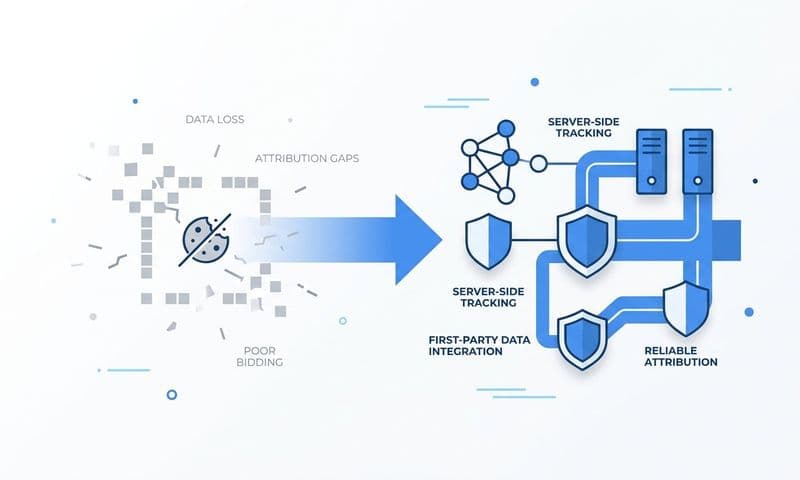
Here's the problem: browser-based pixels are increasingly unreliable. iOS privacy changes mean Safari blocks many tracking pixels by default. Ad blockers prevent pixels from firing. Cookie restrictions limit how long platforms can track someone. Studies show browser-based tracking now misses 30-50% of actual conversions.
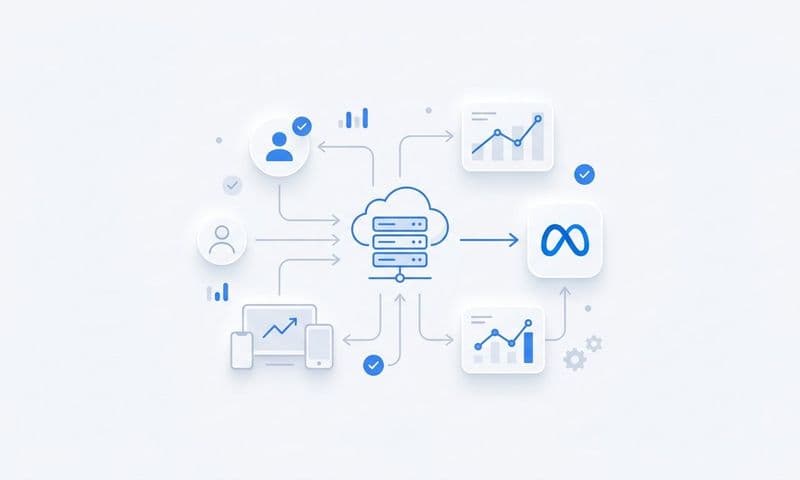
This is where server-side tracking solutions become critical. Instead of relying on a pixel that fires in someone's browser, server-side tracking sends conversion data directly from your server to the ad platform. It bypasses browser restrictions entirely.
Setting up server-side tracking requires connecting your checkout platform to your tracking system. If you use Kajabi, Teachable, ThriveCart, ClickFunnels, or similar platforms, you need to configure webhooks that fire when someone makes a purchase.
These webhooks send purchase data (customer email, order value, product purchased, timestamp) to a tracking platform that then forwards it to Meta, Google, and other ad platforms as a server-side conversion event. This ensures you capture every purchase, regardless of whether the pixel fired in their browser.
Most modern attribution platforms handle this server-side connection for you. You connect your checkout system once, and it automatically syncs all future purchases back to your ad platforms with full attribution data attached.
After installation, test everything. Use the Meta Pixel Helper Chrome extension to verify your pixel fires correctly on each page. Use Google Tag Assistant to check your Google tags. Make a test purchase through your funnel and confirm the purchase event appears in your ad platform within a few minutes.
If events aren't firing, check that your pixel code is in the site header, that your checkout platform webhooks are configured correctly, and that you're not blocking your own tracking with ad blockers during testing.
Step 3: Connect Your Email and CRM Systems
Your email list is where info product sales actually happen. Someone clicks your ad, opts in for your lead magnet, and then your email sequence does the heavy lifting of building trust and making the sale. But if your tracking can't connect that final purchase back to the original ad that brought them in, you're missing the complete picture.
Start by integrating your email platform with your tracking system. If you use ConvertKit, ActiveCampaign, Mailchimp, or any major email service provider, you need to ensure that when someone opts in, their subscriber record includes the tracking data from their original ad click.
This typically works through hidden form fields. When someone lands on your opt-in page from an ad, tracking parameters (UTM codes, click IDs, campaign data) get stored in hidden fields on your form. When they submit the form, those parameters get passed to your email platform and stored with their subscriber profile.
Configure your opt-in forms to capture and store: utm_source, utm_medium, utm_campaign, utm_content, and utm_term parameters. Also capture click IDs if available (fbclid for Meta, gclid for Google). Store the landing page URL they first visited. Record the timestamp of their first interaction.
This data needs to persist with that subscriber forever. When they purchase your course three weeks later via an email link, your tracking system needs to look up their subscriber record, find the original ad data, and attribute that sale back to the correct campaign.
Next, set up conversion tracking for email-driven purchases. When someone clicks a link in your email and completes a purchase, that conversion should be attributed to both the email that drove the click AND the original ad that brought them into your list.
Most attribution software for info products handles this automatically once your systems are connected. They track the subscriber from opt-in through every email interaction to final purchase, maintaining the complete attribution chain.
If you run a coaching business or high-ticket program, integrate your CRM as well. Your CRM tracks actions that happen outside your website: discovery calls booked, applications submitted, sales conversations, deal stages, and closed revenue.
Configure your CRM to fire events back to your tracking system when these actions occur. When someone books a call, that's a valuable conversion signal. When they move to "Qualified" status in your pipeline, that indicates your ads are attracting the right people. When they close as a customer, that's your ultimate conversion.
The key is ensuring subscriber IDs or email addresses are passed consistently across all systems. Your ad platform, website, email platform, and CRM all need to recognize the same person. Email address is typically the universal identifier that makes this possible.
Test the integration by opting in through your own funnel using a test email address. Watch that subscriber move through your email sequence. Make a test purchase. Verify that the purchase shows up in your tracking dashboard with full attribution back to the original source.
Step 4: Configure UTM Parameters and Link Tracking
UTM parameters are the backbone of campaign tracking. These small tags added to your URLs tell your analytics system exactly where traffic came from. Without consistent UTM usage, you're just guessing which campaigns drive results.
Start by creating a UTM naming convention that your entire team will follow. Consistency matters more than the specific format you choose. A common structure for info product businesses looks like this:
utm_source identifies the platform: facebook, google, tiktok, linkedin, youtube. utm_medium identifies the ad type: cpc, video, story, carousel. utm_campaign identifies the specific campaign: webinar_promo_april, course_launch_q2, retargeting_purchasers. utm_content identifies the creative or audience: video_testimonial, image_benefit, audience_entrepreneurs. utm_term is optional but useful for keyword tracking in search campaigns.
Document your naming convention in a shared spreadsheet. Include examples. Make it dead simple for anyone creating ads to tag their links correctly. Inconsistent naming (sometimes using "fb" and sometimes "facebook") breaks your reporting and makes it impossible to aggregate performance data.
Most ad platforms let you set up automatic UTM tagging. In Meta Ads Manager, use URL parameters in your campaign settings. In Google Ads, enable auto-tagging which adds gclid parameters automatically. For other platforms or manual links, use a URL builder tool to generate properly formatted URLs every time.
Here's where info product tracking gets tricky: UTM parameters need to persist through multiple redirects and page transitions. Someone clicks your ad, lands on your opt-in page, submits the form, gets redirected to a thank you page, clicks through to watch a training video, then eventually lands on your sales page days later via an email link.
At each step, you need to maintain the connection to that original ad source. This typically requires your website to store UTM parameters in cookies or local storage when someone first arrives, then reattach those parameters to internal links as they navigate your funnel.
Many landing page builders and marketing platforms handle this automatically, but verify that it's working correctly. Click through your entire funnel and check that attribution data persists at each stage.
Pay special attention to email links. When you send an email promoting your course, those links should include UTM parameters that identify the email campaign, but they should not overwrite the original ad source that brought that subscriber to your list. Your tracking system needs to capture both: the ad that acquired them and the email that converted them.
Build a tracking spreadsheet to manage all your campaign URLs. Include columns for campaign name, platform, URL, UTM parameters, launch date, and status. This becomes your source of truth for all active campaigns and makes it easy to audit tracking implementation. Understanding attribution tracking for multiple campaigns becomes essential as your ad spend grows.
Before launching any new campaign, test your tracking. Click your ad, go through your funnel, and verify that conversions are attributed correctly. Fix tracking problems before you spend money, not after.
Step 5: Set Up Multi-Touch Attribution
Someone sees your Facebook ad, clicks through, opts in for your lead magnet, but doesn't buy. Two weeks later, they see a YouTube ad, click through, watch your training video, but still don't buy. A week after that, they see a retargeting ad, click through, and finally purchase your course. Which ad gets credit for the sale?
This is the attribution question, and for info product businesses with long consideration cycles and multiple touchpoints, it's critical to get right. Single-touch attribution models (giving all credit to the first or last touchpoint) dramatically misrepresent which campaigns actually drive revenue.
Start by choosing an attribution model that fits info product buying behavior. Your options include:
First-touch attribution gives all credit to the first ad someone clicked. This makes sense if you believe your initial awareness campaigns do the heavy lifting and everything else is just nurture. It tends to favor top-of-funnel campaigns and lead generation efforts.
Last-touch attribution gives all credit to the final touchpoint before purchase. This makes sense if you believe the last interaction is what pushes someone over the edge. It tends to favor retargeting campaigns and bottom-of-funnel efforts.
Linear attribution distributes credit equally across all touchpoints. If someone interacted with five ads before purchasing, each ad gets 20% credit. This provides a more balanced view but doesn't account for the reality that some touchpoints matter more than others.
Time-decay attribution gives more credit to touchpoints closer to the conversion. The ad they saw yesterday gets more credit than the ad they saw three weeks ago. This often makes sense for info products where recent interactions have more influence on the purchase decision.
Data-driven attribution uses machine learning to determine which touchpoints actually influence conversions based on your historical data. This is the most accurate but requires significant data volume to work effectively.
For most info product businesses, time-decay or data-driven models provide the most actionable insights. They acknowledge that multiple touchpoints contribute to a sale while recognizing that some interactions matter more than others.
Next, configure your attribution windows. This determines how far back your tracking system looks when attributing a conversion. If someone clicked your ad 45 days ago and purchases today, does that ad get credit?
Your attribution window should match your typical consideration period. If you documented in Step 1 that your average buyer takes 30 days from first touch to purchase, set your attribution window to at least 30 days, ideally 45-60 days to capture outliers.
Different platforms use different default windows. Meta defaults to 7-day click and 1-day view attribution. Google Ads defaults to 30 days. Your attribution platform should let you set custom windows that actually match your business reality.
Now connect all your touchpoints into a unified attribution system. This means your tracking platform needs to see ad impressions, ad clicks, website visits, email opens, email clicks, webinar attendance, sales page visits, and purchases all connected to the same person. Implementing ad performance tracking across platforms ensures you capture every interaction.
When everything is connected, you can finally see the complete customer journey. You'll discover that someone clicked three different ads, attended two webinars, and received 14 emails before purchasing. Your attribution model then distributes credit across those touchpoints according to the rules you set.
Finally, compare platform-reported conversions against your attribution data. Meta might report 10 conversions. Google might report 8. Your attribution platform, which sees the complete journey, might show that both platforms contributed to 25 total conversions through various touchpoints.
This discrepancy is normal and expected. Ad platforms only see their own touchpoints. Your attribution system sees everything. Use your attribution data as the source of truth for budget allocation decisions, but understand that platform reporting will always show different numbers.
Step 6: Feed Conversion Data Back to Ad Platforms
Your ad platforms use machine learning to optimize campaign performance. They show your ads to people likely to convert based on patterns in your conversion data. But if your conversion data is incomplete or inaccurate, their algorithms optimize toward the wrong goal. This step fixes that problem.
Set up conversion syncing to send accurate purchase data back to Meta, Google, and other ad platforms. This is different from pixel tracking. Even if your pixel fired correctly, the ad platform might not have received complete information about that conversion.
Conversion syncing uses your attribution system as the source of truth. When someone purchases your course, your attribution system knows which ads they interacted with across all platforms. It then sends that conversion back to each platform that contributed to the sale, with full attribution data attached.
This dramatically improves ad platform optimization. Instead of only seeing conversions that happened immediately after an ad click, platforms now see conversions that happened days or weeks later, after multiple touchpoints. This gives their algorithms a complete picture of what actually drives sales.
Include revenue values with every conversion you sync. Don't just tell Meta that someone converted. Tell Meta that someone purchased your $997 course, generating $997 in revenue. This allows the platform to optimize for actual profit, not just conversion volume.
Revenue-based optimization is especially important for info product businesses because not all conversions are equal. A lead magnet opt-in is valuable, but a course purchase is worth 100x more. When platforms know the revenue value, they can find people likely to make high-value purchases rather than just people likely to opt in. Leveraging first-party data tracking for ads ensures this revenue data flows accurately.
Configure offline conversion imports for sales that happen outside your normal funnel. If you run a high-ticket coaching program where people book calls, have sales conversations, and close deals over the phone or via DM, those conversions need to be tracked too.
Most attribution platforms let you manually upload offline conversions or automatically sync them from your CRM. When a deal closes in your CRM, that conversion gets sent back to the ad platforms with attribution to the campaigns that generated that lead.
This ensures your ad platforms optimize for actual closed revenue, not just booked calls or submitted applications. The difference in campaign performance can be dramatic when platforms start optimizing for people who actually buy rather than people who just show initial interest.
After setting up conversion syncing, verify that synced conversions appear correctly in your ad platform dashboards. In Meta Ads Manager, check your Events Manager to see server-side events coming through. In Google Ads, check your conversion tracking to see imported conversions.
There will typically be a delay. Server-side conversions might take a few hours to appear in platform dashboards. Offline conversions might take 24 hours. This is normal. What matters is that they eventually show up with correct attribution.
Monitor your conversion sync regularly. If you notice conversions stopping or discrepancies growing, investigate immediately. A broken webhook or API connection means your ad platforms are optimizing with incomplete data, which wastes ad spend and reduces performance.
Step 7: Build Your Reporting Dashboard and Optimize
You've implemented comprehensive tracking across your entire funnel. Now you need to turn that data into actionable insights that drive better decisions. This means building a reporting dashboard that shows true performance and establishing a regular optimization process.
Create a centralized dashboard that shows performance by campaign, ad set, and creative. The key metrics for info product businesses include: Ad spend by campaign. Leads generated (opt-ins, registrations). Cost per lead. Purchases attributed to each campaign. Revenue generated. Return on ad spend (ROAS). Customer acquisition cost (CAC). Lifetime value by acquisition source (if you have repeat purchases or continuity programs).
Your dashboard should show both platform-reported metrics and attribution-based metrics side by side. This lets you see the discrepancy and make decisions based on complete data rather than platform-reported data alone.
Set up automated reports that run weekly. You should be able to review campaign performance without manually pulling data from five different platforms. Your attribution system should compile everything into a single report that lands in your inbox every Monday morning.
The report should highlight: Top-performing campaigns by ROAS. Campaigns spending money but generating low or no revenue. New campaigns that need attention. Attribution trends showing which touchpoints matter most. Week-over-week changes in key metrics.
Now use this data to optimize. Review your dashboard weekly and make decisions based on what the data tells you. If a campaign shows 5x ROAS while another shows 0.5x ROAS, the decision is obvious: shift budget from the loser to the winner.
Look beyond surface-level metrics. A campaign might generate lots of cheap leads but few purchases. Another campaign might generate fewer leads at higher cost, but those leads convert to buyers at 3x the rate. The second campaign is more valuable even though the cost per lead looks worse. Using the best tools for tracking ad performance helps you uncover these insights.
Identify your highest-performing campaigns and double down. If your webinar promotion campaign consistently drives profitable sales, increase the budget. Test new audiences and creatives within that campaign framework. Scale what works before trying to fix what doesn't.
Establish a testing framework to continuously improve. Run systematic tests of: New audience segments. Different ad creative approaches. Various lead magnet offers. Alternative webinar topics or formats. Different price points or payment plans. New platforms or ad types.
Track the results of each test in your dashboard. Give tests enough time and budget to generate meaningful data. For info products with 30-day consideration cycles, you need to run tests for at least 45-60 days before drawing conclusions.
Finally, review your tracking accuracy regularly. Spot-check that conversions are being attributed correctly. Verify that your attribution windows still match your actual customer behavior. Update your tracking as you add new funnel steps or change platforms.
The businesses that win with paid ads aren't necessarily the ones with the best creative or the biggest budgets. They're the ones with the most accurate data and the discipline to act on what that data reveals.
Your Tracking System Is Now Complete
You've built a comprehensive ad tracking system that captures the complete info product customer journey. Let's recap what you've accomplished:
You mapped every conversion point in your funnel and identified where tracking was breaking down. You installed both browser-based pixels and server-side tracking to capture conversions that traditional pixels miss. You connected your email and CRM systems so purchases from nurture sequences get attributed to the original ad. You implemented consistent UTM parameters across all campaigns to maintain attribution through complex funnels. You configured multi-touch attribution that accounts for the multiple touchpoints typical in info product sales. You set up conversion syncing to feed accurate purchase data back to ad platforms with revenue values included. You built a reporting dashboard and established a weekly optimization process based on actual revenue data.
The difference between info product businesses that scale profitably and those that struggle often comes down to tracking accuracy. When you know exactly which ads drive revenue, decision-making becomes straightforward. You can confidently increase budgets on winning campaigns. You can quickly cut spending on campaigns that generate leads but not sales. You can test new approaches knowing you'll accurately measure the results.
Start with Step 1 today. Map your customer journey and identify your tracking gaps. Then work through each subsequent step methodically. Within a few weeks, you'll have complete visibility into what's actually driving your business growth.
Your Quick-Start Checklist: Map all conversion points in your funnel and document typical time to purchase. Install platform pixels and server-side tracking on all key pages. Connect your email platform and CRM to your tracking system. Implement consistent UTM parameters across all campaigns using a documented naming convention. Configure multi-touch attribution with windows that match your sales cycle. Set up conversion syncing to send purchase data back to ad platforms with revenue values. Build a dashboard and schedule weekly performance reviews.
The tracking foundation you've built does more than just show you which ads work. It transforms your entire approach to growth. You stop making decisions based on vanity metrics like clicks and impressions. You start making decisions based on actual revenue and profit. You stop guessing which campaigns to scale. You start knowing with confidence where every dollar should go.
Ready to elevate your marketing game with precision and confidence? Discover how Cometly's AI-driven recommendations can transform your ad strategy. Get your free demo today and start capturing every touchpoint to maximize your conversions.