

Your Facebook Ads Manager shows a 3.2x ROAS. Your Google Ads dashboard reports strong conversion numbers. But when you check your actual revenue in your CRM, the math doesn't add up. You're not imagining things, and you're definitely not alone.
The gap between what ad platforms report and what actually drives revenue has never been wider. iOS privacy updates have created blind spots in your tracking. Browser changes have made third-party cookies unreliable. And somewhere in that data fog, you're making million-dollar budget decisions based on incomplete information.
First party data tracking changes this equation entirely. Instead of relying on ad platforms to tell you what happened, you collect data directly from your owned properties—your website, your CRM, your actual customer records. You connect the dots from ad click to closed deal, then feed that enriched data back to ad platforms so their algorithms can optimize toward real revenue, not estimated conversions.
This is how modern marketers are taking back control of their attribution. Let's break down exactly how it works and why it matters for your ad spend in 2026.
The Truth About Platform Reporting in 2026
Remember when you could trust your Facebook pixel to track nearly every conversion? Those days ended with iOS 14.5 in April 2021. Apple's App Tracking Transparency framework forced apps to ask permission before tracking users across other apps and websites. Industry data suggests only 15-25% of iOS users opt in, though rates vary significantly by app category and region.
That single change didn't just reduce your tracking accuracy by a small margin. It fundamentally broke the attribution model that digital advertising had relied on for years. When three out of four iOS users are invisible to your tracking, your ad platform is essentially guessing at results based on a fraction of your actual traffic.
But iOS updates are only part of the story. Safari has blocked third-party cookies by default since 2020. Firefox followed suit. Chrome's cookie deprecation has been delayed multiple times, but the direction is clear: third-party tracking is ending, whether platforms are ready or not.
What does this mean for your daily workflow? Your attribution window has shrunk. Your retargeting audiences are smaller. Your lookalike models are built on incomplete data. And most critically, the conversion numbers you see in your ad dashboards increasingly represent modeled estimates rather than actual tracked events. Understanding Facebook Ads tracking pixel issues helps explain why platform reporting has become so unreliable.
The real cost isn't just inaccurate reporting. It's the compounding effect of wrong decisions. You pause campaigns that actually drive revenue because the platform can't see the full journey. You scale campaigns that look good in the dashboard but don't convert in your CRM. You argue with your CFO about marketing ROI because your numbers tell completely different stories.
This is exactly why first party data tracking has moved from "nice to have" to "business critical" for any marketer managing serious ad budgets.
How First Party Data Tracking Actually Works
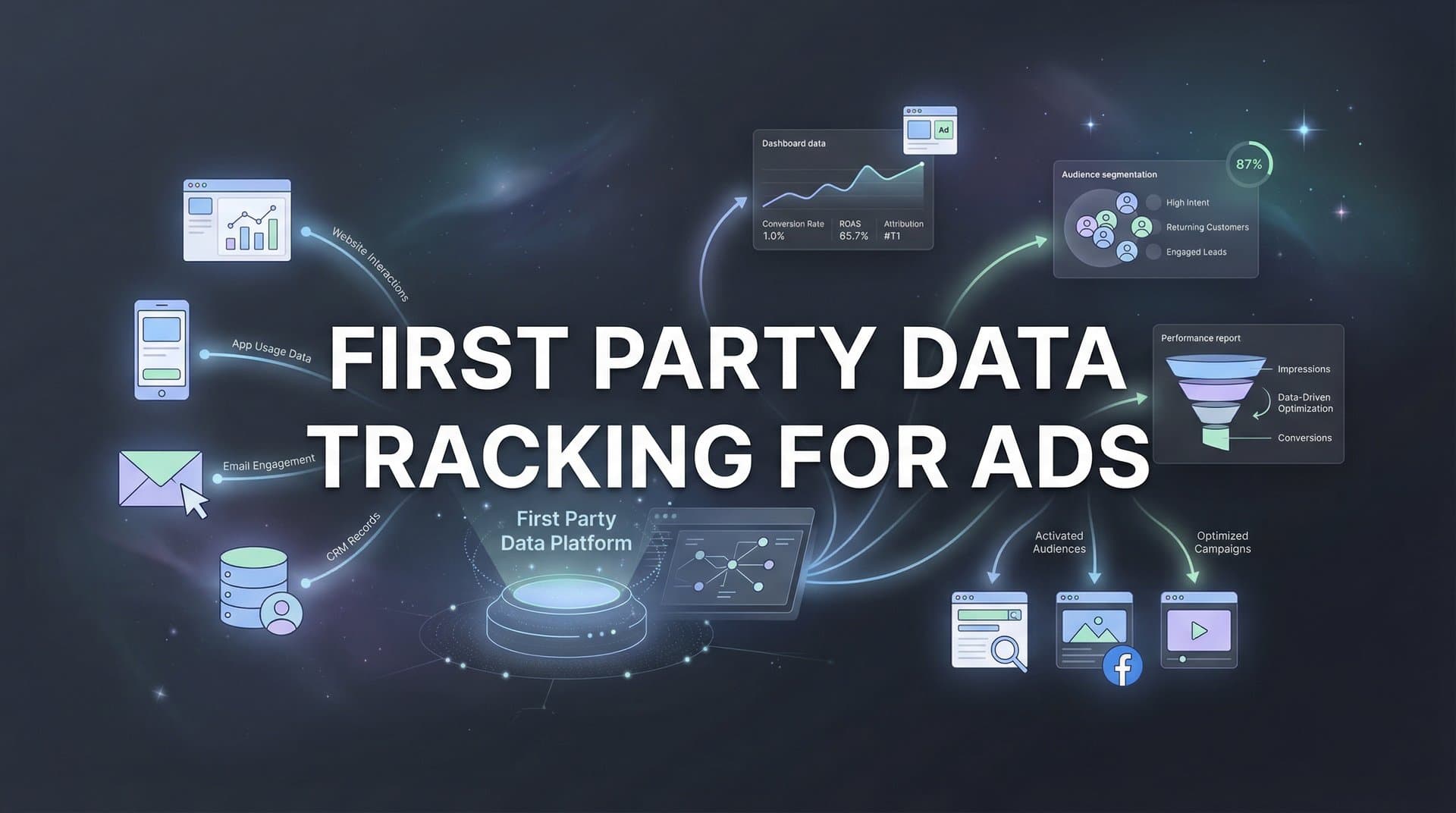
First party data is information you collect directly from your audience through channels you own and control. Your website analytics. Your CRM records. Your email engagement data. Your app usage patterns. This contrasts sharply with third-party data, which is collected by external entities across multiple sites and sold or shared with advertisers. If you're new to this concept, our guide on what is first party data provides a comprehensive foundation.
The fundamental difference is ownership and accuracy. When someone fills out a form on your website, that's your data. When they make a purchase in your CRM, that's your data. No intermediary cookies, no cross-site tracking, no permission requests that users can decline.
But collecting data is only half the equation. The real power comes from how you track it. This is where server-side tracking transforms your attribution accuracy.
Client-side tracking—the traditional approach—relies on JavaScript code running in the user's browser. When someone clicks your ad and lands on your site, your pixel fires, cookies get set, and events get sent to your ad platform. This worked brilliantly until browsers started blocking it, users started declining tracking permissions, and ad blockers became mainstream.
Server-side tracking flips this model. Instead of relying on browser-based pixels, your server captures events and sends them directly to ad platforms. A user clicks your ad, lands on your site, and your server records that session. When they convert, your server sends that conversion event directly to Meta's Conversions API or Google's Enhanced Conversions endpoint.
Why does this matter? Server-to-server communication bypasses browser-level blocking entirely. Ad blockers can't interfere. Privacy settings don't limit what you can track on your own properties. And most importantly, you can enrich those events with data from your CRM—actual revenue numbers, customer lifetime value, lead quality scores—information that browser pixels could never access.
Here's the technical flow in practice. A potential customer sees your Facebook ad and clicks through to your website. Your server-side tracking captures that session, including the ad click ID. They browse your site, maybe download a resource, and eventually fill out a lead form. Your server records each touchpoint and sends the conversion event to Meta's Conversions API with enriched data from your form submission.
Days later, that lead becomes a customer in your CRM. Your attribution system connects that closed deal back to the original ad click, updates the conversion value, and sends the revenue event back to Meta. Now Meta's algorithm knows this specific ad didn't just generate a form fill—it generated $12,000 in actual revenue.
This is first party data tracking in action. You're not guessing at attribution. You're measuring it directly from your systems, then feeding that intelligence back to ad platforms so they can optimize toward real business outcomes.
Building Your First Party Data Infrastructure
Implementing first party data tracking requires three essential components working together: website tracking, CRM integration, and conversion event mapping. Each piece solves a specific problem in your attribution chain. For a detailed walkthrough, check out our first party data tracking implementation guide.
Website tracking is your foundation. You need a reliable way to capture visitor sessions, ad click IDs, and on-site behavior without depending on browser cookies alone. Modern attribution platforms use a combination of first-party cookies (which browsers allow) and server-side session management to maintain visitor identity across page views. The key is ensuring your tracking can connect an ad click to a conversion event, even if that conversion happens days later or on a different device.
CRM integration is where first party data tracking proves its value. Your CRM holds the truth about which leads became customers and how much revenue they generated. Connecting your website tracking to your CRM creates a complete view of the customer journey. When a form submission in your tracking system matches a new contact in your CRM, you can track that lead through your sales pipeline and attribute closed revenue back to the original marketing touchpoint.
Conversion event mapping defines what matters to your business. Not all conversions are created equal. A newsletter signup is different from a demo request, which is different from a closed deal. Your first party data infrastructure needs to distinguish between these events and assign appropriate values. This mapping determines what data gets sent to ad platforms and how their algorithms optimize your campaigns.
Common implementation pitfalls often center on data gaps and integration breaks. Your website tracking captures an ad click, but the visitor converts on mobile and your system can't connect the sessions. Your CRM integration works, but there's a delay in syncing data, so revenue attribution lags behind actual sales. Your conversion events fire correctly, but you're not sending them back to ad platforms, so their optimization algorithms never learn from your best customers. Be aware of the first party data collection challenges you may encounter during setup.
Avoiding these gaps requires careful planning. Test your tracking across devices and browsers. Verify that ad click IDs persist through your conversion flow. Confirm that CRM webhooks trigger reliably when deals close. Set up monitoring to alert you when data stops flowing.
The technical complexity can feel overwhelming, especially if you're running multiple ad platforms, using different CRM systems, and tracking conversions across various customer touchpoints. This is exactly why attribution platforms exist—to handle the infrastructure complexity so you can focus on using the data to make better decisions.
Turning First Party Data Into Smarter Ad Spend
Collecting accurate first party data is valuable. Feeding it back to your ad platforms to improve their optimization is transformative.
Meta's Conversions API and Google's Enhanced Conversions are designed specifically for this purpose. They accept server-side conversion events enriched with first party data, then use that information to improve campaign targeting and optimization. When you send a conversion event that includes actual revenue, customer lifetime value, or lead quality scores, the ad platform's algorithm learns which types of users drive real business outcomes.
Think about how this changes campaign optimization. Without enriched data, Meta's algorithm optimizes toward form submissions. It has no idea whether those leads are qualified, whether they convert to customers, or what they're worth to your business. So it finds more people who fill out forms, regardless of quality.
With enriched first party data, you're telling Meta's algorithm exactly which conversions generated revenue. The algorithm learns that leads from certain demographics, interests, or behaviors convert at higher rates and generate more revenue. It shifts budget toward audiences that drive actual business results, not just vanity metrics. Learn how to improve Facebook Ads performance with better data by implementing these strategies.
This is particularly powerful for B2B companies with longer sales cycles. Your ad platform might report a conversion within days of the ad click, but your actual deal might close weeks or months later. By feeding closed revenue back to the ad platform through server-side events, you're training the algorithm on real outcomes, not early-stage signals.
Accurate attribution also reveals which campaigns actually drive revenue versus just generating clicks or impressions. Your top-of-funnel awareness campaign might not show direct conversions in your ad dashboard, but when you track the full customer journey, you discover it's influencing 40% of your closed deals. Without multi-touch attribution from first party data, you might have paused that campaign based on incomplete information.
The confidence factor matters too. When you can connect ad spend directly to CRM revenue through first party data, you're not debating attribution models or arguing about which platform deserves credit. You're looking at actual customer journeys and making scaling decisions based on data you trust. Explore how marketing attribution platforms enable revenue tracking to see this in action.
Many marketers discover that their best-performing campaigns aren't the ones with the highest platform-reported ROAS. They're the campaigns that consistently appear in the customer journeys of high-value customers. First party data tracking makes these insights visible and actionable.
Measuring Success: KPIs That Matter With First Party Tracking
Platform-reported ROAS has its place, but it's no longer sufficient for understanding true marketing performance. First party data tracking enables you to measure what actually matters: revenue attribution across the complete customer journey.
Multi-touch attribution models distribute credit across every touchpoint that influenced a conversion. A customer might see your display ad, click a search ad days later, visit from an email campaign, and finally convert through a retargeting ad. Which touchpoint deserves credit? The answer depends on your attribution model and what you're trying to optimize. Our guide on attribution tracking for multiple campaigns dives deeper into this topic.
Last-click attribution gives all credit to the final touchpoint before conversion. It's simple and matches how most ad platforms report results, but it systematically undervalues top-of-funnel awareness campaigns and mid-funnel nurturing touchpoints. If you only look at last-click attribution, you'll consistently underinvest in campaigns that introduce customers to your brand.
First-click attribution does the opposite—it credits the initial touchpoint that started the customer journey. This helps you understand which campaigns are best at generating new interest, but it ignores everything that happened afterward. The retargeting campaign that finally convinced someone to convert gets no credit at all.
Linear attribution distributes credit equally across all touchpoints. Every interaction in the customer journey receives the same weight. This approach acknowledges that multiple touchpoints matter, but it treats a brief display ad impression the same as a 30-minute product demo, which rarely reflects reality.
Time-decay attribution gives more credit to touchpoints closer to the conversion. The logic is that recent interactions influenced the decision more than earlier ones. This works well for understanding late-stage conversion drivers but can undervalue the awareness campaigns that started the journey.
Position-based attribution (also called U-shaped) gives more credit to the first and last touchpoints, with remaining credit distributed among middle interactions. This acknowledges that introducing a customer to your brand and closing the deal are both critical moments, while still recognizing the nurturing that happened in between.
Which model should you use? The honest answer is that you should compare multiple models to understand your customer journey from different angles. First party data tracking makes this comparison possible because you have complete journey data to analyze.
Beyond attribution models, first party data enables KPIs that connect directly to business outcomes. Instead of measuring cost per click, you're measuring cost per qualified lead. Instead of tracking conversions, you're tracking revenue per ad dollar. Instead of optimizing for ROAS based on estimated values, you're optimizing for actual customer lifetime value from your CRM. Leveraging data analytics for digital marketing helps you build these comprehensive measurement frameworks.
Setting up dashboards that connect ad performance to business outcomes requires bringing together data from multiple sources. Your ad spend from each platform. Your conversion events from your website. Your revenue data from your CRM. First party data tracking creates the connective tissue that makes these dashboards accurate and actionable.
Putting It All Together: Your First Party Data Action Plan
Implementing first party data tracking doesn't require rebuilding your entire marketing infrastructure overnight. Start with these essential steps to take control of your attribution.
Step 1: Audit Your Current Tracking Review what data you're currently collecting and where gaps exist. Can you connect ad clicks to conversions reliably? Does your tracking work across devices? Are you capturing the full customer journey or just isolated touchpoints?
Step 2: Implement Server-Side Tracking Move beyond browser-based pixels to server-side event tracking. This ensures you're capturing accurate data regardless of browser settings, ad blockers, or privacy updates. Your tracking should persist across sessions and connect to your CRM. Our first party data tracking setup guide walks you through this process step by step.
Step 3: Connect Your CRM Integration with your CRM is what transforms tracking data into revenue attribution. Set up webhooks or API connections that feed conversion events and closed revenue back to your attribution system in real time.
Step 4: Map Your Conversion Events Define which events matter to your business and what they're worth. Assign values to different conversion types based on their typical impact on revenue. This mapping guides how ad platforms optimize your campaigns.
Step 5: Enable Platform Integrations Connect your first party data to Meta's Conversions API, Google's Enhanced Conversions, and other ad platform server-side endpoints. This feeds your enriched conversion data back to improve their optimization algorithms.
Step 6: Build Attribution Dashboards Create reporting that shows the complete customer journey from ad click to revenue. Compare attribution models to understand which campaigns drive awareness versus conversions. Connect ad spend to actual business outcomes. Explore the best data visualization tools for marketing analytics to build effective reporting.
Attribution platforms simplify this complexity by handling the technical infrastructure, integrations, and data processing. Instead of building custom tracking systems and maintaining multiple API connections, you implement one platform that connects your website, CRM, and ad channels automatically.
The difference between accurate attribution and guessing is often the difference between scaling confidently and wasting budget on campaigns that don't actually drive revenue. First party data tracking gives you the foundation to make those decisions based on real data.
The Path Forward: Taking Control of Your Marketing Data
First party data tracking is no longer optional for marketers who want accurate attribution. Third-party cookies are disappearing. Privacy updates have disrupted platform reporting. And the gap between what ad dashboards show and what actually drives revenue continues to widen.
The good news is that first party data tracking gives you back control. You collect data directly from your owned properties. You connect the complete customer journey from ad click to closed revenue. You feed enriched conversion data back to ad platforms so their algorithms optimize toward real business outcomes. And you make budget decisions based on attribution you can trust.
Better data accuracy means you stop pausing campaigns that actually drive revenue. Improved ad platform optimization means your budgets flow toward audiences that convert. Confident scaling decisions mean you grow faster without guessing whether your attribution is directionally correct.
The technical complexity of implementing first party data tracking can feel overwhelming, especially when you're managing multiple ad platforms, CRM systems, and conversion touchpoints. This is exactly where attribution platforms prove their value—handling the infrastructure, integrations, and data processing so you can focus on using insights to grow your business.
Ready to elevate your marketing game with precision and confidence? Discover how Cometly's AI-driven recommendations can transform your ad strategy—Get your free demo today and start capturing every touchpoint to maximize your conversions.



