Pinterest doesn't always get the same attention as Meta or Google in paid media conversations. But that's starting to change, and for good reason. With hundreds of millions of active users who come to the platform specifically to discover products, plan purchases, and find inspiration, Pinterest sits in a unique position in the advertising landscape. It's less about scrolling past ads and more about actively searching for ideas, which means the commercial intent behind many Pinterest sessions is genuinely high.
That opportunity comes with a challenge, though. Pinterest is a deeply visual platform. Success depends on producing high-quality, on-brand creatives at scale, and doing that manually is time-consuming and expensive. This is exactly where AI Pinterest ad generators have entered the picture, promising to speed up creative production, reduce design bottlenecks, and help marketers test more variations without burning through their budget or their team's bandwidth.
But here's what often gets overlooked in the excitement around AI-generated creatives: speed of production means nothing if you can't tell which ads are actually driving revenue. This article is designed to help you understand what AI Pinterest ad generators actually do, what to look for when evaluating them, and how to pair them with proper attribution so your creative velocity translates into real business results. Whether you're exploring Pinterest ads for the first time or looking to scale existing campaigns more efficiently, this guide will give you a practical framework for doing it smarter.
Why Pinterest Deserves a Spot in Your Paid Media Mix
Most social platforms are built around connection and entertainment. Users scroll through feeds passively, consuming content from friends, creators, and brands. Pinterest is fundamentally different. People come to Pinterest with a purpose. They're searching for kitchen renovation ideas, planning a wedding, researching skincare routines, or looking for the perfect running shoe. The intent is active, not passive.
This distinction matters enormously for advertisers. When someone searches for "minimalist home office setup" on Pinterest, they're often in the early stages of a purchasing journey. They're open to discovering new brands, saving products for later, and eventually buying. That mindset is a marketer's dream, and it's one reason why Pinterest often performs well for categories like home goods, fashion, beauty, food, and fitness.
There's another advantage that doesn't get discussed enough: content longevity. On Instagram or Facebook, an ad creative has a short window before it becomes stale and ad fatigue sets in. On Pinterest, pins can continue to drive traffic and conversions for months or even years after they're first published. The platform's search-based discovery model means your content can resurface whenever someone searches a relevant term, long after you've moved on to other campaigns.
This longevity is a double-edged sword, however. Because Pinterest rewards fresh, high-quality visual content, you need a steady pipeline of new creatives to stay competitive. Campaigns that rely on one or two static images quickly lose momentum. Advertisers who succeed on Pinterest tend to be those who can consistently produce varied, visually compelling content that aligns with what their audience is actively searching for. Understanding how to evaluate marketing channels effectively helps you determine whether Pinterest deserves a larger share of your budget.
That's a significant creative burden. A brand running Pinterest ads across multiple product lines and audience segments might need dozens of pin variations per campaign to test effectively. Producing that volume manually requires design resources most marketing teams simply don't have. This is the gap that AI ad generation tools are designed to fill, making it possible to produce high volumes of Pinterest-ready creatives without a full design team working overtime.
What an AI Pinterest Ad Generator Actually Does
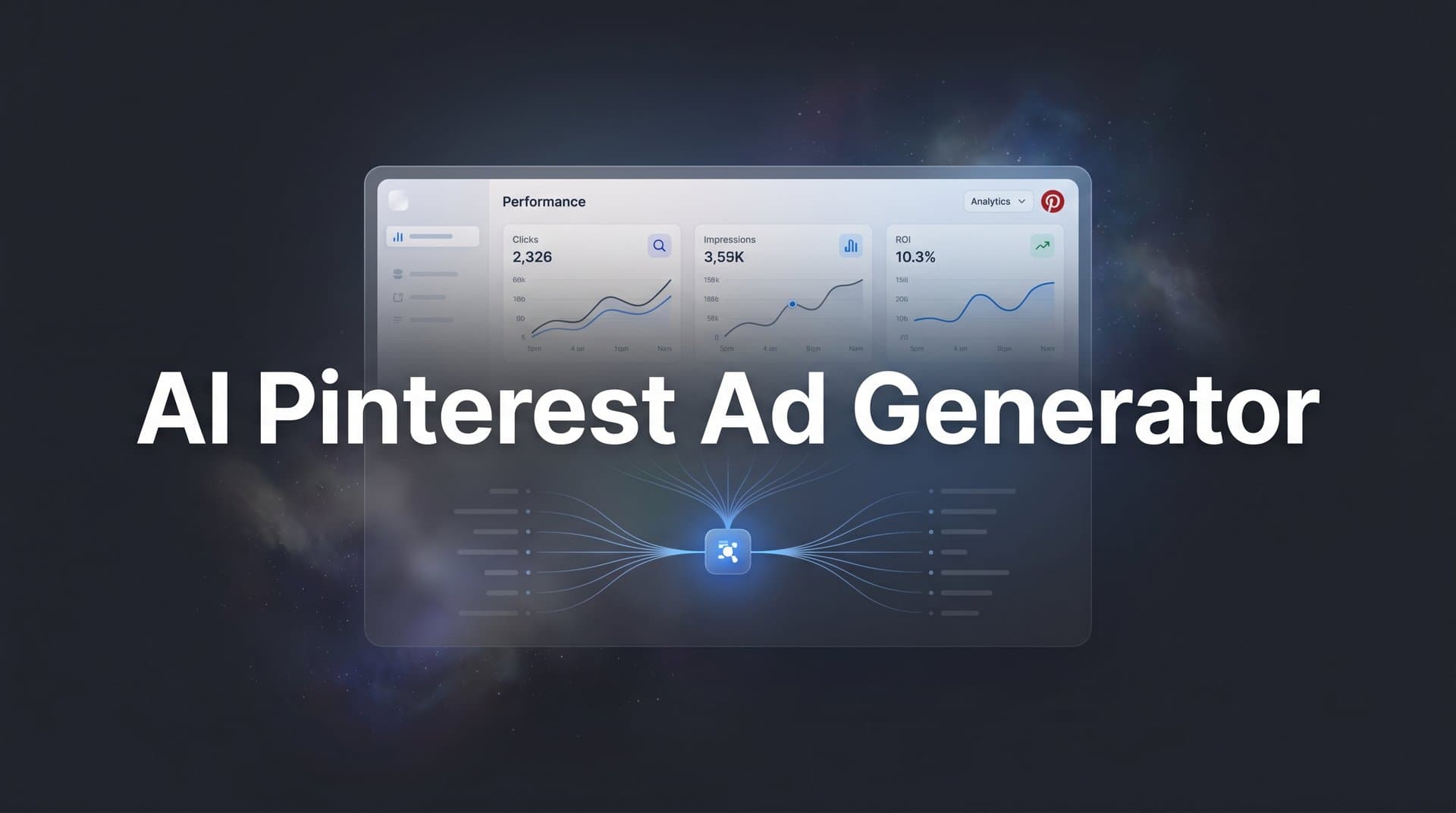
The term "AI Pinterest ad generator" can mean different things depending on the tool you're looking at. At its core, these are platforms that use machine learning and generative AI to produce ad creatives specifically formatted and optimized for Pinterest, often from minimal inputs like a product URL, a brand kit, or a simple text prompt.
If you're evaluating vendors, our AI ad creative platform breakdown can help.
The typical workflow looks something like this. You provide the tool with some combination of brand assets, product images, a description of your offer, and any style preferences. The AI then generates multiple pin variations, each formatted to Pinterest's specifications, with appropriate aspect ratios, text overlays, and visual compositions. Some tools also generate the accompanying copy, including headlines, descriptions, and calls to action, so you receive a complete, ready-to-launch ad package. This is similar to how modern building ads tools help scale campaign creation without the manual work.
It's worth understanding the different categories of tools in this space, because they're not all built the same way.
Pure image generators: These tools focus primarily on visual creation. You input a prompt or product image, and the AI produces visual assets. They're flexible but often require you to handle copy and formatting separately. Examples include general-purpose image generation platforms that marketers adapt for ad creative production.
If you're still comparing platforms, our best AI ad generator guide ranks the leaders.
End-to-end ad creative platforms: These handle both the visual and copy components together. You input your product or brand details, and the platform produces complete ad variations with images, headlines, and descriptions. Many of these tools are built specifically for paid advertising and include format presets for different platforms, including Pinterest.
Pinterest-native AI features: Pinterest has been building AI capabilities directly into its own ad manager. These features are designed to work within the platform's ecosystem, using Pinterest's own data about what performs well on the platform to inform creative recommendations and generation.
Each approach has tradeoffs. Native tools are tightly integrated with Pinterest's data and ad formats, but they may offer less creative flexibility. Third-party platforms often provide more control over brand voice and visual style, but require you to manage the connection between creative production and campaign performance separately.
What all of these tools share is the ability to dramatically compress the time between having a creative idea and having a launch-ready ad. A process that might take a designer several hours can often be completed in minutes, which changes the economics of PPC marketing significantly. More variations, faster testing, and less dependency on design resources are the core value propositions.
Key Features to Look for in AI-Powered Pinterest Ad Tools
Not all AI ad generators are built with Pinterest in mind. Many produce generic social media creatives that technically work on any platform but aren't optimized for how Pinterest users actually browse and engage. When evaluating tools, there are a few specific capabilities that separate the genuinely useful from the merely flashy.
Pinterest-specific format intelligence: Pinterest has its own set of creative best practices that differ significantly from other platforms. The standard pin format is vertical with a 2:3 aspect ratio. Idea Pins have their own specifications. Shopping ads require product imagery that meets specific quality standards. A good AI Pinterest ad generator should understand these requirements natively and produce creatives that are already optimized for the platform, not just resized versions of assets built for Facebook or Instagram.
Copy generation and A/B variation capabilities: The visual is only part of the equation. Pinterest ads also include headlines, descriptions, and calls to action that appear in search results and feeds. Strong tools generate multiple copy variations alongside the visual assets, giving you a range of messaging angles to test. This is particularly valuable because what resonates visually and what resonates in copy don't always align, and the ability to mix and match combinations at scale is a significant testing advantage.
Brand consistency controls: Speed of production is only useful if the output actually looks like your brand. Look for tools that allow you to lock in brand colors, fonts, logo placement, and tone of voice. The best platforms let you create a brand profile that the AI references whenever generating new creatives, so you're not manually correcting off-brand outputs every time you run a new batch. Pairing these tools with the right tools for marketing analytics ensures you can measure the impact of each creative variation.
Bulk creation and campaign-scale output: If a tool produces one or two variations at a time, it doesn't fundamentally change your workflow. The real leverage comes from tools that can produce dozens of variations in a single session, giving you enough creative inventory to run meaningful tests across multiple ad groups and audiences simultaneously.
Integration with your existing workflow: Consider how the tool connects to your broader marketing stack. Can you export directly in formats compatible with Pinterest's ad manager? Does it integrate with your asset management system? The less friction in the handoff from generation to launch, the more value you'll actually capture from the tool.
From Creative to Conversion: Tracking What Actually Works
Here's where a lot of marketers hit a wall. An AI Pinterest ad generator can help you produce creatives faster than ever before. But producing more ads doesn't automatically mean better results. The real question is: which of those creatives are actually driving revenue?
Pinterest's native analytics will tell you which pins are getting impressions, saves, and clicks. That's useful surface-level data. But clicks don't pay the bills. If you're running Pinterest ads to drive purchases, signups, or leads, you need to connect that click data to what happens after someone leaves Pinterest and lands on your site or product page. Implementing proper conversion tracking is essential for bridging this gap.
This is the attribution gap. And it's a significant one, especially in multi-channel campaigns where Pinterest often plays an assist or upper-funnel role rather than being the last touchpoint before conversion. If someone discovers your brand through a Pinterest ad, saves a pin, comes back a week later through a Google search, and then converts, a last-click attribution model gives Pinterest zero credit for that sale. Over time, that leads to systematic undervaluation of Pinterest's contribution to your revenue.
Multi-touch attribution software solves this by distributing credit across all the touchpoints that contributed to a conversion. This gives you a much more accurate picture of how Pinterest fits into your customer journey and whether your investment in Pinterest ads is actually paying off.
There's also a technical dimension to consider. Browser-based tracking has become increasingly unreliable as privacy changes and cookie deprecation limit the data available to marketers. Server-side tracking has emerged as a more robust alternative, capturing conversion data at the server level rather than relying on browser cookies that users may have blocked or that browsers may have restricted.
This is where a platform like Cometly becomes genuinely valuable. Cometly tracks the full customer journey from the initial Pinterest ad click through to downstream conversions, whether those happen immediately or days later across other channels. It connects your ad platforms, CRM, and website data into a single view, so you can see not just which Pinterest ads are getting clicks but which ones are actually contributing to revenue.
Beyond reporting, Cometly feeds enriched conversion data back to Pinterest's algorithm, which improves the platform's ability to optimize ad delivery toward users who are most likely to convert. This creates a compounding benefit over time: better data in means better targeting out, which means your AI-generated creatives are being shown to the right audiences more consistently.
Best Practices for Scaling Pinterest Ads with AI
Having access to an AI Pinterest ad generator and a solid attribution setup is a strong starting point. But how you use those tools together determines whether you scale efficiently or just produce more noise. Here are the practices that separate high-performing Pinterest advertisers from those who spin their wheels.
Start with data-informed creative briefs: Before you feed prompts into your AI generator, spend time reviewing your attribution and analytics data. What visual styles have historically driven conversions, not just clicks? What messaging angles resonate with your highest-value audience segments? Which CTAs correlate with downstream revenue rather than just engagement? Using this data to build your creative brief means the AI is working from a foundation of what actually works, not just what looks good. Learning how to leverage analytics for marketing strategy is critical to getting this step right.
Test aggressively but measure accurately: One of the biggest advantages of AI creative generation is the ability to test at scale. You can produce 20 pin variations in the time it used to take to produce two. But volume of testing only creates value if your measurement is accurate. Relying solely on Pinterest's native reporting to evaluate performance can lead you to optimize for the wrong metrics. Use multi-touch attribution to identify which creative combinations are driving actual revenue, and let that data guide your scaling decisions.
Iterate based on real conversion data: The most powerful use of AI ad generators isn't the initial creative production. It's the feedback loop you can build over time. When your attribution modeling data shows that a particular visual style or messaging angle is consistently contributing to conversions, you feed those insights back into your creative briefs and AI prompts. Over multiple iterations, you develop a clearer picture of what your audience responds to, and your AI-generated creatives get progressively more aligned with what actually drives results.
Don't neglect the post-click experience: AI can optimize your ad creatives, but the landing page experience still matters enormously. A compelling Pinterest ad that leads to a slow, confusing, or irrelevant landing page will underperform regardless of how good the creative is. Use your attribution data to evaluate not just which ads drive clicks but which ads drive clicks that convert, and look for patterns in where the drop-off is happening.
Putting It All Together: Building a Smarter Pinterest Ad Workflow
The ideal Pinterest advertising workflow in 2026 combines creative velocity with measurement precision. AI ad generators handle the production side, compressing the time and cost required to build a robust library of pin variations. Attribution platforms handle the measurement side, connecting creative performance to actual business outcomes across the full customer journey.
Think of it as a two-engine system. The AI generator is the production engine: fast, scalable, and capable of producing more creative variations than any manual process could match. The attribution platform is the intelligence engine: it tells you which of those variations are actually working, feeds better data back to the ad platform algorithms, and gives you the confidence to invest more in what's driving results.
Without both engines running together, you're either producing creatives without knowing which ones work, or you have great measurement but not enough creative volume to test meaningfully. The combination is what creates a genuine competitive advantage.
Marketers who treat AI ad generation as a standalone solution often end up with a lot of creative output and very little clarity on performance. Those who pair it with robust attribution find themselves in a continuous improvement cycle: better data informs better creative briefs, better creatives drive better results, and better results justify more investment in the channel.
Pinterest is a platform that rewards patience and iteration. Its longer content shelf life and search-based discovery model mean that the insights you build over time compound in ways that faster-moving platforms don't always allow. Building a systematic workflow around AI creative production and accurate attribution sets you up to capture that compounding value.
If you're serious about making Pinterest a meaningful part of your paid media strategy, start by evaluating your current tracking setup. Are you measuring Pinterest's true contribution to revenue, including its role as an assist channel? Are you feeding accurate conversion data back to Pinterest's algorithm? These foundational questions matter more than which AI generator you choose.
AI Pinterest ad generators are a genuine productivity multiplier for creative teams. They lower the barrier to testing, reduce design bottlenecks, and make it possible to maintain the creative freshness that Pinterest rewards. But the real competitive edge comes from pairing that creative speed with the attribution clarity to know exactly what's working and why.
If you're running Pinterest ads and relying on native platform reporting to evaluate performance, you're likely missing a significant portion of the picture. Multi-touch attribution gives you the full story: which creatives are contributing to conversions, how Pinterest fits into your broader customer journey, and where to invest your next dollar for maximum return.
Cometly is built for exactly this kind of clarity. It tracks every touchpoint from Pinterest ad click to final conversion, connects your ad platforms and CRM into a unified view, and feeds enriched data back to platform algorithms to improve targeting over time. If you're ready to scale Pinterest ads with confidence, start by making sure your measurement is as smart as your creative production. Get your free demo today and see how Cometly can give you the attribution visibility you need to turn Pinterest ad spend into measurable revenue growth.