Analytics self service is a simple but powerful idea: give your non-technical team members—like marketers and sales pros—the power to get their own data, run their own analyses, and build their own reports. No more waiting on a specialized data analyst or a backlogged IT department.
It’s about turning data analysis from a central bottleneck into a skill anyone can use, leading to faster, smarter decisions across the entire business.
Moving Past the Data Bottleneck with Analytics Self Service
For years, getting a simple report felt like placing an order at a restaurant with only one overworked waiter. A marketer would submit a ticket to a swamped IT or data team, wait for days (or even weeks), and finally get a static report that was probably already out of date.
That slow, frustrating process is the infamous data bottleneck, and it's a huge drag on agility.
This old-school, centralized model creates a massive gap between the people with the questions (your marketers and sales reps) and the people with the answers (your data analysts). It forces fast-moving teams to operate on gut feelings while they wait for the insights they desperately need to optimize campaigns, prove ROI, and react to sudden market shifts.
The Shift to a Data Buffet Model
Analytics self service completely flips this script. Instead of that one overworked waiter, imagine a well-organized data buffet. The data team is no longer taking individual orders. Instead, they’re the master chefs—prepping, organizing, and guaranteeing the quality of all the data "dishes" available.
Now, marketers and other business users can walk up to the buffet with their own plates (user-friendly tools) and serve themselves exactly what they need, right when they need it. This could be anything from:
- Building a custom dashboard to track real-time campaign performance.
- Digging into customer behavior to find high-value segments.
- Pulling a quick report on ad spend effectiveness just before a team meeting.
This is what it means to democratize data—transforming it from a guarded resource into a shared asset everyone can use. To get a high-level view of this shift, let's compare the old way with the new.
Traditional Analytics vs Analytics Self Service
Aspect | Traditional Analytics (The Old Way) | Analytics Self Service (The New Way) |
|---|---|---|
Who Gets Data? | Data analysts, IT, or technical experts | Anyone with a question, including marketers, sales, and operators |
How It Works | Submit a request ticket and wait for a report | Log into a tool and explore data directly |
Speed | Days or weeks for a single report | Minutes or hours with real-time insights |
Flexibility | Static, pre-defined reports | Dynamic, interactive dashboards and ad-hoc queries |
Role of the Data Team | Primarily fulfilling report requests | Building data infrastructure, governance, and enablement |
Outcome | Slow decisions based on outdated information | Fast, data-driven decisions across the organization |
This table shows just how fundamental the change is. It's not just about new tools; it's a complete reimagining of how an organization uses information to its advantage.
The global self-service BI market, a core part of this movement, was valued at $7.99 billion in 2025 and is projected to explode to $32.97 billion by 2034, according to projections from Fortune Business Insights. That kind of growth isn’t just hype—it’s driven by the urgent need for tools that let teams move faster.
This shift doesn’t make data experts obsolete. Far from it. It actually elevates their role. They graduate from being report monkeys to strategic enablers, focusing on the big picture: governance, data quality, and building the systems that empower the entire organization.
Ultimately, analytics self service is about building a culture of curiosity and data fluency. It’s giving your team the power to ask and answer their own questions, turning insights into action at the speed of business. But just buying a tool isn't enough; it requires a solid foundation built on smart strategies. For a deeper look, check out our guide on data integration best practices.
The Three Pillars of a Strong Self-Service Analytics Program
Rolling out a successful analytics self-service program isn't as simple as buying new software and hoping your team uses it. Real, sustainable success is built on three core pillars: Technology, People, and Process. If you neglect any one of these, the whole system gets wobbly.
It’s like trying to build a three-legged stool with one leg shorter than the others—it might stand for a minute, but it’s going to collapse as soon as you put any weight on it. Let's break down how these three pillars work together to create an environment where data actually drives decisions.
Pillar 1: Technology—The Right Tools for the Job
The first pillar, technology, is the one everyone sees first. It's the slick, user-friendly platform that lets your team dig into data without needing to know a single line of code. The right tools act as a bridge, connecting non-technical users to complex data in a way that just makes sense.
An effective self-service tech stack has to deliver on a few key things:
- An Intuitive Interface: Think drag-and-drop report builders and simple query tools. If the platform is clunky or requires a Ph.D. to navigate, your team will abandon it. It’s a non-negotiable.
- Seamless Data Integration: The tool has to connect effortlessly to all your important data sources—ad platforms, your CRM, your e-commerce backend, you name it. This is how you create a single source of truth.
- Robust Visualization Options: Your team needs to be able to build clear, compelling charts and dashboards that tell a story. Data is useless if you can’t make it easy for others to understand at a glance.
The goal of the technology isn't to be flashy; it's to be invisible. The best tools are so easy to use that your team forgets they're even using a powerful analytics platform and can focus solely on the questions they want to answer.
This model shows how self-service breaks down the old-school IT bottleneck and creates an empowered ecosystem for different teams.
 Your Guide to Analytics Self Service for Marketing
Instead of every request getting stuck in a queue for a central team, marketers and sales can pull the insights they need directly, right when they need them.
Pillar 2: People—Fostering a Data-Literate Culture
You can have the most advanced analytics platform on the planet, but it's just an expensive decoration if your team doesn't know why or how to use it. This is where the "People" pillar comes in. It’s about way more than a few training workshops; it's about building a culture of data literacy, where people feel confident asking tough questions and using data to find the answers.
To get this pillar right, you need to focus on:
- Targeted Training: Don't just show people where to click. Teach them how to ask smart questions, interpret the results correctly, and spot common mistakes in analysis.
- Creating Data Champions: Find those enthusiastic users in different departments who just get it. Empower them to be advocates and provide peer support. This kind of ground-up adoption is incredibly powerful.
- Encouraging Curiosity: This has to come from the top. Leadership needs to create an environment where asking "why" and backing up arguments with data is the default, not the exception.
Pillar 3: Process—The Guardrails of Governance
Without the third pillar, Process, your self-service analytics initiative will quickly spiral into chaos. This is where you establish the essential governance and structure that ensures your data is reliable, consistent, and used responsibly. Think of it as the blueprint that keeps the "data buffet" from turning into a messy free-for-all.
A solid process framework needs to establish:
- Clear Data Governance: Who owns what data? What’s the official definition for critical metrics like "customer," "lead," or "conversion"? This is what prevents the nightmare scenario where 7 different dashboards show 7 different numbers for revenue.
- Data Quality Standards: You have to put automated checks and validation rules in place to make sure the data everyone is pulling is accurate, complete, and trustworthy. Garbage in, garbage out.
- Defined Roles and Responsibilities: Make it crystal clear who does what. The data team’s job is to be the enabler and governor, while business users are the explorers and analysts.
When you carefully balance Technology, People, and Process, you create something powerful and sustainable. It's an environment where your team is truly empowered to make faster, smarter decisions, all while the organization maintains control over its most valuable asset—its data.
Unlock Real Business Growth with Self Service Analytics
Let's move past the theory. How does analytics self service actually drive tangible results for a business? The real value isn't just about getting reports faster; it’s about turning that speed into a genuine competitive advantage that boosts your bottom line.
Imagine a marketing manager launching a new campaign. In the old world, they’d wait a week for a performance report, bleeding money on ads that aren't working. With a self-service model, that same manager logs into their own dashboard, spots a bad ad creative within hours, and shifts the budget to a winner before the day is even over.
This isn't just a minor tweak—it's a fundamental change in how quickly your business can operate.
From Reactive Reporting to Proactive Strategy
When you give your teams direct access to data, the whole dynamic of the business shifts. Analysts who were once buried under a mountain of repetitive report requests are suddenly freed up to tackle the big, strategic challenges that actually move the needle.
Instead of just answering "what happened," they can finally focus on "why it happened" and "what should we do next?" This shift not only makes operations more efficient but also elevates your data team from report monkeys to strategic partners in growth.
The ultimate goal of analytics self service is to build a data-driven culture where proactive problem-solving and fresh ideas become the norm. It’s about creating an environment where every team member is equipped to ask better questions and find their own answers.
This approach creates a powerful ripple effect across the entire company. If you're curious about how this plays out on the financial side, you might find our guide on how revenue analytics can illuminate these opportunities helpful.
Measurable Impacts on Your Bottom Line
Faster, more accessible insights translate directly into real-world business outcomes. The connection is simple but incredibly powerful, leading to big improvements in the metrics that matter most.
- Improved Marketing ROI: Marketers can pinpoint winning and losing campaigns almost instantly, making sure every ad dollar is pulling its weight.
- Lower Customer Acquisition Costs (CAC): Teams can analyze customer behavior and channel performance on the fly, doubling down on the most efficient acquisition funnels.
- Enhanced Customer Lifetime Value (LTV): Product teams with direct access to usage data can identify the features that keep customers around and iterate on them faster.
The broader self-service technologies market, which includes analytics, is booming for a reason. It grew from $32.23 billion in 2020 and is projected to hit $88.33 billion by 2030. This isn't just hype; it's driven by the demand for tools that give businesses a clear edge. For instance, e-commerce and SaaS companies often see a 35% jump in operational efficiency by using self-service to zero in on their most profitable campaigns.
To really maximize the impact, consider how your self-service analytics program fits into your wider data analytics for business growth strategy. At the end of the day, empowering your team isn't just about convenience—it's about giving them the tools they need to win.
How Cometly Makes Self-Service Analytics Effortless
 Your Guide to Analytics Self Service for Marketing
True self-service analytics isn't just about having access to data. It’s about making that data instantly useful without needing a technical background to decipher it. The theory is great, but marketers need practical tools that close the gap between having a question and getting a clear answer.
Cometly was built to be that bridge. We turn the promise of self-service into a daily reality for performance marketers. Instead of wrestling with complicated setups or waiting for developers, our zero-code foundation gets you running in minutes, putting your marketing data directly in your hands.
Unify Your Data Instantly
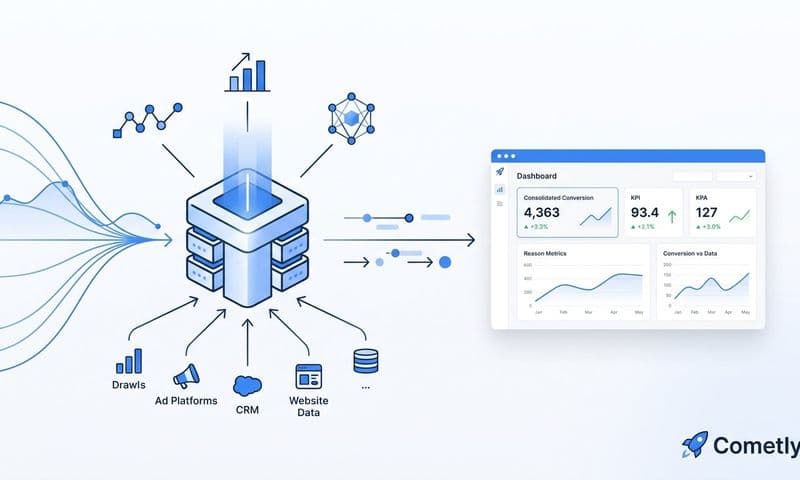
One of the biggest roadblocks to self-service is scattered data. Your campaign stats live on Facebook and Google, your sales numbers are in Shopify, and your leads are tucked away in a CRM. Cometly fixes this with over 100 one-click integrations, automatically pulling all your critical touchpoints into a single, cohesive view.
This isn't just about connecting accounts; it's about piecing together the complete story of your customer's journey. You can finally see how a TikTok ad influenced a sale that was closed through an email campaign—all without writing a single line of code.
This unified approach is a massive trend. The market for customer self-service software is expected to jump from $7 billion in 2019 to $24.9 billion by 2026. Why? Because users are demanding platforms that, like Cometly, give them direct control to see what's working and what's not, all in one place.
Build Reports That Actually Answer Your Questions
Let's be honest: static, pre-built reports rarely answer the specific, nuanced questions that marketers have on a daily basis. Cometly puts the power back in your hands with intuitive, drag-and-drop dashboards. You can build reports that focus on the metrics that actually drive your business forward.
Cometly's goal is to make advanced marketing attribution feel simple. You shouldn't need to be a data scientist to understand what's working. The platform does the heavy lifting so you can focus on strategy.
With this level of control, you can create views for every need:
- High-Level Executive Dashboards: Showcasing overall ROI and channel performance.
- Granular Campaign Reports: Digging into ad-level metrics for daily optimization.
- Funnel-Specific Views: Tracking customer progression from first click to final purchase.
A clear, custom dashboard means you spend less time hunting for numbers and more time acting on them. For anyone ready to go deeper, you can learn more about Cometly's advanced analytics features and see how they can transform your reporting.
Your On-Demand AI Data Analyst
The next step in self-service isn't just seeing the data; it's understanding the "why" behind it. Cometly embeds AI directly into your workflow to act as your on-demand analyst, delivering insights without you even having to ask.
The AI-powered Ads Manager constantly monitors your campaigns, flagging opportunities and risks. It might suggest moving budget from a fatigued ad set to a high-performer or alert you to a sudden drop in conversions. This turns your data from a passive resource into an active partner.
Even better, the AI Chat feature lets you ask plain-English questions about your performance. Instead of filtering through dashboards, you can simply ask, "Which campaign had the best ROAS last week?" and get an instant, accurate answer. It’s the ultimate form of self-service—making deep analysis as easy as sending a message.
Your Practical Roadmap To Implementing Self Service Analytics
 Your Guide to Analytics Self Service for Marketing
Trying to roll out a company-wide analytics self service program all at once is a surefire way to overwhelm your team and stall progress before it even starts. A successful launch isn’t a single, massive event. It's a series of small, strategic wins that build on each other.
Think of it like building a bridge. You don't just stretch a beam across the entire canyon and hope for the best. You start by anchoring a solid foundation on one side, build out a small, stable section, and then expand from there.
This gradual approach lets you prove the concept, iron out the kinks, and generate real enthusiasm. It transforms a massive project into a sequence of manageable, achievable steps.
Step 1 Start With a Pilot Project
The best place to begin is with a small, focused pilot project. Find a single team—usually a marketing or sales group—that’s already hungry for data but is held back by the current reporting bottlenecks. This team will be your proof of concept and, if you do it right, your most vocal supporter.
The goal here isn’t to solve every data problem at once. It’s to score a quick, visible win that shows everyone else what's possible.
- Define a Clear Business Question: Ditch vague goals like "improve data access." Instead, focus on a real pain point, like, "Why did our customer acquisition cost jump 15% last month?"
- Select a Champion: Find someone on that business team who is genuinely excited about data and can rally their colleagues. This person is your internal champion.
- Keep the Scope Tight: Limit the initial data sources and the number of users involved. This keeps the project manageable and laser-focused on a clear outcome.
A successful pilot creates a powerful internal case study. When other departments see that team making faster, data-backed decisions, they'll be lining up to get involved.
A successful pilot project does more than just prove a tool works. It demonstrates a new way of working, shifting the conversation from "this is too complicated" to "how can we get this for our team?"
Step 2 Choose the Right Tools and Establish Governance
With a win from your pilot, it’s time to think bigger about your technology and processes. The tool you used for the pilot might be perfect for the long run, but now you need to be sure it can scale. Look for platforms that are intuitive enough for non-technical users but still offer the robust data management capabilities your technical team needs.
This is also the right time to lay the groundwork for your governance framework. This doesn't need to be a complex, bureaucratic mess. Start with the basics to make sure your data stays trustworthy as more people get access.
- Create a Data Dictionary: Define critical business metrics like "Lead," "Conversion," and "ROI." This simple step prevents the chaos that comes from five different dashboards showing five different numbers for revenue.
- Define User Roles: Clearly outline who can create new data sources versus who can only view and build reports from existing ones.
- Establish Quality Checks: Put some basic automated checks in place to ensure the data flowing into the system is clean and reliable from the start.
To help you structure this process, a phased rollout plan can keep everyone aligned. Here’s a simple table outlining what that might look like:
Self Service Analytics Rollout Plan
Phase | Objective | Key Actions | Success Metric |
|---|---|---|---|
Phase 1: Pilot (1–2 Months) | Prove the value of self-service analytics with a small, focused team | Identify a champion team and a key business question | The pilot team independently answers their initial business question using the new tool |
Phase 2: Foundation (3–6 Months) | Establish governance, formalize the tech stack, and prepare for broader rollout | Finalize tool selection | 80% of key business metrics are clearly defined and documented |
Phase 3: Expansion (6–12 Months) | Onboard additional departments and drive widespread adoption | Roll out training to new teams | 50% of targeted business users have actively used the self-service tool in the last 30 days |
Phase 4: Maturity (12+ Months) | Embed self-service analytics into company culture as the default way to get insights | Continuously gather feedback and refine processes | A measurable decrease in ad-hoc report requests to the central data team |
A structured plan like this turns a big idea into a concrete project, ensuring you build momentum instead of creating confusion.
Step 3 Invest in Training and Scale Thoughtfully
With your tools and rules ready, you can start the wider rollout. But just giving people access to a tool won't drive adoption. Real success comes from empowering your users with the skills and confidence to explore data on their own. Our guide on reporting and analytics best practices offers a solid foundation for this.
Training needs to be practical and tailored to each role. A marketer needs to know how to analyze campaign performance, while a sales leader needs to track pipeline velocity. Focus on hands-on workshops that solve real-world problems, not boring feature walkthroughs.
As you expand, keep gathering feedback, celebrating the wins (big and small), and refining your approach. A great self-service analytics program isn't a one-and-done project; it's a living system that grows with your organization, turning data into a true company-wide asset.
Common Pitfalls to Avoid on Your Self-Service Journey
Rolling out a self-service analytics program is a huge step forward, but it’s not a magic bullet. Too many companies just launch a new tool, cross their fingers, and then wonder why nobody’s using it. If you want to build a program that actually sticks, you need to know what trips most people up.
Many initiatives are doomed from the start because they stumble over the most basic hurdle: poor data quality. It's the classic "garbage in, garbage out" scenario. If your underlying data is a mess—inconsistent, incomplete, or just plain wrong—every dashboard built on top of it will be just as unreliable. User confidence evaporates on day one.
The whole point of self-service is to create a single source of truth. But when different dashboards show conflicting numbers for the same metric, you don't get clarity—you get chaos and endless meetings debating whose numbers are "right."
This chaos is almost always a symptom of another major pitfall: a total lack of governance.
The Dangers of an Ungoverned System
Without clear rules, a self-service environment can quickly turn into the Wild West. Well-meaning team members start creating their own versions of key metrics, and suddenly you have a dozen different definitions for "customer" or "revenue." This makes it impossible to have a coherent, data-driven conversation.
Good governance isn’t about locking people out; it’s about creating clarity. It’s about making sure everyone is speaking the same data language.
- Solution: Create a data dictionary that clearly defines your core business metrics. Appoint data stewards who are responsible for the quality and consistency of key datasets. This ensures everyone is working from a shared, trusted foundation.
Tool Complexity and Training Gaps
Another common mistake is picking a tool that’s way too complicated for the average user. A platform loaded with features that only a data scientist could love will intimidate your team, not empower them. The best tools feel intuitive and are built for non-analysts.
This problem gets even worse when there’s no real training. Just sending out logins with a link to a help doc is a recipe for failure. Without proper onboarding, users will fall back on old habits—exporting everything to Excel or, even worse, giving up completely. It’s no surprise that analytics adoption rates often stall out around 20%; teams just aren’t given the skills or confidence to use the new systems. For example, tackling common attribution challenges in marketing requires both the right tool and the right know-how.
- Solution: Make user experience a top priority when choosing a platform. Then, invest in hands-on, role-specific training that shows people how to solve their actual business problems, not just how to click buttons in a new interface. This builds real confidence and drives adoption across the board.
Still Have Questions About Self-Service Analytics?
Even with the best game plan, switching to a self-service model is bound to bring up a few questions. That’s perfectly normal. Let's tackle some of the most common ones that pop up when teams start this journey.
How Does This Change the Role of Our Data Team?
This is a big one. Instead of being stuck in a reactive loop of building reports and fulfilling tickets, your data team gets to become proactive and strategic. Their focus shifts from being order-takers to becoming genuine enablers of the business.
Think of them less as short-order cooks and more as executive chefs designing a world-class buffet. Their new job is to:
- Build and Maintain the "Data Buffet": They’re responsible for making sure the data served to the company is clean, reliable, and organized in a way that makes sense to non-technical users.
- Manage Governance: They set the rules of the road. This means defining key metrics, ensuring consistency, and making sure everyone is speaking the same data language.
- Empower Users: They transform into internal consultants and coaches, training business teams to fish for their own answers and build confidence with data.
Ultimately, this shift elevates their role from a service desk to a strategic partner, freeing them up to work on the complex, high-impact projects that actually move the needle.
What Makes a Good First Self-Service Project?
Starting small and aiming for a quick, visible win is the way to go. A great pilot project is small enough to manage but impactful enough to get the rest of the company excited.
Look for a specific, urgent business problem that everyone agrees needs a solution. The team you choose to work with should be genuinely enthusiastic about trying a new way of working—no arm-twisting needed. Most importantly, define a clear, measurable outcome from the start. This way, you can definitively prove the value of self-service analytics and build momentum for a wider rollout.
Is Self-Service Analytics Secure?
Absolutely, but only when it’s built on a solid foundation of governance. There's a common misconception that self-service means a data free-for-all, but that couldn’t be further from the truth.
A well-designed self-service analytics platform uses role-based access controls to ensure users only see the data they are authorized to see. Sensitive information stays locked down, while teams get the specific insights they need to do their jobs.
It's not an open door; it's about giving the right people the right keys.
Can We Really Do This Without Turning Everyone into an Analyst?
Yes, and that’s the whole point. The goal isn’t to force marketers or product managers to become data scientists. It's about giving them tools so intuitive they don’t need deep technical skills to get answers.
Modern platforms, especially those with AI baked in, are designed to bridge this exact gap. They allow users to ask questions in plain English and get back immediate, easy-to-understand answers. The platform handles all the complex queries and calculations behind the scenes, so your team can focus on strategy, not syntax. This is how the original promise of self-service—making data truly accessible to everyone—is finally being delivered.
Ready to make self-service analytics a reality for your marketing team? Cometly provides the zero-code platform you need to unify your data, build custom dashboards, and get AI-powered insights in minutes. See how it works at https://www.cometly.com.