Reporting and analytics often get tossed around like they’re the same thing, but they answer two completely different—and equally critical—questions for your business.
Think of it this way: Reporting tells you what happened. It’s like the dashboard in your car, showing your speed and fuel level. Analytics explains why it happened and what to do next. That’s your GPS, guiding your future decisions.
Reporting Is Your Dashboard, Analytics Is Your GPS
Confusing these two is a classic mistake, and it’s one that costs businesses a ton of missed opportunities. Getting their distinct roles straight is the first step toward building a data strategy that doesn’t just track performance but actively drives it forward.
Your weekly sales report? That's pure reporting. It tells you revenue hit $10,000, a 15% jump from last week. This is essential, factual, and gives you a clean snapshot of performance. Without it, you’d be flying blind.
But that report leaves you with a huge question: why did revenue jump 15%? Was it that new marketing campaign? A product launch? A random seasonal spike? This is where analytics steps in to connect the dots.
From Looking Back to Looking Forward
Analytics isn't just about presenting numbers; it’s about digging into them to find the story. It’s your strategic GPS. Instead of just stating that sales went up, analytics might reveal the 15% jump was almost entirely driven by a single TikTok ad that nailed its targeting with a new demographic.
By interpreting the data, analytics answers the "why" and helps you decide your next move. It transforms a simple observation ("sales are up") into an actionable strategy ("we should allocate more budget to TikTok ads targeting this new audience").
This forward-looking approach is what separates stalled businesses from growing ones. You absolutely need both functions working in harmony:
- Reporting organizes and presents data so you can monitor business health.
- Analytics interrogates that data to find opportunities and steer your strategy.
To make this crystal clear, here’s a quick breakdown of how these two functions operate.
Reporting vs Analytics At a Glance
AspectReporting (The What)Analytics (The Why and Next)PurposeTo monitor and display past performance.To interpret data, find patterns, and guide future actions.Question It Answers"What happened?" (e.g., "Sales increased by 15%.")"Why did it happen?" and "What should we do now?"Time FocusRetrospective (looks at the past).Predictive and prescriptive (looks to the future).OutputDashboards, scorecards, static reports.Insights, recommendations, strategic models.AnalogyA car's dashboard (speed, fuel).A GPS system (route, ETA, traffic alerts).
Ultimately, having one without the other just doesn't cut it. Reporting gives you the facts, but analytics gives you the roadmap.
Why Both Are Essential for Modern Marketing
The whole industry is waking up to this reality. The marketing analytics market is surging, expected to jump from $5.35 billion to $6.2 billion, fueled by a 15.9% growth rate as businesses demand more than just basic reports. With 63% of marketers already using generative AI, the focus has shifted to systems that help interpret data, not just show it. You can see the full market analysis on The Business Research Company for more on this trend.
At the end of the day, relying only on reporting is like driving by looking in the rearview mirror. You know exactly where you've been, but you have no clue where you're headed.
For a deeper dive into turning raw numbers into strategic wins, check out this guide on analytics in advertising. Platforms like Cometly are built specifically to bridge this gap, combining powerful reporting dashboards with the deep analytical tools needed to give you the complete picture of your marketing performance.
Mastering Metrics and Attribution Models
Once you get the difference between the 'what' of reporting and the 'why' of analytics, you can start focusing on the numbers that actually grow your business. It’s time to stop obsessing over surface-level data and zero in on the key performance indicators (KPIs) that truly signal your company’s health and profitability.
These are the metrics that connect your marketing spend directly to the bottom line. They tell a clear financial story, moving you way beyond simple click and impression counts.
Key Metrics That Drive Decisions
To really get a grip on your performance, you only need to concentrate on a few core metrics that tell a powerful story about your marketing's financial impact.
- Return on Ad Spend (ROAS): This is the ultimate gut-check for ad profitability. ROAS calculates how much revenue you generate for every single dollar you spend on ads, giving you a direct line of sight into how well your campaigns are working.
- Customer Lifetime Value (LTV): LTV is a prediction of the total revenue a customer will bring in over their entire relationship with you. Knowing this helps you justify spending more to acquire high-value customers who will pay off in the long run.
- Customer Acquisition Cost (CAC): This one’s simple: how much does it cost, on average, to get a new customer? The golden rule is to keep your CAC well below your LTV. If you can do that, you have a sustainable, profitable business.
When you focus on this trio—ROAS, LTV, and CAC—your entire perspective shifts from just running campaigns to making a real business impact. This is what data-driven decision-making actually looks like.
This concept map breaks down the fundamental difference between reporting (what happened) and analytics (why it happened and what to do next).
 Reporting and Analytics: Build Dashboards, Drive Growth with Data Insights
As you can see, reporting looks backward, while analytics is all about looking forward and making strategic moves. You absolutely need both to win.
Understanding Marketing Attribution
Knowing your key metrics is only half the battle. The other half is figuring out how to give credit where credit is due—pinpointing which marketing touchpoints actually led to a sale. This is where multi-touch attribution comes in, and it’s a total game-changer.
Think of it like a soccer team scoring a goal. A basic, last-click attribution model gives 100% of the credit to the player who kicked the ball into the net. It completely ignores the midfielders who passed the ball up the field and the defenders who started the play. It’s an incomplete and frankly misleading picture of how the goal was scored.
Multi-touch attribution is like watching the full game replay. It acknowledges every player—every marketing touchpoint—that contributed to the goal, providing a complete and accurate understanding of how you won the customer.
This complete view is critical for making smart budget decisions. If you only give credit to the last ad someone clicked, you might mistakenly cut funding for the top-of-funnel campaigns that introduced them to your brand in the first place.
Common Multi-Touch Attribution Models
Different models assign credit in different ways, and the right one for you really depends on your business goals and how your customers buy. Here are a few common ones:
- Linear Model: This model spreads credit out equally across every single touchpoint. It’s simple, democratic, and values every interaction along the way.
- Time-Decay Model: This one gives more credit to the touchpoints that happened closer to the conversion. The thinking here is that the most recent interactions were the most influential.
- U-Shaped Model: This model gives the most credit to the very first touchpoint and the very last one (40% each), with the remaining 20% spread across the interactions in the middle. It values both the initial discovery and the final conversion driver.
Platforms like Cometly are built to handle this complexity, tracking every single interaction to help you choose and apply the model that makes the most sense for your business. To see how this works in more detail, check out our guide on attribution in marketing.
The shift to smarter analytics is happening fast, with US paid search spending now at $124.59 billion. To see how these metrics apply in other business areas, you can explore resources on Human Resources Analytics. The proof is in the numbers: 83% of sales teams using AI reported revenue growth, and 63% of marketers now use it for sharper reporting. By tracking the entire customer journey, you can finally prove which channels are effective with hard, undeniable numbers.
Building Dashboards That Inspire Action
 Reporting and Analytics: Build Dashboards, Drive Growth with Data Insights
A dashboard crammed with charts and numbers isn't insightful—it’s just noise. The best dashboards don't just display data; they tell a clear story that drives smart decisions. They turn raw information into a roadmap for action.
An effective dashboard isn’t about showing everything. It’s about showing the right things in the right way. And that starts with understanding the basics of data visualization.
Choosing the Right Visual for Your Data
How you present your data can be the difference between instant clarity and total confusion. Each chart type has a specific job, and matching the right visual to your data is the first step toward building a dashboard that actually works.
Here’s a quick rundown of the most common chart types:
- Line Charts: Perfect for tracking a metric’s performance over time. Use them to see trends in website traffic, sales revenue, or ROAS over weeks and months.
- Bar Charts: Ideal for comparing different categories. A bar chart makes it easy to compare ad campaign performance, traffic from different sources, or sales across product lines.
- Pie Charts: Best for showing parts of a whole, like the percentage breakdown of your traffic sources. Just be careful not to overcrowd them with too many slices.
When you pick the right visualization, the story in your data becomes immediately obvious to anyone looking. This principle is at the heart of designing a powerful data analysis dashboard that your team will actually use.
Structuring Your Dashboard for Every User
A great dashboard serves different needs for different people. An executive wants a high-level overview, while a channel manager needs to dig into the details. A well-designed dashboard accommodates both through a smart, logical hierarchy.
Think of it like a pyramid. At the top, you put the most critical, big-picture KPIs—the numbers your leadership team cares about most.
A dashboard should start with the "so what?"—the top-level metrics that define success. From there, it should allow users to intuitively drill down to find the "why." This creates a clear path from observation to action.
Start with high-level metrics like overall ROAS, total new customers, and LTV. Then, create sections that let users click into more specific data, like ROAS by ad platform or customer acquisition cost per campaign. This layered approach ensures every team member gets the information they need without feeling overwhelmed.
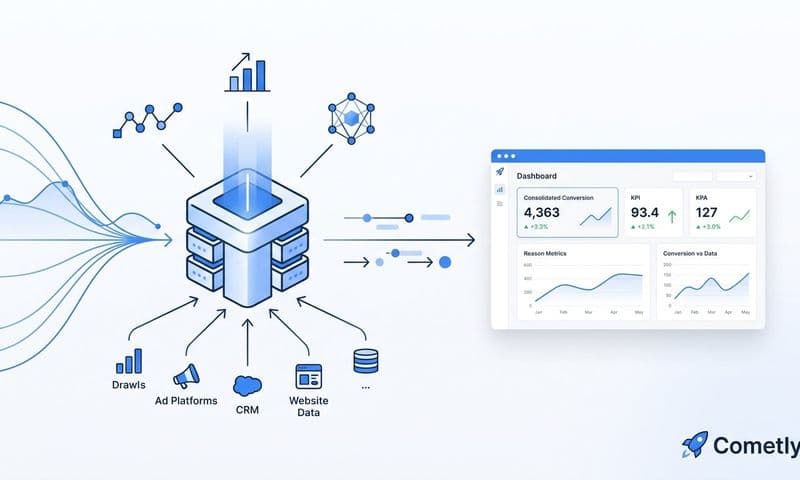
For example, a platform like Cometly presents a clean, intuitive interface that organizes this hierarchy for you.
Reporting and Analytics: Build Dashboards, Drive Growth with Data Insights
This dashboard immediately shows top-level metrics like ad spend and ROAS, with clear visuals for tracking trends. The clean layout transforms raw data into an obvious path for optimization, empowering your team to stop drowning in numbers and start making impactful decisions.
The Technical Foundation for Accurate Data
 Reporting and Analytics: Build Dashboards, Drive Growth with Data Insights
Powerful reporting and analytics don't just happen by magic. They’re built on a foundation of clean, complete, and trustworthy data. Without that solid groundwork, even the most beautiful dashboard is just displaying fiction.
In today's privacy-first world, the old ways of collecting data are breaking down. The technical choices you make now are critical for ensuring your marketing decisions are based on reality, not guesswork.
The Shift to Server-Side Tracking
For years, marketers relied on client-side tracking, where a tracking pixel runs in a user's web browser to send data back to ad platforms. Think of it like sending mail through a public postal service—it’s convenient, but a lot can go wrong. Ad blockers, browser updates like iOS 14, and cookie restrictions can intercept that data, causing it to never reach its destination.
Server-side tracking is the modern solution. Instead of relying on the user's browser, data is sent from your website's server directly to the ad platform or analytics tool. This is like using a secure, private courier. The data transmission happens server-to-server, so it’s invisible to ad blockers and unaffected by most browser restrictions.
Server-side tracking isn’t just a workaround; it’s a necessary evolution for data accuracy. It ensures that critical conversion events are captured reliably, bypassing the obstacles that now block up to 30% or more of client-side data.
This direct line of communication results in a much more complete and accurate picture of user behavior, which is essential for proper reporting and analytics.
To make it even clearer, let's compare the two approaches side-by-side. The differences in reliability and accuracy are striking.
Data Collection Methods Compared
Feature | Client-Side Tracking (Browser-Based) | Server-Side Tracking (Platform-Based) |
|---|---|---|
Data Transmission | Sent from the user’s browser such as Chrome or Safari. | Sent directly from your website’s server. |
Reliability | Susceptible to ad blockers, network issues, and browser privacy settings. | High reliability and bypasses most browser-level interruptions. |
Accuracy | Often incomplete due to lost data packets and blocked requests, with up to 30 percent data loss. | Nearly 100 percent data capture for a complete and consistent view. |
Security & Privacy | More exposed to third-party scripts and potential data leakage. | More secure and controlled environment for handling user data. |
Resilience | Breaks with platform changes such as iOS 14 updates and cookie deprecation. | Future-proof and resilient to changes in browser and privacy technology. |
As you can see, server-side tracking isn't just a minor upgrade—it's a fundamental shift required to maintain a clear view of your marketing performance.
Breaking Down Data Silos with Integrations
Accurate tracking is just one piece of the puzzle. The other is making sure all your data sources can talk to each other. When your CRM, payment processor, and ad platforms operate in isolation, you create data silos—fragmented views of the customer journey that make true attribution impossible.
Did that new customer come from a Google Ad, a sales call logged in your CRM, or an email campaign? Without integration, you'll never know for sure. This is where connecting your tools becomes essential for creating a single source of truth.
This is one of the most important aspects of building a reliable system. For a closer look at how to connect your tools effectively, you can learn more from our guide on data integration best practices.
The rise of AI in marketing, a market that has exploded to $47.32 billion from just $12.05 billion in 2020, highlights this need. As the market barrels toward $107.5 billion by 2028, platforms that unify data with server-side tracking are becoming the standard. AI helps shift staff time from manual data work to high-level strategy, making this technical foundation more critical than ever. Read the full marketing statistics to see how these trends are shaping the industry.
Tools like Cometly are built to solve these technical headaches from the ground up. With built-in server-side tracking and zero-code integrations for over 100 platforms, it automates the creation of a reliable data foundation, ensuring every touchpoint is captured and attributed correctly.
Common Reporting Pitfalls and How to Avoid Them
Even with perfect data and beautiful dashboards, it’s surprisingly easy to get lost. A few common mistakes in reporting and analytics can derail even the best strategies, sending your team on a wild goose chase after the wrong goals.
Knowing what these traps look like is the first step to sidestepping them entirely. Once you can spot them, you can build a smarter, more effective analytics culture that’s laser-focused on real business impact.
Chasing Vanity Metrics
This is probably the most common mistake in the book: focusing on vanity metrics. These are the numbers that look great on a slide deck but don't actually move the needle for the business. Think social media likes, raw page views, or email open rates. They feel good, but they often create a false sense of security.
An e-commerce brand might get excited about hitting 50,000 Instagram followers. But if none of those followers are clicking through to the site or actually buying anything, that number is just noise. The real story is always in the actionable metrics—the data that ties directly back to revenue and growth, like conversion rates, Customer Lifetime Value (LTV), and Return on Ad Spend (ROAS).
To dodge this trap:
- Connect every single metric to a business goal. Before you add anything to a dashboard, ask the tough question: "How does this number help us make more money or get more customers?"
- Prioritize KPIs that track conversions. Put your energy into metrics like lead-to-customer rate, average order value, and ROAS. These are the numbers that tell you if your marketing is actually working.
Falling for Confirmation Bias
We’re all human, which means we’re wired to look for proof that we’re right. In analytics, this is called confirmation bias, and it's incredibly dangerous. It's the tendency to cherry-pick data that supports what we already believe while conveniently ignoring anything that challenges it.
For example, a marketer who’s convinced their new ad campaign is a home run might fixate on a spike in click-through rates. At the same time, they might completely overlook the fact that conversion rates have dropped off a cliff.
Confirmation bias turns data from an objective source of truth into a tool for self-validation. It stops you from seeing the full picture and making a change when a strategy is failing.
To fight this, you have to actively look for evidence that proves you wrong. Build a team culture where people are rewarded for challenging assumptions, not just agreeing with the boss. If you think a campaign is a winner, make it your mission to find data that suggests otherwise. This disciplined approach ensures your decisions are grounded in reality, not wishful thinking.
A great way to get an objective view is by using attribution models that show the whole customer journey, not just the final click. To learn more, read about the limitations of last-click attribution and how a broader view provides a more accurate picture.
Suffering from Analysis Paralysis
On the flip side of the coin, you have analysis paralysis. This is what happens when you’re so buried in data that you can’t make a decision at all. With endless ways to slice and dice information, teams can get stuck in a never-ending loop of investigation without ever actually doing anything.
Imagine a team spending weeks digging through hundreds of data points to find the "perfect" time to post on social media. By the time they have an answer, the algorithm has already changed. The whole point of reporting and analytics isn’t to find a perfect, risk-free answer; it’s to make better, more informed decisions, faster.
To break out of this cycle, set hard deadlines for analysis and define what "good enough" information looks like for your team. Zero in on the insights that can lead to immediate, testable actions. Remember, it's almost always better to make a good decision today than a perfect one next month.
Unifying Your Data with an Integrated Platform
 Reporting and Analytics: Build Dashboards, Drive Growth with Data Insights
So far, we’ve walked through everything from telling reporting (the “what”) apart from analytics (the “why”) to building a rock-solid technical foundation for accurate data. Each piece of the puzzle—from action-oriented dashboards to sidestepping common pitfalls—is critical.
But if you’re managing all these pieces separately, you’re leaving gaps. Big ones.
The real magic in modern reporting and analytics happens when you bring everything under one roof. When your data, tracking, attribution, and reporting all live in the same system, you kill the friction that leads to bad insights and wasted ad spend. This is where an integrated platform isn't just a nice-to-have; it's a necessity.
Solving Key Challenges with a Single Solution
Instead of duct-taping multiple tools together and hoping for the best, a unified system is built from the ground up to solve the core problems that plague marketers. It's designed to fix the persistent headaches you deal with every single day.
An integrated platform like Cometly creates a complete ecosystem for growth. It connects the dots between every single concept we've covered:
- Attribution Accuracy: It tackles the credit assignment problem head-on with advanced multi-touch attribution, so you can finally see the entire customer journey, not just the last click.
- Data Reliability: By using server-side tracking and over 100 native integrations, it builds a data foundation that stands up to ad blockers and privacy updates. No more flying blind.
- Actionable Reporting: It turns messy, complex data into clean, customizable dashboards that actually tell a story, helping your team move from analysis to action without hesitation.
This cohesive approach gets rid of the guesswork. You get a single source of truth you can actually trust for all your marketing efforts.
From Reactive Reporting to Proactive Optimization
The whole point of a great analytics system isn't just to show you what happened last week. It's to help you figure out what to do next. This is where AI-driven features give you a massive advantage, turning your platform from a simple reporting tool into a strategic partner.
An integrated platform does more than unify data—it activates it. By using AI to analyze performance and offer proactive recommendations, it helps you understand not just what the data says, but how to act on it for maximum impact.
For example, AI can analyze your campaign performance and flag which ads are burning cash, then suggest reallocating that budget to your top performers. Or it might spot which audience segments are getting tired of your ads before your ROAS completely tanks. These are the kinds of proactive insights that let you make smarter, faster decisions, turning your analytics into a real-time engine for growth.
This centralized view immediately clarifies which channels are driving real results, empowering you to optimize your ad spend with confidence. When you create this complete ecosystem, you can finally stop wasting your budget and empower your team to focus on scaling what works.
For a deeper look into the benefits of this approach, explore our guide on creating a unified analytics platform.
Frequently Asked Questions About Reporting and Analytics
Even with a solid plan, questions always come up when you’re building a new reporting and analytics system. Here are some of the most common ones we hear, with straight answers to help you lock in the key concepts we’ve covered.
How Long Does It Take to Set Up a Proper Analytics System?
This can vary, but modern platforms have completely changed the game. A few years ago, a custom-coded setup could take weeks and eat up a ton of developer resources just to get the basics right.
Today, a tool like Cometly is built for a zero-code setup that you can get live in just a few minutes. With one-click integrations for major e-commerce platforms, CRMs, and ad networks, you can connect your data sources almost instantly. The technical hurdles are gone, which means you can focus on strategy instead of getting bogged down in setup.
What Is the Biggest Mistake Companies Make with Analytics?
By far, the most common mistake is obsessing over vanity metrics instead of revenue-driven KPIs. It’s easy to get excited about a spike in traffic or a million impressions, but if those numbers don’t actually lead to paying customers, they're just noise.
A winning analytics strategy ties every single marketing action directly to a business outcome.
The core of effective analytics is prioritizing metrics that tell a financial story. This means shifting focus from superficial numbers to key indicators like Customer Acquisition Cost (CAC), Lifetime Value (LTV), and Return on Ad Spend (ROAS).
This simple shift ensures your team is always pulling in the same direction—toward goals that actually impact the bottom line.
Can I Trust My Ad Platform's Reporting Data?
While ad platforms like Facebook and Google give you useful data, their reporting is often limited and, frankly, self-serving. They almost always use a last-click attribution model and have no visibility into a customer's journey across other channels or touchpoints.
This creates data silos and means they often take more credit for conversions than they deserve. Using a third-party attribution platform gives you a single, unbiased source of truth that’s far more reliable for making budget decisions. It provides the complete picture of performance across your entire marketing mix, not just one channel’s skewed view.
How Do I Move from Just Reporting to True Analytics?
The key is to shift your mindset from asking "what happened?" to asking "why did it happen?" and "what can we do better?" It all starts by setting clear hypotheses before you dive into the data.
Instead of just noting a drop in conversions (that’s reporting), you investigate which channel, campaign, or audience drove the drop and then test potential solutions (that’s analytics). This proactive, question-driven approach is what builds an analytics culture that drives continuous improvement and real growth.
Ready to get a truly accurate picture of your marketing performance? Cometly unifies your data with server-side tracking and multi-touch attribution, giving you a single source of truth to eliminate wasted ad spend and scale what works. See how Cometly can transform your reporting and analytics.