

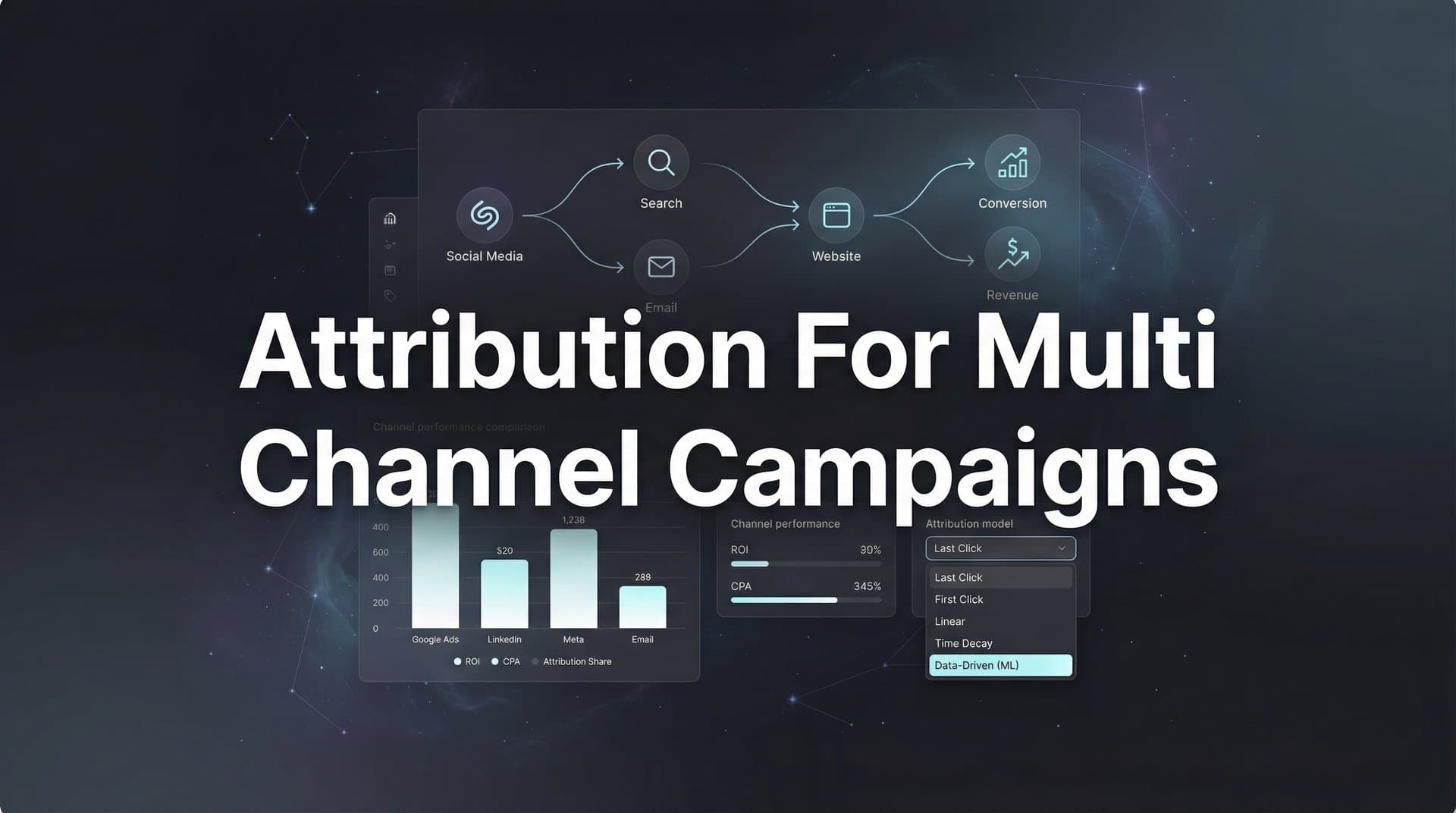
Modern marketing spans dozens of touchpoints across paid social, search, display, email, and organic channels. Yet most marketers still struggle to answer a fundamental question: which channels actually drive revenue?
The challenge intensifies when customers interact with multiple channels before converting. A prospect might click a Facebook ad, read a blog post, receive an email, and finally convert through a Google search. Without proper attribution for multi-channel campaigns, you are left guessing where to allocate budget and which channels deserve credit.
Think of it like trying to understand a conversation when you can only hear every third word. You might catch the general idea, but you will miss the nuances that matter most. That is what marketing without multi-channel attribution feels like: you see conversions happening, but you cannot understand the full story of how customers found you.
This guide covers seven actionable strategies to build attribution that captures the complete customer journey and reveals what is truly driving your results. Each approach addresses a specific challenge that marketers face when tracking performance across multiple platforms and touchpoints.
1. Unify Your Data Sources Before Anything Else
The Challenge It Solves
Your marketing data lives in silos. Facebook Ads Manager shows one set of conversions. Google Analytics reports different numbers. Your CRM tracks leads that never appear in your ad platforms. When data sources do not communicate, you cannot see how channels work together to drive revenue.
This fragmentation leads to budget decisions based on incomplete information. You might cut spending on a channel that appears to underperform in isolation, not realizing it plays a crucial role in warming up prospects who convert through other channels later.
The Strategy Explained
Data unification means connecting all your marketing platforms, CRM, and website tracking into a single source of truth. This creates a foundation where every click, impression, form submission, and purchase gets recorded in one place with consistent naming conventions.
The key is establishing a unified tracking infrastructure before you try to analyze attribution. Without this foundation, you are building on sand. Every platform uses different conversion windows, attribution models, and tracking methods, making direct comparisons impossible.
When your data sources connect properly, you can track a prospect from their first ad click through multiple website visits, email interactions, and finally to a CRM-tracked sale. This complete view transforms how you understand channel performance. For a deeper dive into connecting disparate data sources, explore solutions for integrating multiple marketing channels.
Implementation Steps
1. Audit every platform where marketing data lives, including ad platforms, analytics tools, email systems, and your CRM, to map what data each source captures.
2. Establish consistent naming conventions across all platforms for campaigns, UTM parameters, and conversion events so data matches when you connect systems.
3. Implement a tracking infrastructure that captures events from all sources and sends them to a central platform that can reconcile data across channels.
Pro Tips
Start with your highest-value conversion events and work backward. If you try to unify everything at once, you will get overwhelmed. Focus first on tracking purchases or qualified leads, then expand to capture earlier-stage interactions once your core tracking works reliably.
2. Implement Server-Side Tracking to Capture Lost Conversions
The Challenge It Solves
Browser-based tracking is dying. iOS App Tracking Transparency restrictions, browser cookie limitations, and ad blockers create massive blind spots in your conversion data. Many marketers discover that 30-40% of their actual conversions never register in their ad platforms.
This data loss does not just hurt your reporting. It actively damages your campaign performance because ad platform algorithms optimize based on the conversion data they receive. When they only see a fraction of actual conversions, they cannot effectively optimize targeting and bidding.
The Strategy Explained
Server-side tracking moves conversion tracking from the browser to your server. Instead of relying on cookies and pixels that users can block, your server directly communicates conversion events to ad platforms and analytics tools.
This approach captures conversions that browser-based tracking misses. When a customer converts, your server sends that event to Meta, Google, and other platforms regardless of whether the customer blocked cookies or opted out of tracking on their device. Understanding attribution tracking for multiple campaigns becomes significantly easier with server-side implementation.
The result is more complete data that reflects actual business results rather than just trackable conversions. Your ad platforms receive accurate signals about what drives revenue, enabling better optimization.
Implementation Steps
1. Set up server-side tracking infrastructure that captures conversion events on your server before sending them to ad platforms through their Conversion APIs.
2. Implement event matching that connects server-side conversion data back to the original ad click using identifiers like email addresses, phone numbers, or click IDs.
3. Test your implementation by comparing conversion counts before and after server-side tracking to quantify how many conversions were previously missing.
Pro Tips
Run browser-based and server-side tracking in parallel initially. This lets you validate that server-side tracking works correctly before you rely on it completely. You should see server-side tracking capture more conversions than browser-based methods alone.
3. Choose the Right Attribution Model for Your Sales Cycle
The Challenge It Solves
Different attribution models tell radically different stories about channel performance. Last-click attribution gives all credit to the final touchpoint before conversion, often overvaluing bottom-funnel channels like branded search. First-click attribution credits only the initial interaction, potentially overvaluing awareness channels while ignoring what actually closes deals.
Using the wrong attribution model for your business leads to misallocated budgets and strategic mistakes. A company with a six-month sales cycle needs different attribution insights than an e-commerce store where customers convert in hours.
The Strategy Explained
Attribution model selection should match your typical customer journey length and complexity. Businesses with short sales cycles and few touchpoints can often work with simpler models. Companies with longer, more complex journeys need multi-touch attribution that distributes credit across multiple interactions.
Multi-touch attribution models recognize that multiple channels contribute to conversions. Linear models split credit evenly across all touchpoints. Time-decay models give more credit to recent interactions. Position-based models emphasize both the first touchpoint that created awareness and the last touchpoint that drove conversion. For a comprehensive breakdown, review multi-channel attribution models explained.
The goal is not finding the "perfect" model, but selecting one that helps you make better decisions about where to invest marketing budget based on how your customers actually buy.
Implementation Steps
1. Map your typical customer journey by analyzing how many touchpoints prospects interact with before converting and how much time passes from first touch to conversion.
2. Compare how different attribution models distribute credit for your actual conversions to understand how each model would change your channel performance analysis.
3. Select a model that balances giving credit to awareness-building channels while still recognizing conversion-driving touchpoints based on your sales cycle characteristics.
Pro Tips
Do not rely on a single attribution model exclusively. Compare multiple models side by side to understand which channels drive awareness versus conversions. This multi-model view reveals strategic insights that any single model would miss.
4. Track the Full Customer Journey, Not Just Conversions
The Challenge It Solves
Most marketing analytics focus exclusively on the endpoints: impressions and conversions. This creates a massive blind spot around everything that happens in between. You know a prospect clicked your ad and eventually converted, but you have no visibility into the journey that connected those two events.
Without journey-level tracking, you cannot understand how channels work together. You might discover that LinkedIn ads rarely get last-click credit but consistently appear early in journeys that eventually convert through other channels. That insight completely changes how you value LinkedIn in your marketing mix.
The Strategy Explained
Full journey tracking means capturing every meaningful interaction a prospect has with your brand, from initial ad clicks through website visits, content downloads, email opens, and CRM events. This creates a timeline of touchpoints that shows how awareness builds into consideration and finally conversion.
The power comes from analyzing patterns across successful journeys. You might discover that prospects who engage with three specific content pieces convert at twice the rate of those who do not. Or that email touchpoints within 48 hours of an ad click significantly increase conversion probability. Learn how to effectively analyze multi-channel ad performance to uncover these patterns.
These journey-level insights reveal opportunities that conversion-focused analytics miss entirely. They show you not just what converts, but how to move prospects through stages more effectively.
Implementation Steps
1. Define which touchpoints matter for your business beyond just conversions, including content engagement, email interactions, demo requests, and CRM status changes.
2. Implement tracking that captures these mid-journey events and connects them to individual prospects so you can reconstruct complete customer timelines.
3. Analyze common patterns in successful conversion journeys to identify which touchpoint sequences most reliably lead to revenue.
Pro Tips
Focus on tracking quality over quantity. You do not need to capture every page view and scroll depth. Identify the 5-10 touchpoint types that actually matter for your business and track those reliably before expanding to capture additional interactions.
5. Feed Enriched Conversion Data Back to Ad Platforms
The Challenge It Solves
Ad platform algorithms optimize based on the conversion data they receive. When you only send basic conversion signals, their algorithms work with incomplete information. They cannot distinguish between a $50 customer and a $5,000 customer, so they treat all conversions equally when optimizing targeting and bidding.
This limitation becomes especially problematic for businesses with variable customer values. Your ad platforms might efficiently drive conversions while unknowingly targeting low-value customers and missing high-value prospects entirely.
The Strategy Explained
Conversion enrichment means sending detailed, value-based conversion data back to ad platforms instead of just basic conversion signals. This includes actual revenue amounts, customer lifetime value predictions, lead quality scores, and other business metrics that differentiate valuable conversions from less valuable ones.
When Meta or Google receives this enriched data, their algorithms can optimize for outcomes that actually matter to your business. Instead of maximizing conversion volume, they can maximize revenue or focus on acquiring customers who match your highest-value segments. Platforms focused on marketing attribution and revenue tracking make this process significantly more manageable.
The result is smarter automated optimization that aligns with your business goals rather than just driving generic conversion volume.
Implementation Steps
1. Identify which conversion value metrics matter most for your business, such as purchase amounts, predicted lifetime value, or lead quality scores from your CRM.
2. Configure your tracking to capture these values at the point of conversion so you can pass them to ad platforms through their conversion APIs.
3. Send enriched conversion events that include value data back to ad platforms, then monitor how campaign optimization changes when algorithms have access to this richer information.
Pro Tips
Start with actual purchase value for e-commerce or closed deal value for B2B before attempting to predict lifetime value. Get platforms optimizing for real revenue first, then layer in predictive metrics once your basic value tracking works reliably.
6. Segment Attribution by Audience and Campaign Type
The Challenge It Solves
Aggregate attribution data hides crucial insights. Your overall attribution report might show that Facebook drives 30% of conversions, but that average masks huge variations. Facebook might drive 50% of conversions for one customer segment while contributing only 10% for another.
When you only analyze attribution at the aggregate level, you make budget decisions based on averages that do not reflect how different audiences actually behave. This leads to over-investing in channels that work for some segments while under-investing in channels that excel with others.
The Strategy Explained
Segmented attribution means breaking down your attribution analysis by customer characteristics, value tiers, geographic regions, and campaign types. This reveals how channel effectiveness varies across different parts of your business.
You might discover that search dominates for high-value customers while social drives volume among lower-value segments. Or that certain geographic markets respond completely differently to your channel mix than others. These insights enable targeted optimization that aggregate data would never reveal. Implementing a marketing analytics dashboard for multiple platforms helps visualize these segment-level differences.
The goal is moving from "which channels work?" to "which channels work for which audiences and objectives?" This nuanced understanding drives more sophisticated budget allocation.
Implementation Steps
1. Define the segments that matter most for your business, such as customer value tiers, product categories, geographic regions, or new versus returning customers.
2. Analyze attribution separately for each segment to identify how channel performance varies across different customer groups and business contexts.
3. Adjust channel strategies and budget allocation based on segment-specific insights rather than treating all conversions as equivalent in your attribution analysis.
Pro Tips
Start with value-based segmentation first. Understanding how attribution differs between high-value and low-value customers typically drives the most impactful optimization opportunities. Expand to other segmentation dimensions once you have optimized for customer value.
7. Build a Testing Framework to Validate Attribution Insights
The Challenge It Solves
Attribution models show correlation, not causation. Just because a channel appears in successful conversion journeys does not prove it actually causes those conversions. Some channels might simply be present in journeys that would have converted anyway, receiving credit without driving incremental results.
Without validation testing, you risk over-investing in channels that look effective in attribution reports but do not actually drive incremental business. This wastes budget on marketing that captures conversions rather than creating them.
The Strategy Explained
Incrementality testing validates attribution insights by measuring what happens when you change channel investment. The most rigorous approach uses holdout tests where you stop spending on a channel for a segment of your audience and measure whether conversions actually decrease.
If pausing a channel causes conversions to drop significantly, that confirms it drives incremental results. If conversions stay roughly the same, the channel was likely capturing conversions that would have happened through other channels anyway. Following multi-channel attribution best practices ensures your testing methodology produces reliable results.
This testing framework transforms attribution from descriptive reporting into validated insights about what actually drives business results. You move from "this channel appears in conversion journeys" to "this channel creates conversions that would not happen otherwise."
Implementation Steps
1. Design incrementality tests for your most important channels by creating matched audience segments where you can vary marketing exposure while controlling for other factors.
2. Run holdout tests where you stop spending on a channel for the test segment while maintaining normal spending for the control segment, then measure conversion differences.
3. Use test results to adjust your attribution model interpretation, giving more weight to channels that prove incrementality and less to channels that appear in journeys but do not drive incremental conversions.
Pro Tips
Test your highest-spend channels first, even if you are confident they work. The channels where you invest the most budget create the biggest opportunities for optimization if testing reveals they are less incremental than attribution suggests.
Putting These Attribution Strategies Into Action
Multi-channel attribution transforms from an overwhelming challenge into a competitive advantage when you approach it systematically. Start by unifying your data sources and implementing server-side tracking to establish a foundation of accurate data. These first two strategies solve the data quality problems that undermine most attribution efforts.
Then select attribution models that match your sales cycle and begin tracking the complete customer journey beyond just conversions. This gives you the analytical framework to understand how channels work together rather than in isolation.
As your attribution matures, feed enriched data back to ad platforms so their algorithms can optimize for outcomes that actually matter to your business. Segment your analysis to uncover insights hidden in aggregate data, and validate everything with incrementality testing to confirm attributed channels actually drive incremental results.
The marketers who master multi-channel attribution gain a significant competitive advantage. They know exactly where revenue comes from and can scale what works with confidence. While competitors guess at budget allocation, they make decisions based on complete data about the customer journey.
Cometly captures every touchpoint from ad clicks to CRM events, providing AI a complete, enriched view of every customer journey. The platform connects all your marketing data sources, implements server-side tracking to capture conversions that browser-based methods miss, and feeds accurate conversion data back to ad platforms to improve their optimization.
Ready to elevate your marketing game with precision and confidence? Discover how Cometly's AI-driven recommendations can transform your ad strategy. Get your free demo today and start capturing every touchpoint to maximize your conversions.


