You're running eight different campaigns across Meta, Google, TikTok, and LinkedIn. This month, you hit 100 conversions. Your boss asks the obvious question: "Which campaigns are actually working?" You open your dashboards, and every platform claims credit for those same conversions. Meta says it drove 60. Google says 55. Your analytics tool shows a different number entirely.
Sound familiar?
This is the attribution puzzle that marketers face every single day. Without knowing which touchpoints truly drive conversions, you're essentially flying blind—making budget decisions based on incomplete data, gut feelings, or whichever platform shouts loudest about its results.
Attribution answers the fundamental question every marketer needs to solve: What's actually working? It's the bridge between your marketing spend and your business outcomes. Understanding attribution meaning in marketing isn't just helpful—it's the foundation of every profitable advertising decision you'll make.
The Bridge Between Marketing Activity and Revenue Reality
At its core, attribution is the process of identifying which marketing touchpoints contribute to conversions and revenue. Think of it as connecting the dots between every interaction a potential customer has with your brand and the moment they finally convert.
Here's the reality: your customers don't see an ad and immediately buy. They might discover you through a LinkedIn post, research you on Google a week later, click a retargeting ad on Facebook, read your email newsletter, and then finally convert through a direct visit to your website. That's five touchpoints across four different channels.
The question becomes: which of those interactions deserves credit for the conversion?
Without attribution, you're making critical decisions in the dark. You might see that your Facebook ads generated 50 conversions this month and assume they're your best performer. But what if those 50 people all discovered you initially through organic search? What if your email campaign was the real catalyst that pushed them over the edge?
This is where guessing becomes expensive. When you can't trace conversions back to their true sources, you end up pouring budget into channels that look good on paper but aren't actually driving results. Meanwhile, the channels doing the heavy lifting might get starved of resources because they're not getting proper credit.
Attribution solves this by creating a clear line of sight from every marketing touchpoint to actual business outcomes. It transforms vague impressions and clicks into concrete revenue data. Instead of wondering which campaigns work, you know. Instead of hoping your budget allocation makes sense, you can prove it.
The modern customer journey has become increasingly complex. Your buyers are bouncing between devices, platforms, and channels throughout their decision-making process. They're researching on mobile during their commute, comparing options on desktop at work, and making purchases on tablet from their couch. Each of these interactions plays a role in their eventual conversion.
Attribution captures this complexity and makes it actionable. It shows you the complete journey, not just the final click. This comprehensive view is what separates marketers who scale profitably from those who burn through budget chasing vanity metrics.
How Different Models Distribute Credit Across Your Marketing Mix
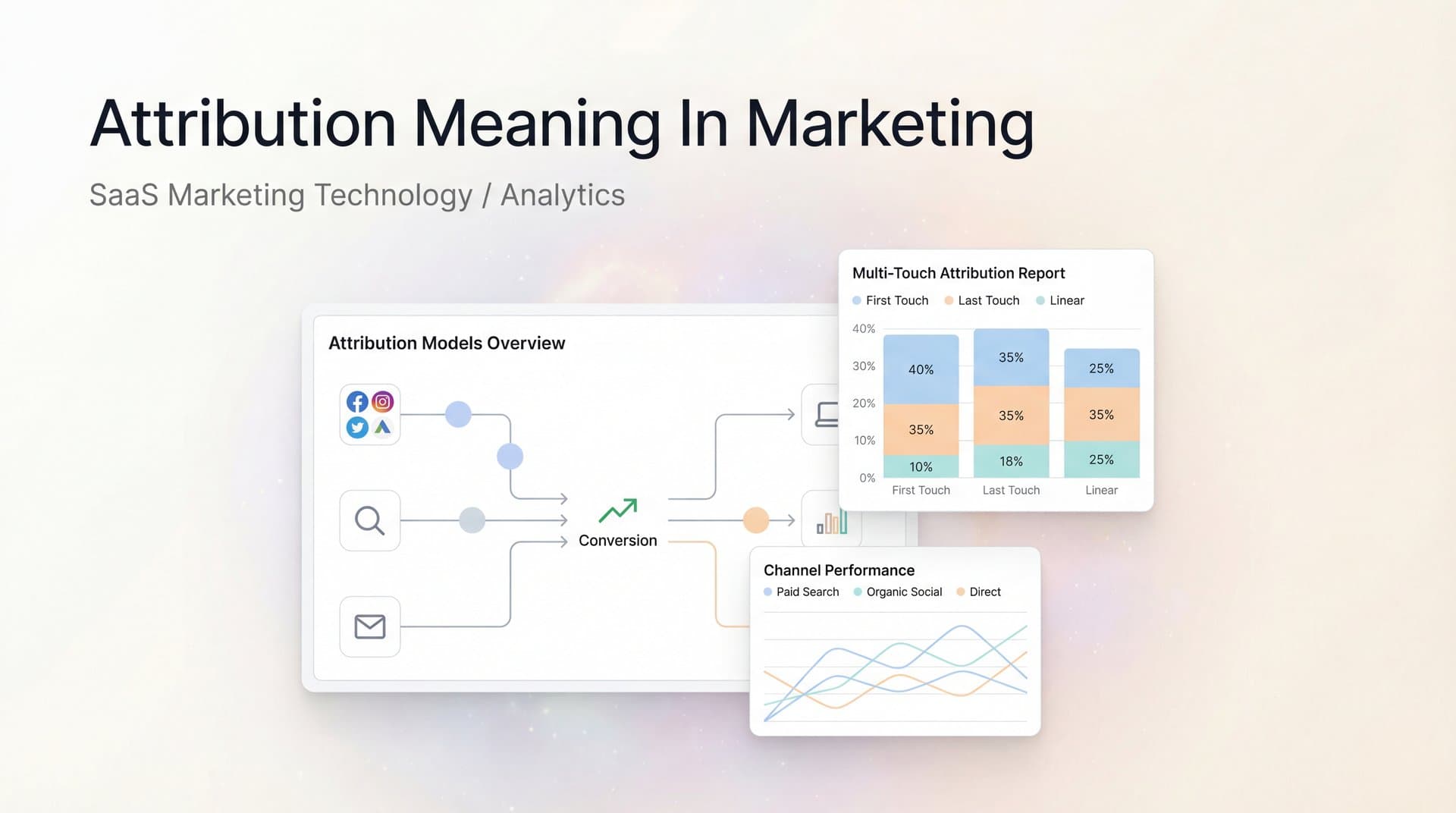
Not all attribution models work the same way. Each one uses a different logic to assign credit to your marketing touchpoints, and understanding these differences is crucial for interpreting your data correctly.
First-Touch Attribution: This model gives 100% of the credit to the very first interaction a customer had with your brand. If someone discovered you through a blog post, clicked a Facebook ad two weeks later, and then converted through an email, the blog post gets all the credit.
First-touch makes sense when you're focused on top-of-funnel awareness and want to understand which channels are best at introducing new people to your brand. It's particularly useful for businesses with short sales cycles where that initial discovery moment is genuinely decisive.
Last-Touch Attribution: The opposite approach—100% of credit goes to the final touchpoint before conversion. In the same scenario above, the email would get all the credit while the blog post and Facebook ad get nothing.
Last-touch works well when you're optimizing for immediate conversion actions. It highlights which channels are best at closing deals and pushing people over the finish line. Many marketers default to this model because it's simple and aligns with how most ad platforms report conversions by default.
Linear Attribution: This model distributes credit equally across every touchpoint in the customer journey. If someone had five interactions before converting, each interaction gets 20% of the credit.
Linear attribution is useful when you believe every touchpoint contributes equally to the conversion, or when you want a balanced view that doesn't over-emphasize any single interaction. It's often used by businesses with longer sales cycles where nurturing matters as much as initial discovery. You can explore linear model marketing attribution software to implement this approach effectively.
Time-Decay Attribution: This model gives more credit to touchpoints that happened closer to the conversion. The logic: recent interactions had more influence on the final decision than ones from weeks ago.
Time-decay makes sense for businesses where recency matters—think about retargeting campaigns or limited-time offers where that final push genuinely carries more weight than early awareness efforts.
Position-Based (U-Shaped) Attribution: This model typically assigns 40% credit to the first touch, 40% to the last touch, and splits the remaining 20% among all the middle touchpoints.
Position-based attribution acknowledges that both discovery and closing moments are critical while still recognizing the nurturing that happens in between. It's popular among B2B marketers who know that both initial awareness and final conversion tactics play outsized roles in their sales cycles.
Data-Driven Attribution: Instead of following predetermined rules, data-driven models use algorithms to analyze your actual conversion data and assign credit based on which touchpoints statistically correlate with conversions.
This is the most sophisticated approach because it adapts to your specific business reality rather than imposing a one-size-fits-all framework. Data-driven models can reveal surprising insights—like discovering that a touchpoint you thought was minor actually plays a crucial role in driving conversions. Understanding types of marketing attribution models helps you choose the right approach for your business.
Here's the critical insight: there's no universally "correct" attribution model. A SaaS company with a 90-day sales cycle needs different attribution logic than an e-commerce brand selling impulse purchases. A business focused on brand awareness should look at attribution differently than one optimizing for immediate conversions.
The smartest marketers don't pick one model and call it done. They compare multiple models to understand how credit shifts depending on the framework. This multi-model approach reveals patterns you'd miss if you only looked through one lens.
Why Your Tracking Setup Might Be Lying to You
Even with the perfect attribution model, you're building on quicksand if your underlying tracking isn't capturing the full picture. And here's the uncomfortable truth: most tracking setups today are missing significant chunks of the customer journey.
The privacy landscape has fundamentally changed how tracking works. iOS updates introduced App Tracking Transparency, which lets users opt out of cross-app tracking. When someone says no—and most do—Facebook and other platforms lose visibility into what happens after someone clicks your ad.
This creates attribution blind spots. You might be running a Facebook campaign that introduces thousands of people to your brand, but if those users opt out of tracking and convert later through a different channel, Facebook never sees the conversion. Your attribution data shows Facebook "underperforming" when it's actually doing exactly what you wanted.
Cookie deprecation compounds the problem. Third-party cookies—the technology that let marketers track users across different websites—are being phased out across major browsers. Safari and Firefox already block them by default. Chrome is following suit.
Without cookies, browser-based tracking pixels struggle to connect the dots between a user's journey across multiple sites. Someone might click your Google ad on their laptop, research your product on review sites, and then convert on your website from their phone. Traditional pixel-based tracking sees these as three separate users, not one complete journey.
The result? Incomplete attribution data that leads to poor decisions. You might cut budget from channels that are actually driving awareness because they're not getting credit for downstream conversions. Or you might over-invest in last-click channels that look great in your dashboard but are just harvesting demand created elsewhere. These are common attribution challenges in marketing analytics that every marketer must address.
This is where server-side tracking changes the game. Instead of relying on browser pixels and cookies, server-side tracking sends data directly from your server to ad platforms and analytics tools. This approach is far more reliable because it doesn't depend on browser settings, cookie acceptance, or cross-device matching.
Server-side tracking captures the full customer journey even when users opt out of app tracking or block cookies. It connects touchpoints across devices by using first-party data—information you collect directly from users through logins, email addresses, or customer IDs. This creates a complete attribution picture that browser-based tracking simply can't match anymore.
The gap between what traditional tracking captures and what actually happens in your customer journey isn't just a technical problem—it's a business problem. Every missing touchpoint is a potential misallocation of your marketing budget.
Turning Attribution Insights Into Profitable Actions
Attribution data is only valuable if you actually use it to make better decisions. Let's break down the practical applications that directly impact your bottom line.
Budget Allocation Across Channels: This is the most obvious application, but it's where attribution delivers the biggest immediate impact. When you can see which channels truly drive revenue—not just clicks or impressions—you can shift budget toward what works and away from what doesn't.
Let's say your attribution data reveals that LinkedIn generates fewer total conversions than Facebook, but LinkedIn's conversions come from higher-value customers with better lifetime value. Without attribution, you might cut LinkedIn budget because the conversion volume looks low. With attribution, you realize LinkedIn is actually your most profitable channel and deserves more investment. This is why cross channel attribution marketing ROI analysis is essential for smart budget decisions.
This kind of insight lets you optimize for revenue, not vanity metrics. Clicks and impressions feel good, but they don't pay your bills. Attribution connects your marketing activity to actual dollars, which is the only metric that ultimately matters.
Feeding Better Data to Ad Platform Algorithms: Here's where attribution gets really powerful. Modern ad platforms like Meta and Google use machine learning to optimize your campaigns. They need conversion data to learn what works—but they can only optimize based on the conversions they can see.
When your tracking is incomplete, these algorithms are learning from a partial picture. They might optimize toward users who are easy to track while missing the high-value customers who opt out of tracking or convert through complex journeys.
By feeding accurate, complete conversion data back to ad platforms through server-side tracking and proper attribution, you give their algorithms the full picture. This improves their optimization over time. They learn to find more people like your actual customers, not just people like the subset of customers they can track with browser pixels. Understanding how machine learning can be used in marketing attribution helps you leverage these algorithms effectively.
This creates a compounding effect. Better data leads to better optimization, which leads to better results, which generates more data to improve optimization further. It's a virtuous cycle that starts with accurate attribution.
Understanding True Performance Beyond Surface Metrics: Attribution reveals which creative, audiences, and campaigns drive real revenue versus just generating activity. This distinction is crucial.
You might have a campaign with a high click-through rate that looks amazing in your dashboard. But if attribution shows those clicks rarely lead to conversions, you know that campaign is generating curiosity, not customers. Meanwhile, a campaign with a lower CTR might be attracting exactly the right people who convert at high rates.
Attribution also shows you how different channels work together. You might discover that people who see both your Google ads and your email campaigns convert at 3x the rate of people who only interact with one channel. This insight tells you to run coordinated campaigns across both channels rather than treating them as separate initiatives.
Or you might find that certain audiences need more touchpoints before converting. Your attribution data might reveal that enterprise customers typically interact with your brand 8-10 times before purchasing, while small business customers convert after just 2-3 touches. This tells you to adjust your nurturing strategy and budget expectations for each segment.
The key is moving from "what happened" to "why it happened" to "what should we do next." Attribution data provides the foundation for all three questions.
Building an Attribution Framework That Grows With Your Business
Setting up attribution isn't a one-time project—it's an ongoing system that needs to evolve as your marketing becomes more sophisticated. Here's how to build a foundation that scales.
Start With Proper Tracking Infrastructure: Everything else depends on this. You need tracking that captures the complete customer journey across all your channels, devices, and touchpoints. This means implementing server-side tracking, connecting your ad platforms to your CRM, and ensuring every conversion event is properly tagged and categorized.
Don't try to boil the ocean on day one. Start by tracking your most important conversion events—purchases, signups, qualified leads—and expand from there. Make sure your tracking setup can handle both online and offline conversions, since many businesses have customer journeys that span both digital and physical touchpoints. The right software for tracking marketing attribution makes this process significantly easier.
Integrate Your CRM and Revenue Data: Attribution becomes exponentially more valuable when you connect it to actual revenue outcomes. Your ad platforms can tell you about clicks and conversions, but your CRM knows which customers are worth $500 and which are worth $50,000.
By integrating CRM data with your attribution system, you can optimize for customer lifetime value instead of just conversion volume. This is the difference between treating all customers as equal and actually understanding which marketing channels drive your most profitable relationships. Platforms that offer marketing attribution revenue tracking capabilities are essential for this integration.
This integration also lets you track the full customer journey beyond the initial conversion. You can see which acquisition channels lead to customers who buy repeatedly, refer others, or upgrade to premium plans. These insights are invisible if you only look at first-purchase attribution.
Compare Multiple Attribution Models: Don't lock yourself into a single way of viewing your data. Run first-touch, last-touch, and data-driven attribution side by side to understand how credit shifts depending on the framework.
When all three models agree that a channel is performing well, you can be confident in that insight. When models disagree, that's actually valuable information—it tells you that channel plays different roles at different stages of the customer journey. Learning comparing marketing attribution software features helps you find tools that support this multi-model approach.
For example, if a channel gets high credit in first-touch attribution but low credit in last-touch, that tells you it's great for awareness but weak at closing. You might pair it with retargeting campaigns or email nurturing to convert the interest it generates.
Prioritize Real-Time Data Access: Attribution data from last month is interesting. Attribution data from yesterday is actionable. Real-time attribution lets you spot trends as they emerge and adjust campaigns before wasting budget on what's not working.
This is especially crucial during high-stakes periods like product launches or seasonal campaigns. You need to know immediately if your attribution patterns are shifting so you can reallocate budget while the opportunity is still fresh.
Real-time data also enables rapid testing. You can launch a new campaign, see how it performs in your attribution model within days rather than weeks, and either scale it or kill it based on actual results rather than waiting for monthly reports.
Create a Single Source of Truth: One of the biggest attribution challenges is data fragmentation. Your conversion data lives in Google Analytics, your ad spend is scattered across platform dashboards, and your revenue data sits in your CRM. Trying to manually reconcile all these sources is a recipe for errors and missed insights.
Build a unified system that brings all your marketing data into one place. This eliminates discrepancies, makes analysis faster, and ensures everyone on your team is looking at the same numbers when making decisions. Robust marketing attribution analytics capabilities are crucial for achieving this unified view.
Making Attribution Your Competitive Advantage
Understanding attribution meaning in marketing isn't optional anymore—it's the foundation of profitable advertising in a privacy-first, multi-channel world. While your competitors are guessing which campaigns work or relying on incomplete platform data, you can make confident decisions based on the complete picture of what drives revenue.
Attribution transforms marketing from a cost center into a growth engine. It shows you exactly where to invest more, where to cut back, and how different channels work together to drive business outcomes. It turns your ad platforms' algorithms into more effective tools by feeding them accurate conversion data. Most importantly, it gives you the confidence to scale what works without the fear of wasting budget on what doesn't.
The marketers who master attribution are the ones who consistently outperform their peers. They're not smarter or more creative—they just have better data informing their decisions. They know which touchpoints matter, which customer journeys convert, and which investments actually pay off.
This is where Cometly transforms attribution from a theoretical concept into a practical advantage. Cometly captures every touchpoint across your entire customer journey—from initial ad clicks to CRM events—giving your AI a complete, enriched view of what's really driving revenue. You can compare multiple attribution models, see real-time performance data, and feed accurate conversion events back to Meta, Google, and other platforms to improve their optimization.
Ready to elevate your marketing game with precision and confidence? Discover how Cometly's AI-driven recommendations can transform your ad strategy—Get your free demo today and start capturing every touchpoint to maximize your conversions.