You're spending thousands—maybe tens of thousands—on ads each month. Facebook says your campaigns are crushing it. Google claims credit for half your conversions. Your email platform insists it's the real hero. Meanwhile, you're staring at your bank account wondering why the math doesn't add up.
This is the attribution nightmare that keeps marketers up at night. And it's exactly why attribution software has become essential infrastructure for modern marketing teams. But here's the thing: the way you pay for that clarity has fundamentally changed.
Gone are the days of buying attribution software like you'd buy a car—one big payment and it's yours forever. Today's attribution tools operate on monthly subscriptions, and for good reason. Marketing platforms update constantly. Privacy regulations shift the ground beneath our feet. Customer journeys span more touchpoints than ever before. A static tool would be obsolete before you finished onboarding.
The subscription model means you're not just buying software—you're buying continuous adaptation to an ever-changing digital landscape. But what exactly are you getting for that monthly investment? How do you know if you're choosing the right plan? And most importantly, how do you ensure the subscription pays for itself through better marketing decisions?
Let's break down everything you need to know about attribution software subscriptions, from pricing structures to premium features, so you can make a confident decision about where to invest your marketing budget.
Understanding Monthly Subscription Pricing Models
Attribution software pricing isn't one-size-fits-all, and understanding the different models helps you predict what you'll actually pay as your marketing operation grows.
Most providers use tiered pricing structures, but the metric that determines your tier varies significantly. Some platforms charge based on your monthly ad spend tracked—the total amount you're investing across all your advertising channels. This approach makes sense because higher ad spend typically means more complexity, more data to process, and more value at stake in getting attribution right.
Other platforms price based on data volume, measuring the number of events tracked or conversions processed each month. This model works well for businesses with high website traffic but moderate ad spend, though it can get expensive quickly if you're tracking granular user interactions.
Team-based pricing is another common approach, where your subscription cost scales with the number of users who need access to the platform. This model favors smaller teams with large budgets but can become a barrier for agencies or larger marketing departments where multiple people need visibility into attribution data.
Entry-level plans typically start around a few hundred dollars per month, designed for small businesses or solo marketers managing straightforward campaigns on one or two platforms. Mid-tier plans often range from several hundred to a few thousand monthly, accommodating growing teams with multi-channel strategies. Enterprise plans can reach five figures monthly for agencies or large organizations tracking millions in ad spend across dozens of campaigns. Understanding attribution software pricing plans helps you budget appropriately for your needs.
The pricing spread reflects real differences in infrastructure costs. Processing millions of data points daily, maintaining integrations with constantly-updating ad platforms, and providing AI-powered analysis requires significant backend resources. The more data you're tracking and the more sophisticated your attribution needs, the more computational power required to deliver accurate insights.
Monthly versus annual billing presents a strategic choice. Monthly billing offers flexibility—you can cancel or downgrade without being locked into a long-term commitment. This works well when you're testing a platform or if your ad spend fluctuates seasonally. Annual billing typically comes with a discount, often 15-20% off the monthly rate, which adds up significantly over time. The tradeoff is commitment: you're betting that the platform will continue meeting your needs for the next twelve months.
Many providers offer a middle path: quarterly billing with a modest discount. This reduces the risk of annual commitments while still providing some cost savings compared to month-to-month payments.
What Every Attribution Subscription Should Include
Regardless of which tier you choose, certain core capabilities should be table stakes in any attribution software subscription. These features form the foundation of useful attribution—without them, you're not really getting the clarity you're paying for.
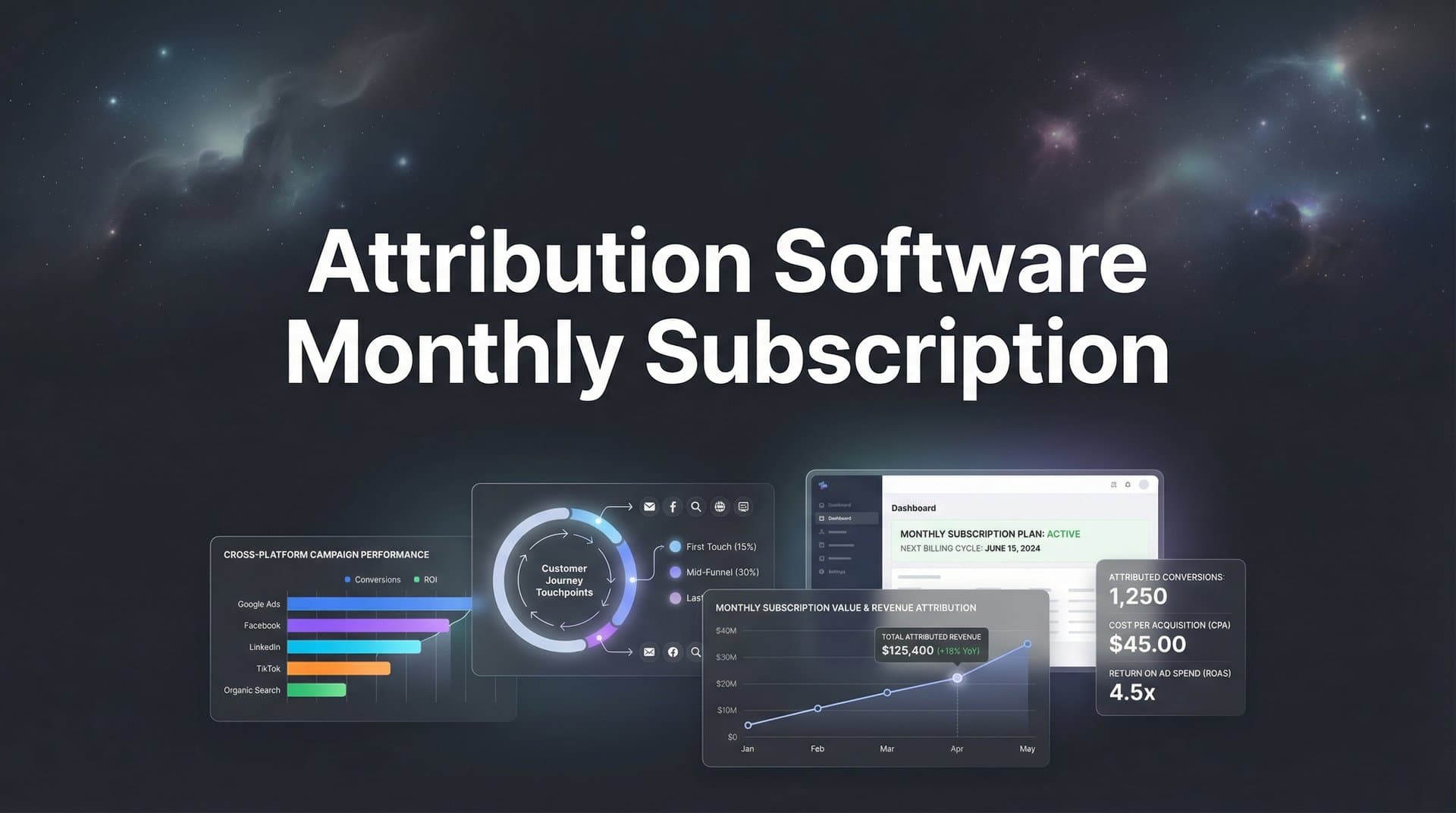
Multi-touch attribution is the centerpiece. This means tracking every touchpoint a customer encounters on their path to conversion, not just the last click before they bought. A customer might see your Facebook ad on Monday, click a Google search ad on Wednesday, receive an email on Friday, and finally convert through a direct visit on Saturday. Single-touch attribution would credit only that final direct visit, completely missing the Facebook and Google ads that introduced your brand and built interest.
Quality attribution software maps this entire journey, assigning appropriate credit to each touchpoint based on the attribution model you choose. You should be able to switch between different models—first-touch, last-touch, linear, time-decay, position-based—to understand how different perspectives change which channels appear most valuable. Exploring multi-touch attribution modeling software reveals how these different approaches impact your analysis.
Integration capabilities determine whether your attribution tool can actually see your complete customer journey. At minimum, expect direct integrations with major ad platforms like Meta, Google Ads, TikTok, and LinkedIn. CRM integration is equally critical—without connecting to your CRM, the attribution tool can't track leads through your sales funnel to see which marketing touchpoints influence closed revenue, not just form submissions.
Website tracking integration, typically through a JavaScript pixel or tag manager implementation, captures on-site behavior. This shows how users navigate your site after clicking ads, which pages influence conversions, and how different traffic sources behave differently once they arrive.
The reporting dashboard is where all this data becomes actionable. You should expect customizable reports that let you view attribution data by channel, campaign, ad set, or even individual ad creative. Time-based filtering lets you compare performance across different periods to spot trends. Conversion path reports show the most common sequences of touchpoints leading to conversion, revealing patterns in how your best customers discover and evaluate your offering.
Data visualization matters more than you might think. Attribution data is complex, and a poorly designed dashboard can obscure insights rather than revealing them. Look for clear charts that make it easy to compare channel performance, understand conversion paths, and spot outliers or opportunities at a glance.
Real-time or near-real-time data processing is increasingly standard. Marketing moves fast, and waiting 24-48 hours for data to populate means making decisions based on outdated information. The best platforms process data continuously, giving you an up-to-date view of campaign performance whenever you check.
Premium Features That Separate Basic Plans From Advanced Solutions
Once you move beyond core attribution capabilities, premium tiers introduce features that don't just track what happened—they help you decide what to do next.
AI-powered recommendations represent the cutting edge of attribution software. Rather than simply showing you which ads performed well, AI analyzes patterns across your entire campaign history to suggest specific optimizations. It might identify that video ads consistently outperform image ads in your awareness campaigns, or that certain audience segments convert better through Instagram than Facebook despite similar cost-per-click. Platforms offering attribution software with AI capabilities deliver these intelligent insights automatically.
We compare the leading options in our WooCommerce image ad tool roundup.
These recommendations become more valuable over time as the AI learns from your specific marketing patterns. The system might notice that campaigns launched on Tuesday mornings consistently outperform those launched on Fridays, or that certain ad copy themes resonate particularly well with customers who eventually convert at high values.
Server-side tracking has become essential as browser-based tracking grows less reliable. iOS privacy changes, cookie restrictions, and ad blockers mean that traditional pixel-based tracking misses significant portions of your actual traffic. Server-side tracking processes data on your server before sending it to analytics platforms, bypassing many of these limitations.
The practical impact is substantial. Without server-side tracking, you might be making decisions based on incomplete data, potentially cutting budgets from channels that actually perform better than your browser-based tracking suggests. Premium plans that include robust server-side tracking capabilities help you maintain data accuracy even as privacy regulations continue tightening.
Conversion sync features feed enriched conversion data back to ad platforms, improving their algorithmic optimization. When you run campaigns on Meta or Google, their algorithms learn from conversion data to improve targeting and bidding. But if you're only sending basic conversion events, the algorithms have limited information to work with.
Conversion sync sends detailed, enriched conversion data—including customer lifetime value, purchase amounts, and other relevant attributes—back to ad platforms. This gives their algorithms much richer information for optimization. A platform like Cometly captures every touchpoint from ad clicks through CRM events, then syncs this complete picture back to Meta, Google, and other platforms. The result is ad algorithms that make smarter decisions about who to target and how much to bid.
Advanced segmentation and filtering capabilities let you slice attribution data in sophisticated ways. You might want to see attribution patterns specifically for customers in certain geographic regions, or compare how attribution differs for high-value versus low-value conversions. Premium tiers typically offer much more granular filtering and segmentation options than entry-level plans. When comparing marketing attribution software features, these advanced capabilities often differentiate enterprise solutions from basic tools.
Calculating Return on Your Attribution Investment
A monthly subscription to attribution software is a line item on your marketing budget, which means it needs to justify its cost through measurable value. The good news: attribution tools often pay for themselves many times over through better budget allocation.
Consider a straightforward scenario. You're spending ten thousand monthly on ads across Meta, Google, and LinkedIn. Without proper attribution, you're making budget decisions based on each platform's self-reported data—which inevitably credits itself generously. You might be over-investing in last-click channels while starving awareness channels that actually drive significant influence.
With accurate multi-touch attribution, you discover that LinkedIn ads rarely get last-click credit but consistently appear early in high-value conversion paths. Armed with this insight, you test increasing LinkedIn budget by 30% while slightly reducing spend on a last-click channel that was getting credit for conversions it didn't truly influence. The result: a 15% improvement in overall conversion efficiency.
On ten thousand in monthly ad spend, a 15% efficiency improvement is worth fifteen hundred dollars monthly. If your attribution software costs five hundred monthly, you're netting a thousand dollars in additional value every month. Scale this up to fifty thousand in monthly ad spend, and the math becomes even more compelling. Using an attribution software ROI calculator helps quantify these potential gains for your specific situation.
The hidden costs of not having proper attribution are harder to quantify but equally real. How many times have you cut budget from a channel that seemed underperforming, only to see overall conversions drop mysteriously? How often have you scaled a "winning" channel only to hit diminishing returns faster than expected? These mistakes stem from attribution blindness—making decisions without understanding the true customer journey.
Poor attribution also leads to creative and messaging decisions based on incomplete data. You might kill ad creative that actually performs well in awareness stages because it doesn't generate immediate conversions. Or you might over-invest in bottom-funnel tactics while neglecting the top-of-funnel touchpoints that feed your conversion pipeline.
When evaluating a platform during a trial or demo, focus on questions that reveal real value. Can you see the complete customer journey for your actual conversions, not just sample data? How quickly can you identify your most efficient ad spend allocation? Does the platform surface insights you genuinely didn't know before, or does it just repackage data you could get from individual platform dashboards?
Ask about data accuracy and verification. How does the platform handle discrepancies between its attribution data and what ad platforms report? What percentage of conversions does it successfully track compared to your total known conversions? Gaps in tracking mean gaps in your understanding—and potentially flawed decisions based on incomplete information.
Matching Subscription Tiers to Your Marketing Reality
Choosing the right subscription tier isn't about buying the most expensive plan—it's about matching capabilities to your actual needs and growth stage.
If you're a small business or solo marketer spending under five thousand monthly on ads, primarily on one or two platforms, entry-level plans often provide everything you need. You get core multi-touch attribution, essential integrations, and basic reporting. You probably don't need advanced AI recommendations yet because your campaign structure is straightforward enough to optimize manually with good attribution data. Many providers offer affordable attribution software for small business at this tier.
Growing teams managing ten to fifty thousand in monthly ad spend across three or more channels typically benefit from mid-tier plans. At this scale, campaign complexity increases significantly. You're running multiple campaigns simultaneously, testing different audiences and creative approaches, and the manual analysis required to optimize everything becomes overwhelming. Mid-tier features like advanced segmentation, more frequent data updates, and additional user seats become valuable as your team grows.
Enterprise-level plans make sense for organizations spending six figures monthly on advertising, agencies managing multiple client accounts, or businesses where marketing attribution directly impacts major budget decisions. At this scale, features like white-labeling, custom attribution models, dedicated support, and advanced API access become worth the premium pricing. Enterprise marketing attribution software delivers these advanced capabilities for large-scale operations.
Distinguish between essential features and nice-to-haves for your current stage. Server-side tracking is increasingly essential regardless of business size, given privacy changes affecting all advertisers. Multi-touch attribution is fundamental—without it, you're not really doing attribution. Integration with your primary ad platforms and CRM is non-negotiable.
AI-powered recommendations might be nice-to-have when you're starting but become essential as complexity grows. Advanced segmentation is similar—helpful early on, critical at scale. White-labeling only matters if you're an agency presenting reports to clients. For agencies specifically, attribution software for marketing agencies offers features designed for managing multiple client accounts.
Watch for red flags in subscription terms. Contracts that lock you in for extended periods with expensive early termination fees should raise concerns. Attribution software should prove its value quickly—if a provider isn't confident enough to offer monthly cancellation, question whether they believe in their product's ability to retain customers through value rather than contractual obligation.
Data ownership clauses matter too. Your marketing data is valuable, and you should retain full ownership. Be wary of terms that give the provider rights to use your data for purposes beyond delivering the service you're paying for. Clear data export capabilities are essential—you should be able to extract your historical attribution data if you ever decide to switch platforms.
Maximizing Value From Your Attribution Subscription
Buying attribution software is just the beginning. Getting real value requires thoughtful implementation and ongoing optimization of how you use the platform.
Onboarding sets the trajectory for everything that follows. Start by connecting your highest-priority data sources first—typically your primary ad platforms and CRM. Verify that data is flowing correctly before adding additional integrations. Many marketers rush to connect everything simultaneously, then struggle to troubleshoot when data doesn't match expectations.
Define your key conversion events clearly from the start. What actions actually matter for your business? For e-commerce, completed purchases are obvious. For B2B, you might track demo requests, trial signups, and qualified leads. For lead generation, form submissions and phone calls matter most. Configure these events properly in your attribution platform so it knows what to track and optimize around. Businesses focused on prospect tracking should explore attribution software for lead generation specifically designed for these use cases.
Establish baseline metrics before making major changes based on attribution insights. Document your current cost per acquisition, conversion rates, and channel mix. This baseline lets you measure the impact of attribution-informed optimizations over time, proving the value of your subscription investment.
Build regular attribution analysis into your workflow rather than treating it as an occasional check-in. Weekly reviews of top-performing channels, monthly deep-dives into conversion path patterns, and quarterly strategic assessments of budget allocation keep attribution insights actively informing decisions rather than gathering dust in a dashboard you rarely check.
The most successful users develop specific optimization habits. They review new conversion paths daily to spot emerging patterns. They compare different attribution models weekly to understand how perspective changes channel valuation. They analyze cohort performance monthly to see how attribution patterns differ across customer segments.
When to upgrade to a higher tier becomes clear when you consistently bump against current plan limitations. If you're regularly hitting data volume caps, experiencing delays in data processing, or finding that features available in higher tiers would solve specific problems you're facing, it's probably time to level up. Growth in ad spend is another clear signal—if you've doubled or tripled your advertising budget since choosing your initial plan, your attribution needs have likely outgrown your current tier.
Don't upgrade prematurely based on features you might need someday. Upgrade when current limitations are actively preventing better decision-making or when you can clearly articulate how premium features would improve specific aspects of your marketing operation.
Investing in Clarity, Not Just Software
A monthly subscription to attribution software isn't really a software purchase—it's an investment in marketing clarity. Every dollar you spend on attribution should return multiples through smarter budget allocation, better campaign optimization, and deeper understanding of what actually drives revenue for your business.
The subscription model exists because attribution isn't a one-time problem you solve and forget. Customer behavior evolves. Platform algorithms change. Privacy regulations shift. New channels emerge. Your attribution system needs to adapt continuously, which is exactly what a well-designed subscription delivers.
Start by honestly assessing your current attribution gaps. Are you making budget decisions based on incomplete data? Do you really understand which touchpoints influence your best customers? Can you confidently explain why your marketing mix is allocated the way it is? If the answers reveal gaps, you're leaving money on the table.
The right attribution platform captures every touchpoint across your customer journey, from initial ad impression through final conversion and beyond. It connects your ad platforms, CRM, and website into a unified view of how marketing actually drives results. It helps you move from guessing to knowing, from hoping to proving.
Cometly delivers this complete picture by tracking every touchpoint from ad clicks to CRM events, giving AI a complete view of each customer journey. You'll know what's really driving revenue beyond surface-level metrics, get AI-powered recommendations to identify high-performing ads across every channel, and feed enriched conversion data back to Meta, Google, and other platforms to improve their targeting algorithms.
Ready to elevate your marketing game with precision and confidence? Discover how Cometly's AI-driven recommendations can transform your ad strategy—Get your free demo today and start capturing every touchpoint to maximize your conversions.