

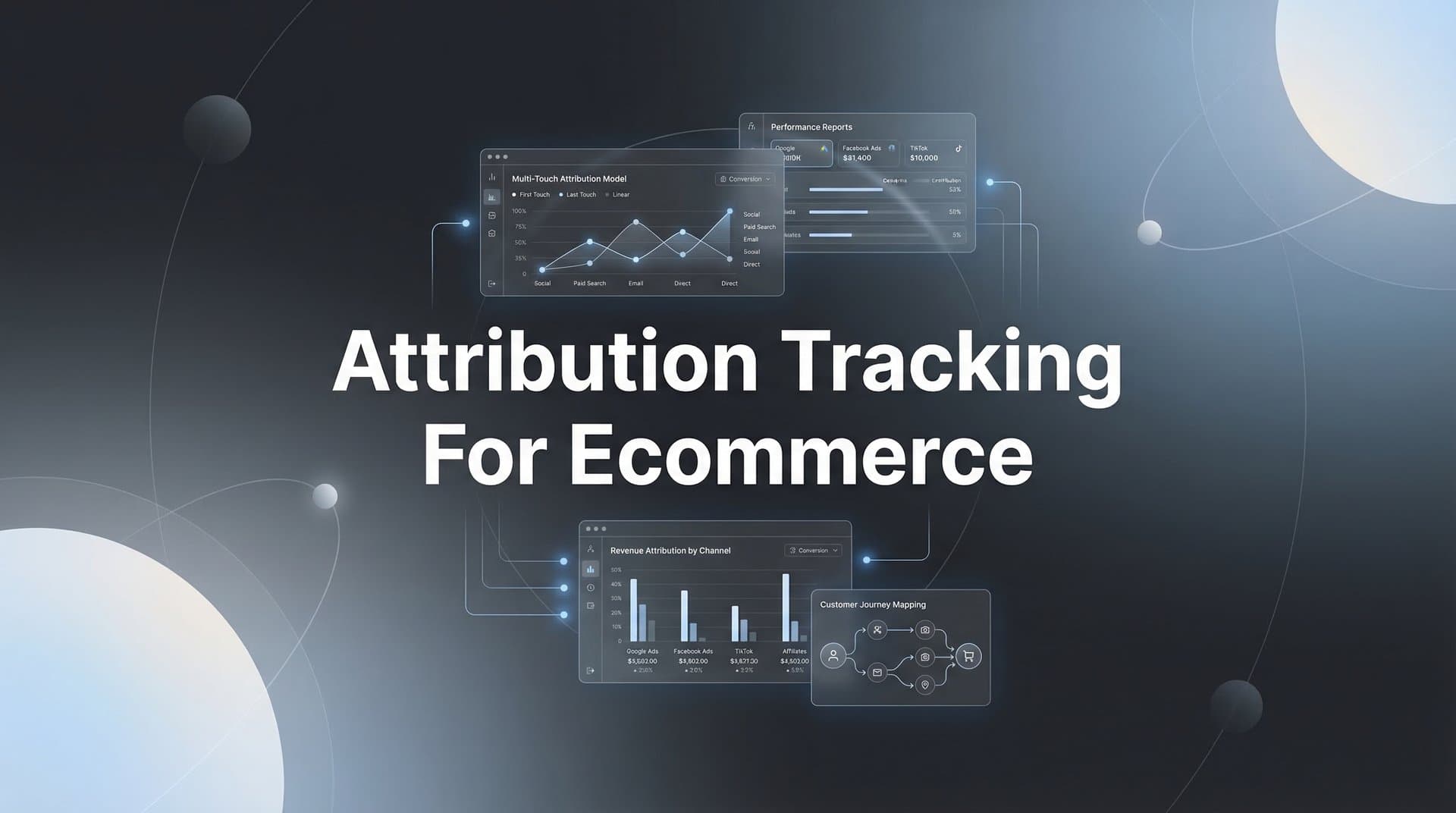
You're spending $50,000 a month across Meta ads, Google Shopping, TikTok campaigns, and email nurture sequences. Sales are coming in. Your revenue dashboard looks healthy. But when you sit down to decide where to allocate next month's budget, you hit a wall.
Meta claims credit for 200 conversions. Google says they drove 180. TikTok reports 95. Your email platform shows 110 purchases from their flows. Add those up and you've somehow generated 585 conversions—except your actual order count was 320.
Which channel actually drove those sales? Where should you double down? Which campaigns are secretly bleeding money while looking profitable in their own dashboards?
This is the attribution nightmare that keeps ecommerce marketers up at night. You're making million-dollar budget decisions based on conflicting data, platform self-reporting bias, and gut instinct. Attribution tracking for ecommerce exists to solve exactly this problem—connecting every marketing touchpoint to actual revenue so you can see what's really working.
This guide will walk you through how attribution tracking actually works, why it's become essential rather than optional, and how to implement it so you're making decisions based on complete customer journey data instead of fragmented platform metrics. By the end, you'll understand not just what attribution tracking is, but how to use it to transform your marketing from expensive guesswork into a predictable growth engine.
Why Ecommerce Brands Struggle to Connect Ads to Revenue
The fundamental challenge is simple: your customers don't buy the way platforms report conversions. They don't see one Facebook ad, click through, and immediately purchase. Real customer journeys are messy, multi-channel, and stretched across days or weeks.
A typical ecommerce buyer might see your Instagram ad on Monday morning during their commute. They don't click. Tuesday evening, they search for your product category on Google and click a Shopping ad to your site. They browse but don't buy. Wednesday, they receive your abandoned cart email and click through to read reviews. Thursday, they see a retargeting ad on Facebook, click again, and finally purchase.
That's four distinct touchpoints across three different channels before conversion. Now here's the problem: Facebook will claim that sale because they showed the final retargeting ad. Google will claim it because their Shopping ad drove a site visit. Your email platform will claim it because the cart abandonment flow generated a click.
Everyone takes credit. Nobody's lying—they're each reporting what they can see from their limited vantage point. But you're left with inflated conversion counts and no clear picture of what actually influenced the purchase decision.
This multi-touchpoint reality has always existed, but it's gotten dramatically more complex. Research consistently shows that ecommerce customers now interact with six to eight marketing touchpoints before making a purchase decision. They move fluidly between devices, platforms, and channels. They research on mobile and buy on desktop. They see ads while logged out and convert days later while logged in.
Then iOS 14.5 arrived and broke everything that was barely working. Apple's App Tracking Transparency framework gave users the option to block cross-app tracking. Most said no. Suddenly, the pixel-based tracking that powered Facebook attribution stopped seeing huge portions of mobile traffic.
Cookie deprecation is finishing the job. Browser-based tracking—the foundation of traditional web analytics—is dying. Safari already blocks third-party cookies by default. Firefox follows the same approach. Chrome has delayed their timeline multiple times, but the direction is clear: the tracking infrastructure that ecommerce brands built their attribution on is disappearing.
The result? Massive data gaps. Conversions happening that platforms can't see. Attribution models built on incomplete information. And marketing teams making budget decisions while flying blind through a storm.
Platform-reported metrics have become increasingly unreliable not because the platforms are incompetent, but because they literally cannot see what they used to see. When Facebook reports conversions, they're estimating based on modeled data for users who opted out of tracking. When Google claims credit, they're working with their own limited view of the customer journey.
The trust gap has widened. Marketers look at platform dashboards and know the numbers don't add up, but they lack a better alternative. So they keep optimizing based on incomplete data, wondering why their ROAS keeps declining even as they follow best practices.
How Attribution Tracking Actually Works
Attribution tracking solves this problem by building a complete record of every marketing touchpoint a customer encounters, then intelligently assigning credit for conversions across those interactions. Instead of trusting each platform's self-reported metrics, you create a unified view of the entire customer journey.
The core mechanics work like this: every time a potential customer interacts with your marketing—clicking an ad, opening an email, visiting from organic search—that interaction gets recorded with specific identifying information. When that same person eventually converts, the attribution system connects their purchase back to all the touchpoints they encountered along the way.
This requires solving a fundamental technical challenge: tracking the same person across multiple sessions, devices, and channels. Traditional cookie-based tracking fails here because cookies are browser-specific, easily deleted, and increasingly blocked by privacy features.
Server-side tracking represents the modern solution. Instead of relying on browser cookies and client-side pixels that users can block, server-side tracking captures data directly on your servers where ad blockers and privacy restrictions can't interfere. When someone clicks your ad or visits your site, that interaction gets logged server-side with identifying information that persists across sessions.
The technical implementation involves several components working together. First, you need proper UTM parameters on all your marketing links. These URL tags identify the source, medium, and campaign for each click. When someone clicks your Facebook ad with UTM parameters attached, your attribution system knows exactly which campaign drove that visit. Understanding the difference between UTM tracking and attribution software is crucial for building an effective system.
Click IDs take this further. Platforms like Facebook (fbclid), Google (gclid), and TikTok (ttclid) append unique identifiers to their ad clicks. These IDs allow your attribution system to connect specific conversions back to specific ad clicks, even when the conversion happens days later on a different device.
CRM integration completes the picture. When a visitor eventually converts—whether that's making a purchase, signing up for your email list, or submitting a lead form—that conversion event includes their email address or customer ID. Your attribution system can then match that identifier back through all their previous anonymous sessions to reconstruct their complete journey.
This is where first-party data becomes crucial. You're not relying on third-party cookies that track users across the entire web. You're collecting data about interactions with your own properties—your website, your ads, your emails. This first-party approach is both more privacy-compliant and more reliable than cookie-based tracking ever was.
The system builds what's essentially a timeline for each customer. On Day 1, they clicked your Instagram ad (touchpoint recorded). On Day 3, they searched for your brand and clicked a Google ad (touchpoint recorded). On Day 5, they opened your email campaign (touchpoint recorded). On Day 7, they returned directly to your site and purchased (conversion recorded, connected to all previous touchpoints).
Now you have the raw data showing the complete journey. The next challenge is deciding how to assign credit for that conversion across the four touchpoints that led to it. Should the Instagram ad that started the journey get credit? The Google ad that brought them to your site? The email that re-engaged them? The direct visit where they finally converted?
This is where attribution models come in—the rules that determine how to distribute credit across multiple touchpoints. But before we dive into models, understand that accurate attribution tracking is the foundation. You can't intelligently assign credit to touchpoints you never captured in the first place.
Attribution Models Explained: Choosing the Right One for Your Store
Attribution models are the lens through which you interpret your customer journey data. Each model applies different logic for distributing conversion credit across the touchpoints that led to a sale. Choosing the right model—or using multiple models to compare perspectives—dramatically impacts how you evaluate channel performance.
First-touch attribution gives 100% of the credit to the first interaction a customer had with your marketing. In our earlier example where someone saw an Instagram ad, clicked a Google ad, received an email, then purchased, first-touch would credit Instagram with the entire conversion. The logic: this channel created awareness and started the journey.
First-touch makes sense when your primary goal is customer acquisition and brand awareness. If you're launching a new product or entering a new market, knowing which channels introduce people to your brand is valuable. It helps you understand what's filling the top of your funnel.
But first-touch has serious limitations for ecommerce. It completely ignores all the nurturing, retargeting, and conversion-focused touchpoints that actually convinced someone to buy. That Instagram ad might have created awareness, but maybe it was your abandoned cart email that closed the deal. First-touch attribution would never reveal this.
Last-touch attribution takes the opposite approach: 100% credit goes to the final touchpoint before conversion. If someone's last interaction was clicking your retargeting ad, that ad gets full credit regardless of the five touchpoints that came before it.
Most ad platforms default to last-touch because it makes their performance look better. Of course your retargeting campaigns show amazing ROAS when they get full credit for conversions that were set up by awareness campaigns, organic search, and email nurture. Last-touch systematically overvalues bottom-of-funnel channels and undervalues everything else.
That said, last-touch can be useful for understanding what's closing deals. If you're focused purely on conversion optimization and want to know what's happening in the final moments before purchase, last-touch provides that perspective. Just don't use it as your only attribution model or you'll starve your awareness channels of budget.
Multi-touch attribution models distribute credit across multiple touchpoints rather than giving everything to the first or last interaction. These models acknowledge the reality that customer journeys involve multiple influences.
Linear attribution is the simplest multi-touch approach: divide credit equally across all touchpoints. If there were four interactions before conversion, each gets 25% credit. This treats every touchpoint as equally valuable, which is more realistic than first- or last-touch, but still oversimplified. Your initial awareness ad probably doesn't deserve the same credit as the retargeting ad that directly drove the purchase.
Time-decay attribution weights touchpoints based on recency. Interactions closer to the conversion get more credit than earlier ones. This makes intuitive sense—the touchpoints right before someone bought probably influenced their decision more than an ad they saw three weeks ago. Time-decay is particularly useful for ecommerce brands with longer consideration cycles.
Position-based attribution (also called U-shaped) gives 40% credit to the first touchpoint, 40% to the last, and divides the remaining 20% among everything in between. This model values both customer acquisition and conversion while acknowledging that middle touchpoints played a role. It's a balanced approach that works well for many ecommerce brands.
Data-driven attribution represents the most sophisticated approach. Instead of using predetermined rules about how credit should be distributed, data-driven models analyze your actual conversion patterns to determine what credit each touchpoint deserves. The system looks at thousands of customer journeys, identifies which touchpoint combinations lead to higher conversion rates, and assigns credit accordingly. Understanding what attribution model is best for optimizing ad campaigns depends on your specific business goals and customer behavior.
If your data shows that customers who see both a Facebook ad and a Google Shopping ad convert at 3x the rate of those who only see one, the data-driven model will assign more credit to that combination. It's personalized to your actual customer behavior rather than generic assumptions.
The challenge with data-driven attribution is that it requires substantial conversion volume to work effectively. If you're only generating 50 conversions per month, you don't have enough data for the model to identify meaningful patterns. But for brands doing significant volume, data-driven attribution provides the most accurate picture of what's actually driving results.
Here's the truth: there's no single "correct" attribution model. Each one reveals different insights about your marketing performance. The most sophisticated approach is comparing multiple models to understand how different perspectives change your channel evaluation. When you see that Facebook looks amazing in last-touch but mediocre in first-touch, you learn something valuable about its role in your funnel.
Setting Up Attribution Tracking: Essential Components
Understanding attribution theory is one thing. Actually implementing tracking that captures complete customer journeys is another. The technical infrastructure you build determines whether your attribution data is comprehensive and reliable or riddled with gaps that lead to bad decisions.
Server-side tracking is the foundation. This isn't optional anymore—it's the difference between seeing 60% of your conversions and seeing 95% of them. Browser-based pixels are blocked by ad blockers, deleted when users clear cookies, and restricted by browser privacy features. Server-side tracking bypasses all of this by capturing data on your servers before it ever touches the user's browser.
Implementation involves setting up a server-side tracking endpoint that receives conversion events directly from your website backend. When someone completes a purchase, your ecommerce platform sends that conversion data to your attribution system server-to-server. No reliance on browser cookies. No vulnerability to ad blockers. Just reliable data capture.
The technical setup varies by platform, but the concept is consistent: move data collection from the client side (user's browser) to the server side (your infrastructure). This requires some development work, but the payoff in data accuracy is substantial. If you're running a Shopify store, understanding ad tracking setup for Shopify is essential for proper implementation.
Connecting your ad platforms, website, and CRM into a unified data ecosystem is the next critical piece. Your attribution system needs to receive data from every channel where customers interact with your marketing. This means integrations with Facebook Ads, Google Ads, TikTok, your email service provider, your analytics platform, and your ecommerce backend.
Each integration serves a specific purpose. Ad platform integrations pull campaign data so you know which specific ads drove clicks. Website tracking captures on-site behavior and conversion events. CRM integration connects customer identities across anonymous sessions. When all these data sources flow into a central attribution platform, you can reconstruct complete journeys.
UTM parameter consistency is essential but often overlooked. If your team isn't using standardized UTM naming conventions across all campaigns, your attribution data will be fragmented and unreliable. Create a clear taxonomy for source, medium, and campaign parameters, then enforce it across every marketing channel.
Conversion sync represents the final component—and it's what transforms attribution from a reporting tool into a performance improvement system. Conversion sync means sending your accurate, server-side conversion data back to your ad platforms to improve their optimization algorithms.
Here's why this matters: Facebook and Google optimize your campaigns based on the conversion data they receive. If they're only seeing 60% of your actual conversions because of iOS privacy restrictions, their algorithms are optimizing based on incomplete information. They're making decisions about which audiences to target and which ads to show more often using a fundamentally flawed dataset.
Conversion sync solves this by feeding your complete conversion data back to the platforms. When someone converts on your site, your attribution system captures it server-side, then sends that conversion event back to Facebook and Google via their Conversion APIs. Now the platforms see conversions they would have missed, and their algorithms can optimize more effectively.
The result is better ad performance. When Facebook's algorithm has accurate data about which audiences actually convert, it can find more people like your best customers. When Google knows which keywords drive real sales, it can adjust bids more intelligently. You're not just tracking better—you're making your ad platforms work harder for you.
Turning Attribution Data Into Profitable Decisions
Having accurate attribution data is worthless if you don't act on it. The goal isn't to create prettier dashboards—it's to make fundamentally better marketing decisions that increase revenue and reduce waste. Here's how attribution tracking transforms from interesting data into profit-driving action.
Start by identifying which campaigns actually drive revenue versus those that just look good in platform dashboards. This is where the conflict between platform-reported metrics and attribution data becomes valuable. When Facebook claims a campaign generated 50 conversions with a 4x ROAS, but your attribution system shows it only influenced 20 conversions with a 2x ROAS, you've discovered something important.
That campaign is getting credit for conversions it didn't earn. Maybe it's showing retargeting ads to people who were already going to buy. Maybe it's in the customer journey but not actually influencing purchase decisions. Either way, the platform metrics are misleading you into thinking it's more valuable than it is.
Compare performance across attribution models to understand each channel's role. If a channel performs well in first-touch attribution but poorly in last-touch, it's driving awareness but not closing sales. That's not necessarily bad—awareness is valuable—but it means you shouldn't expect direct ROAS from that channel. Budget it accordingly.
Conversely, channels that excel in last-touch but show weak first-touch performance are conversion-focused. They're closing deals that other channels started. Retargeting campaigns typically fit this pattern. Understanding this helps you allocate budget appropriately across funnel stages rather than expecting every channel to perform the same way.
Budget reallocation becomes data-driven rather than instinctual. When you see that a specific Google Shopping campaign consistently appears in high-value customer journeys across multiple attribution models, you have evidence to increase its budget. When a TikTok campaign that looked promising in platform metrics barely shows up in your attribution data, you have evidence to cut it.
The key is looking for patterns across attribution models rather than optimizing for a single perspective. If a channel performs well in first-touch, linear, time-decay, and data-driven attribution, you've found a winner. If it only looks good in one model, dig deeper before scaling.
AI-powered recommendations take this analysis further by identifying patterns humans might miss. Advanced attribution platforms analyze thousands of customer journeys to surface insights like "customers who see both Facebook and Google ads convert at 2.8x the rate of single-channel exposure" or "time between first touch and conversion is 40% shorter when email is part of the journey."
These insights translate directly into action. If multi-channel exposure drives higher conversion rates, you should ensure your campaigns reach customers across platforms rather than concentrating budget in one channel. If email shortens the sales cycle, you should prioritize growing your email list and improving welcome sequences. Leveraging data science for marketing attribution can help uncover these deeper patterns.
The most sophisticated approach involves building feedback loops. Track performance, analyze attribution data, make budget adjustments, then measure how those changes impact results. Attribution tracking isn't a one-time setup—it's an ongoing optimization system that gets smarter as you feed it more data and test more hypotheses.
One critical insight that attribution data often reveals: your best customers have different journey patterns than average customers. Maybe high-value purchasers are more likely to interact with educational content before buying. Maybe they respond better to specific ad creatives. Attribution tracking can segment journeys by customer value, revealing which marketing approaches attract your most profitable segments.
Your Attribution Action Plan: From Setup to Optimization
Theory and strategy mean nothing without execution. Here's your practical roadmap for implementing attribution tracking that actually improves your ecommerce marketing performance.
Start with infrastructure before analysis. You cannot analyze data you're not capturing. Prioritize implementing server-side tracking first, even if it means delaying other projects. The data gaps from client-side-only tracking will undermine every decision you make. Invest in getting this foundation right before you worry about which attribution model to use or which dashboards to build.
Standardize your UTM parameters across every marketing channel. Create a simple taxonomy document that your entire team follows. Define exactly how you'll tag Facebook campaigns versus Google campaigns versus email campaigns. Enforce this consistently. Messy UTM data leads to messy attribution that you can't trust.
Connect all your data sources to a central attribution platform. Don't try to build this yourself unless you have a strong engineering team and unlimited time. Modern attribution software for tracking marketing handles the complex integrations, data processing, and model calculations that would take months to build in-house. Focus your energy on using the insights, not building the infrastructure.
Compare multiple attribution models rather than picking one as "correct." Set up dashboards that show the same campaigns evaluated through first-touch, last-touch, linear, and data-driven lenses. The differences between these perspectives reveal how each channel functions in your marketing ecosystem. A channel that looks weak in one model but strong in another is telling you something valuable about its role.
Implement conversion sync to close the loop with your ad platforms. This is where attribution tracking transforms from a reporting tool into a performance improvement system. When you feed accurate conversion data back to Facebook and Google, their algorithms optimize more effectively. Your ads perform better, your ROAS improves, and you're not just measuring success—you're creating it.
Build a regular attribution review into your marketing process. Monthly is a good cadence for most ecommerce brands. Look at how attribution patterns have changed, which channels are trending up or down, and where budget reallocation opportunities exist. Attribution data is most valuable when you act on it consistently, not when you check it once and forget about it.
Test incrementally rather than making massive budget shifts based on initial data. If attribution reveals that a channel is underperforming, reduce its budget by 20% and monitor results rather than cutting it entirely. If a channel looks promising, increase budget by 30% and watch what happens. Attribution data guides decisions, but you still need to validate insights through testing.
Making Every Marketing Dollar Count
Attribution tracking for ecommerce transforms marketing from a collection of isolated channel budgets into a unified revenue system. Instead of wondering which platform's self-reported metrics to trust, you build a complete view of how customers actually discover, consider, and purchase from your store.
The shift from platform-reported metrics to unified attribution isn't just about better reporting. It's about making smarter decisions with your marketing budget. When you know which campaigns truly drive revenue, you stop wasting money on channels that look good in isolation but don't contribute to actual sales. When you understand the complete customer journey, you can optimize the entire path to purchase rather than individual touchpoints.
But attribution tracking delivers its greatest value when you close the loop. Capturing accurate data is the foundation. Analyzing it with the right models reveals insights. But feeding that enriched conversion data back to your ad platforms through conversion sync is what transforms insights into improved performance. You're not just understanding what happened—you're giving Facebook, Google, and other platforms the information they need to optimize more effectively on your behalf.
The ecommerce brands winning in 2026 aren't the ones spending the most on ads. They're the ones with the clearest view of what's working, the discipline to cut what isn't, and the infrastructure to continuously improve their marketing machine through better data.
Ready to elevate your marketing game with precision and confidence? Discover how Cometly's AI-driven recommendations can transform your ad strategy—Get your free demo today and start capturing every touchpoint to maximize your conversions.



