

You're spending $10,000 a month on Facebook ads, another $8,000 on Google, $5,000 on TikTok, and running consistent email campaigns. Your Shopify dashboard shows solid revenue numbers. But when you try to figure out which channel is actually driving those sales, you get three different stories from three different platforms—each one claiming credit for the same conversions.
Sound familiar?
This is the attribution nightmare that keeps ecommerce marketers up at night. Without accurate attribution, you're essentially flying blind, making budget decisions based on inflated platform metrics rather than real revenue data. You might be pouring money into channels that look great on paper but barely move the needle, while starving the campaigns that actually convert browsers into buyers.
Attribution for ecommerce stores isn't just about tracking clicks anymore. It's about connecting every touchpoint across every platform to understand the complete customer journey from first impression to final purchase. In this guide, we'll break down exactly how modern attribution works, which models fit different ecommerce goals, and how to build a tech stack that captures the truth about what's driving your sales.
Why Ecommerce Attribution Has Become Non-Negotiable
The path from discovery to purchase has never been more complex. Your customers don't see one ad and immediately buy. They see your Instagram ad on their phone during lunch, Google your brand later that evening on their laptop, read reviews on their tablet before bed, click an email reminder two days later, and finally purchase on their phone during their morning commute.
That's five touchpoints across three devices over multiple days. And every single one of those interactions influenced the final decision.
Here's where it gets messy: Facebook will claim that conversion. Google will claim it too. Your email platform will take credit. Each platform lives in its own silo, reporting conversions based on its last interaction with the customer. The result? You're seeing 200% more conversions reported across platforms than you actually received in orders. This multiple ad platforms attribution confusion is one of the biggest challenges facing ecommerce marketers today.
The iOS 14.5 update in 2021 fundamentally changed the game. When Apple introduced App Tracking Transparency, it gave users the power to opt out of cross-app tracking. The majority did. Suddenly, Facebook's pixel couldn't track users across apps and websites like it used to. Google faced similar limitations. Cookie deprecation across browsers added another layer of tracking disruption.
For ecommerce brands, this created a credibility crisis. Platform-reported data became increasingly unreliable. Brands noticed significant discrepancies between what Facebook claimed as conversions and what actually appeared in their Shopify orders. The gap between reported ROAS and actual revenue grew wider.
The cost of misattribution isn't abstract—it's real money leaving your business. When you can't accurately identify which campaigns drive purchases, you make decisions based on false signals. You might kill a prospecting campaign that's actually seeding your entire funnel because it doesn't show last-click conversions. Or you might double down on retargeting that's getting credit for purchases that would have happened anyway.
Without accurate attribution, you're optimizing for the wrong metrics. You're feeding incomplete data back to ad platform algorithms, which means their AI can't effectively optimize for your actual high-value customers. You're building lookalike audiences based on partial customer data rather than the complete picture of who actually converts and stays.
This is why attribution has shifted from "nice to have" to "business critical" for ecommerce brands. The brands winning in 2026 aren't the ones spending the most—they're the ones who know exactly where every dollar goes and what it returns.
Attribution Models Explained: Which One Fits Your Store
Attribution models are the rules that determine how credit gets assigned across the customer journey. Choose the wrong model, and you'll optimize your entire marketing strategy around misleading data. Choose the right one, and suddenly the fog clears. Understanding attribution modeling for ecommerce is essential for making informed marketing decisions.
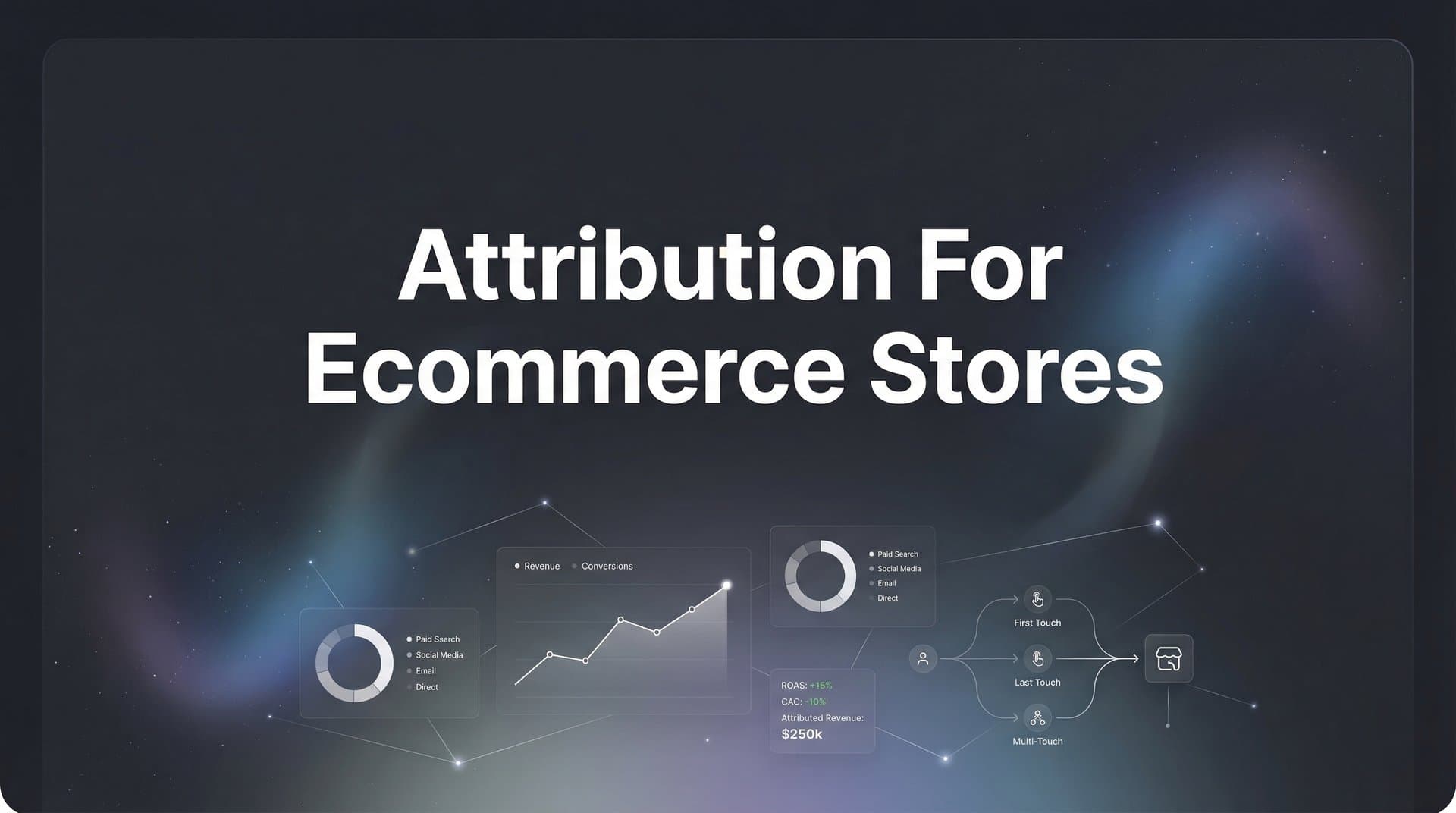
Let's start with the simplest: first-touch attribution. This model gives 100% of the credit to the first interaction a customer has with your brand. If someone clicks your Facebook ad, then later Googles your brand, clicks an email, and finally purchases, Facebook gets all the credit.
We compare the leading options in our WooCommerce Instagram ad tool roundup.
First-touch makes sense when you're primarily focused on awareness and top-of-funnel performance. If you're a new brand trying to understand which channels are best at introducing you to cold audiences, first-touch shows you where customers first discover you. It's particularly useful for brands with shorter sales cycles where the first impression heavily influences the purchase decision.
Last-touch attribution does the opposite—it gives 100% of the credit to the final touchpoint before purchase. In the same customer journey, your email would get all the credit because it was the last thing they clicked before buying.
Last-touch is useful when you want to understand what's closing deals. It highlights which channels are best at converting warm audiences who are ready to buy. Many ecommerce brands default to last-touch because it's simple and aligns with how most ad platforms natively report conversions.
But here's the problem with both single-touch models: they ignore everything in between. Real customer journeys aren't linear. That Facebook ad that introduced your brand? It mattered. The Google search that validated your credibility? It mattered. The email that reminded them about the product in their cart? It mattered too.
This is where multi-touch attribution enters the picture. These models distribute credit across multiple touchpoints, acknowledging that the customer journey is a series of influences rather than a single moment. Exploring multi-touch attribution models can help you understand which approach works best for your data.
Linear attribution splits credit equally across all touchpoints. If a customer had five interactions before purchasing, each one gets 20% of the credit. This model works well when you believe every touchpoint contributes equally to the decision—though in reality, some interactions usually matter more than others.
Time-decay attribution gives more credit to touchpoints closer to the conversion. The logic is sound: the interactions that happened right before purchase likely had more influence than the ad someone saw three weeks ago. This model is particularly useful for ecommerce brands with longer consideration periods, like furniture or electronics, where recent interactions tend to be more decisive.
Position-based attribution (also called U-shaped) gives 40% credit to the first touchpoint, 40% to the last touchpoint, and splits the remaining 20% among everything in between. This model recognizes that both discovery and conversion moments are critical, while still acknowledging the supporting role of mid-funnel interactions.
Then there's data-driven attribution—the most sophisticated approach. Instead of using predetermined rules, data-driven models analyze your actual conversion data to understand which touchpoints historically lead to purchases. The algorithm learns from thousands of customer journeys to assign credit based on real patterns in your specific business.
If your data shows that customers who see both a Facebook ad and a Google search are 3x more likely to convert than those who only see one, the model weights those touchpoints accordingly. It adapts to your unique customer behavior rather than forcing your data into a generic framework.
So which model should you use? For most ecommerce stores, the answer is: start with multi-touch, preferably data-driven if you have sufficient conversion volume. Why? Because ecommerce customer journeys are inherently multi-touch. Your customers research, compare, read reviews, and often need multiple exposures before buying.
Single-touch models will systematically undervalue critical parts of your funnel. If you only use last-touch, you'll underinvest in awareness campaigns. If you only use first-touch, you'll undervalue your conversion-focused channels. Multi-touch attribution gives you the complete picture.
The Ecommerce Attribution Tech Stack
Attribution models are only as good as the data feeding them. If you're missing touchpoints or tracking them inaccurately, even the most sophisticated model will give you garbage insights. Building the right tech stack is what transforms attribution from theory into actionable intelligence.
The foundation of accurate ecommerce attribution in 2026 is server-side tracking. Here's why it matters: traditional browser-based tracking relies on cookies and pixels that fire in the user's browser. But with iOS restrictions, cookie blockers, and privacy-focused browsers, a significant percentage of your conversions simply don't get tracked through browser-based methods.
Server-side tracking bypasses these limitations. Instead of relying on the customer's browser to send data, your server sends conversion information directly to your attribution platform and ad networks. When someone completes a purchase on your Shopify store, your server immediately sends that conversion data to Facebook's Conversion API, Google's server-side tracking, and your attribution platform—regardless of whether the customer has cookies enabled or tracking blocked.
If you're evaluating vendors, our Shopify carousel ad generator breakdown can help.
The difference is dramatic. Many ecommerce brands see 20-30% more conversions captured with server-side tracking compared to pixel-only implementations. That's not because you're suddenly getting more sales—it's because you're finally seeing the sales that were always there but going untracked. If you're running a Shopify store, proper ad tracking setup for Shopify stores is critical for capturing this data.
Next, you need to connect your ad platforms into a unified view. Your attribution platform should integrate directly with Facebook Ads, Google Ads, TikTok Ads, and any other paid channels you're running. This allows it to capture impression data, click data, and ad spend from each platform.
But here's the crucial part: your attribution platform also needs direct integration with your ecommerce platform—whether that's Shopify, WooCommerce, BigCommerce, or another solution. This integration pulls actual order data: who purchased, what they bought, how much they spent, and when the transaction occurred.
This is where the magic happens. By matching ad interaction data with actual purchase data, your attribution platform can definitively connect which ads led to which orders. You're no longer relying on what Facebook thinks converted. You're matching real orders from your Shopify backend to the actual customer journey that preceded them.
Website analytics integration is equally critical. Your attribution platform should connect with Google Analytics or your analytics tool of choice to capture organic traffic, direct visits, and on-site behavior. This ensures that non-paid touchpoints—like someone finding you through organic search or directly typing your URL—get properly credited in the attribution model. Understanding the differences between Google Analytics vs attribution platforms helps you leverage both tools effectively.
For ecommerce brands serious about understanding true customer value, CRM integration completes the picture. When you connect your attribution platform to your CRM or customer data platform, you can track post-purchase behavior: repeat purchases, lifetime value, and long-term customer retention.
This transforms attribution from a simple "what drove this sale?" question into "what channels acquire customers who actually stick around and buy again?" You might discover that your Google Shopping campaigns have a lower initial ROAS than Facebook, but Google customers have 2x higher lifetime value because they make repeat purchases. Without CRM integration, you'd never see that pattern. Platforms that offer marketing attribution with revenue tracking make this connection seamless.
The technical implementation matters too. Your attribution platform should use persistent customer IDs that track users across devices and sessions. When someone clicks your ad on mobile, browses on desktop, and purchases on tablet, the platform needs to recognize that as one customer journey—not three separate, unrelated interactions.
Email and SMS marketing platforms should also feed into your attribution system. Many ecommerce purchases are directly influenced by email campaigns—abandoned cart reminders, promotional offers, or product recommendation emails. If these touchpoints aren't captured in your attribution model, you're missing a significant piece of the puzzle.
The result of this integrated tech stack is a single source of truth. Instead of logging into five different platforms to piece together what's working, you see every touchpoint, every channel, and every conversion in one unified dashboard. You can answer questions like "What's the typical path to purchase for customers who spend over $200?" or "Which channel combination produces the highest lifetime value customers?"
From Data to Decisions: Using Attribution to Scale Profitably
Accurate attribution data is worthless if it just sits in a dashboard. The real value comes from turning those insights into action—reallocating budget, optimizing campaigns, and feeding better signals back to ad platforms to improve their algorithmic performance.
Start by identifying your true top-performing campaigns. Open your attribution platform and filter for campaigns that drive actual revenue, not just platform-reported conversions. You'll likely find some surprises.
That prospecting campaign Facebook claims has a 1.5x ROAS? When you look at multi-touch attribution, it might actually be initiating customer journeys that convert at 4x ROAS when you account for all the downstream touchpoints it influences. Conversely, that retargeting campaign showing a 6x ROAS in Facebook Ads Manager might drop to 2x when you realize it's mostly getting credit for conversions that would have happened anyway.
This is where the budget reallocation begins. Take the campaigns that attribution reveals as true performers and increase their budgets. Cut or optimize the campaigns that look good in platform metrics but don't hold up under multi-touch analysis. Managing attribution tracking for multiple campaigns becomes much easier with the right systems in place.
One of the most powerful applications of attribution data is feeding it back to ad platform algorithms. Facebook, Google, and TikTok all use conversion data to optimize delivery—showing your ads to people most likely to convert. But if they're only seeing partial conversion data due to tracking limitations, their algorithms are optimizing based on incomplete information.
This is where Conversion APIs and server-side tracking become game-changers. When you send complete, accurate conversion data back to these platforms through server-side connections, you're giving their algorithms a much clearer picture of who actually converts. Facebook's algorithm can then find more people who look like your real customers, not just the subset of customers whose conversions were tracked through browser pixels.
Many ecommerce brands report significant performance improvements after implementing proper conversion tracking. The ad platforms can finally optimize effectively because they're working with accurate data about what success actually looks like.
Attribution data also transforms how you build audiences. Instead of creating lookalike audiences based on all purchasers, you can create them based on high-value purchasers—customers who spent above a certain threshold or who made repeat purchases. Your attribution platform can identify these valuable customer segments, and you can export them to your ad platforms for more precise targeting.
You can also use attribution insights to optimize your creative strategy. If attribution reveals that customers who see both video ads and carousel ads convert at higher rates than those who only see one format, you know to diversify your creative mix. If certain product categories show longer consideration periods with more touchpoints before purchase, you can adjust your retargeting windows and frequency caps accordingly.
Attribution data should also inform your channel expansion decisions. Before launching on a new platform like Pinterest or Snapchat, look at your attribution data to understand where your customers currently are in their journey. If you see significant organic traffic from Pinterest already appearing in customer journeys, that's a strong signal that paid Pinterest ads might perform well. Implementing cross-platform attribution tracking ensures you capture the full picture across all channels.
For brands with multiple product lines, attribution can reveal which channels work best for which products. You might discover that Google Shopping crushes it for your lower-priced impulse purchases, while Facebook performs better for higher-consideration items that benefit from social proof and lifestyle imagery.
The key is treating attribution as a continuous optimization loop, not a one-time analysis. Review your attribution data weekly. Look for shifts in customer journey patterns. Test new channel combinations based on what the data reveals about how customers actually discover and convert. Use those insights to constantly refine where you spend, what you say, and who you target.
Common Attribution Pitfalls Ecommerce Brands Must Avoid
Even with the right tools and models in place, there are several attribution mistakes that can undermine your entire strategy. Recognizing these pitfalls helps you avoid costly misinterpretations of your data.
The biggest trap is over-relying on single-platform reporting. When you make budget decisions based solely on what Facebook Ads Manager or Google Ads reports, you're guaranteed to see inflated numbers. These platforms naturally want to show their value, and their attribution windows often overlap, leading to the same conversion being claimed by multiple platforms.
A customer might click your Facebook ad, then later click a Google ad, and finally purchase. Facebook will count that as a Facebook conversion (because there was a click within their attribution window). Google will count it as a Google conversion (same reason). You'll see two conversions reported, but you only received one actual order. Multiply this across hundreds of daily conversions, and the discrepancy becomes massive.
The solution is using a third-party attribution platform as your source of truth. It sits above individual ad platforms and tracks the complete customer journey without the bias of any single channel trying to claim maximum credit. Reviewing the best attribution tools for ecommerce can help you find the right solution for your needs.
Attribution window mismatches are another common pitfall. Most ad platforms default to a 7-day click, 1-day view attribution window. But if you're selling high-consideration products like furniture, electronics, or luxury items, your actual sales cycle might be 14, 21, or even 30 days. For brands selling premium products, understanding attribution for high-ticket products requires different approaches.
When your attribution window is shorter than your actual sales cycle, you systematically undercount conversions from top-of-funnel awareness campaigns. That Facebook video ad that introduced someone to your brand three weeks ago? It won't get any credit if you're using a 7-day window, even though it was a crucial first touchpoint.
The fix is aligning your attribution windows with your actual customer behavior. Look at your data to understand how long the typical consideration period is for your products, then set your attribution windows accordingly.
Failing to account for non-digital touchpoints is particularly problematic for omnichannel ecommerce brands. If you run TV ads, podcast sponsorships, direct mail campaigns, or have retail locations, these touchpoints influence online purchases—but they're often invisible in digital attribution.
You might see a spike in direct traffic and branded search after a TV campaign airs, but if you're only looking at last-touch attribution, those channels get the credit instead of the TV ad that actually drove awareness. The solution is incorporating offline conversion tracking and using promo codes or unique URLs to connect offline campaigns to online conversions.
Another mistake is ignoring organic and direct traffic in attribution models. When someone Googles your brand name and clicks the organic result, that's often the final step in a journey that started with a paid ad. If your attribution model doesn't capture organic touchpoints, you're missing a critical part of the story.
Many brands also fail to account for cross-device behavior properly. Your customer might research on mobile during their commute, continue on desktop at work, and purchase on tablet at home. Without proper cross-device tracking using persistent customer IDs, these appear as three separate customer journeys instead of one continuous path to purchase.
Finally, there's the mistake of treating attribution as a "set it and forget it" implementation. Customer behavior changes. New platforms emerge. Privacy regulations evolve. Your attribution setup needs regular audits to ensure it's still capturing data accurately and that your models reflect current customer journey patterns.
Putting It All Together
Accurate attribution isn't a luxury for ecommerce brands anymore—it's the competitive advantage that separates profitable growth from expensive guesswork. When you can definitively connect ad spend to actual revenue across every touchpoint and every device, you stop making decisions based on inflated platform metrics and start optimizing based on truth.
The brands winning in 2026 are the ones who've moved beyond single-platform reporting to implement comprehensive attribution systems. They're using server-side tracking to capture conversions that browser-based pixels miss. They're applying multi-touch attribution models that reveal the complete customer journey, not just the first or last click. And they're feeding accurate conversion data back to ad platforms to supercharge algorithmic optimization.
This isn't about tracking for tracking's sake. It's about understanding which marketing investments actually drive revenue so you can do more of what works and eliminate what doesn't. It's about identifying your true high-value customer acquisition channels and scaling them with confidence. It's about building a sustainable, profitable marketing engine instead of burning cash on campaigns that look good in platform dashboards but don't move the bottom line.
The path forward starts with auditing your current attribution setup. Are you capturing every touchpoint across all channels? Is your ecommerce platform feeding real order data into your attribution system? Are you using multi-touch models that reflect actual customer journeys? Are you sending complete conversion data back to ad platforms to improve their targeting?
If you answered no to any of these questions, you're leaving money on the table. Cometly captures every touchpoint—from ad clicks to CRM events—providing a complete view of every customer journey. You'll know what's really driving revenue, get AI-powered recommendations to identify high-performing campaigns, and feed enriched conversion data back to Meta, Google, and other platforms for better targeting and optimization.
Ready to elevate your marketing game with precision and confidence? Discover how Cometly's AI-driven recommendations can transform your ad strategy—Get your free demo today and start capturing every touchpoint to maximize your conversions.


