

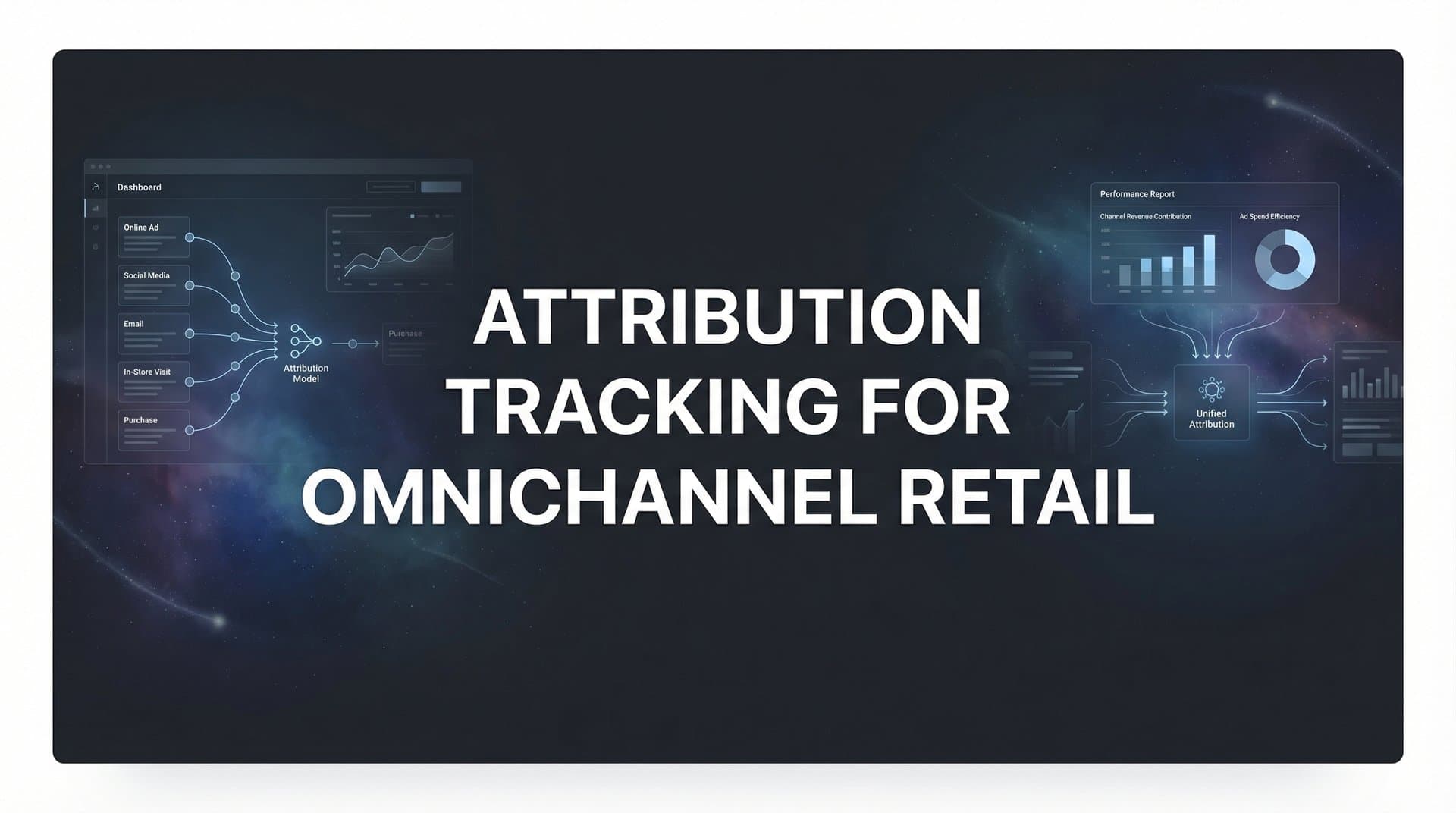
Picture a customer who discovers your brand through an Instagram ad during their morning commute, researches products on your website during lunch, receives a promotional email that evening, visits your physical store the next day to see items in person, and finally completes the purchase on their laptop that weekend. Which marketing touchpoint deserves credit for that sale?
For most retailers, this question remains frustratingly unanswered. Marketing teams operate with fragmented data scattered across platforms that don't communicate with each other. Your social ads report clicks and impressions. Your email platform tracks opens and link clicks. Your point-of-sale system records transactions. Your website analytics shows sessions and page views. But none of these systems reveal the complete story of how these touchpoints work together to drive revenue.
This is the core challenge that attribution tracking for omnichannel retail solves. It connects the dots across every customer interaction, whether digital or physical, to create a unified view of the journey from initial awareness to final purchase. When implemented correctly, attribution tracking transforms how you understand campaign performance, allocate marketing budgets, and optimize your cross-channel strategy. This guide breaks down exactly how attribution tracking works in modern retail environments and how to implement it effectively for your business.
The Critical Gaps in Traditional Retail Tracking
Traditional tracking methods were built for a simpler time when customers followed more linear paths to purchase. Someone would see a banner ad, click through to a website, and complete a transaction in the same session. Attribution was straightforward because the entire journey happened in one place with clear cause and effect.
That world no longer exists. Today's retail customers interact with brands across an average of six to eight touchpoints before making a purchase decision. They switch between devices constantly. They research online and buy in-store, or browse in-store and purchase online later. They engage with content on social media, receive retargeting ads, open emails, and visit websites multiple times before converting.
The fundamental problem with traditional tracking is that each channel operates in its own silo. Your Facebook Ads Manager shows you which ads generated clicks, but it has no visibility into what happened after someone left the platform. Google Analytics tracks website behavior but cannot see the Instagram ad that originally introduced the customer to your brand. Your email platform reports conversions that happened immediately after clicking an email link, but it misses customers who opened the email, didn't click, and later returned directly to purchase.
This siloed approach creates massive blind spots. You might be investing heavily in upper-funnel awareness campaigns that introduce thousands of new potential customers to your brand, but if those customers don't convert immediately, the campaigns appear ineffective in your last-click attribution reports. Meanwhile, branded search campaigns that capture customers already familiar with your brand receive disproportionate credit because they represent the final touchpoint before purchase.
Privacy changes have intensified these tracking challenges. Browser restrictions on third-party cookies, iOS privacy features that limit cross-app tracking, and increasing user awareness around data privacy have made it progressively harder to follow customers across devices and platforms. Cookie-based tracking, which powered digital marketing for two decades, has become unreliable as a foundation for attribution. Understanding the differences between Google Analytics vs attribution platforms helps clarify why dedicated solutions are now essential.
The business impact of these attribution gaps is significant. Marketing teams make budget allocation decisions based on incomplete data, often shifting resources away from valuable awareness channels toward bottom-funnel tactics that appear more effective only because they capture the last touchpoint. Channels that play crucial roles in the customer journey get undervalued and underfunded. Optimization efforts focus on the wrong variables because the data doesn't reflect actual customer behavior patterns.
The Technical Foundation of Omnichannel Attribution
Effective attribution tracking for omnichannel retail requires connecting multiple data sources into a unified system that can follow customers across their entire journey. This goes far beyond simply installing tracking pixels on your website.
The foundation starts with comprehensive data collection from every channel where customers interact with your brand. This includes advertising platforms like Meta, Google, and TikTok; your website analytics; email marketing systems; CRM platforms; e-commerce systems; and crucially for omnichannel retailers, point-of-sale data from physical stores. Each of these sources captures different aspects of customer behavior, and none provides the complete picture alone.
Modern attribution platforms connect these disparate data sources through integrations that pull information into a centralized system. When someone clicks a Facebook ad, that interaction gets recorded. When they later visit your website from a Google search, that session connects to the same customer profile. When they make a purchase in your store three days later, that transaction links back to the same journey. Implementing a robust campaign attribution tracking system makes this unified view possible.
Identity resolution represents one of the most technically challenging aspects of omnichannel attribution. This is the process of recognizing that the anonymous person who clicked your ad, the website visitor who browsed products, and the customer who made a purchase are all the same individual, even though they used different devices and interacted across different platforms.
There are several methods for achieving identity resolution. Email addresses serve as powerful identifiers when customers log into accounts or provide their information during checkout. Phone numbers can connect online and offline interactions when customers provide them for loyalty programs or purchase confirmations. Device fingerprinting uses technical signals like IP addresses, browser configurations, and device characteristics to probabilistically match sessions to users.
The most accurate attribution systems use deterministic matching when possible, relying on concrete identifiers like email addresses, and fall back to probabilistic matching when deterministic data isn't available. This layered approach maximizes coverage while maintaining data quality. Effective cross device attribution tracking depends on these identity resolution methods working seamlessly together.
Real-time data processing has become increasingly important for modern attribution. Batch processing systems that update once daily or weekly cannot support the rapid optimization cycles that digital advertising demands. When you're running campaigns across multiple platforms simultaneously, you need to see performance data quickly enough to make meaningful adjustments before significant budget gets wasted on underperforming approaches.
Server-side tracking has emerged as a critical component of reliable attribution infrastructure. Unlike browser-based tracking that depends on cookies and can be blocked by privacy tools, server-side tracking captures conversion events directly from your backend systems. When a customer completes a purchase, your e-commerce platform sends that conversion data directly to your attribution system and advertising platforms, regardless of browser settings or cookie restrictions. This approach provides significantly more reliable data collection in the current privacy landscape.
Selecting Attribution Models That Match Your Business
An attribution model determines how credit for conversions gets distributed across the various touchpoints in a customer journey. Choosing the right model significantly impacts how you interpret campaign performance and where you allocate marketing resources.
First-touch attribution assigns 100% of the credit to whichever channel first introduced a customer to your brand. If someone discovered you through a Facebook ad, first-touch gives that ad complete credit for the eventual purchase, even if the customer interacted with multiple other channels before converting. This model excels at identifying which channels drive new customer acquisition and build awareness. It helps you understand what's bringing people into your funnel for the first time.
The limitation of first-touch is that it completely ignores the nurturing and conversion work done by other channels. That educational email sequence, the retargeting campaign that brought the customer back, and the Google search that finally drove the purchase all receive zero credit under pure first-touch attribution.
Last-touch attribution takes the opposite approach, giving 100% credit to the final touchpoint before conversion. If a customer's last interaction was clicking a promotional email before purchasing, last-touch attributes the entire sale to email marketing. This model naturally favors bottom-funnel channels like branded search, retargeting, and promotional emails that capture customers already close to making a purchase decision.
Last-touch is useful for understanding what finally convinces customers to convert, but it systematically undervalues the awareness and consideration channels that made the customer interested in your brand in the first place. Many businesses over-invest in last-touch channels because they appear highly effective in last-touch reports, while simultaneously under-investing in upper-funnel channels that receive no credit despite playing crucial roles.
Multi-touch attribution models distribute credit across multiple touchpoints in the customer journey. Linear multi-touch gives equal credit to every interaction. Position-based models (sometimes called U-shaped) give more weight to the first and last touchpoints while distributing remaining credit among middle interactions. Time-decay models give progressively more credit to touchpoints closer to the conversion. Understanding multi-touch attribution models for data analysis helps you select the approach that best fits your customer journey complexity.
These models provide a more balanced view of how different channels work together throughout the customer journey. They recognize that awareness channels, nurturing touchpoints, and conversion tactics all contribute to the final sale. For retailers with longer sales cycles or higher-consideration products, multi-touch models typically provide more actionable insights than single-touch approaches.
Data-driven attribution represents the most sophisticated approach. Instead of using predetermined rules about how to distribute credit, data-driven models analyze your actual conversion data to determine which touchpoints statistically correlate with higher conversion rates. Machine learning algorithms compare journeys that converted against those that didn't, identifying which specific touchpoints appear to have the strongest influence on purchase decisions.
The advantage of data-driven attribution is that it adapts to your specific business and customer behavior patterns. The model learns that for your particular audience, Instagram ads followed by educational blog content leads to significantly higher conversion rates than Instagram ads alone, and adjusts credit accordingly. This approach requires substantial conversion volume to generate statistically significant insights, making it most practical for retailers with significant transaction data.
The best attribution model for your business depends on your sales cycle, average order value, and specific business questions you're trying to answer. Retailers selling impulse-purchase items with short sales cycles might find last-touch perfectly adequate. Businesses with longer consideration periods and multiple touchpoints benefit more from multi-touch or data-driven approaches. Many sophisticated marketers use multiple models simultaneously, comparing results across different attribution lenses to build a comprehensive understanding of channel performance.
Bridging the Online-to-Offline Attribution Gap
For omnichannel retailers with both digital presence and physical locations, connecting online marketing efforts to in-store purchases represents both the biggest challenge and the biggest opportunity in attribution tracking.
The core difficulty is that traditional digital tracking ends when a customer leaves your website. If someone clicks your Google ad, browses products online, and then visits your physical store to complete the purchase, standard web analytics has no way to connect that in-store transaction back to the original ad click. The sale happens, but the digital marketing that drove it receives no credit. Implementing offline to online attribution tracking solves this fundamental visibility problem.
Server-side tracking provides the technical foundation for solving this problem. When a customer makes a purchase in your physical store, your point-of-sale system captures transaction details including what was purchased, the total amount, and ideally, customer identification through loyalty programs or payment information. This transaction data can be sent to your attribution platform and back to advertising platforms through server-side connections.
The key is establishing identity connections between online interactions and offline purchases. When customers provide email addresses or phone numbers at checkout, join loyalty programs, or use saved payment methods, these identifiers link their in-store purchase to their digital profile. The attribution system can then trace back through their interaction history to identify which online touchpoints preceded the store visit.
Conversion sync functionality takes this a step further by feeding enriched conversion data back to advertising platforms. When Meta or Google's algorithms know that someone who clicked an ad later converted in-store, they can optimize targeting and bidding to find more customers likely to follow similar paths. This creates a powerful feedback loop where better attribution data leads to better ad performance.
The enrichment aspect is crucial. Rather than just telling ad platforms that a conversion happened, you can send detailed information about purchase value, products bought, customer lifetime value predictions, and whether this was a new or returning customer. Ad platforms use this enriched data to improve their targeting models, finding audiences more likely to generate high-value conversions rather than just any conversion. This is where cross platform attribution for retail becomes essential for maximizing marketing ROI.
For retailers running store visit campaigns, attribution tracking can measure how effectively online ads drive foot traffic. By combining location data (with appropriate privacy considerations and consent), transaction data, and digital interaction history, you can quantify how many store visits and subsequent purchases originated from specific digital campaigns. This visibility transforms how you evaluate the ROI of awareness and consideration campaigns that drive offline behavior.
Implementation requires tight integration between your commerce systems, CRM platform, and attribution infrastructure. The technical setup varies based on your specific technology stack, but the principle remains consistent: capture conversion events from all channels, match them to customer identities, and connect them back to the marketing touchpoints that influenced those conversions.
Transforming Attribution Insights Into Strategic Actions
Collecting attribution data is only valuable if it changes how you make marketing decisions. The real power of omnichannel attribution tracking emerges when you use those insights to optimize budget allocation, refine targeting strategies, and scale campaigns with confidence.
Start by identifying which channels genuinely drive revenue versus those that simply assist in the conversion process. This distinction matters because both types of channels serve important purposes, but they require different evaluation criteria and budget considerations. A channel that introduces thousands of new potential customers to your brand deserves investment even if those customers don't convert immediately. A retargeting campaign that captures customers already familiar with your brand should be evaluated on conversion efficiency rather than new customer acquisition.
Attribution data reveals these patterns clearly. You might discover that TikTok ads rarely drive immediate conversions but consistently appear as the first touchpoint for customers who later convert through other channels. This insight suggests TikTok is performing valuable awareness work that deserves continued investment, even though last-touch attribution would classify it as ineffective. Learning how to leverage attribution data for ad optimization transforms these insights into measurable performance improvements.
Budget reallocation becomes more strategic when based on complete attribution data. Instead of simply moving money toward channels with the lowest cost-per-acquisition in last-touch reports, you can optimize across the entire funnel. Perhaps you discover that customers who interact with both Instagram ads and educational email content convert at three times the rate of those who only see one touchpoint. This insight suggests increasing investment in both channels simultaneously rather than choosing between them.
AI-powered recommendations take attribution analysis to the next level by identifying patterns humans might miss in complex multi-channel data. Machine learning models can detect that specific combinations of touchpoints, timing patterns, or audience segments consistently lead to higher conversion rates. These insights translate into concrete optimization recommendations: increase bids for this audience segment, shift budget from Channel A to Channel B during this time period, or test creative variations that worked well in similar contexts.
The confidence factor cannot be overstated. When you scale a campaign based on complete attribution data rather than partial channel-specific metrics, you reduce the risk of over-investing in approaches that appeared effective only because of attribution gaps. You can confidently increase budgets on campaigns that show strong performance across proper multi-touch attribution, knowing the success will likely continue as you scale.
Regular attribution reporting should become part of your marketing rhythm. Weekly or monthly reviews of cross-channel performance reveal trends, identify emerging opportunities, and catch underperforming campaigns before they waste significant budget. Look for changes in how customers move through your funnel, shifts in which channels drive the most valuable customers, and opportunities to test new channel combinations based on successful patterns.
Implementing Your Attribution Infrastructure
Building an effective omnichannel attribution stack requires connecting several essential systems and prioritizing implementation steps that deliver value quickly while building toward comprehensive tracking.
The core integrations you need include your advertising platforms, website analytics, CRM system, e-commerce platform, and for omnichannel retailers, point-of-sale systems. Each integration serves a specific purpose in the complete attribution picture. Ad platform connections capture click and impression data. Analytics integration tracks website behavior and engagement. CRM systems provide customer identity and interaction history. Commerce and POS integrations deliver conversion and revenue data. Exploring ecommerce attribution tracking solutions helps you understand which integrations matter most for your business model.
Start with the integrations that will provide the most immediate value for your specific business model. If you're primarily an e-commerce retailer with limited physical presence, prioritize connecting your major advertising platforms, website analytics, and e-commerce system. If you operate significant physical retail locations, getting POS data into your attribution system should be an early priority. The goal is to capture the majority of your customer journey touchpoints as quickly as possible.
Identity resolution setup requires careful attention to data quality and privacy compliance. Establish clear processes for how customer identifiers get captured, matched, and stored. Implement proper consent mechanisms that comply with privacy regulations in your markets. Build redundancy into your identity matching by using multiple identifiers when available, so tracking remains robust even when individual signals become unavailable.
Server-side tracking implementation should happen early in your attribution journey. The reliability advantages over browser-based tracking alone make this a foundational component rather than an advanced feature. Work with your development team or attribution platform provider to establish server-side connections from your commerce systems to your attribution infrastructure and advertising platforms.
Common implementation pitfalls to avoid include trying to achieve perfect tracking before launching anything, which delays time to value significantly. Start with core integrations and expand coverage progressively. Avoid the temptation to customize attribution models extensively before understanding how standard models perform with your data. Begin with established approaches and refine based on actual insights rather than theoretical preferences. If you encounter issues, our guide on attribution tracking not working covers the most common problems and solutions.
Another frequent mistake is implementing tracking without establishing clear processes for how attribution data will inform decisions. Technical infrastructure alone doesn't change outcomes. Build regular reporting cadences, define who reviews attribution data and when, and establish clear decision-making frameworks for how insights translate into budget shifts or campaign optimizations.
Testing and validation matter enormously. After implementing new integrations or tracking mechanisms, verify that data flows correctly and conversions attribute accurately. Compare conversion counts across systems to identify discrepancies. Test customer journeys manually to confirm touchpoints get captured properly. Small tracking gaps can create significant blind spots in attribution analysis.
The Competitive Advantage of Attribution Mastery
Attribution tracking for omnichannel retail has evolved from a nice-to-have analytics feature to a fundamental requirement for competitive marketing performance. The retailers who master cross-channel attribution gain decisive advantages in understanding customer behavior, optimizing marketing investments, and scaling successful campaigns.
The core components work together to create this advantage: comprehensive data collection that captures every touchpoint across online and offline channels, proper attribution modeling that reflects how customers actually move through your funnel, identity resolution that connects fragmented interactions into unified customer journeys, and most importantly, the discipline to transform attribution insights into concrete optimization actions.
As privacy regulations continue evolving and browser-based tracking becomes less reliable, server-side attribution infrastructure will separate sophisticated retailers from those struggling with incomplete data. The ability to feed enriched conversion data back to advertising platforms creates a virtuous cycle where better attribution leads to better targeting, which generates better results, which provides even richer attribution data.
The marketing landscape rewards those who can answer fundamental questions with confidence: Which channels truly drive revenue? How do different touchpoints work together throughout the customer journey? Where should we invest our next marketing dollar for maximum impact? Attribution tracking provides these answers with data rather than guesswork.
Ready to elevate your marketing game with precision and confidence? Discover how Cometly's AI-driven recommendations can transform your ad strategy. Get your free demo today and start capturing every touchpoint to maximize your conversions.



