

Running ads without proper attribution data is like driving with a foggy windshield—you might reach your destination, but you'll waste fuel and risk wrong turns along the way. Many marketers pour budget into campaigns based on incomplete data, only to discover that their 'best-performing' ads weren't actually driving revenue.
The disconnect between ad platform metrics and real business outcomes creates a costly blind spot. Facebook might tell you one campaign drove 100 conversions while Google claims credit for 75 of those same customers. Meanwhile, your analytics show only 60 actual purchases. Who's right? More importantly, which campaigns should you scale?
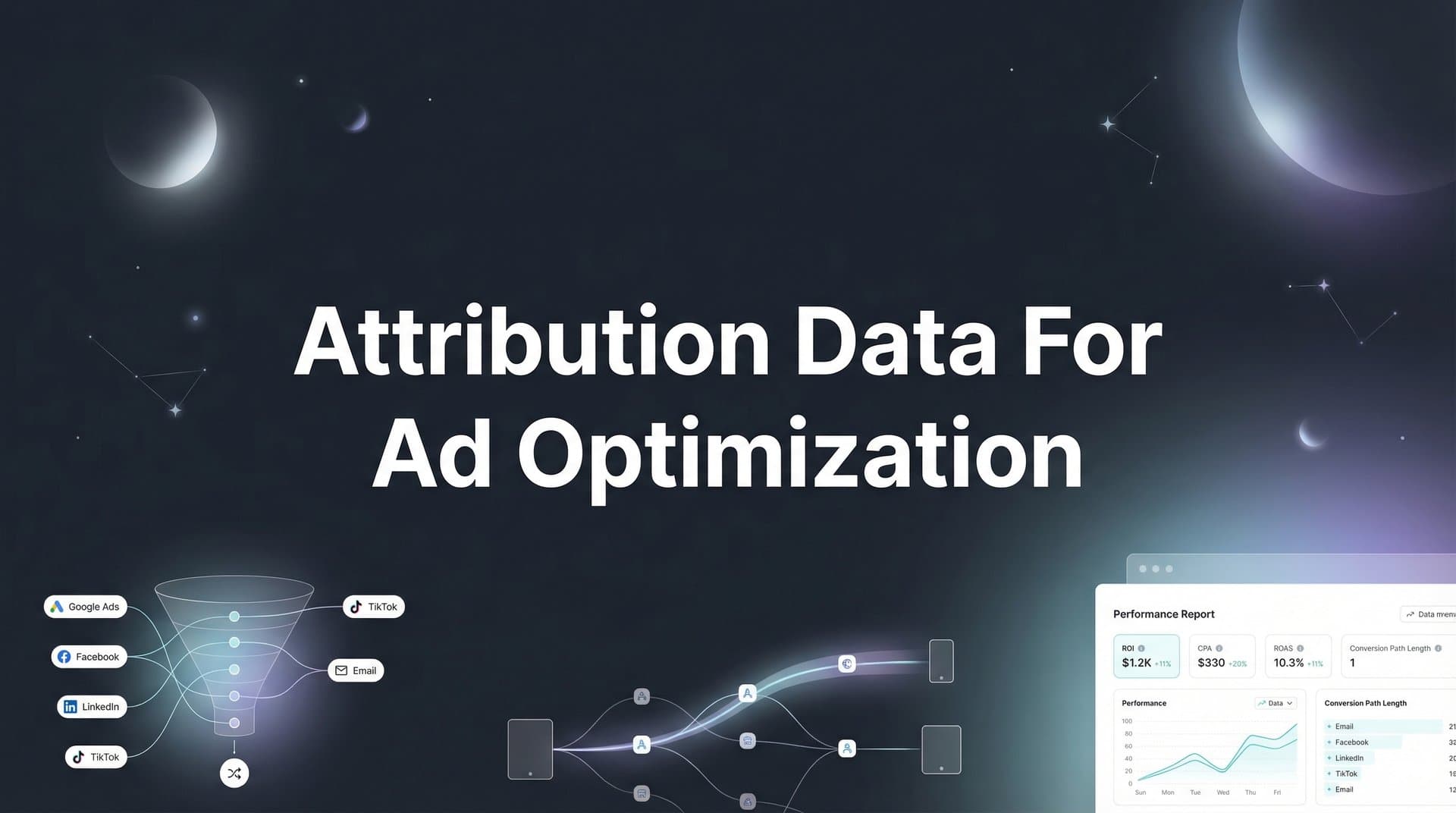
Attribution data bridges this gap by revealing which touchpoints genuinely contribute to conversions, not just which ones claim credit. When you understand the true customer journey—from that first TikTok ad impression through the Google search, email click, and final purchase—you can shift budget toward what works, eliminate waste, and feed better signals back to ad platform algorithms.
This guide walks you through the practical process of collecting, analyzing, and applying attribution data to optimize your advertising campaigns across platforms. You'll learn how to connect your data sources, choose the right attribution model, identify genuinely high-performing ads, and create a feedback loop that makes both your decisions and your ad platforms smarter over time.
Step 1: Connect Your Data Sources for Complete Journey Visibility
Before you can optimize based on attribution data, you need to actually capture that data. This means connecting every system that touches your customer journey into a unified view.
Start by identifying all your touchpoints. This includes obvious sources like Meta Ads, Google Ads, and TikTok, but don't stop there. Your website analytics, CRM system, email platform, and any other tools that track customer interactions all contribute pieces of the puzzle. Each platform sees part of the story, but none of them see it all.
Here's where most marketers hit their first roadblock: client-side tracking pixels that worked reliably for years now miss significant portions of your traffic. iOS App Tracking Transparency restrictions and browser privacy features have created blind spots that can affect 30-50% of your mobile traffic. You're making budget decisions based on incomplete information without even realizing it, which is why understanding losing attribution data privacy updates has become essential for modern marketers.
This is where server-side tracking becomes essential. Instead of relying solely on browser-based pixels that users can block, server-side tracking captures conversion data directly from your server and sends it to your attribution platform. This approach bypasses many privacy restrictions because it doesn't depend on third-party cookies or device identifiers.
Setting up comprehensive tracking typically involves installing tracking scripts on your website, connecting your ad platform accounts through API integrations, and linking your CRM so you can see which leads actually close into customers. The technical implementation varies by platform, but the principle remains the same: create a data pipeline that captures every meaningful interaction.
Once you've connected your sources, verification becomes critical. Run test conversions and trace them through your system. Can you see the complete path? If someone clicks a Facebook ad, lands on your site, signs up for your email list, then purchases three days later after clicking an email, does your attribution data platform capture all those steps?
Look for gaps in your data. Common issues include missing UTM parameters, conversion events that fire inconsistently, or CRM integrations that only sync certain deal stages. Each gap represents potential misattribution that could lead to poor optimization decisions.
Your success indicator here is simple but powerful: you should be able to pull up a single customer and see their entire journey from first touchpoint to conversion. If you can trace one customer's path completely, you can analyze patterns across thousands of customers and make confident optimization decisions.
Step 2: Choose the Right Attribution Model for Your Business Goals
Now that data is flowing, you need to decide how to assign credit for conversions. Different attribution models tell different stories about the same customer journeys, and choosing the wrong model can lead you to optimize for the wrong things.
Let's break down the main models you'll encounter. First-touch attribution gives all credit to the initial touchpoint that brought someone into your ecosystem. This model highlights your awareness-building efforts and answers the question: "What's getting people in the door?" It's particularly useful if you're focused on top-of-funnel growth and want to understand which channels introduce you to new audiences.
Last-touch attribution does the opposite, crediting the final interaction before conversion. This model emphasizes your closing channels and shows what's pushing people over the finish line. Many marketers default to this because it feels intuitive, but it completely ignores the nurturing that happened along the way.
Linear attribution splits credit equally across all touchpoints. If someone interacted with five ads before converting, each gets 20% of the credit. This approach acknowledges that multiple touchpoints matter, though it assumes they all matter equally—which rarely reflects reality.
Data-driven or algorithmic models use machine learning to assign credit based on actual conversion patterns in your data. These models analyze which touchpoint combinations correlate with conversions and weight them accordingly. They're sophisticated but require substantial conversion volume to produce reliable results. For a deeper dive into these approaches, explore multi touch attribution models for data analysis.
So which model should you use? The answer depends on your sales cycle and business model. If you're running a quick-conversion e-commerce business where most customers purchase within hours of first seeing your ad, last-click might accurately reflect your reality. The customer journey is short and direct.
But if you're in B2B with a 60-day sales cycle involving multiple decision-makers, last-click will systematically undervalue your awareness and consideration campaigns. That LinkedIn ad that introduced your solution three weeks ago deserves credit even if the final conversion came from a Google search for your brand name.
Here's a practical approach: compare multiple models side by side. Run the same conversion data through first-touch, last-touch, and a multi-touch model. The discrepancies reveal insights. If a channel looks amazing in last-touch but terrible in first-touch, it's likely capturing demand you created elsewhere rather than generating new demand.
Your success indicator is being able to explain why your chosen model makes sense for your specific business. If you can articulate how customers actually move through your funnel and why your attribution model reflects that reality, you're ready to move forward with confidence.
Step 3: Identify High-Performing Ads and Channels Beyond Platform Metrics
With attribution data flowing and a model selected, you can finally see which campaigns actually drive revenue. This is where most marketers discover uncomfortable truths about their 'best performers.'
Start by looking past the vanity metrics that ad platforms push to the forefront. Clicks, impressions, and even conversion counts don't tell you what you really need to know: which campaigns generate profitable customers? A campaign with 1,000 clicks and 50 conversions might look worse than one with 2,000 clicks and 100 conversions—until you realize the first campaign's customers have twice the lifetime value.
Focus instead on revenue-connected metrics. Calculate true cost per acquisition by dividing your ad spend by attributed conversions, not platform-reported conversions. This distinction matters enormously. Platforms often claim credit for conversions they influenced minimally, inflating their apparent performance. Understanding marketing attribution platforms revenue tracking capabilities helps you cut through this noise.
Next, calculate actual ROAS at the campaign, ad set, and creative level. Take the attributed revenue from customers acquired through each campaign and divide by the spend. This gives you the real return on ad spend, not the optimistic version platforms report to make their algorithms look good.
Pay special attention to discrepancies between platform metrics and attribution data. If Meta reports a 4x ROAS but your attribution shows 2.5x, that gap represents either misattributed conversions or customers who would have converted anyway. Learning solving attribution data discrepancies becomes critical for accurate optimization decisions.
Look for campaigns that show strong assisted conversion rates even if they don't get last-click credit. These are your unsung heroes—the campaigns introducing customers to your brand and moving them through consideration stages. They might look mediocre in platform dashboards but prove essential when you see the full journey.
Customer lifetime value adds another crucial dimension. Some campaigns attract bargain hunters who make one small purchase and disappear. Others bring customers who stick around and generate revenue for months or years. Two campaigns with identical immediate ROAS can have wildly different long-term value.
Create a ranked list of your campaigns by attributed revenue contribution. Sort by total revenue generated, not conversion count or platform-reported ROAS. This ranking becomes your optimization roadmap—it shows you exactly where your money is actually working.
Your success indicator: you have a clear, data-backed understanding of which campaigns drive real revenue, regardless of what individual platforms claim. You can confidently say "Campaign X generated $50,000 in attributed revenue at a 3.2x ROAS" based on complete journey data, not platform estimates.
Step 4: Reallocate Budget Based on Attribution Insights
Understanding performance is valuable, but optimization requires action. Now you'll shift budget from campaigns that look good on paper to ones that actually drive revenue.
Start by identifying campaigns with the biggest discrepancies between platform-reported performance and attributed performance. If a campaign shows 5x ROAS in Meta but only 2x in your attribution data, that's a prime candidate for budget reduction. The platform is claiming credit for conversions driven by other channels, and scaling based on inflated metrics will waste money.
Conversely, look for campaigns that show strong attributed performance even if platform metrics seem modest. These campaigns might not get much last-click credit but play crucial roles in the customer journey. A LinkedIn campaign with a 1.5x platform ROAS might actually contribute to a 4x ROAS when you account for its role in assisted conversions.
Make budget shifts gradually rather than all at once. Start by moving 15-20% of budget from underperformers to proven winners. Monitor the results for at least a week to ensure the pattern holds. Dramatic overnight budget shifts can disrupt ad platform algorithms and create temporary performance dips that have nothing to do with the underlying quality of your campaigns.
As you scale winning campaigns, watch for diminishing returns. A campaign that performs brilliantly at $500 per day might struggle at $2,000 per day because you've exhausted the best audiences. Incremental scaling with close monitoring helps you find the optimal spend level for each campaign. Implementing automated budget optimization for paid media can help manage this process more efficiently.
Don't forget to consider the full funnel when reallocating budget. If you cut too much from top-of-funnel awareness campaigns to fund bottom-funnel conversion campaigns, you might see immediate ROAS improvements followed by a gradual decline as your pipeline dries up. Attribution data should inform a balanced investment across the customer journey.
Document every significant budget change you make. Note the date, the change amount, and the reasoning based on your attribution data. This creates an optimization history that helps you understand what worked, what didn't, and why. Over time, you'll build institutional knowledge that makes each subsequent optimization decision smarter.
Your success indicator: your budget allocation reflects actual revenue contribution from attribution data rather than platform-reported performance. When you look at where money is going, it aligns with where revenue is actually coming from.
Step 5: Feed Enriched Conversion Data Back to Ad Platforms
Here's where attribution optimization creates a powerful feedback loop. The conversion data you've been analyzing doesn't just inform your decisions—it can also improve how ad platform algorithms target and bid.
Ad platforms like Meta and Google use conversion data to train their machine learning algorithms. When someone converts after clicking your ad, the platform analyzes that person's characteristics and behavior to find similar users. But here's the problem: platforms only optimize based on conversions they know about.
Remember those tracking gaps from Step 1? Every conversion that client-side pixels miss represents a signal that ad platforms never receive. They're optimizing with incomplete information, which means they're finding audiences and placing bids based on a partial picture of what actually works. This is one of the most common ad performance optimization blind spots that marketers face.
Server-side event syncing solves this by sending conversion data directly from your attribution platform to ad platforms. This ensures they receive signals about conversions that browser-based tracking missed. The more complete the data they receive, the better they can optimize.
But don't just send conversion events—send conversion value data too. Instead of telling Meta "this person converted," tell them "this person converted and generated $500 in revenue." This allows platforms to optimize for revenue rather than just conversion count, which fundamentally changes how they bid and target.
Think about the difference: without value data, platforms treat a $50 customer and a $500 customer identically. They'll spend the same amount to acquire either one. With value data, they can bid more aggressively for high-value customers and pull back on low-value segments. This value-based optimization can dramatically improve overall ROAS.
Setting up conversion syncing typically involves configuring your attribution platform to send events to Meta's Conversions API, Google's Enhanced Conversions, or similar server-side endpoints on other platforms. The technical setup varies by platform, but the principle remains consistent: create a direct pipeline for enriched conversion data.
Include as much detail as platforms allow. Send not just the conversion event but also the order value, product categories, customer type (new vs. returning), and any other relevant data points. Richer signals enable more sophisticated optimization.
Monitor the impact over time. As platforms receive more complete conversion data, you should see improvements in targeting efficiency and bid optimization. Campaigns might start finding better audiences or adjusting bids more appropriately for different user segments.
Your success indicator: ad platforms receive complete, revenue-enriched conversion data for every customer, not just the ones client-side pixels catch. You can verify this by comparing conversion counts in your attribution platform against what platforms report receiving through server-side events.
Step 6: Establish an Ongoing Optimization Cadence
Attribution-informed optimization isn't a one-time project—it's an ongoing process that compounds value over time. The final step is building a sustainable rhythm for reviewing data and adjusting campaigns.
Set a weekly review schedule where you analyze attribution data against ad spend and performance. Weekly reviews provide enough data to spot meaningful trends without waiting so long that opportunities slip away. During these reviews, look at campaign-level performance, check for new discrepancies between platform and attribution data, and identify optimization opportunities.
Create a simple review template that keeps you focused on actionable insights. Check which campaigns moved up or down in attributed revenue contribution. Look for budget allocation mismatches where high-performing campaigns are underfunded or poor performers are getting too much spend. Identify any technical issues like tracking gaps or integration failures that need attention.
Document every change you make and the reasoning behind it. This optimization log becomes invaluable over time. When you wonder "why did we reduce budget on that campaign three months ago?" you'll have the answer. When a new team member joins, they can read through your optimization history and understand your strategic thinking. Following best practices for using data in marketing decisions ensures your documentation remains actionable.
Track outcomes from your changes. When you shift budget from Campaign A to Campaign B, note the results over the following weeks. Did attributed revenue increase as expected? Did ROAS improve? Building this cause-and-effect understanding helps you get better at optimization over time.
Stay alert for shifts in customer behavior or platform changes that affect attribution accuracy. When iOS releases a major privacy update or a browser changes cookie policies, your tracking might be impacted. When consumer behavior shifts seasonally or in response to market conditions, attribution patterns can change. Regular monitoring helps you spot these shifts quickly.
Build in time for deeper monthly reviews where you zoom out and look at longer-term trends. Weekly reviews focus on tactical adjustments, but monthly reviews let you assess strategic questions: Are our attribution models still appropriate? Should we adjust our budget balance between awareness and conversion campaigns? Are there new channels worth testing?
Share insights with your broader team. Attribution data often reveals insights that matter beyond just ad optimization—they inform product development, pricing strategy, and customer experience decisions. When you notice that customers who interact with certain content convert at higher rates, that's valuable for your content team. When you see that certain customer segments have much higher lifetime value, that matters for your pricing and retention strategies.
Your success indicator: attribution-informed optimization becomes a repeatable, documented process that continuously improves campaign performance. You're not starting from scratch each time—you're building on accumulated knowledge and proven optimization patterns.
Putting It All Together: Your Attribution Optimization Checklist
Attribution data transforms ad optimization from guesswork into a systematic process. When you can see the complete customer journey across all touchpoints, you make better decisions about where to invest, which campaigns to scale, and how to improve ad platform performance.
The six steps we've covered create a complete optimization system. You connect data sources to capture the full journey. You choose attribution models that reflect your business reality. You identify truly high-performing campaigns beyond platform metrics. You reallocate budget based on actual revenue contribution. You feed enriched data back to platforms to improve their algorithms. And you establish an ongoing rhythm that makes optimization sustainable.
Each step builds on the previous ones. Better data enables better analysis. Better analysis leads to better decisions. Better decisions improve results. And those improved results feed back into the system, making future optimizations even more effective.
The marketers who win in today's complex advertising landscape aren't necessarily the ones with the biggest budgets—they're the ones with the clearest visibility into what actually works. Attribution data provides that visibility, but only if you act on it consistently.
Start with the fundamentals: get your tracking right, choose an appropriate attribution model, and begin analyzing performance through the lens of complete customer journeys rather than isolated platform metrics. Even basic attribution insights will reveal optimization opportunities you're currently missing. Exploring top attribution platforms for marketers can help you find the right tools for your needs.
As you build momentum, the compound effects become powerful. Your budget allocation gets more efficient. Your ad platforms receive better signals and optimize more effectively. Your team develops deeper understanding of what drives conversions. The gap between ad spend and revenue narrows as you eliminate waste and double down on what works.
Remember that attribution isn't about finding one perfect answer—it's about continuous improvement based on increasingly complete data. Your optimization process will evolve as you learn more about your customers, test new approaches, and refine your systems.
Ready to elevate your marketing game with precision and confidence? Discover how Cometly's AI-driven recommendations can transform your ad strategy—Get your free demo today and start capturing every touchpoint to maximize your conversions.



