Your Facebook campaigns were crushing it six months ago. Clear attribution, strong ROAS, confident budget decisions. Then overnight, everything changed. Conversion numbers dropped by 30%, your analytics dashboard stopped matching what Meta reported, and suddenly you're second-guessing campaigns that were proven winners.
This isn't a glitch. It's not bad creative or audience fatigue. You're experiencing the ripple effects of privacy updates that fundamentally changed how digital advertising measurement works. And if you're still relying on the same tracking methods you used two years ago, you're flying blind.
The good news? This problem has solutions. Better ones than just accepting incomplete data or making decisions based on guesswork. Let's break down exactly what's happening to your attribution data, why traditional tracking methods are failing, and how modern marketers are restoring visibility without fighting against privacy trends.
The Privacy Landscape That Changed Everything
When Apple rolled out iOS 14.5 in April 2021, they included a feature called App Tracking Transparency. Sounds innocent enough—until you realize what it actually does. Every time an app wants to track user activity across other apps or websites, iOS now forces them to ask permission with a popup that essentially says "Let this app track you everywhere you go online?"
Most users tap "Ask App Not to Track." Studies show that opt-in rates hover around 25% globally, meaning roughly 75% of iOS users have effectively disappeared from traditional tracking methods. For platforms like Meta, TikTok, and Snapchat that rely heavily on cross-app tracking to measure conversions and optimize delivery, this was devastating.
But Apple wasn't alone in reshaping the privacy landscape. Safari's Intelligent Tracking Prevention has been quietly disrupting attribution since 2017, and it keeps getting more aggressive. ITP blocks third-party cookies by default and caps first-party cookies at just seven days of storage. If someone clicks your ad on Monday and converts the following Tuesday, Safari's restrictions can break that connection entirely.
Firefox implemented Enhanced Tracking Protection that blocks tracking scripts by default. Even Google Chrome, which generates revenue from advertising, announced plans to phase out third-party cookies. They've delayed the timeline multiple times, but the direction is clear—browser-level tracking is dying.
Layer on top of this the regulatory environment: GDPR in Europe and CCPA in California require explicit consent for data collection. Cookie consent banners have become ubiquitous, and many users either decline tracking or simply close the banner without engaging, which legally means no consent. Each "decline" click is another hole in your attribution data. Understanding privacy-safe attribution methods has become essential for modern marketers navigating these restrictions.
The result? A perfect storm of technical restrictions and user choices that make traditional tracking methods increasingly unreliable. The tracking pixels and cookies that powered digital advertising for the past decade are systematically being blocked, limited, or regulated out of existence.
How Traditional Attribution Breaks Under Privacy Restrictions
Let's talk about what actually happens when someone clicks your ad. Traditionally, a small piece of JavaScript—a tracking pixel—loads in their browser. This pixel drops a cookie, records the visit, and watches for conversion events. Simple, effective, and now increasingly broken.
Here's why: Safari's ITP doesn't just block third-party cookies. It actively identifies and restricts tracking scripts, even first-party ones. That Meta Pixel or Google tag you've relied on? Safari treats it as a potential privacy risk and limits its functionality. The pixel might load, but its ability to track users across sessions or share data with ad platforms gets severely restricted.
Cross-domain tracking becomes nearly impossible. If your ad sends traffic to a landing page on one domain, which then redirects to a checkout page on another domain, you've likely lost the connection between the initial click and the final conversion. Each domain hop is another opportunity for cookies to fail, for browser restrictions to kick in, or for attribution data to simply vanish.
This creates what marketers call the "attribution gap"—the difference between conversions that actually happened and conversions your tools can measure. Your CRM shows 100 new customers this month, but your ad platforms report only 65 conversions. Learning how to fix attribution discrepancies in data becomes critical when facing these measurement gaps.
The consequences extend beyond reporting confusion. Ad platform algorithms rely on conversion data to optimize delivery. When Meta's algorithm receives incomplete conversion signals, it makes poor decisions about who to show your ads to. It's like asking someone to navigate while wearing a blindfold—they might eventually reach the destination, but the journey will be inefficient and expensive.
Google Ads faces similar challenges. Without complete conversion data, Smart Bidding strategies struggle to identify patterns. Your campaigns end up showing ads to people who aren't likely to convert while missing high-intent audiences entirely. You're spending the same budget but getting worse results, not because your offer weakened, but because the optimization algorithms are working with corrupted data.
This isn't theoretical. Many marketers have watched their cost per acquisition climb 40-60% while conversion volume dropped, even though actual business results remained stable. The campaigns are working—the measurement system is broken. And when you can't measure accurately, you can't optimize effectively, leading to a vicious cycle of declining performance and eroding confidence in paid advertising. Conducting thorough attribution data analysis helps identify exactly where your tracking breaks down.
Server-Side Tracking: The Foundation of Privacy-Resilient Attribution
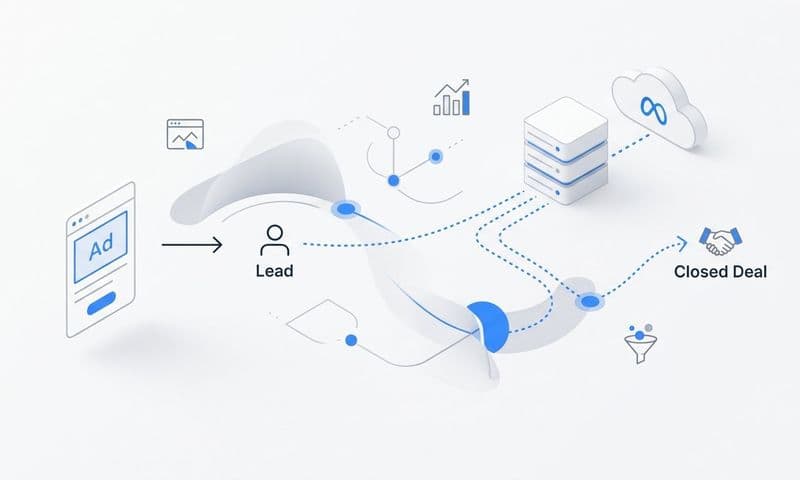
Here's where the solution starts to take shape. Instead of relying on browser-based tracking that can be blocked, limited, or deleted, server-side tracking sends conversion data directly from your server to ad platforms and analytics tools. The user's browser never enters the equation.
Think of it like this: traditional client-side tracking is like asking someone to carry a message through a crowded room where people keep intercepting and reading it. Server-side tracking is like sending that message through a secure, direct channel that bypasses the crowd entirely. No browser restrictions, no cookie limitations, no privacy extensions blocking your scripts.
When a conversion happens on your site, your server captures that event and sends it directly to Meta's Conversions API, Google's Measurement Protocol, or whatever platforms you're using. This happens at the infrastructure level, completely independent of what's happening in the user's browser. Safari can block every cookie it wants—your server still reports the conversion.
The technical shift is significant. You're moving from a model where ad platforms control the tracking (their pixel in your user's browser) to one where you control the data pipeline. Your server becomes the source of truth, collecting conversion events, enriching them with additional context from your CRM or database, and then distributing that data to the platforms that need it.
This approach also solves the cross-domain tracking problem. Since your server handles the connection between ad clicks and conversions, it doesn't matter how many domains the user visits or how many times they close and reopen their browser. Your server maintains the complete journey, linking the initial touchpoint to the final conversion regardless of browser restrictions. Implementing proper first-party data tracking setup is the foundation of this server-side approach.
First-party data collection becomes your competitive advantage. While competitors struggle with incomplete browser-based tracking, you're capturing every conversion, every customer journey, every touchpoint. You own the data infrastructure, which means you control the quality and completeness of your attribution data. In a privacy-first world, that ownership is everything.
Feeding Ad Platforms Better Data for Smarter Optimization
Server-side tracking solves the data collection problem, but there's a second critical piece: getting that data back to ad platforms in a format their algorithms can use. This is where Conversion APIs become essential.
Meta's Conversions API, Google's Enhanced Conversions, TikTok's Events API—these tools allow you to send conversion data directly from your server to ad platforms. You're not just tracking conversions for your own reporting; you're feeding complete, accurate signals back to the algorithms that optimize your campaigns.
Here's why this matters: when Meta's algorithm receives only 60% of actual conversions through browser-based tracking, it optimizes toward an incomplete picture of success. It might think certain audiences don't convert when they actually do—their conversions just weren't tracked. By sending complete conversion data through the Conversions API, you're teaching the algorithm what success actually looks like.
Data enrichment takes this even further. Your server doesn't just report that a conversion happened—it can include customer lifetime value, product categories purchased, whether this was a new or returning customer, and any other first-party data you've collected. This enriched data helps ad platforms identify patterns that browser-based tracking could never capture. Leveraging data-driven attribution ensures your optimization decisions are based on complete information rather than fragmented signals.
Consider a SaaS company that tracks both trial signups and paid conversions. Browser-based tracking might capture the signup but miss the payment event that happens later. With server-side tracking and Conversion APIs, you send both events with complete context: which ad drove the signup, which features the user engaged with during trial, and ultimately whether they converted to paid. The ad algorithm learns not just to drive signups, but to drive signups that convert to revenue.
This complete feedback loop reduces customer acquisition costs. When algorithms have accurate data about what works, they make smarter decisions about targeting, creative optimization, and budget allocation. You're not just restoring the measurement capabilities you lost—you're potentially improving them beyond what browser-based tracking ever provided.
The technical implementation requires coordination between your marketing stack, your server infrastructure, and your ad platforms. But the payoff is substantial: campaigns that optimize toward real business outcomes rather than incomplete proxy metrics, lower costs per conversion, and the confidence that comes from knowing your data is accurate. Exploring post-purchase attribution tracking solutions can help capture the full customer journey from click to conversion.
Building a Future-Proof Attribution Strategy
Server-side tracking and Conversion APIs restore signal, but complete attribution requires a more sophisticated approach to modeling customer journeys. This is where multi-touch attribution becomes valuable—especially in a world where tracking individual touchpoints is increasingly difficult.
Traditional last-click attribution gives all credit to the final touchpoint before conversion. But in a privacy-restricted environment where you might miss several touchpoints in the journey, last-click becomes dangerously misleading. Understanding multi-touch attribution models for data helps distribute credit across all known touchpoints, providing a more complete picture even when some interactions go untracked.
Modern attribution combines two approaches: deterministic matching, where you have definitive proof of a connection (like a user logging in across devices), and probabilistic matching, where you use statistical models to infer likely connections based on patterns. When individual tracking is limited, probabilistic models help fill gaps in the customer journey.
For example, if someone clicks your Facebook ad on their iPhone, visits your site on their laptop later that day, and converts on their desktop the next week, traditional tracking might miss the connection. A probabilistic model can identify these as likely the same person based on behavioral patterns, IP address ranges, and timing, then attribute the conversion appropriately across all touchpoints.
Building this capability requires infrastructure that captures data from multiple sources and connects them into unified customer journeys. Your attribution platform needs to ingest data from ad platforms, your website analytics, your CRM, and any offline conversion sources, then stitch them together into coherent journeys that reveal which marketing efforts actually drive results. Implementing an attribution data warehouse provides the centralized infrastructure needed for this comprehensive approach.
Start by auditing your current setup. Map out every conversion event that matters to your business—not just purchases, but qualified leads, trial signups, demo requests, whatever indicates progress toward revenue. Then identify where in your funnel you're losing visibility. Are conversions happening that your ad platforms don't know about? Are there gaps between online interactions and offline outcomes?
Prioritize fixes based on impact. If you're running significant Meta or Google spend, implementing their Conversion APIs should be your first move. If you have a complex funnel with multiple conversion stages, focus on tracking those intermediate steps and connecting them to initial touchpoints. If you sell both online and offline, build systems that capture and attribute offline conversions to their digital origins. Reviewing the best marketing attribution tools can help you select the right platform for your specific needs.
The goal isn't perfect attribution—that's increasingly impossible in a privacy-first world. The goal is accurate enough attribution to make confident decisions. You need to know which channels drive results, which campaigns are profitable, and where to allocate budget. Modern attribution strategies achieve this by combining multiple data sources, using both deterministic and probabilistic matching, and accepting that some uncertainty is unavoidable while minimizing it wherever possible.
Taking Control of Your Attribution Future
Privacy updates aren't slowing down—they're accelerating. Chrome's cookie deprecation will eventually happen. More countries will pass privacy legislation. Browsers will implement stricter tracking protections. Fighting against these trends is futile. The winning strategy is adaptation: building measurement systems that work with privacy restrictions rather than against them.
The shift from reactive tracking to proactive data ownership represents a fundamental change in how digital marketing measurement works. Instead of relying on ad platforms and browsers to handle tracking for you, you're taking control of your data infrastructure. You're capturing conversion events at the source, enriching them with business context, and distributing complete signals to the tools and platforms that need them.
This approach doesn't just restore the capabilities you've lost—it positions you for a future where first-party data becomes the primary competitive advantage in digital advertising. While competitors struggle with incomplete browser-based tracking, you'll have complete visibility into customer journeys, accurate attribution across all touchpoints, and the confidence to make data-driven decisions that actually drive growth.
The technical complexity can feel overwhelming, but the alternative—accepting incomplete data and making decisions based on guesswork—is far worse. Every day you operate without accurate attribution is a day you're potentially misallocating budget, undervaluing successful campaigns, and missing opportunities to optimize toward real business outcomes.
Ready to elevate your marketing game with precision and confidence? Discover how Cometly's AI-driven recommendations can transform your ad strategy—Get your free demo today and start capturing every touchpoint to maximize your conversions.