You're staring at three different dashboards, and they're telling you three different stories. Meta claims 150 conversions this month. Google Ads says 120. Your CRM shows 95 actual sales. Which number do you trust? More importantly, which campaigns do you scale and which do you cut?
This isn't just frustrating—it's expensive. When your attribution data lives in silos across platforms, you're essentially flying blind with a multi-million dollar ad budget. You're making optimization decisions based on incomplete information, scaling campaigns that might not actually be driving revenue, and cutting budgets from channels that could be your hidden winners.
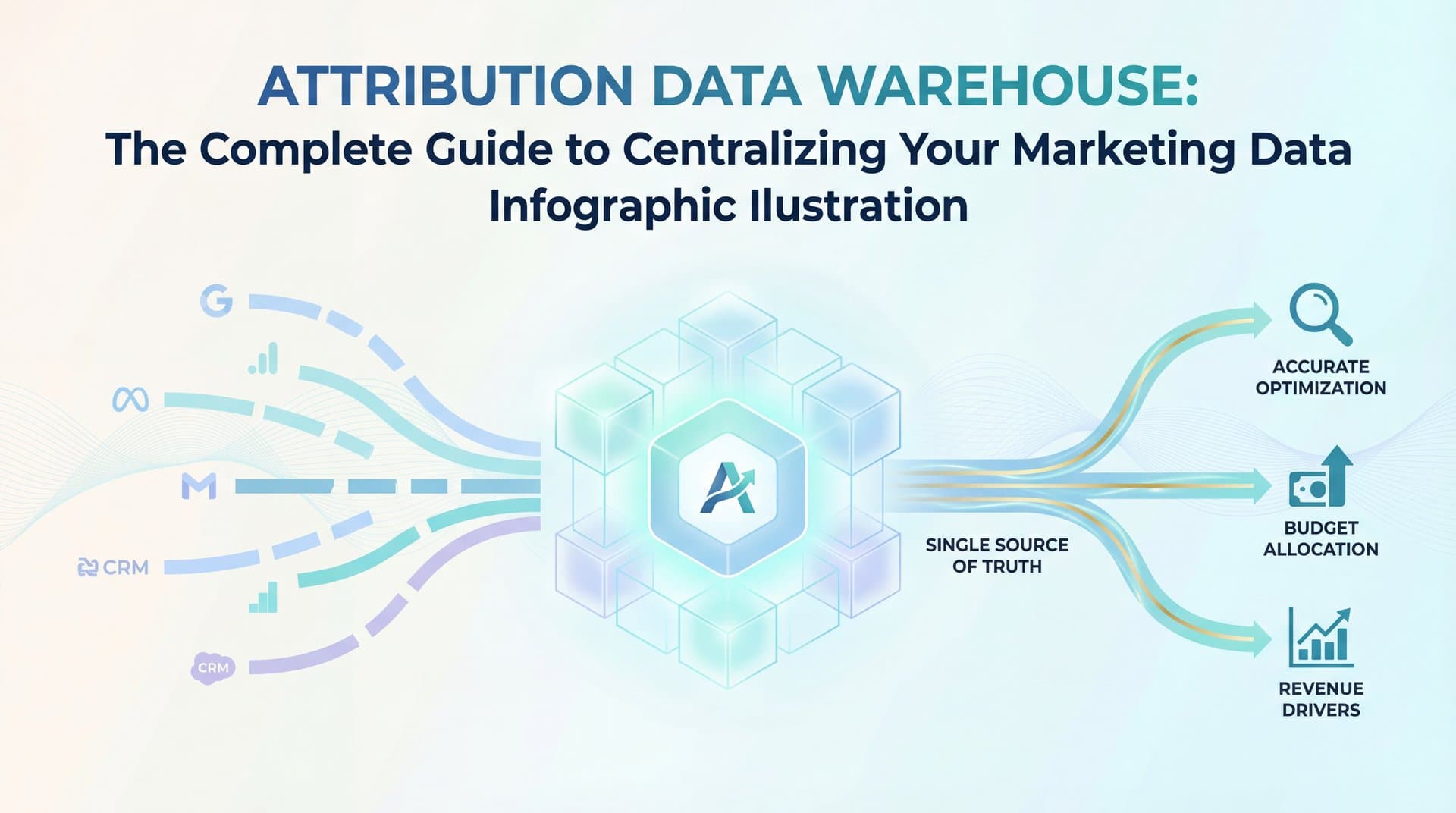
The solution? An attribution data warehouse that brings every touchpoint, every click, every conversion into one unified source of truth. Think of it as the central nervous system for your marketing data—connecting signals from every platform and customer interaction into a complete picture of what's actually working. This guide will show you exactly how to build that foundation, whether you're managing campaigns for a fast-growing SaaS company or running an agency with dozens of clients.
Why Scattered Attribution Data Costs You More Than You Think
Let's talk about what fragmented data is really costing you. The most obvious problem? Duplicated conversions. When someone clicks your Facebook ad, visits through a Google search, and then converts, both platforms claim credit. Suddenly, that one $500 sale shows up as two conversions in your reports. Scale this across hundreds of daily conversions, and you're dramatically overestimating your marketing performance.
But the damage goes deeper than inflated numbers. When each platform operates in its own data silo, you can't see the actual customer journey. That "winning" Facebook campaign might just be retargeting people who already found you through organic search. Meanwhile, the Google campaign you're about to pause could be your primary customer acquisition engine. Without unified data, you're optimizing based on platform-reported attribution that's designed to make each channel look as valuable as possible.
Here's where it gets expensive: poor optimization decisions compound over time. You shift budget toward channels that appear to perform well in isolation but actually just capture demand created by other touchpoints. You cut spending on awareness campaigns because they don't show immediate conversions, not realizing they're feeding your entire funnel. Every decision made on incomplete data pushes you further from optimal performance. Understanding how to fix attribution discrepancies in data becomes essential for accurate reporting.
The problem grows exponentially as you scale. Running campaigns on two platforms with disconnected data is manageable—frustrating, but manageable. Add TikTok, LinkedIn, and programmatic display to the mix, and you're drowning in conflicting reports. Each new channel adds another data silo, another attribution methodology, another source of truth that contradicts the others. Your team spends hours in spreadsheets trying to reconcile numbers instead of optimizing campaigns.
This chaos has real financial consequences. Marketers operating without unified attribution typically overspend by 15-30% on channels that look good in platform dashboards but underperform when you trace conversions to actual revenue. They also miss opportunities to scale genuinely profitable campaigns because the data doesn't clearly show which touchpoints drive outcomes. In a competitive market where efficiency determines who wins, this data fragmentation is a strategic disadvantage you can't afford.
How an Attribution Data Warehouse Actually Works
An attribution data warehouse isn't just a place to dump data—it's a system designed to collect, unify, and transform customer journey information into actionable insights. At its core, it pulls data from every source that touches your customers: ad platforms, website analytics, CRM systems, email tools, and even offline conversion events. All of this flows into a centralized repository where it's standardized and connected using unified customer identifiers.
Here's the key difference from basic data storage: an attribution-ready warehouse doesn't just store raw events. It transforms them into a format that reveals relationships between touchpoints. When someone clicks a Facebook ad at 2 PM, visits your site through organic search at 4 PM, and converts via email the next day, the warehouse links these events to a single customer journey. This requires identity resolution—the process of recognizing that the anonymous cookie from the ad click, the website visitor, and the email subscriber are all the same person.
The architecture typically works in layers. First, data collection captures every interaction: ad impressions, clicks, page views, form submissions, purchases, and CRM updates. Second, identity resolution stitches together these events across devices and sessions using various identifiers—cookies, device IDs, email addresses, phone numbers, and customer IDs. Third, attribution logic applies models (first-touch, last-touch, multi-touch) to assign credit to different touchpoints. Finally, the warehouse makes this processed data available for analysis, reporting, and feeding back to ad platforms. A comprehensive marketing data warehouse solution handles all these layers seamlessly.
Real-time versus batch processing matters more than you might think. Real-time processing means events flow into your warehouse and become available for analysis within seconds or minutes. This enables immediate optimization decisions and powers features like real-time dashboards or instant conversion syncing back to ad platforms. Batch processing, where data updates hourly or daily, works fine for historical analysis and trend reporting but can't support time-sensitive optimization.
The magic happens in data transformation. Raw events like "user_clicked_ad" or "purchase_completed" need to be enriched with context: Which campaign did that click come from? What was the order value? Was this a new or returning customer? The warehouse connects these dots, creating a complete customer profile that includes every touchpoint, the sequence of interactions, and the ultimate outcome. This enriched data is what enables sophisticated attribution modeling and AI-powered optimization.
Modern attribution warehouses also handle data quality at scale. They validate incoming data, flag inconsistencies, deduplicate events, and maintain data hygiene automatically. When your Facebook pixel fires twice on the same page load, the warehouse catches it. When a conversion gets reported to both Google and your CRM, it reconciles them into a single event. This quality control is essential because even small data issues multiply across thousands of daily events, corrupting your insights and leading to poor decisions. Without proper systems in place, you risk losing attribution data that's critical for optimization.
Building Your Attribution Data Foundation: Key Components
The foundation of any attribution data warehouse starts with connecting your essential data sources. At minimum, you need your ad platforms—Meta, Google Ads, TikTok, LinkedIn, and any others where you run campaigns. These provide impression and click data, along with platform-reported conversions. Next comes website tracking, typically through tools like Google Analytics or custom tracking implementations, which captures visitor behavior, page views, and on-site conversions. Your CRM system is equally critical, as it holds the ultimate truth about which leads actually became customers and their lifetime value.
But don't stop there. Email marketing platforms, SMS tools, and offline conversion sources all contribute to the complete picture. That trade show lead who eventually converts online? Without offline data, you'll miss the initial touchpoint. The email campaign that re-engaged a cold lead? If it's not in your warehouse, you can't credit it properly. The more complete your data collection, the more accurate your attribution becomes. Implementing first party data tracking ensures you capture these touchpoints reliably.
Identity resolution is where theory meets reality. When someone clicks your ad on mobile, visits your site on desktop, and converts after receiving an email, you need to connect those dots. This requires multiple identification strategies working together. Cookie-based tracking handles same-device journeys. Email addresses bridge the gap when users log in or submit forms. Device fingerprinting helps recognize returning visitors across sessions. Customer IDs from your CRM tie everything together once someone becomes a known contact.
The challenge? Privacy regulations and browser changes have made identity resolution harder. Third-party cookies are disappearing. Users clear cookies regularly. People switch between devices constantly. A robust attribution warehouse uses probabilistic matching (educated guesses based on behavior patterns) alongside deterministic matching (exact identifier matches) to maintain accuracy even as tracking becomes more difficult. Server-side tracking, which processes data on your servers rather than in browsers, has become essential for reliable identity resolution.
Data quality can't be an afterthought—it's the foundation everything else builds on. Garbage in equals garbage out, and in attribution, small data problems create massive insights errors. Your warehouse needs consistent event naming across sources. A "purchase" event should mean the same thing whether it comes from your website, your CRM, or your ad platform. Timestamps must be accurate and synchronized. Currency conversions need to be handled properly if you operate internationally. Customer identifiers must be formatted consistently.
Establish data validation rules from day one. Define what constitutes a valid conversion event. Set acceptable ranges for order values. Flag duplicate events automatically. Build alerts for data anomalies—if your conversion count suddenly drops by 50%, you need to know immediately, not discover it weeks later when you're analyzing monthly performance. The time you invest in data quality upfront saves countless hours of troubleshooting and prevents costly optimization mistakes based on bad data. Proper attribution data analysis depends entirely on this foundation.
From Raw Data to Revenue Insights: Putting Your Warehouse to Work
Once your attribution data warehouse is collecting and unifying data, the real power emerges: running sophisticated attribution models across your complete customer journey data. Multi-touch attribution shows you every touchpoint that contributed to a conversion, not just the first click or last click. You can see that awareness campaigns on TikTok introduce customers who later search your brand on Google and convert through a retargeting ad. Each touchpoint gets appropriate credit based on its role in the journey.
Different attribution models tell different stories, and comparing them side-by-side reveals crucial insights. First-touch attribution shows which channels are best at introducing new customers. Last-touch highlights which channels close deals. Linear attribution spreads credit equally across all touchpoints. Time-decay gives more credit to recent interactions. Position-based (U-shaped) emphasizes the first and last touches. When you can run all these models on the same unified data and compare results, patterns emerge that single-model analysis misses. Exploring multi touch attribution models for data helps you choose the right approach for your business.
For example, you might discover that your LinkedIn campaigns rarely get last-touch credit but appear early in nearly every high-value customer journey. Traditional last-touch reporting would suggest cutting LinkedIn spend. Multi-touch attribution reveals it's actually a critical awareness driver for your best customers. This insight alone can reshape your entire media strategy and prevent you from killing campaigns that seem inefficient but are actually essential.
The warehouse also enables cohort analysis that connects attribution to actual business outcomes. You can track customers acquired through different channels and compare their lifetime value, retention rates, and purchase frequency. Maybe Facebook drives tons of conversions but those customers churn quickly. Meanwhile, organic search traffic converts at lower volumes but delivers customers who stick around and spend more over time. This revenue-focused view of attribution helps you optimize for profit, not just conversion count. Implementing marketing attribution platforms revenue tracking makes this analysis possible.
Here's where modern attribution warehouses create a competitive advantage: feeding enriched conversion data back to ad platforms. Facebook, Google, and other platforms use machine learning to optimize ad delivery, but they can only optimize based on the conversion data they receive. When you send back richer signals—not just "conversion happened" but "high-value customer with strong intent signals converted"—their algorithms get smarter. This creates a virtuous cycle where better data improves targeting, which drives better results, which generates more data to learn from.
Conversion API implementations and server-side event tracking make this possible. Instead of relying solely on browser-based pixels that miss conversions due to ad blockers or cookie restrictions, you send conversion events directly from your server to ad platforms. These server-side events include enriched data from your warehouse: customer lifetime value, product categories, custom audiences, and attribution insights. Ad platforms use this enhanced data to find more customers like your best converters, improving efficiency across your campaigns.
Build vs. Buy: Choosing Your Attribution Data Strategy
The DIY approach to building an attribution data warehouse appeals to companies with strong engineering resources and unique data requirements. You have complete control over architecture, can customize every aspect of data processing, and avoid recurring software costs. The technical stack typically includes a cloud data warehouse like Snowflake or BigQuery, ETL tools to move data from sources to warehouse, identity resolution logic you build yourself, and custom dashboards for visualization. Learning how to setup datalake for marketing attribution is essential if you choose this path.
But here's the reality: building and maintaining a custom attribution warehouse is a massive ongoing commitment. You need data engineers to design the architecture and write transformation logic. You need analysts to define attribution models and ensure data quality. You need developers to build integrations with each ad platform, CRM, and analytics tool. Then you need to maintain all of this as platforms change their APIs, tracking methods evolve, and privacy regulations shift. The total cost of ownership—including salaries, infrastructure, and opportunity cost—often exceeds $500,000 annually for a robust implementation.
Purpose-built attribution platforms handle this complexity for you. They come with pre-built integrations to major ad platforms, automatic identity resolution, configurable attribution models, and dashboards designed specifically for marketing teams. The technical infrastructure is managed for you, updates happen automatically, and you can start getting insights in days rather than months. For most marketing teams, this is the practical path to unified attribution without building a data engineering department. Reviewing the best marketing attribution tools can help you evaluate your options.
When evaluating options, consider time to value first. How quickly can you start making better decisions based on unified data? A DIY warehouse might take 6-12 months to build and refine. A purpose-built platform can be operational in weeks. That time difference matters when you're spending thousands or millions on ads monthly—every week of fragmented data costs you in optimization opportunities.
Maintenance burden is equally important. Who handles updates when Facebook changes its API? Who fixes the pipeline when data stops flowing? Who adds new attribution models as your needs evolve? With a DIY approach, these responsibilities fall on your team. With a platform, they're handled by specialists who focus full-time on attribution technology. This lets your team focus on strategy and optimization rather than infrastructure maintenance.
Total cost of ownership extends beyond software fees or engineering salaries. Factor in opportunity cost: what could your team accomplish if they weren't building data infrastructure? Consider risk: what happens if your attribution system breaks during a critical campaign period? Think about scalability: as you add new channels and data sources, how much additional work is required? Often, the apparent cost savings of building your own warehouse disappear when you account for these hidden factors. Understanding the difference between Google Analytics vs attribution platform capabilities can inform this decision.
Putting It All Together: Your Path to Unified Attribution
Starting your journey to unified attribution doesn't require a massive upfront commitment. Begin with a clear audit of your current data sources and the questions you need to answer. Which platforms are you running campaigns on? What conversion events matter most? Where does customer data currently live? This inventory helps you prioritize which integrations are essential versus nice-to-have.
Next, establish your data quality standards before you start centralizing data. Define exactly what constitutes a conversion for your business. Create consistent naming conventions for campaigns, ad sets, and tracking parameters. Document how you'll handle edge cases like refunds, duplicate purchases, or test transactions. These standards prevent the most common pitfall: building a unified data warehouse that unifies garbage data from multiple sources into a single source of garbage.
Common mistakes to avoid: Don't try to integrate everything at once. Start with your two or three highest-spend platforms and your CRM, get those working correctly, then expand. Don't underestimate identity resolution complexity—this is where most DIY projects struggle. Don't ignore data latency requirements—if you need real-time optimization, batch processing won't cut it. And don't forget to actually use the insights you generate. The best attribution warehouse in the world creates zero value if optimization decisions don't change based on what it reveals. Embracing data driven attribution means acting on these insights consistently.
The competitive advantage of operating from a single source of truth compounds over time. When you know with confidence which campaigns drive revenue, you optimize faster than competitors guessing based on platform reports. When you can feed enriched conversion data back to ad platforms, their algorithms work better for you than for advertisers using basic tracking. When your team aligns around unified metrics instead of arguing about whose dashboard is right, you move faster and execute more effectively.
Think of unified attribution as the foundation for everything else you want to do with marketing data. Want to implement AI-powered optimization? It needs complete data. Want to accurately calculate customer acquisition costs and lifetime value by channel? You need unified attribution. Want to confidently scale winning campaigns without wasting budget? Start with a single source of truth. Every advanced marketing capability builds on this foundation. Mastering data analytics in marketing becomes possible only with this unified approach.
Your Next Step Toward Data-Driven Marketing Confidence
An attribution data warehouse isn't just a technical upgrade—it's the difference between guessing and knowing what's actually working in your marketing. When every touchpoint connects to revenue in a unified system, you stop arguing about which dashboard is right and start making confident decisions that drive growth. You identify winning campaigns earlier, cut losing spend faster, and optimize with precision that fragmented data simply can't support.
The marketers winning in competitive markets right now aren't necessarily spending more—they're spending smarter because they operate from complete data. They know which channels introduce customers versus which ones close deals. They understand how touchpoints work together across the journey. They feed better signals back to ad platforms, making every dollar work harder. This clarity doesn't come from hoping your data is accurate—it comes from building systems that ensure it is.
You don't need to build data infrastructure from scratch to get there. Modern attribution platforms handle the complexity of collecting, unifying, and analyzing your marketing data so you can focus on what matters: scaling campaigns that drive real revenue. The question isn't whether unified attribution will improve your marketing performance—it's how much opportunity cost you're willing to accept while your data stays fragmented.
Ready to elevate your marketing game with precision and confidence? Discover how Cometly's AI-driven recommendations can transform your ad strategy—Get your free demo today and start capturing every touchpoint to maximize your conversions.