

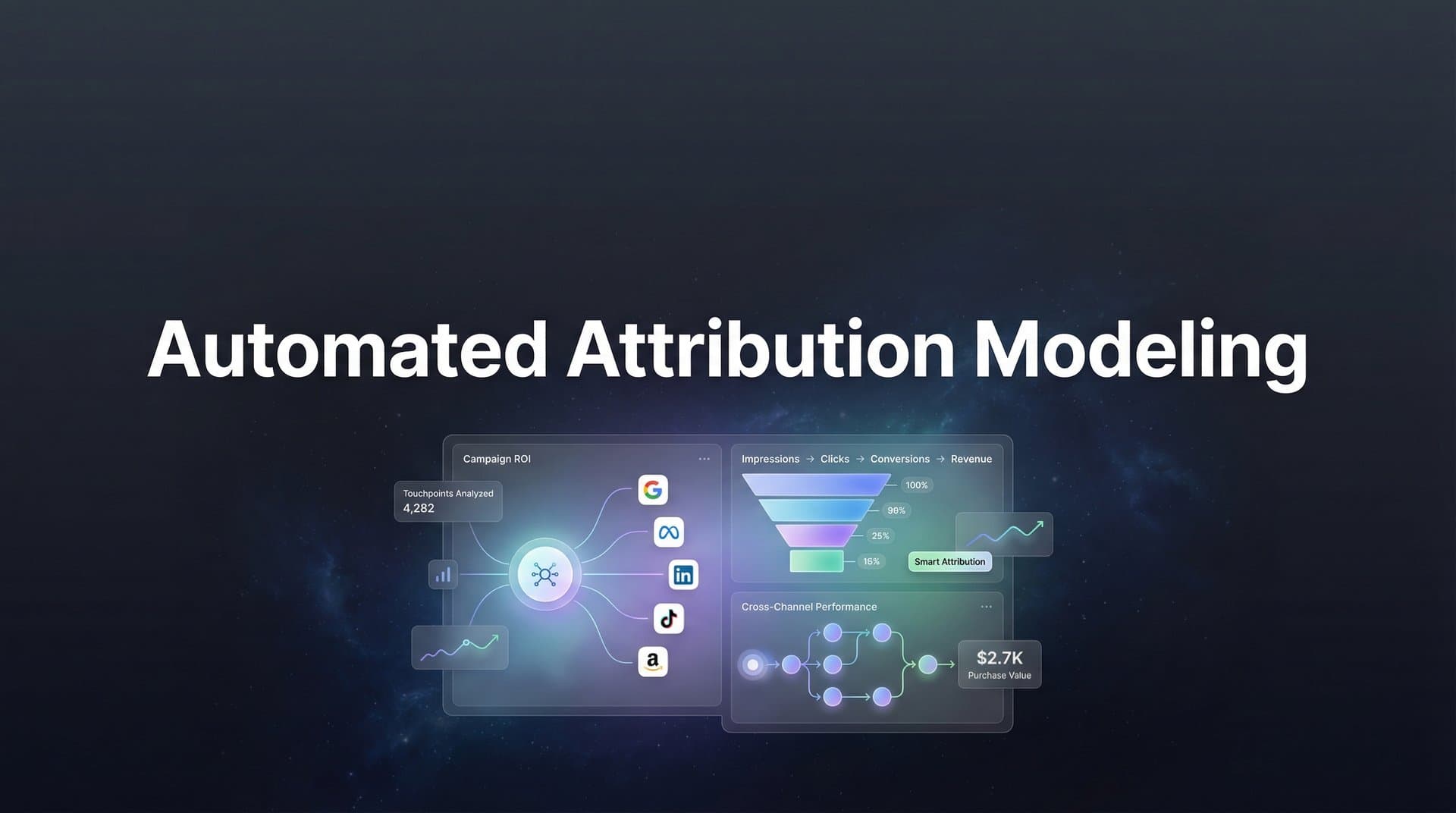
You're running ads on Meta, Google, TikTok, and maybe a handful of other platforms. Traffic is flowing. Conversions are happening. But here's the question that keeps you up at night: which of these channels is actually driving revenue?
Most marketers are flying blind. They see a sale come through and credit it to the last ad someone clicked. But what about the YouTube video that introduced your brand? The Instagram ad that built trust? The Google search that sealed the deal? Traditional attribution methods force you to choose one touchpoint as the "winner" while ignoring the entire journey that led to conversion.
Automated attribution modeling changes everything. Instead of manually piecing together data from disconnected platforms and making educated guesses about what's working, you get real-time intelligence that tracks every interaction and calculates the true impact of each marketing touchpoint. This isn't just better reporting. It's the difference between optimizing based on assumptions and optimizing based on reality.
The Evolution From Spreadsheets to Smart Systems
Remember the old way of doing attribution? You'd export data from Meta Ads Manager on Monday morning. Pull Google Ads reports Tuesday afternoon. Extract CRM data Wednesday. Spend Thursday trying to merge everything in Excel, hunting for duplicate conversions and reconciling mismatched timestamps.
By Friday, you'd finally have a report showing last week's performance. The problem? That campaign you were analyzing already burned through another week of budget. The insights you discovered were historical artifacts, not actionable intelligence.
Traditional attribution required constant manual intervention. Every data pull was a separate task. Every platform used different conversion windows and attribution logic. Marketers became data janitors instead of strategists, spending more time wrangling spreadsheets than optimizing campaigns.
Automated attribution modeling flips this entire paradigm. Modern systems use algorithms and machine learning to continuously analyze touchpoint data across all channels without human intervention. The moment a conversion happens, the system traces backward through every interaction, applies attribution logic, and updates your dashboards in real time.
Think of it like upgrading from manually calculating your taxes with a calculator to using tax software that imports all your financial data automatically. The core math might be similar, but the speed, accuracy, and insight quality are incomparable.
This shift enables a fundamental change in how marketers operate. Instead of looking backward at what happened last week, you're making forward-looking decisions based on what's happening right now. You spot winning campaigns while they're still active. You catch underperforming channels before they waste significant budget. You move from reactive reporting to proactive optimization.
The competitive advantage is obvious. While your competitors are still reconciling last month's data, you're already reallocating budget toward channels that actually drive conversions. That's not just efficiency. That's a strategic edge.
How Automated Attribution Actually Works
Automated attribution modeling operates through three interconnected layers that work together to transform raw interaction data into actionable intelligence. Understanding this architecture helps you evaluate platforms and implement attribution effectively.
The foundation is the data collection layer. This is where every customer interaction gets captured and tagged. Server-side tracking monitors website activity without relying on browser cookies that users can block. Pixel integrations on your landing pages record ad clicks and traffic sources. CRM connections capture offline conversions, phone calls, and sales team interactions.
The key is comprehensive coverage. If your attribution system only sees paid ad clicks but misses organic search, email campaigns, and direct traffic, you're making decisions based on incomplete data. Modern automated systems connect all these sources into a unified customer journey map through multi-channel attribution modeling capabilities.
Once data flows in, the processing engine takes over. This is where algorithms apply attribution models to each conversion automatically. When someone purchases your product, the system identifies every touchpoint in their journey—maybe they saw a Facebook ad three weeks ago, clicked a Google search ad last week, and visited directly today before buying.
The processing engine applies your chosen attribution model to this journey. A last-touch model gives all credit to that direct visit. A linear model splits credit equally among all three interactions. A time-decay model weights the recent touchpoints more heavily. A data-driven model uses machine learning to determine which touchpoints statistically correlate with conversion based on thousands of similar journeys.
This happens continuously, in real time, for every conversion across all your marketing channels. No manual intervention required.
The output layer is where automation becomes strategic advantage. Real-time dashboards surface which channels and campaigns deserve more budget based on actual conversion contribution, not vanity metrics like clicks or impressions. AI recommendations analyze patterns across your attribution data to suggest specific optimizations.
For example, the system might notice that customers who interact with both Instagram ads and email campaigns convert at three times the rate of single-channel visitors. That insight becomes an actionable recommendation: increase budget on Instagram campaigns specifically targeting your email subscriber audience.
The beauty of automation is consistency. The system applies the same attribution logic to every conversion, eliminating the human error and bias that creeps into manual analysis. You're not guessing which touchpoints matter. You're measuring it.
Comparing Attribution Models: Which One Fits Your Goals
Not all attribution models are created equal. The model you choose fundamentally changes how you evaluate channel performance and allocate budget. Understanding the strengths and limitations of each approach is critical for making informed decisions.
Single-touch models are the simplest but most limited. First-click attribution gives all credit to the initial touchpoint—the ad or channel that first introduced someone to your brand. Last-click attribution credits the final interaction before conversion. These models work well for businesses with simple, short sales cycles where customers typically convert on their first or second visit. For a deeper dive into these approaches, explore the difference between single source attribution and multi-touch attribution models.
The problem with single-touch models is they ignore the reality of modern customer journeys. People research. They compare. They see multiple ads before deciding to buy. Giving all credit to one touchpoint systematically undervalues the channels that build awareness and consideration.
If you're only looking at last-click data, you might conclude that Google search ads are your best performer because they capture high-intent searches right before purchase. But you'd miss that your Meta awareness campaigns are creating that search demand in the first place. Cut the awareness budget, and your search conversions drop too.
Multi-touch models distribute credit more fairly across the customer journey. Linear attribution splits credit equally among all touchpoints. If someone saw three ads before converting, each gets 33% credit. This approach acknowledges that multiple channels contribute to conversion, but it assumes all touchpoints are equally valuable—which is rarely true. Learn more about implementing these approaches with multi-touch attribution modeling strategies.
Position-based attribution (also called U-shaped) gives more weight to the first and last touchpoints, typically 40% each, with the remaining 20% split among middle interactions. This model recognizes that introducing someone to your brand and closing the sale are particularly important moments.
Time-decay attribution weights recent touchpoints more heavily than older ones. The logic is that interactions closer to conversion have more influence on the final decision. This model works well for businesses with longer consideration periods where recent remarketing efforts significantly impact conversion probability.
Data-driven models represent the next evolution. Instead of using predetermined rules about how to distribute credit, machine learning algorithms analyze your actual conversion data to identify patterns. The system learns which touchpoint combinations correlate with conversion and assigns credit accordingly. This is where algorithmic attribution modeling truly shines.
For example, a data-driven model might discover that customers who see a YouTube ad followed by an Instagram ad convert at much higher rates than those who see the same ads in reverse order. It would then weight that specific sequence more heavily when calculating attribution.
The advantage is precision. The model adapts to your unique customer behavior rather than forcing your data into a one-size-fits-all framework. The downside is that data-driven models require significant conversion volume to produce reliable insights. If you're only generating a handful of conversions per week, simpler models may be more appropriate.
Choosing the right model depends on your business complexity, conversion volume, and strategic goals. Many marketers run multiple models simultaneously to compare perspectives and validate decisions.
Solving the iOS and Privacy Tracking Challenge
iOS 14.5 changed everything. When Apple introduced App Tracking Transparency in 2021, requiring apps to ask permission before tracking users across other apps and websites, the majority of iPhone users opted out. Suddenly, the pixel-based tracking that powered digital advertising stopped working for a massive portion of your audience.
Browser privacy features compounded the problem. Safari's Intelligent Tracking Prevention, Firefox's Enhanced Tracking Protection, and Chrome's planned third-party cookie phase-out created additional blind spots in attribution data. Traditional attribution models that relied on browser cookies to track customer journeys across websites were left with massive gaps.
The impact was immediate and severe. Advertisers saw reported conversion volumes drop by 20-30% or more, not because actual conversions decreased, but because tracking systems could no longer see them. Attribution windows shortened from the standard seven days to just one day for many iOS users. Multi-touch attribution became nearly impossible when you couldn't track users across multiple sessions.
Server-side tracking emerged as the primary solution. Instead of relying on browser-based pixels that users can block, server-side tracking sends conversion data directly from your server to ad platforms. When someone completes a purchase on your website, your server immediately notifies Meta, Google, and other platforms about the conversion, along with the click ID that links it back to the original ad.
This approach bypasses browser limitations entirely. Even if someone has disabled tracking in their iPhone settings, your server can still report the conversion because it's happening on your infrastructure, not in their browser. The data quality improves dramatically.
Automated attribution systems take this further by reconciling first-party data with ad platform data to maintain accuracy despite privacy restrictions. Your CRM knows when someone converts, regardless of tracking limitations. The attribution platform matches those conversions back to ad clicks using first-party identifiers like email addresses or phone numbers. Understanding cross-device attribution tracking becomes essential in this privacy-first landscape.
For example, someone clicks your Meta ad on their iPhone but doesn't convert immediately. A week later, they return via direct traffic and make a purchase. Traditional pixel tracking would miss the connection to that original Meta ad. Server-side attribution can match the purchaser's email address to the email associated with their Meta profile, correctly attributing the conversion to that initial ad click.
This first-party data matching is critical for maintaining attribution accuracy in the privacy-first era. Automated systems handle this reconciliation continuously, ensuring your attribution data remains reliable even as tracking capabilities evolve.
Turning Attribution Data Into Ad Platform Fuel
Accurate attribution isn't just about understanding what happened. It's about improving what happens next. The most powerful application of automated attribution modeling is feeding enriched conversion data back to ad platforms to improve their optimization algorithms.
Here's how it works. When you send conversion events to Meta, Google, or TikTok, their machine learning algorithms use that data to identify patterns in who converts and optimize ad delivery accordingly. The problem is that standard conversion tracking often sends incomplete or delayed data. You might report that a conversion happened, but not include the conversion value, customer lifetime value prediction, or additional context that makes the conversion meaningful.
Automated attribution systems with conversion sync capabilities send enriched events that include this critical context. Instead of just telling Meta "someone converted," you're sending "a high-value customer who purchased $500 worth of products and matches the profile of your best repeat buyers converted from this specific ad."
This data quality difference is transformative. Ad platform algorithms can now optimize toward your actual business goals, not just surface-level conversion events. They learn to identify and target people who look like your best customers, not just anyone who might convert. Implementing AI-powered attribution modeling amplifies these optimization capabilities.
The impact shows up in your metrics. Lower cost per acquisition because platforms are finding better-qualified prospects. Higher return on ad spend because the traffic quality improves. Better retention rates because you're attracting customers who genuinely fit your product, not just bargain hunters who saw a discount ad.
Automated syncing is critical because it happens continuously without manual intervention. Every time someone converts, the enriched event data flows to your ad platforms within minutes. This real-time feedback loop means ad algorithms are always learning from your most recent conversion patterns, not outdated data from last week.
The competitive advantage compounds over time. As your ad platforms accumulate more accurate conversion data, their algorithms get better at predicting who will convert. Your targeting improves. Your creative testing becomes more efficient because you're measuring against real conversion quality, not just conversion quantity.
Think of it as training the ad platform's AI with better data. The same way feeding better training data to a language model produces better outputs, feeding better conversion data to ad platforms produces better targeting and optimization decisions.
Implementing Automated Attribution: A Practical Roadmap
Understanding automated attribution conceptually is one thing. Actually implementing it effectively requires a structured approach. Here's how to transition from manual attribution to an automated system that drives real business impact.
Step 1: Audit Your Current Tracking Infrastructure
Before you can improve attribution, you need to understand what you're currently measuring and where the gaps exist. Review your pixel implementation across all landing pages. Check whether your CRM is capturing all conversion types, including offline sales and phone calls. Identify which ad platforms are connected and which are reporting in silos. Many marketers discover significant Google Analytics attribution limitations during this audit phase.
Common gaps include missing conversion tracking on thank-you pages, incomplete e-commerce event tracking that captures purchases but not add-to-cart or checkout initiation, and disconnected CRM data that never gets associated with ad clicks. Document everything you find.
Step 2: Choose an Attribution Platform
Look for a solution that connects your ad accounts, website, and CRM in one unified view. The platform should support server-side tracking to maintain accuracy despite privacy restrictions. It should offer multiple attribution models so you can compare perspectives. And it should include conversion sync capabilities to feed data back to ad platforms. Review the best attribution modeling for marketing platforms to find the right fit for your needs.
Evaluate how the platform handles data matching and deduplication. You want a system that can recognize when the same conversion is reported by multiple sources and count it only once. This prevents inflated conversion numbers that make your attribution unreliable.
Step 3: Establish Baseline Metrics
Before switching attribution models or implementing new tracking, document your current performance metrics. Record your cost per acquisition, return on ad spend, and conversion rates for each channel using your existing attribution method. This baseline lets you measure the impact of better attribution on your actual campaign performance.
Many marketers skip this step and can't prove whether their new attribution system improved results or just changed how results are reported. Don't make that mistake.
Step 4: Implement Server-Side Tracking
Work with your development team or attribution platform to set up server-side conversion tracking. This typically involves installing a tracking script on your server that sends conversion events directly to ad platforms using their server-side APIs. Test thoroughly to ensure conversions are being captured and attributed correctly.
Step 5: Configure Attribution Models
Start with a multi-touch model that aligns with your business goals. If you're focused on customer acquisition and early-stage awareness, consider position-based attribution that values first-touch interactions. If you're optimizing for conversion efficiency, time-decay might be more appropriate. Run multiple models in parallel initially to understand how different approaches change your channel evaluation.
Step 6: Enable Conversion Sync
Configure your attribution platform to send enriched conversion events back to your ad platforms. Include conversion value, customer segment data, and any other context that helps ad algorithms optimize more effectively. Monitor how this improved data quality impacts your campaign performance over the following weeks.
Step 7: Train Your Team
Automated attribution changes how you evaluate success. Your team needs to understand what the new metrics mean and how to use attribution data for optimization decisions. Create documentation explaining your chosen attribution model, how to interpret the dashboard, and what actions to take based on attribution insights. Address common attribution challenges in marketing analytics proactively during training.
Moving Forward With Confidence
Automated attribution modeling transforms marketing measurement from a tedious reporting chore into a genuine competitive advantage. When you can see exactly which touchpoints drive revenue, you stop guessing and start optimizing with confidence.
The marketers who win in this environment aren't necessarily the ones with the biggest budgets. They're the ones with the best data. They know which channels deserve more investment because they can trace every conversion back through the complete customer journey. They feed their ad platforms better conversion signals, creating a compounding advantage as algorithms learn to target their ideal customers more effectively.
The key takeaway is simple: accurate attribution enables confident budget decisions. When you trust your data, you can move faster, test more aggressively, and scale what works without the nagging doubt that you're optimizing toward the wrong metrics.
The question isn't whether automated attribution modeling is worth implementing. It's whether you can afford to keep making marketing decisions without it. Every day you operate with incomplete attribution data is another day you're potentially investing in underperforming channels while undervaluing the touchpoints that actually drive conversions.
Ready to elevate your marketing game with precision and confidence? Discover how Cometly's AI-driven recommendations can transform your ad strategy—Get your free demo today and start capturing every touchpoint to maximize your conversions.


