You're running campaigns across Meta, Google, TikTok, and LinkedIn. Your website analytics show thousands of sessions. Your CRM logs hundreds of conversions. But when your CFO asks which channels actually drive revenue, you're stuck piecing together incomplete data and making educated guesses.
The problem isn't effort—it's that customer journeys now span dozens of touchpoints across multiple devices and platforms. Someone might discover your brand through a TikTok ad on their phone, research on desktop via Google search, read comparison articles, return through a retargeting ad, and finally convert after clicking an email. Traditional attribution models weren't built for this complexity.
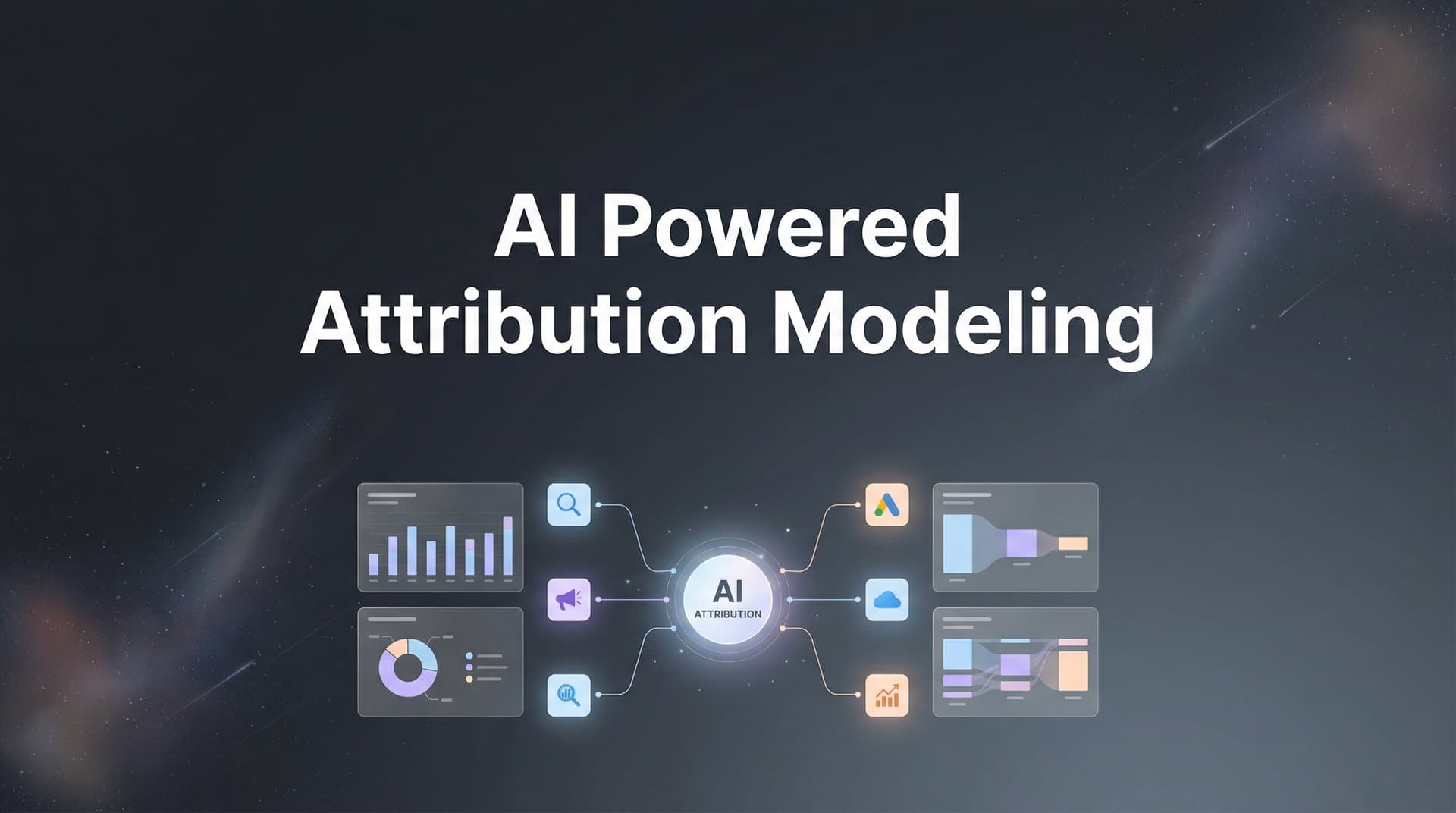
AI-powered attribution modeling represents the evolution marketing teams have been waiting for. Instead of applying predetermined rules that ignore actual behavior, machine learning algorithms analyze complete customer journeys and assign credit dynamically based on genuine impact. This guide breaks down how this technology works, why it matters for modern marketing measurement, and how to evaluate whether it fits your marketing stack.
The Limitations Traditional Attribution Models Can't Escape
First-touch attribution credits only the initial interaction—the first ad click, the original blog post visit, the initial social media engagement. This approach completely ignores every nurturing touchpoint that followed. If someone discovered you through an organic search but converted three weeks later after seeing five retargeting ads and reading your comparison guide, first-touch gives 100% credit to that initial search. Your retargeting budget looks worthless even though it closed the deal.
Last-touch attribution swings to the opposite extreme. It awards all credit to the final interaction before conversion—typically direct traffic, branded search, or email clicks. This makes closing channels look like heroes while systematically undervaluing the awareness campaigns that introduced prospects to your brand in the first place. Your top-of-funnel spend appears ineffective because it rarely gets the last click.
Multi-touch models like linear attribution try to split the difference by distributing credit evenly across all touchpoints. Time-decay models give more weight to recent interactions. Position-based models assign higher value to first and last touches. These approaches feel more sophisticated, but they share a fatal flaw: they use arbitrary formulas completely unrelated to actual influence. Understanding the difference between single source attribution and multi-touch attribution models helps clarify why neither approach alone solves the problem.
Think about it. Linear attribution assumes every touchpoint contributes equally—that seeing a display ad matters exactly as much as attending a product demo. Time-decay assumes recent interactions matter more, regardless of whether that's true for your specific buying cycle. These are rules someone invented, not insights derived from your actual customer behavior.
The real problem emerges when you're managing hundreds of campaigns simultaneously. Manual analysis becomes impossible. You can't evaluate which specific ad creative combinations work best, which audience segments convert most efficiently, or how channel interactions affect conversion probability. Traditional models give you a single number per channel—a gross oversimplification of complex marketing reality.
Static rule-based attribution also fails to account for timing effects. Maybe social media ads work best at the beginning of the journey while search ads close deals. Perhaps email performs differently for enterprise prospects versus SMB customers. Traditional models can't detect these patterns because they're not looking for them. They apply the same logic to every journey regardless of context.
How Machine Learning Redefines Credit Assignment
AI-powered attribution flips the entire approach. Instead of imposing predetermined rules, machine learning algorithms analyze your historical conversion data to identify patterns that actually exist in your customer journeys. The system examines thousands of conversion paths—which touchpoints appeared, in what sequence, with what timing—and determines which combinations genuinely correlate with conversions.
Here's where it gets interesting. These algorithms don't just count touchpoint frequency. They evaluate the removal effect: what happens to conversion probability when a specific touchpoint is removed from the journey? If removing your retargeting ads barely affects conversion rates, they're getting over-credited. If removing your educational content dramatically drops conversions, it's more valuable than simple click data suggests.
Markov chain models approach this by treating customer journeys as sequences of states. Each interaction moves prospects from one state to another—from awareness to consideration to decision. The model calculates transition probabilities between states and determines how much each channel increases the likelihood of reaching the conversion state. This reveals which touchpoints genuinely advance prospects versus those that just happen to appear in successful journeys. For a deeper dive into algorithmic attribution modeling, explore how these mathematical frameworks translate into practical marketing insights.
Shapley value approaches, borrowed from game theory, take a different angle. They calculate each channel's marginal contribution by examining every possible combination of touchpoints. What value does adding your Facebook ads bring when combined with Google search? What about when combined with email and content marketing? The algorithm evaluates all permutations to determine fair credit distribution based on actual contribution.
The power multiplies when you consider timing and frequency. AI models detect that prospects who see three touchpoints within five days convert at higher rates than those who see five touchpoints spread over three weeks. They identify that certain channel sequences work better than others—perhaps social media followed by content followed by search outperforms the reverse order. Traditional models miss these insights entirely.
Machine learning also handles interaction effects that rule-based models ignore. Maybe your display ads alone don't drive many conversions, but when combined with search ads, they significantly boost conversion rates. The AI detects this synergy and adjusts credit accordingly. It recognizes that some channels work as amplifiers—they make other channels more effective even if they don't directly close deals.
The most valuable aspect? Continuous learning. As new data flows in—new campaigns launch, audience behavior shifts, market conditions change—the model adapts automatically. You're not locked into static assumptions made months ago. The attribution logic evolves with your business, maintaining accuracy without constant manual recalibration.
Key Components of an AI Attribution System
Building effective AI attribution starts with comprehensive data collection. You need to capture every meaningful touchpoint across the complete customer journey—from initial ad impressions through website visits, content engagement, email interactions, and CRM events. Partial data produces partial insights. If your system only tracks ad clicks but misses website behavior, the AI works with an incomplete picture.
Server-side tracking has become essential for this data layer. Client-side pixels that rely on browser cookies increasingly miss events due to ad blockers, privacy settings, and tracking restrictions. Server-side tracking captures events directly from your server, creating a more reliable data foundation. This matters especially for iOS users where traditional tracking often fails completely.
The second critical component is identity resolution—connecting fragmented user sessions across devices and platforms into unified customer profiles. Someone might browse on mobile, research on desktop, and convert on tablet. Without identity resolution, these look like three separate people with three separate journeys. The AI can't detect patterns when it thinks one customer is actually three. Implementing cross-device attribution tracking solves this fragmentation problem.
Deterministic matching works when you have concrete identifiers—someone logs into your site on multiple devices, fills out forms with the same email, or uses consistent account credentials. This creates definitive connections. But deterministic matching only works for a fraction of your traffic. Most visitors browse anonymously across devices.
That's where probabilistic matching enters. These algorithms analyze behavioral signals—browsing patterns, timing, device characteristics, IP addresses—to estimate when anonymous sessions likely belong to the same person. If someone browses your pricing page on mobile at 2pm, then visits from a desktop at 2:15pm from the same geographic area with similar browsing behavior, probabilistic matching connects those sessions with high confidence.
Privacy restrictions have made probabilistic modeling even more important. iOS tracking changes and cookie deprecation mean you'll never have complete deterministic data again. AI attribution systems must handle gaps intelligently, using statistical methods to infer likely journeys when direct tracking isn't possible. This doesn't mean guessing—it means applying sophisticated probability models to incomplete data. Teams leveraging data science for marketing attribution gain significant advantages in handling these measurement challenges.
The modeling layer itself requires integration with every data source that matters. Your AI attribution system needs connections to ad platforms like Meta and Google to pull campaign performance data. It needs website analytics to understand on-site behavior. It needs CRM integration to connect marketing touchpoints to actual revenue events. Without these integrations, you're building models on partial information.
Real-time processing capabilities separate powerful systems from basic ones. If attribution insights arrive three days late, they're historical curiosities rather than actionable intelligence. Modern AI attribution processes data continuously, updating credit assignments as new touchpoints occur. This enables you to make budget adjustments and optimization decisions based on current performance, not last week's reality.
Practical Applications That Drive Marketing Decisions
AI attribution transforms budget allocation from guesswork to data-driven strategy. Instead of distributing spend based on which channels claim the most last-click conversions, you can identify which channels genuinely contribute to revenue. The system reveals that your awareness campaigns drive significant value even though they rarely get final credit. It shows which retargeting segments actually influence purchases versus those that target people who would have converted anyway.
Consider campaign optimization through AI-generated recommendations. The system analyzes performance across all your campaigns and identifies specific opportunities: this ad creative performs exceptionally well with this audience segment, that keyword converts at twice the rate of similar terms, this campaign shows declining efficiency and should be paused. You're not manually reviewing hundreds of data points—the AI surfaces what matters.
This gets particularly powerful when examining cross-channel effects. Maybe your LinkedIn ads don't directly drive many conversions, but prospects who see them convert at higher rates when they later click Google search ads. The AI detects this pattern and recommends maintaining LinkedIn spend because it amplifies your search performance. Without machine learning, you'd likely cut LinkedIn as "underperforming" and wonder why your search efficiency dropped. Mastering multi-channel attribution modeling reveals these hidden relationships between platforms.
Audience segmentation becomes dramatically more sophisticated. AI attribution reveals which customer segments respond to which channel combinations. Enterprise prospects might require content marketing followed by demo requests, while SMB customers convert quickly through retargeting ads. The system identifies these patterns automatically, enabling you to build segment-specific strategies rather than treating all prospects identically.
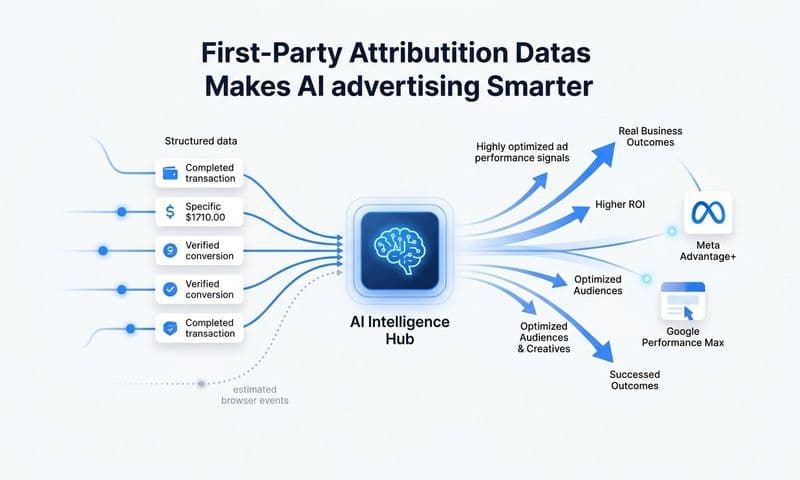
Here's an application many marketers overlook: feeding better data back to ad platform algorithms. Meta and Google use machine learning to optimize targeting and bidding, but they only work with the conversion data you send them. If you're only reporting last-click conversions, you're teaching their algorithms to optimize for the wrong signals.
Conversion sync capabilities solve this. Your AI attribution system identifies which ad interactions genuinely influenced conversions—even if they weren't the last click—and sends those enriched events back to ad platforms. Now Meta's algorithm learns that certain ad impressions contribute to conversions even without immediate clicks. Google's smart bidding receives signals about which audiences convert, not just which ones click last. The ad platforms optimize more effectively because they're working with better training data.
This creates a compounding advantage. Better attribution data improves your internal decisions about budget allocation. That same data improves ad platform algorithms, which increases campaign performance, which generates more conversion data, which further improves attribution accuracy. You're building a flywheel rather than making isolated optimizations.
The practical impact shows up in metrics that matter. Marketing teams using AI attribution typically discover that 30-40% of their budget was flowing to channels that appeared valuable under traditional attribution but actually contributed minimally to revenue. Reallocating that spend to genuinely high-performing channels drives immediate ROI improvements without increasing total budget.
Evaluating Whether AI Attribution Fits Your Marketing Stack
AI attribution isn't equally valuable for every business. The technology requires sufficient data volume to identify meaningful patterns. If you're generating fewer than 50-100 conversions monthly, machine learning models struggle to separate signal from noise. Traditional multi-touch attribution might serve you better until your conversion volume increases.
The complexity of your customer journeys matters too. If 90% of your conversions happen through a single channel with minimal touchpoints—perhaps you're running only branded search campaigns—sophisticated attribution adds little value. You already know where conversions come from. But if you're running campaigns across multiple platforms with prospects taking weeks or months to convert, AI attribution becomes essential for understanding what's actually working.
Integration complexity presents a real consideration. Effective AI attribution requires connecting your ad platforms, website analytics, and CRM systems into a unified data environment. If your tech stack consists of disconnected tools with limited API access, implementation becomes challenging. You'll need technical resources to build integrations, or you'll need to adopt a platform that handles integrations natively. Reviewing enterprise attribution tracking software options helps identify solutions with robust integration capabilities.
Team readiness often determines success more than technology capabilities. AI attribution shifts decision-making from intuition and experience to data-driven insights. Some marketers embrace this transition enthusiastically. Others resist recommendations that contradict their assumptions about what works. If your team isn't prepared to trust algorithmic insights over gut feelings, the technology won't deliver value regardless of how sophisticated it is.
Consider your reporting requirements. If stakeholders demand simple answers—"What's our Facebook ROI?"—AI attribution complicates conversations. Attribution models reveal that most channels contribute to conversions rather than driving them independently. You'll need to educate executives about why traditional channel-level ROI calculations oversimplify reality. This cultural shift requires investment beyond just implementing technology.
Budget allocation flexibility matters. AI attribution identifies optimization opportunities, but you need the ability to act on them. If your budget is locked into annual contracts or political considerations prevent shifting spend between channels, attribution insights become frustrating rather than actionable. The value comes from making changes based on what you learn.
Privacy compliance deserves attention. AI attribution systems that rely heavily on third-party cookies or aggressive tracking face increasing limitations. Evaluate whether platforms use server-side tracking and probabilistic modeling to maintain effectiveness as privacy regulations evolve. You're investing in attribution infrastructure that needs to work not just today but as the tracking landscape continues changing. Many teams discover Google Analytics attribution limitations push them toward dedicated attribution platforms.
The competitive context influences value too. If you're in a crowded market where small efficiency improvements determine profitability, AI attribution provides significant competitive advantage. If you're in a blue ocean with minimal competition, the incremental gains matter less. Consider whether optimizing your marketing efficiency represents a strategic priority or a nice-to-have.
Making the Shift from Guessing to Knowing
AI-powered attribution modeling represents a fundamental shift in how marketing teams understand performance. Instead of applying arbitrary rules to assign credit, you're analyzing actual customer behavior to determine what genuinely drives conversions. Instead of making budget decisions based on incomplete data and intuition, you're acting on insights derived from comprehensive journey analysis.
The competitive advantage compounds over time. Teams using AI attribution continuously improve their understanding of what works. They identify high-performing audience segments, optimize channel combinations, and eliminate wasted spend with precision impossible under traditional measurement. Meanwhile, competitors relying on last-click attribution keep investing in channels that look effective but contribute minimally to revenue.
This technology also future-proofs your measurement approach. As privacy restrictions continue limiting traditional tracking methods, AI attribution systems that use server-side tracking and probabilistic modeling maintain effectiveness. You're building measurement infrastructure that adapts to regulatory changes rather than breaking when cookies disappear completely.
The shift requires more than just implementing new technology. It demands cultural change—moving from opinions about what should work to evidence about what does work. It requires integration work to connect your marketing stack into a unified data environment. It needs team members willing to trust algorithmic recommendations even when they contradict conventional wisdom.
But for marketing teams ready to make this transition, the results justify the effort. You gain visibility into which campaigns truly drive revenue. You receive AI-generated recommendations for scaling winners and cutting losers. You feed better conversion data back to ad platforms, improving their targeting algorithms. You make budget decisions with confidence rather than crossing your fingers and hoping.
Ready to elevate your marketing game with precision and confidence? Discover how Cometly's AI-driven recommendations can transform your ad strategy—Get your free demo today and start capturing every touchpoint to maximize your conversions.