You launch a campaign, watch traffic climb, and then a prospect hops on a demo call and tells you they heard about your product from a colleague in a private Slack channel. Your analytics show the visit as Direct. Your attribution model credits no channel. The conversation that actually drove the deal happened somewhere your tracking tools will never reach.
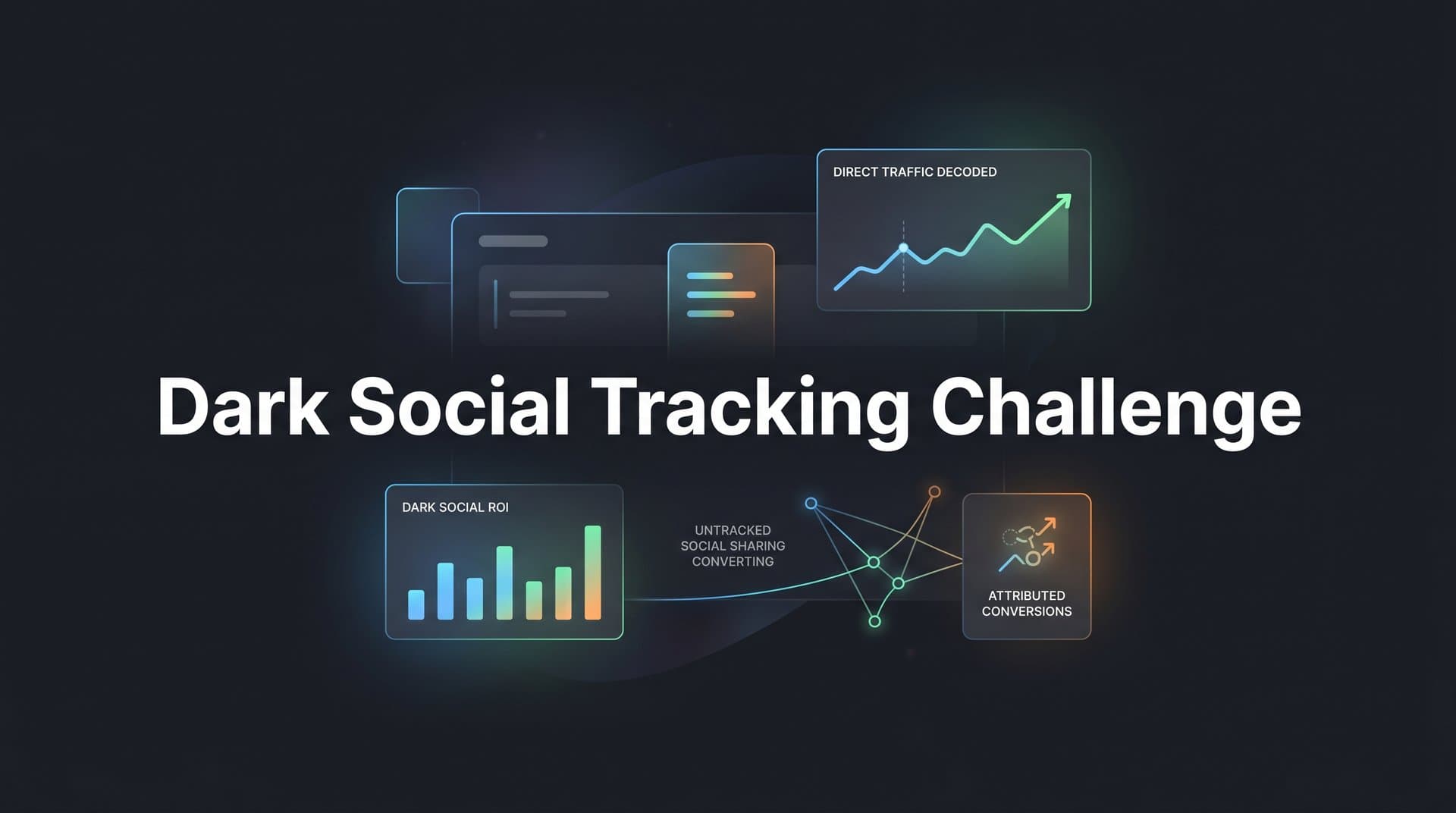
This is the dark social tracking challenge, and it plays out constantly across B2B SaaS companies. A newsletter gets forwarded. A LinkedIn post gets copy-pasted into a team chat. A satisfied customer drops your URL into a WhatsApp thread. Each of those moments influences a buying decision, and none of them leave a trace in your analytics platform.
The problem sits at the intersection of three converging forces: privacy-first browsing behavior, the fundamentally private nature of how professionals share information, and the hard technical limits of pixel-based tracking. Understanding all three is essential before you can start building a more complete picture of what is actually driving your pipeline.
This article breaks down what dark social is, why it structurally defeats standard attribution, and what modern approaches can do to close the gap. You will not walk away with a perfect solution, because one does not exist. But you will have a clear framework for making smarter decisions despite the blind spots.
The Hidden Traffic Your Analytics Will Never Show You
Dark social is not a new concept. The term was coined by journalist Alexis Madrigal in The Atlantic in 2012 to describe web traffic that arrives without any referral data, typically because the link was shared through a private channel. What has changed since then is the scale of the problem and its specific relevance to B2B buying behavior.
When someone shares a URL through a direct message on LinkedIn, a Slack workspace, an email thread, a WhatsApp group, or an SMS, the recipient's browser receives no information about where the link originated. The visit registers on your analytics platform, but it shows up without a referral source. Most platforms bucket this traffic under "Direct," which is the same category used for people who type your URL directly into their browser or use a bookmark.
That conflation is where the real damage happens.
For B2B SaaS companies specifically, this matters more than in almost any other context. B2B buying decisions are rarely made by a single person acting on a single touchpoint. They involve multiple stakeholders, extended evaluation cycles, and heavy reliance on peer input. Professionals routinely ask colleagues for vendor recommendations, share product links in community forums, and circulate content through private group chats before a buying committee ever formally evaluates a solution.
These conversations are where genuine influence lives. A recommendation from a trusted peer in a private Slack community carries far more weight than a retargeting ad, yet the ad shows up in your attribution data and the Slack conversation does not.
It is worth clarifying the distinction between dark social traffic and true direct traffic. Genuine direct traffic comes from people who already know your brand and navigate to your site intentionally. Dark social traffic comes from people who were referred by someone else but whose referral path was invisible to your tracking infrastructure. Both land in the same bucket. Both look identical in your dashboard. But they represent completely different buyer states and completely different signals about your marketing effectiveness.
The practical consequence is that your "Direct" channel is almost certainly a mix of brand-loyal returners, dark social referrals, and visitors from private sharing activity. Treating that bucket as a single cohort means you are making decisions based on a category that does not actually describe a coherent audience or acquisition path.
Why Standard Tracking Breaks Down in Private Channels
To understand why dark social defeats standard analytics, you need to understand how referral tracking actually works. When a user clicks a link on a webpage, the browser sends an HTTP referrer header to the destination server. That header tells the receiving site where the visitor came from. This is the mechanism that powers referral attribution in every standard analytics platform.
The problem is that this mechanism only works when a link is clicked in a context where the browser passes the referrer. When a URL is copied and pasted into a messaging app, email client, or SMS thread, and then clicked from there, the referrer header is either absent or stripped. The destination server receives a visit with no origin signal. The browser is not broken. This is intentional behavior designed to protect user privacy.
Several additional technical factors compound the problem. Modern browsers have become progressively more aggressive about restricting referrer data, even in contexts where it was previously passed. When a user navigates from an HTTPS site to an HTTP site, referrer headers are stripped by default. Mobile apps, including most messaging platforms, handle link navigation through embedded browsers or deep link handlers that do not pass referrer data in the same way a standard browser click would.
Ad blockers add another layer of signal loss. A significant share of B2B buyers, particularly in technical roles, run ad blockers that interfere with client-side tracking pixels. Even when a referral path does exist, the pixel that would capture it may never fire.
The cumulative effect is a structural gap in client-side tracking that no amount of pixel optimization can close. The data is not being lost due to misconfiguration. It is being lost because the architecture of private communication is fundamentally incompatible with the architecture of browser-based referral tracking.
Here is why this matters beyond the technical frustration: B2B buyers who arrive via dark social channels often arrive pre-sold. They have already received a recommendation from a trusted peer. They have already been through an informal vetting process in a private conversation. When they arrive on your site, they are further along in the buying journey than a cold paid traffic visitor, and they tend to convert at higher rates.
Yet because their referral path is invisible, they get attributed to Direct or None. Every other channel in your stack gets diluted credit. Your paid campaigns look more important than they are. Your community-driven and word-of-mouth channels look less important than they are. The distortion is not random noise. It systematically inflates the apparent contribution of measurable channels and deflates the contribution of the channels where real influence is happening.
How Dark Social Distorts Your Attribution Models
Attribution models are only as good as the data they run on. When a significant share of your high-intent traffic arrives without referral data, every model you use is working from an incomplete picture. The distortion shows up differently depending on which model you apply, but none of them are immune.
First-touch attribution assigns full credit to the first measurable touchpoint in a buyer's journey. If a prospect first encountered your brand through a peer recommendation in a private Slack channel, that touchpoint is invisible. The first-touch model instead credits whatever the first trackable interaction was, often a paid ad click or an organic search visit that happened later in the journey. You end up crediting a channel for starting a relationship it did not actually start.
Last-click attribution has the same problem in reverse. A prospect who was referred through dark social, spent weeks doing research, and then clicked a branded search ad before converting will have that entire journey credited to the branded search. The peer recommendation that initiated the process gets no credit. The search ad that captured an already-interested buyer looks like the hero.
Linear and time-decay models distribute credit more evenly across touchpoints, but they still only distribute credit across the touchpoints they can see. Dark social interactions are not in the model at all. The credit that should flow to peer referrals and community shares gets redistributed to the channels that happened to be visible, inflating their apparent contribution.
The downstream business impact of this distortion is significant. Budget allocation decisions get made based on what the models show, not what is actually working. Channels that generate strong dark social activity, such as community building, thought leadership content, and partner programs, consistently underperform on attribution metrics relative to their actual contribution. Paid channels that capture demand generated elsewhere look disproportionately effective.
The natural response is to invest more in what looks like it is working and less in what looks like it is underperforming. This means defunding the community and content programs that are actually driving peer recommendations while increasing paid spend to compensate for the apparent gap. The result is a channel mix that drifts further from what is actually generating pipeline.
This is the compounding nature of attribution blind spots. The longer a team relies on flawed data without acknowledging the gap, the further their investment decisions diverge from reality. Course correction becomes harder over time because the distorted model has been reinforced by months or years of decisions made on its basis. Recognizing the problem is the first step toward building something more accurate.
Practical Strategies to Reduce the Dark Social Gap
No single tactic eliminates the dark social tracking challenge. But combining several complementary approaches can meaningfully reduce the gap and give your team more directional confidence in attribution data.
UTM Parameter Discipline: This is the most accessible starting point. When you consistently tag every link you share, including links in newsletters, community posts, internal Slack messages, and partner communications, you create the opportunity to capture attribution data when users click rather than copy-paste. A link shared in a Slack channel without a UTM tag is a missed opportunity. The same link with a properly structured UTM tag becomes a trackable referral if the recipient clicks it directly. UTM discipline will not capture every dark social interaction, but it raises the floor on how much you can recover. The key is consistency: building UTM tagging into your workflow so that every shared link is tagged by default, not as an afterthought.
Server-Side Tracking and Conversion API Integration: Moving event capture from the browser to the server layer is one of the most durable improvements you can make to your overall data quality. Server-side tracking and Conversion API integrations bypass the client-side limitations that cause signal loss: ad blockers, browser privacy restrictions, and referrer stripping. While server-side tracking does not recover dark social referrer data specifically, it does ensure that the conversions and events you can track are captured accurately. This matters because when your conversion data is more complete and reliable, your attribution models have better inputs to work with. The signal quality of your measurable touchpoints improves, which makes the overall attribution picture more trustworthy even if the dark social gap remains.
Self-Reported Attribution: Sometimes the most effective data collection method is simply asking. Including a "How did you hear about us?" field during signup, trial activation, or demo booking captures qualitative data that no technical solution can replicate. When a prospect writes "a colleague recommended it" or "saw it mentioned in a community forum," you are getting direct evidence of dark social activity. This data is imprecise and subject to recall bias, but it is directionally valuable. Across a large enough sample, patterns emerge. You might discover that a specific community or a particular thought leadership channel is generating far more referrals than your analytics suggest. That insight can directly inform where you invest in brand and community building.
The most effective approach combines all three layers: UTM discipline to capture what can be captured, server-side tracking to ensure conversion data is accurate, and self-reported attribution to fill in the qualitative gaps that technology cannot reach. None of these tactics alone solves the problem, but together they give you a substantially more complete picture than pixel-based tracking alone.
Building an Attribution Stack That Accounts for What You Cannot See
Closing the dark social gap is not just about adding more tracking tools. It requires rethinking what your attribution stack is trying to accomplish. The goal shifts from tracking every touchpoint to building a model that acknowledges unmeasured influence and makes smarter decisions based on the full picture, including the parts you cannot directly observe.
Multi-touch attribution is a meaningful step in this direction. By distributing credit across all known touchpoints in a buyer's journey rather than assigning it to a single interaction, multi-touch models reduce the over-crediting of any single channel. They do not solve the dark social problem, but they create a more balanced view of how multiple channels contribute to a conversion. When combined with first-party data enrichment from your CRM, the model becomes richer: you can see how prospects moved through stages, which touchpoints preceded high-intent behaviors, and where patterns cluster.
Connecting your CRM events, ad platform data, and server-side conversion signals into a single attribution platform is where the real analytical leverage comes from. When all of these data streams are unified, patterns that would be invisible in any single source become visible in the aggregate. A cluster of direct traffic spikes in the days following a community post or a LinkedIn thread is a signal. A surge in demo bookings from visitors with no referral data, concentrated in a specific time window, points to dark social activity even if you cannot identify the exact source.
This is where AI-driven attribution analysis becomes genuinely useful. Machine learning can surface these patterns at a scale and speed that manual analysis cannot match. By identifying anomalies in traffic and conversion data that correlate with known dark social triggers, such as content shares, community activity, or partner mentions, AI attribution tools can give teams directional confidence even when exact source data is unavailable. You may not know precisely which Slack channel drove a wave of signups, but you can identify that something drove it and when it happened.
Platforms like Cometly are built specifically for this kind of integrated analysis. By connecting ad platform data, CRM events, and first-party conversion signals into a single source of truth, Cometly helps B2B SaaS teams identify which channels and campaigns are genuinely contributing to pipeline and revenue, even when individual touchpoints are invisible. The AI-driven recommendations surface high-performing patterns across your entire channel mix, giving you a clearer basis for budget decisions than any single attribution model could provide on its own.
The practical output of this approach is not perfect attribution. It is attribution that is honest about its limits while still being actionable. You know what you can measure, you have a framework for inferring what you cannot, and your decisions reflect both.
Turning Attribution Gaps Into Strategic Advantages
Here is a reframe worth considering: the dark social tracking challenge is not just a measurement problem. It is also a signal about where your brand's real influence is concentrated.
When you see sustained high volumes of unattributed direct traffic, particularly following content releases, community activity, or thought leadership moments, that pattern is telling you something important. People are sharing your content in spaces you cannot see. Peers are recommending your product in conversations that never touch your tracking infrastructure. That is not a gap to mourn. It is evidence that your brand has earned a level of trust and relevance that generates organic peer-to-peer distribution.
B2B SaaS teams that understand this dynamic can use it as a strategic input rather than treating it purely as a data problem. Investing deliberately in community building, thought leadership, and peer referral programs generates exactly the kind of dark social activity that drives high-intent, pre-sold visitors to your site. These visitors convert well, they tend to have shorter sales cycles, and they often become advocates who generate more dark social activity in turn.
The measurement approach shifts accordingly. Instead of trying to track every top-of-funnel touchpoint, you measure the downstream outcomes: pipeline created, revenue closed, customer lifetime value. When you see revenue attribution data showing strong results from cohorts that entered through direct or unattributed channels, you have evidence that your dark social investment is working, even if you cannot see every link in the chain.
This requires a genuine mindset shift for teams that have been trained to optimize for trackable metrics. The instinct is to defund what you cannot measure and double down on what you can. But in B2B SaaS, where peer influence is structurally invisible to standard analytics, that instinct leads you away from the channels that are actually building your pipeline.
The smarter approach is to build an attribution framework that captures what can be measured, acknowledges what cannot, and makes budget decisions based on the full picture. That means combining rigorous technical tracking with qualitative data collection, connecting all available signals in a unified platform, and using revenue attribution to validate the downstream impact of channels that resist click-level measurement.
Moving Forward With Clearer Attribution
The dark social tracking challenge is not a problem you solve once and move on from. It is a permanent feature of the B2B marketing landscape that requires ongoing, deliberate management. Private sharing behavior is not going away. Browser privacy restrictions are becoming more stringent, not less. The gap between what actually influences buyers and what standard analytics can see is likely to widen before it narrows.
The practical response is a layered approach: UTM discipline to capture what can be captured, server-side tracking and Conversion API integration to ensure your measurable conversion data is accurate, self-reported attribution to fill in the qualitative gaps, and a multi-touch attribution platform that connects ad spend to pipeline and revenue rather than relying on click-level data alone.
Cometly brings these signals together in a single attribution layer built specifically for B2B SaaS companies. It connects your ad platform data, CRM events, and first-party conversion signals into one source of truth, so you can see which channels are actually driving revenue even when individual touchpoints are invisible. The AI-driven analysis surfaces patterns across your entire channel mix, giving you the confidence to make smarter budget decisions and invest in the channels that genuinely move pipeline.
Attribution will never be perfect. But it can be honest, complete within its limits, and actionable. That is the standard worth building toward. Get your free demo and see how Cometly can close your attribution gaps and show you which channels are actually driving revenue.