Consumer lifecycle management (CLM) is all about seeing the customer journey for what it really is: a long-term relationship, not a one-time transaction. It’s a roadmap for nurturing that relationship at every single stage, from the moment someone first hears about your brand to the day they start telling their friends about you.
This approach is the key to sustainable growth, especially when the market gets noisy and competitive.
Understanding Consumer Lifecycle Management
Instead of pouring all your energy into just getting new customers, CLM gives you a complete playbook for building real, lasting loyalty. Think of it like this: a traditional sales funnel often stops the second a purchase is made. But with CLM, that first sale is just the beginning of the conversation.
This strategic map helps you understand, anticipate, and guide what your customers do at every critical point. By knowing exactly where they are in their journey, you can send the right message at the right time. This is how you turn a flicker of interest into repeat business and, eventually, passionate brand advocacy. It’s a proactive way of thinking that shifts the focus from short-term wins to long-term, predictable revenue.
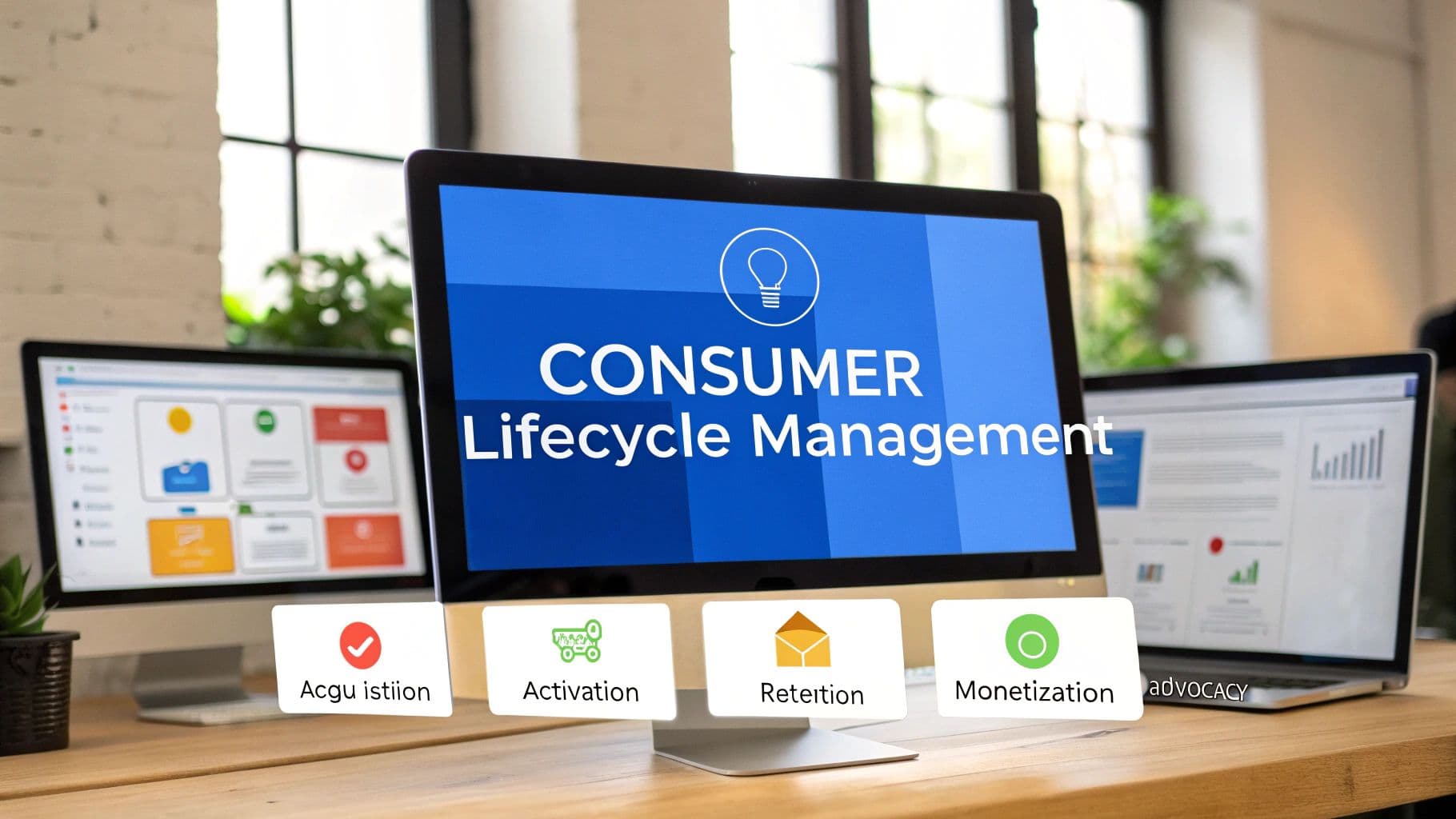
To give you a clearer picture, here’s a quick breakdown of how these stages fit together.
Core Stages of Consumer Lifecycle Management at a Glance
This table breaks down the five core stages, the main goal for each, and a common activity you’d focus on.
Lifecycle Stage | Primary Goal | Example Activity |
|---|---|---|
Acquisition | Attract new, high-intent customers | Running targeted ad campaigns |
Activation | Get new users to their “aha!” moment | Offering a guided product onboarding |
Retention | Keep existing customers engaged and happy | Sending personalized email newsletters |
Monetization | Increase revenue from existing customers | Creating up-sell or cross-sell offers |
Advocacy | Turn loyal customers into brand champions | Launching a customer referral program |
As you can see, each stage builds on the last, creating a powerful cycle of growth that goes far beyond just acquiring new leads.
Why CLM Is a Growth Engine
For any SaaS, e-commerce, or direct-to-consumer (DTC) brand, getting this process right is non-negotiable. It’s a clear, repeatable system for growth that doesn’t just rely on spending more money on ads. The real benefits are huge:
- Increased Customer Lifetime Value (LTV): When you focus on keeping customers around and offering them more value, you naturally earn more from each one over time.
- Improved Retention Rates: A structured plan for what happens after the purchase keeps customers happy and stops them from churning.
- Lower Acquisition Costs: Happy, loyal customers become your best marketers. They drive powerful and incredibly cost-effective word-of-mouth referrals.
- Enhanced Customer Experience: Understanding each stage lets you create interactions that feel personal and relevant, building much stronger connections with your audience.
CLM in High-Velocity Markets
This framework becomes even more critical in fast-moving industries like consumer electronics. Here, effective CLM is a total game-changer, especially with a mind-boggling number of smartphones being shipped worldwide every year.
These devices often have incredibly short product cycles of just 12-18 months, which means brands have to manage complex supply chains and meet safety certifications in over 150 countries. Trying to handle that level of complexity without a structured lifecycle approach is pretty much impossible. You can find more insights on the challenges within the process lifecycle management market here.
At its core, consumer lifecycle management is about recognizing that every single customer interaction is an opportunity. It's the art of turning a first-time buyer into a repeat customer, and a repeat customer into a brand evangelist who does your marketing for you. This guide will break down the essential stages of this cycle, providing a clear path to building a powerful growth engine for your business.
Navigating the Five Stages of the Consumer Lifecycle
Think of consumer lifecycle management like a detailed roadmap for building a lasting customer relationship. Instead of seeing every touchpoint as a one-off event, you start to view it as a single step in a much bigger journey. This journey isn't a straight line; it's a cycle, and navigating it well means using a different strategy for each of its five critical stages.
This visual guide breaks down the core philosophy: guiding new prospects, nurturing them into loyal customers, and growing them into powerful advocates.
 A Marketers Guide to Consumer Lifecycle Management
This model simplifies the entire lifecycle into three core actions—Guide, Nurture, and Grow. These line up perfectly with the five stages we're about to cover and serve as a constant reminder: every stage is a new chance to strengthen the bond with your customer.
Stage 1: Acquisition
Every customer relationship has to start somewhere. That "somewhere" is the Acquisition stage—the moment a potential customer first discovers your brand. The goal here isn't just to get attention; it's to get the right attention from people who will actually find value in what you offer.
Smart acquisition isn't about casting the widest net possible. It's about knowing your ideal customer inside and out and using targeted channels to reach them. That could mean running dialed-in ad campaigns on social media, creating blog content that ranks for specific keywords, or partnering with niche influencers. Success isn't measured by traffic alone, but by the quality of the leads you bring in the door.
Stage 2: Activation
Once you've caught someone's eye, the next step is turning that flicker of interest into real engagement. Welcome to the Activation stage. Your job here is to guide a new user to their "aha!" moment—that instant they truly experience the core value of your product or service.
For a SaaS company, this is when a user nails a key task during a free trial. For an e-commerce brand, it's the thrill a customer feels unboxing their first order and loving the quality.
The activation stage is arguably the most fragile point in the entire lifecycle. A clunky first experience can cause a potential customer to tune out for good, making a smooth, intuitive onboarding process absolutely non-negotiable.
To nail activation, you need to create a frictionless first experience. Here's how:
- Guided Onboarding: Use tooltips, welcome emails, or video tutorials to show new users exactly how to win.
- Clear Value Proposition: Don't make them guess. Immediately show them the main benefit and how to get it.
- Low-Friction Sign-Up: Keep registration forms dead simple. Only ask for what you absolutely need to lower the barrier to entry.
Stage 3: Retention
Getting a customer is just the beginning. Keeping them is where real, sustainable growth comes from. The Retention stage is all about building lasting relationships that make customers want to stick around. A high retention rate is the clearest sign that you're consistently delivering value long after that first sale.
This stage demands a proactive approach. You can't wait for customers to get unhappy before you reach out. Instead, you need ongoing strategies that prove you understand their needs and appreciate their business. For a deeper look, check out our guide on the core stages of the customer lifecycle and how they all connect.
Effective retention tactics include personalized email campaigns, loyalty programs that reward repeat business, and top-tier customer support that resolves issues in a flash. The key is to make customers feel seen and valued, not just like another number in your database.
Stage 4: Monetization
Once you've built a loyal customer base, the Monetization stage kicks in. This is where you focus on increasing the revenue generated from each customer. It's not about squeezing every penny out of them; it's about strategically offering more value that aligns with their changing needs. The goal here is to grow Customer Lifetime Value (LTV) in a way that helps both the customer and your bottom line.
Common monetization strategies include:
- Upselling: Encouraging customers to upgrade to a more advanced or premium version of a product they're already using.
- Cross-selling: Recommending complementary products or services that make their current experience even better.
- Bundling: Offering packages of related products at a discount to increase the average order value.
Success here is all about timing and relevance. An upgrade offer should land when a customer is highly engaged and getting tons of value, not when they're showing signs of checking out.
Stage 5: Advocacy
This is it—the final and most powerful stage of the lifecycle: Advocacy. This is where your happiest, most loyal customers turn into volunteer marketers for your brand. An advocate doesn't just buy from you; they actively promote your business to their network through word-of-mouth, social media shout-outs, and glowing reviews.
This kind of marketing is priceless because it’s built on genuine trust. A recommendation from a friend carries way more weight than a paid ad ever will. To cultivate advocates, you have to deliver an amazing experience, time after time, and then make it easy for customers to share their excitement. Think referral programs that reward both the advocate and the new customer, or building a community where your biggest fans can connect and share their stories.
Measuring What Matters in Your Lifecycle Strategy
A solid consumer lifecycle strategy is built on data, not guesswork. If you want to know what's actually working, you have to ditch the vanity metrics and start tracking the key performance indicators (KPIs) that matter at each stage. These are the numbers that tell you the real story about the health of your customer relationships and give you the confidence to make smart business decisions.
 A Marketers Guide to Consumer Lifecycle Management
Think of it like a dashboard for your entire customer journey. When you're tracking the right metrics, you can spot weaknesses in your funnel, double down on what’s working, and turn raw data into insights that actually help you grow. It’s about making sure your strategy is always moving in the right direction.
Key Metrics for Each Lifecycle Stage
Effective measurement isn't about tracking everything; it's about tracking the right thing at the right time. A KPI that's critical for acquisition might be totally useless for retention.
Here’s a breakdown of the core metrics you need to keep your eyes on:
- Acquisition Stage - Customer Acquisition Cost (CAC): This tells you exactly how much you’re spending to bring in one new customer. Just divide your total marketing and sales costs by the number of new customers you won in a certain period. A low CAC is great, but it only tells half the story.
- Activation Stage - Engagement Rate: So you got a new user... now what? Engagement rate tracks whether they're actually using your product or interacting with your site. For a SaaS tool, this might be feature adoption; for an e-commerce store, it could be repeat visits. High engagement is the first real sign that a customer is finding value.
- Retention Stage - Churn Rate: This is the percentage of customers who stop doing business with you. A high churn rate is a massive red flag that something is broken—whether it's your product, your customer service, or your post-purchase experience.
- Monetization Stage - Average Revenue Per User (ARPU): ARPU shows you the average revenue you're generating from each active customer. Tracking this helps you figure out if your upselling and cross-selling efforts are actually paying off.
- Advocacy Stage - Net Promoter Score (NPS): NPS gets a read on customer loyalty with one simple question: "How likely are you to recommend us to a friend?" It sorts customers into Promoters, Passives, and Detractors, giving you a straightforward score of your overall brand sentiment.
Connecting the Dots for Profitable Growth
These metrics don't live in a vacuum—they’re all deeply connected. For instance, a high Customer Acquisition Cost (CAC) might look scary on its own. But if that high CAC is bringing in customers with an even higher Customer Lifetime Value (LTV), your strategy is actually incredibly profitable.
This relationship between CAC and LTV is the cornerstone of a data-driven lifecycle engine. It allows you to invest confidently in acquisition channels that deliver long-term value, even if the upfront cost is higher.
This holistic approach is really catching on. Across the industry, brands are feeling more confident about hitting their growth goals. Reports from over 600 brands show that marketers are zeroing in on acquisition, onboarding, and retention to turn those first-time buyers into loyal advocates.
By focusing on the complete picture, you move beyond siloed metrics and start building a growth model that's both holistic and profitable. If you want to get started with the practical side of this, check out our guide on how to calculate CLTV and apply it to your business.
Building Your Consumer Lifecycle Playbook
Putting lifecycle management theory into practice means you need a clear, actionable plan. A winning strategy isn't built on guesswork; it stands on three foundational pillars: deep data instrumentation, accurate attribution modeling, and seamless tech integration. This is your blueprint for turning abstract concepts into a real, scalable framework that actually drives growth.
Think of it like building a detailed map of your customer's world. To get it right, you have to track every meaningful touchpoint. This isn't just about the first ad they click—it's about every single interaction, from visiting a pricing page to submitting a support ticket. Without this granular data, your picture of the customer journey will always have blind spots, leading to flawed decisions.
 A Marketers Guide to Consumer Lifecycle Management
Pillar 1: Data Instrumentation and Tracking
First things first: you have to capture the right data. Data instrumentation is just a technical term for setting up tracking across all your digital properties—your website, app, and marketing channels—to collect user events. This is non-negotiable if you want to understand what people are actually doing at each stage of the lifecycle.
Key actions for this pillar include:
- Define Core Events: Pinpoint the key actions a user takes that signal they're moving forward. Think
user_signed_up,trial_started, orfirst_purchase_made. - Implement Tracking Tools: Use analytics platforms to capture these events. This gives you the raw material you need to analyze user paths and spot friction points.
- Ensure Data Consistency: Standardize how you name events and collect data across all platforms. This creates a single, reliable dataset you can trust.
Pillar 2: Adopting the Right Attribution Model
Once data is flowing in, the next challenge is making sense of it. This is where attribution modeling comes into play. So many businesses still lean on last-click attribution, which gives 100% of the credit for a conversion to the very last thing a customer did. Honestly, this model is dangerously simplistic and almost always misleading.
The reality is that a customer’s decision to buy is shaped by a whole series of interactions over time. A multi-touch attribution model gives you a much more accurate picture by assigning value to multiple touchpoints along the journey. This helps you see which channels are great for generating initial awareness versus those that are critical for actually closing the deal.
Relying solely on last-click attribution is like giving all the credit for a championship win to the person who scored the final point, ignoring the assists, defense, and coaching that made it possible. A holistic view is essential for smart budget allocation.
Pillar 3: Integrating Your Technology Stack
Finally, your data and attribution models need a home where they can actually work together. An integrated technology stack is the engine that powers your entire lifecycle management strategy. It ensures data flows seamlessly between your systems, giving every team a unified view of the customer.
Your essential tech stack should include:
- Customer Relationship Management (CRM): This is the central hub for all your customer data, interactions, and history.
- Marketing Automation Platform: These are the tools that execute your targeted campaigns, like personalized email sequences and messages triggered by user behavior. To see how this works in practice, check out our guide on building an effective customer journey builder.
- Attribution Platform: A specialized tool like Cometly connects your marketing efforts directly to revenue, giving you a clear, undeniable picture of what's driving results.
Getting these three pillars right isn't just about better marketing—it's about building a smarter, more resilient business that understands its customers on a completely different level.
How Unified Attribution Supercharges Your CLM Strategy
A solid consumer lifecycle management strategy is built on a foundation of accurate, unified data. Without it, you’re just flying blind, making big budget decisions based on gut feelings instead of hard evidence. This is exactly where a marketing attribution platform becomes your most valuable asset, turning messy data into a clear roadmap for growth.
Think about trying to figure out why a customer bought from you when you can only see the very last ad they clicked. You’re missing the entire story—the blog post that first caught their eye, the social media ad they saw a week later, and the email that finally sealed the deal. That's the core problem unified attribution solves.
Escaping the Last-Click Trap
For years, marketers were stuck with last-click attribution, a model that gives 100% of the credit to whatever touchpoint came right before a conversion. This model is dangerously misleading because it completely ignores all the earlier interactions that built awareness and trust. It often leads you to overvalue channels that close deals (like brand search) while undervaluing the channels that bring you new customers in the first place.
Modern attribution platforms use multi-touch models to spread the credit across the entire customer journey. This reveals the true influence of each campaign, empowering you to see which channels are best for acquisition versus those that excel at moving leads toward a purchase. Getting this holistic view is non-negotiable for a successful consumer lifecycle management program.
Without a single source of truth for your data, every team—from marketing to sales to customer success—is operating with a different, incomplete picture of the customer. Unified attribution breaks down these silos and creates one clear, trustworthy view for everyone.
This unified approach is essential for today's marketing. To get a better handle on how different models work, you can check out our complete guide to marketing attribution and find the right fit for your business.
Overcoming Modern Data Challenges
The modern privacy-focused world has thrown some serious hurdles at marketers. Ad blockers, cookie restrictions, and iOS privacy updates can easily wipe out huge chunks of your data, leaving you with an incomplete and inaccurate picture of your performance.
This is where server-side tracking becomes a total game-changer. Instead of relying on fragile, browser-based tracking (client-side), server-side solutions capture data directly from your server. This method is far more reliable and resistant to ad blockers, making sure you get a complete and accurate view of every conversion event. Tools like Cometly are built with this technology at their core, solving data loss before it ever becomes a problem.
From Fragmented Data to Unified Insights
Let's make this real with an example. An e-commerce brand was running campaigns across three channels: Google Ads, Facebook Ads, and a TikTok influencer collaboration. Based on their last-click data, the Google Ads campaign looked like the obvious winner, driving the most direct sales at the lowest cost.
But after they implemented a unified attribution platform, a completely different story emerged. The platform showed that while Google Ads were great at closing sales, the TikTok influencer campaign was actually introducing the highest number of new, high-value customers to the brand.
These customers had a 35% higher average order value and were twice as likely to make a second purchase within 90 days. Sure, the initial cost-per-acquisition for the TikTok campaign was higher, but the lifetime value of the customers it produced was astronomical in comparison. Without unified data, the brand would have mistakenly cut the budget for its most profitable long-term channel.
The table below really drives home the shift in thinking that a unified platform enables.
Before and After Using a Unified Attribution Platform
Challenge | With Fragmented Data (Before) | With Unified Attribution (After) |
|---|---|---|
Budget Allocation | Over-investing in last-click channels like brand search | Allocating budget based on full-funnel impact and LTV |
Channel Value | Underestimating top-of-funnel awareness campaigns | Identifying which channels introduce the most valuable customers |
Data Accuracy | Missing conversions due to ad blockers and privacy rules | Capturing a complete picture with reliable server-side tracking |
Growth Strategy | Focusing only on initial acquisition cost | Optimizing for long-term profitability and customer loyalty |
By creating a single source of truth, a unified attribution platform doesn't just clean up your data—it supercharges your entire consumer lifecycle management strategy. It gives you the confidence to invest in the campaigns that attract and retain your very best customers.
Frequently Asked Questions About CLM
Even with a clear roadmap of the consumer lifecycle, some practical questions always pop up when you start putting it all into practice. Getting these fundamentals right from the start is the key to building a strategy that actually works and lasts.
This section tackles the most common questions we hear, with direct answers to help you sidestep hurdles and really lock in your understanding of CLM. Think of it as your quick-reference guide for the real-world stuff you'll face.
What Is the Difference Between CLM and CRM?
This is a super common point of confusion, but the difference is actually pretty simple once you break it down. While CLM and CRM are definitely related and work hand-in-hand, they have fundamentally different jobs in your growth machine.
A CRM (Customer Relationship Management) platform is your system of record. It's the database where you store and organize all your customer data and track interactions. Think of it as a detailed, super-powered digital address book that holds everything from names and contact info to purchase history and support tickets.
In contrast, consumer lifecycle management (CLM) is the strategy that puts all that data into action. It's the "how" and "why" behind your customer engagement. CLM uses the information sitting in your CRM to create targeted campaigns and experiences designed to move customers from one stage to the next—from their very first click to becoming a loyal brand advocate.
In simple terms: Your CRM holds the data (the "who"), while your CLM strategy is the playbook for how you use that data to build relationships and maximize lifetime value (the "what to do next"). You need both, but one is a tool, and the other is the game plan.
A huge part of an effective CLM program is knowing all the different ways you interact with a customer. To build a complete journey map, you need to identify every single customer touchpoint in our detailed guide.
How Can a Small Business Implement CLM?
Good news: you don't need a massive budget or a dedicated team to get started with consumer lifecycle management. Small businesses can get huge results by starting with a focused, manageable approach. The trick is to avoid trying to do everything all at once.
First, just map out your customer journey as it exists right now. What are the key moments and interactions that define each stage for your specific business?
From there, take these practical first steps:
- Focus on Two Key Stages: Don't try to tackle all five stages at once. Activation and Retention usually deliver the biggest bang for your buck right out of the gate.
- Track Basic Metrics: You don’t need a complex analytics setup to begin. Start simple by monitoring fundamental KPIs like customer acquisition cost, repeat purchase rate, and customer churn.
- Use Affordable Tools: Your existing email marketing software is perfect for personalized retention campaigns. The built-in analytics from your e-commerce platform can give you tons of insight into customer behavior.
The whole point is to build momentum. Start small, prove the value with clear data, and then expand your CLM strategy one stage at a time as your business grows.
What Are the Biggest Mistakes to Avoid in CLM?
Putting a real consumer lifecycle management strategy in place is a game-changer, but a few common mistakes can easily sink your efforts. Knowing these pitfalls from the start will save you a ton of time and money down the road.
The most frequent—and most costly—mistake is an imbalanced focus. So many companies pour the vast majority of their budget and energy into acquisition, constantly chasing new customers while the ones they've already won are walking out the back door. This is a losing game, since getting a new customer is almost always more expensive than keeping an existing one.
Here are the top three mistakes to steer clear of:
- Neglecting Retention: As mentioned, putting all your focus at the top of the funnel is like trying to fill a leaky bucket. A successful CLM strategy balances acquisition with a solid plan for keeping customers happy and engaged long after their first purchase.
- Operating with Siloed Data: When your marketing, sales, and support data don't talk to each other, you can never see the full customer journey. This leads to clunky, disjointed experiences for your customers and tons of missed opportunities for you.
- One-Size-Fits-All Communication: Treating every customer the same is another huge pitfall. Real lifecycle management runs on segmentation and personalization to deliver the right message to the right person at exactly the right time.
Avoiding these common mistakes will put you in a much stronger position to build a CLM framework that doesn't just work, but becomes a core driver of sustainable growth for your business.
Ready to build your consumer lifecycle strategy on a foundation of perfect data? Cometly is the marketing attribution platform that unifies every touchpoint, giving you a single source of truth to measure what truly drives revenue and customer loyalty. See how Cometly can supercharge your CLM strategy today.