
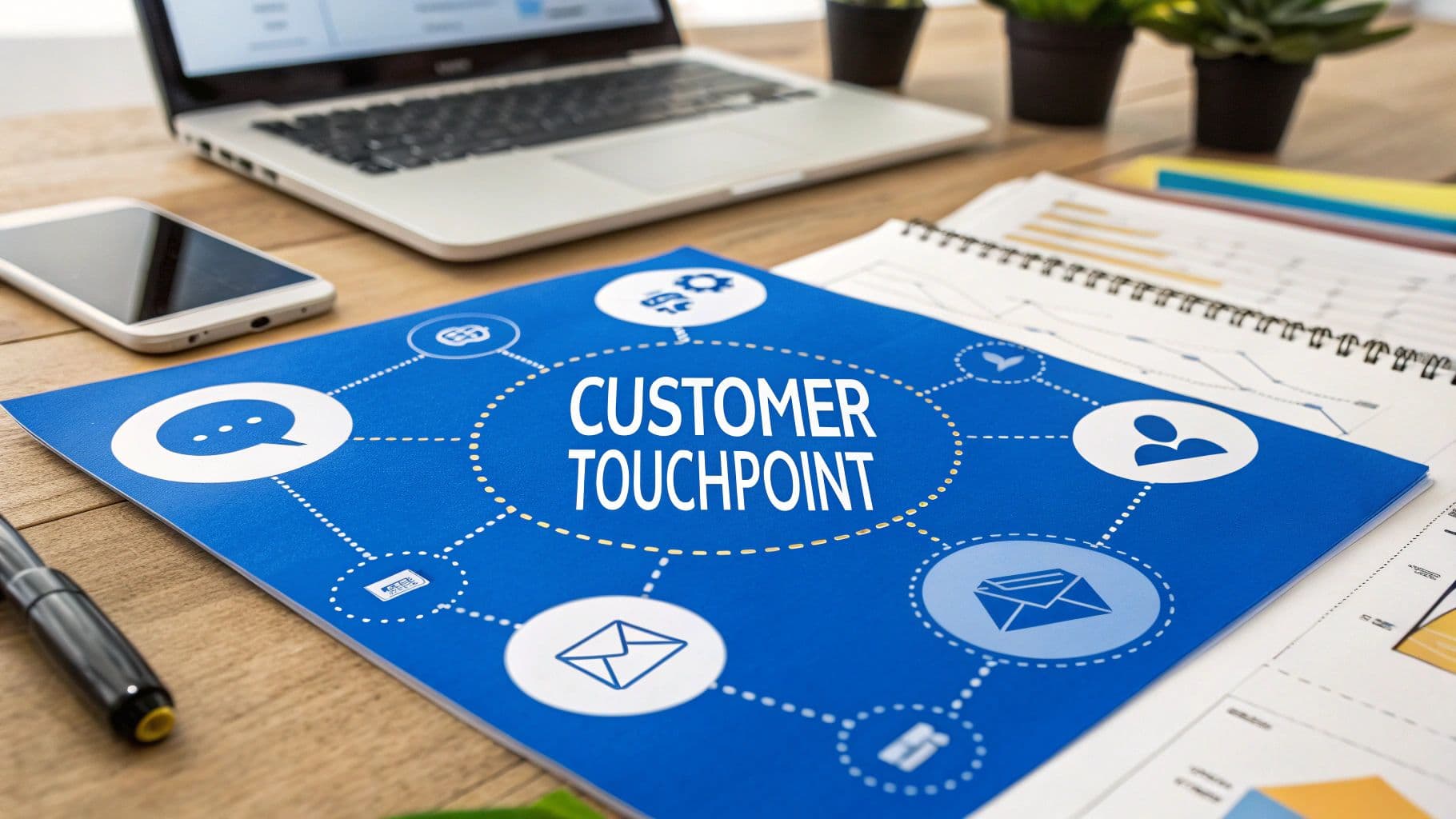
Think of your brand as having a long, evolving conversation with a customer. Every single interaction—from the big ones to the tiny, almost unnoticeable moments—is a word in that conversation.
Those individual words are your customer touchpoints.
What Is a Customer Touchpoint Really?
A customer touchpoint is any time a person comes into contact with your brand. It’s the entire collection of interactions that shape how someone feels about you, what they buy, and whether they stick around for the long haul.
These moments are the fundamental building blocks of the entire customer relationship. They start way before someone clicks "buy" and continue long after the transaction is over. A touchpoint can be as indirect as a friend mentioning your brand at dinner or as direct as a live chat with your support team.
 What is a customer touchpoint? The Essential Guide to Mapping the Customer Journey
It’s Broader Than You Think
This definition is critical because it forces you to acknowledge that your brand's story is being told in places you don't always control. A glowing review on an independent blog can be just as powerful—if not more so—than the perfectly polished copy on your website.
Every interaction matters. Every touchpoint is an opportunity to either build trust or create friction.
A customer journey is simply a series of touchpoints. By understanding and improving these individual moments, you aren't just enhancing the customer experience—you're building a stronger, more resilient business.
Touchpoints Across the Customer Journey
To really get a handle on all these interactions, it helps to group them by where they happen in the customer lifecycle. While the journey is rarely a straight line, most touchpoints fall into three main phases. Understanding the different customer journey phases is the first step toward mapping these critical moments.
Here’s a look at how touchpoints are spread across the typical buyer's journey.
Customer Touchpoints Across the Buyer's Journey
This table breaks down common examples of where and when customers interact with your brand, from their first impression to becoming a loyal advocate.
Pre-Purchase (Awareness and Consideration) | During Purchase (Decision) | Post-Purchase (Retention and Advocacy) |
|---|---|---|
|
|
|
Each item in this table represents a chance to either strengthen the customer relationship or push someone away. Recognizing these moments is the foundation of a truly customer-centric strategy, and it’s why mapping and optimizing them is a game-changing move for any business serious about growth.
Understanding the Three Types of Touchpoints
 What is a customer touchpoint? The Essential Guide to Mapping the Customer Journey
Not all touchpoints are created equal. While every interaction a customer has with your brand matters, they don't all come from the same place—and you certainly don't have the same level of control over each one.
To build a strong and consistent brand, you have to understand the strategic differences between them. Customer touchpoints fall into three buckets: Owned, Paid, and Earned. Think of these as different ways of telling your brand's story.
Mastering the balance between them is the secret to building a brand that feels both trustworthy and ever-present. This framework helps you see where you have direct control versus where you need to listen, influence, and react. Let’s break each one down.
Owned Touchpoints: Your Digital Real Estate
Owned touchpoints are the channels and assets you control completely. This is your brand’s home base—the places where you call the shots on messaging, design, and the entire user experience. You build them, manage them, and optimize them yourself.
Your website is the most obvious example. From the homepage copy to the checkout button, every single element is under your command. These touchpoints are the foundation for building a consistent brand identity.
Common owned touchpoints include:
- Your company website and blog: The central hub for information, content, and sales.
- Your mobile app: A direct line to your most loyal and engaged users.
- Email newsletters and campaigns: Perfect for nurturing leads and retaining customers through direct communication.
- Physical stores or offices: The tangible, in-person experience of your brand.
- Company-run social media profiles: Your official voice on platforms like Instagram, LinkedIn, or TikTok.
Because you have full control, these touchpoints carry the most responsibility for quality and consistency. They are where you set customer expectations.
Paid Touchpoints: Accelerating Your Reach
Paid touchpoints are the interactions you pay for. They’re designed to amplify your message, find new audiences, and pull potential customers into your owned channels. While you control the ad’s message, the context and delivery depend on the platform you’re using.
These touchpoints are absolutely crucial for growth and generating demand. For example, a well-targeted Facebook ad can introduce your brand to thousands of ideal customers who have never heard of you.
The goal of paid media is often to drive traffic to owned media, turning a fleeting impression into a deeper, more controlled brand experience.
Paid touchpoints cover a huge range of activities:
- Digital Advertising: This includes pay-per-click (PPC) ads on Google, social media ads, and display advertising.
- Sponsored Content: Paying for an article or video to be featured on a popular blog or media outlet.
- Influencer Marketing: Partnering with creators to get your product in front of their followers.
- Retargeting Campaigns: Showing ads to people who have already visited your website or app.
The success of these interactions comes down to sharp targeting and compelling creative. They’re the engine for customer acquisition.
Earned Touchpoints: The Voice of the Customer
Finally, we have earned touchpoints. These are the conversations and exposure you don't pay for or directly control. They’re the organic mentions, reviews, and referrals that happen simply because people are talking about your brand.
Earned touchpoints are often the most trusted form of marketing because they come from unbiased, third-party sources. A glowing customer review on a site like G2 or Yelp is a classic example—it carries immense credibility because it’s a real opinion from a real user.
Examples of earned touchpoints are:
- Customer Reviews and Testimonials: Feedback on third-party sites or shared on social media.
- Word-of-Mouth Referrals: A friend recommending your brand to another.
- Press Mentions and Media Coverage: Journalists or bloggers writing about your company organically.
- Social Media Mentions and Shares: Users tagging your brand or sharing your content.
While you can't control these interactions, you can absolutely influence them by delivering an exceptional product and customer experience. These three touchpoint types work together to create a complex web of interactions.
Understanding how they connect is fundamental to effective marketing. You can learn more about how to connect these interactions in our guide to multi-touchpoint marketing attribution, which shows how each touchpoint gets credit for its role in the customer journey.
How Many Touchpoints Does It Take to Win a Customer?
It’s the million-dollar question every marketer asks, but the answer isn’t a clean number like seven, ten, or twelve. Anyone selling you on a magic number of interactions that guarantees a sale is selling you a myth. The reality is far more nuanced and depends entirely on who you’re talking to and what you’re selling.
A one-size-fits-all approach to customer touchpoints is a recipe for wasted ad spend. The path to purchase is rarely a straight line; it's a winding, intricate web of interactions unique to each customer. The number of touchpoints required is shaped by a handful of key factors that every business needs to get a handle on.
These variables determine whether a customer journey is a brief sprint or a long marathon. Understanding them shifts the focus from asking "how many?" to identifying "which ones?" are actually driving results.
Factors That Define the Journey Length
Think about the difference between buying a pack of gum and buying a new car. One is an impulse decision needing almost no thought, while the other involves weeks of research, multiple test drives, and a massive financial commitment. The exact same principle applies to your customer touchpoints.
Several core elements will stretch or shrink the number of interactions needed:
- Product Complexity and Price: High-ticket or technically complex products naturally demand more education and trust-building. A B2B software company might need dozens of touchpoints—demos, case studies, sales calls—over several months to close a deal. In contrast, an e-commerce brand selling t-shirts might convert a customer after just a few social media ads and a quick visit to their product page.
- Industry and Sales Cycle: Some industries just have longer sales cycles baked in. Real estate, for instance, involves a lengthy consideration phase packed with touchpoints like open houses, agent calls, and mortgage applications. A direct-to-consumer snack brand, however, operates on a much shorter timeline where seeing an ad can lead directly to a purchase.
- Customer Familiarity with Your Brand: A lead's "temperature" is maybe the biggest factor of all. Are you talking to a completely cold prospect who has never heard of you, or a loyal fan who eagerly awaits your next product launch? Each one requires a vastly different game plan.
The Role of Customer Temperature
The relationship you have with a potential customer dramatically alters the number of touchpoints needed to inspire action. A cold lead is a total stranger; you need to introduce yourself, build rapport, and earn their trust long before you can ask for a sale. A warm lead is more like an acquaintance who already knows and likes you, making the conversation a whole lot easier.
This isn't just theory—it's backed by data. Projections show that the number of interactions needed varies wildly depending on the audience segment. For example, a completely cold prospect might need 20-50 interactions to feel comfortable enough to pull the trigger in today's competitive markets.
A truly effective touchpoint strategy isn't about hitting an arbitrary number. It's about delivering the right message at the right time to the right person, guiding them from one stage of awareness to the next.
Research breaks this down even further, showing just how much the journey shifts based on familiarity. Inactive customers might only need 1-3 touches to be reactivated, while warm inbound leads who have already shown interest could require 5-12 interactions. Meanwhile, prospects who are only somewhat familiar with your brand might need 5-20 touchpoints before they’re convinced. You can find more details on these projections in this breakdown of touchpoints needed for a sale.
This data completely demolishes the myth of a simple, linear journey. It proves that the path to purchase is a dynamic process where context is king. Instead of obsessing over a universal number, the smarter strategy is to understand your different audience segments and tailor your touchpoint sequences to meet them where they are. The goal is not just to be seen, but to be genuinely helpful at every step.
How to Map Your Customer Touchpoints
Knowing what a customer touchpoint is and why it matters is one thing. Actually turning that knowledge into a powerful, visual tool for your business? That's the next critical step. This is where touchpoint mapping comes into play—the process of visually laying out every single interaction a customer has with your brand.
Think of it like creating a detailed travel itinerary for your customers. Instead of just knowing the final destination (a purchase), you’re plotting every stop, connection, and potential detour along the way. This map turns an abstract concept into an actionable strategy, helping you spot friction points and find opportunities to create a smoother, more enjoyable experience.
To really nail this, you need to get familiar with the broader practice of customer journey mapping. It provides the foundational framework you'll need to identify and organize every interaction.
Start with Who You Are Mapping For
Before you even think about listing a single touchpoint, you have to know exactly whose journey you’re mapping. A vague idea of your "average customer" just won't cut it. You need to develop clear, detailed customer personas.
A persona is basically a semi-fictional character that represents your ideal customer, built from real data and market research. Give them a name, a job, goals, and challenges. What motivates them? What are their biggest headaches? Answering these questions helps you step into their shoes and see your brand from their perspective.
For example, a persona for a SaaS company might be "Marketing Manager Molly," who's struggling to prove ROI on her ad spend. For an e-commerce brand, it could be "Busy Dad Brian," who just wants convenience and fast shipping. You’ll end up creating a separate map for each major persona, because their journeys will look completely different.
Brainstorm Every Possible Interaction
With your persona locked in, it’s time to brainstorm every single way they might interact with your brand. The key here is to think broadly and, most importantly, collaboratively. Get your marketing, sales, and customer support teams in a room together—each one has a unique and valuable view of the customer experience.
List out every possible interaction, no matter how small, across the entire customer lifecycle:
- Pre-Purchase: How do people first discover you? Think social media ads, blog posts, word-of-mouth referrals, and online reviews.
- During Purchase: What happens when they decide to buy? This includes your website, product pages, sales calls, the checkout process itself, and confirmation emails.
- Post-Purchase: How do you keep the relationship alive after the sale? Consider onboarding sequences, customer support chats, satisfaction surveys, and loyalty programs.
And don't just think about the channels you control. You also need to include earned touchpoints like third-party review sites or social media mentions. You can't directly manage them, but you absolutely have to be aware of them.
The goal of brainstorming isn’t to be perfect; it’s to be thorough. A comprehensive list is the raw material you'll use to build your map, revealing the true complexity of the customer journey.
Organize Touchpoints Along the Customer Journey
Once you have your exhaustive list, the next job is to organize these touchpoints chronologically along the stages of the customer journey. This structure is what helps you see how interactions connect and where transitions are either seamless or clunky. A typical framework includes Awareness, Consideration, Purchase, Retention, and Advocacy.
For each touchpoint, really dig into the customer's mindset. What are they thinking, feeling, and doing at that moment? What questions do they have? For instance, during the Awareness stage, a customer seeing your Instagram ad is probably thinking, "What is this?" During the Purchase stage, a customer on your checkout page is feeling hopeful but might be worried about shipping costs.
This infographic shows how customers can be segmented by their familiarity with your brand, which directly impacts the touchpoints they encounter.
 What is a customer touchpoint? The Essential Guide to Mapping the Customer Journey
This flow illustrates that a cold, warm, or inactive customer will follow a very different path, requiring a unique sequence of touchpoints to move them forward.
Pinpoint the Moments of Truth
Here’s the thing: not all touchpoints are created equal. Some are simple, low-stakes interactions. But others are "moments of truth"—pivotal points that have a massive impact on a customer's perception and loyalty. These are the make-or-break interactions where a positive experience can create a customer for life, and a negative one can lose them forever.
Identifying these moments is the most important part of mapping. They often happen during times of high emotion or high stakes, such as:
- The first time a customer uses your product.
- Their first interaction with customer support.
- The unboxing experience.
- How you handle a product return or a complaint.
Circle these moments on your map. These are the areas where you need to invest the most effort in optimization. By creating a visual map, you're building more than just a flowchart; you're creating a blueprint for empathy.
Platforms that offer customer journey mapping software can help automate this process, pulling data from multiple sources to create a dynamic and accurate map that evolves with your customers.
Measuring and Improving Your Key Touchpoints
Having a map of your customer touchpoints is a great start, but a map is only useful if it helps you find a better route. Now it's time for action—turning that visual guide into a performance-driving machine that actually improves the customer experience.
The goal is to move beyond simply knowing where your touchpoints are to understanding how well each one performs. Are they creating delight or causing frustration? By assigning the right metrics, you can stop guessing and start measuring what truly matters to your bottom line.
Assigning KPIs to Your Touchpoints
To measure performance, you need to attach meaningful Key Performance Indicators (KPIs) to your most important interactions. Not every touchpoint needs a complex suite of metrics, but your "moments of truth"—those critical interactions that make or break the customer's perception—absolutely do.
The right KPI depends entirely on the touchpoint's purpose. For example, the metric for a blog post (awareness) will be completely different from the metric for a checkout page (conversion).
Here’s a quick look at how you can match touchpoints with relevant KPIs:
- Social Media Ad (Awareness): Your primary KPI here is Click-Through Rate (CTR). This tells you how compelling your ad creative and messaging are at grabbing initial attention.
- Website Landing Page (Consideration): Focus on the Conversion Rate. This measures the percentage of visitors who take the desired action, like signing up for a newsletter or downloading a free guide.
- Customer Support Chat (Retention): Customer Satisfaction (CSAT) scores are perfect here. A simple post-chat survey reveals how effectively you resolved the customer's issue.
Choosing the right metrics is foundational. For a deeper dive into this process, check out our complete guide on how to measure touchpoints and turn raw data into actionable insights.
The table below breaks down a few more common touchpoints and the metrics used to evaluate their success.
Key Metrics for Measuring Touchpoint Performance
Touchpoint Example | Primary KPI | What It Measures |
|---|---|---|
Email Newsletter | Open Rate / Click Rate | Audience engagement and interest in content. |
Webinar Registration Page | Form Submission Rate | Effectiveness of the offer and page design. |
Onboarding Email Sequence | Completion Rate | How well you guide new users to activation. |
Checkout Page | Cart Abandonment Rate | Friction or hesitation in the final purchase step. |
In-App Feature Tour | Adoption Rate | User engagement with new product features. |
Blog Post | Time on Page / Scroll Depth | How engaging and valuable the content is to readers. |
By tracking these KPIs, you can move from subjective feedback to objective data, pinpointing exactly where your customer journey is strong and where it needs work.
Strategies for Continuous Optimization
Once you're measuring, you can start improving. Optimization isn't a one-and-done project; it's a continuous cycle of testing, learning, and refining to ensure every customer interaction is better than the last. This commitment to consistency is what customers now demand.
In fact, the pressure for a unified experience is overwhelming. According to Salesforce, a staggering 79% of global customers in 2023 insisted on consistent interactions across all points of contact. This shows how fragmented touchpoints kill trust, while a seamless journey builds loyalty and keeps people coming back.
Here are a few actionable strategies you can implement to start optimizing your key touchpoints right away.
A great touchpoint feels intentional, helpful, and effortless. Optimization is simply the process of identifying and removing anything that gets in the way of that feeling, one interaction at a time.
Test, Personalize, and Simplify
Your optimization efforts should zero in on three core areas: testing your assumptions, personalizing the experience, and simplifying the process.
- A/B Test Your Messaging: Never assume you know what works best. Continuously test different headlines, ad copy, calls-to-action, and email subject lines. Even tiny tweaks can lead to huge improvements in engagement and conversion rates.
- Personalize Follow-Up Sequences: Generic communication just doesn't cut it anymore. Use the data you have on a customer—like their purchase history or browsing behavior—to tailor your email and ad sequences. A personalized recommendation is far more powerful than a generic email blast.
- Simplify Critical Flows: Friction is the mortal enemy of conversion. Go through your high-stakes processes like the checkout flow or onboarding sequence with a fine-tooth comb. Remove unnecessary steps, clarify instructions, and make it as dead-simple as possible for the customer to get what they want. Every field you remove or step you simplify is one less reason for them to leave.
Common Questions About Customer Touchpoints
Once you start digging into customer interactions, a bunch of practical questions always pop up. It’s one thing to understand the theory, but moving from a whiteboard to the real world can feel like a big leap. This is where the rubber meets the road.
Think of this section as the FAQ for your new touchpoint strategy. We'll tackle the most common questions we hear, giving you clear, straightforward answers to help you sidestep the usual hurdles and start making smarter decisions.
What Is the Single Most Important Customer Touchpoint?
This is a classic trick question, and the honest answer is: there isn’t one. The idea of a single "most important" touchpoint that works for every business is a myth. The real impact of any interaction boils down to your industry, your specific customer, and exactly where they are in their journey.
Instead of chasing a magic bullet, the goal is to pinpoint your unique "moments of truth."
These are the make-or-break interactions where a customer’s opinion of your brand is formed—for better or worse. For an e-commerce brand, a moment of truth might be the unboxing experience. For a SaaS company, it could be the first time they chat with your support team. These pivotal moments carry far more weight than others, and they’re what you need to identify and nail for your business.
How Do Customer Touchpoints Differ for B2B Vs. B2C?
The core idea is the same—manage interactions—but the touchpoints themselves look wildly different in B2B versus B2C. The buying cycles, what motivates a purchase, and who makes the final call are worlds apart, and that completely changes the game.
B2C journeys are often quick, emotional, and driven by a single person's wants or needs. The touchpoints reflect that.
- Eye-catching social media ads
- Influencer reviews and unboxing videos
- A dead-simple mobile checkout
- Flash sale emails that create urgency
On the other hand, B2B journeys are typically much longer, built on logic and ROI, and involve a whole committee of decision-makers. The touchpoints here are all about building trust and proving value.
You’ll see B2B touchpoints like:
- In-depth webinars and whitepapers
- Detailed case studies showing real results
- Personalized sales demos
- Contract negotiations and onboarding calls
While both worlds aim for a smooth customer experience, the actual interactions are tailored to two completely different buying mindsets.
How Often Should I Update My Customer Touchpoint Map?
Your touchpoint map is a living document, not a "set it and forget it" project. For it to be useful, it has to evolve right alongside your business and your customers. A good rule of thumb is to review and update your map at least once a year.
A touchpoint map is only as valuable as it is accurate. Treating it as a snapshot in time guarantees it will quickly become obsolete, leading to decisions based on outdated assumptions about the customer experience.
But an annual review is just the baseline. You should also revisit your map anytime there’s a major shift in your business. Key triggers for an update include:
- Launching a new product or service
- Expanding into a new market or demographic
- Adding a new marketing channel, like TikTok or LinkedIn ads
- Spotting new trends in customer feedback or analytics data
Keeping your map current is non-negotiable. It’s the only way to ensure it remains a reliable tool for finding friction points and spotting new opportunities. To build that map on solid ground, you first need a clear process for how to capture every customer touchpoint.
Ready to stop guessing which touchpoints are driving revenue? Cometly is the marketing attribution platform that unifies and analyzes every interaction across the customer journey. See exactly which channels, campaigns, and ads are making an impact and optimize your spend with confidence. Learn more at https://www.cometly.com.