Your retargeting campaigns aren't performing like they used to. Your lookalike audiences feel less precise. Your attribution reports show gaps you can't explain. If you've noticed these shifts over the past few years, you're not imagining things. The digital advertising landscape has fundamentally changed as third-party cookies disappear from major browsers, and many marketers are still trying to figure out what this means for their day-to-day operations.
The uncertainty is real. How do you track users across sessions when browsers actively block that tracking? How do you build accurate attribution models when huge portions of the customer journey are invisible? How do you scale campaigns confidently when the data feeding your decisions is incomplete?
Here's the thing: cookie deprecation isn't just a technical inconvenience. It's forcing a complete rethink of how we measure, target, and optimize advertising campaigns. But this shift also creates an opportunity for marketers who understand what's actually happening and invest in better measurement infrastructure. This guide will walk you through exactly what cookie deprecation means for your advertising operations and show you how forward-thinking teams are adapting their strategies to maintain accurate attribution and campaign effectiveness in 2026.
The Third-Party Cookie Era Is Ending: Here's What Changed
Let's start with the basics. A cookie is just a small text file that websites store in your browser to remember information about you. First-party cookies come from the website you're actually visiting. When you log into a site and it remembers you next time, that's a first-party cookie doing its job. These are generally considered acceptable because they improve user experience on that specific site.
Third-party cookies are different. They're set by domains other than the one you're visiting, usually by ad networks and tracking companies. When you browse a shoe store and then see ads for those exact shoes on completely different websites, third-party cookies made that possible. They enabled advertisers to follow users across the web, building profiles of interests and behaviors to power retargeting, frequency capping, and conversion attribution.
For nearly three decades, these cookies were the backbone of digital advertising. But that era is ending, and the timeline of change has been swift. Understanding the full third-party cookie deprecation impact is essential for any marketer navigating this transition.
Safari fired the first major shot in 2017 with Intelligent Tracking Prevention, which limited third-party cookie tracking. By 2020, Safari blocked third-party cookies by default. Firefox followed suit with Enhanced Tracking Protection, giving users automatic blocking of cross-site tracking cookies. These moves immediately impacted Safari and Firefox users, but the real earthquake came when Google Chrome, which commands the majority of browser market share, announced its own deprecation plans.
Chrome has taken a phased approach, giving the advertising industry time to adapt while developing Privacy Sandbox alternatives. But make no mistake: the direction is clear. Third-party cookies are being systematically eliminated across all major browsers.
Why is this happening? Three forces converged to make cookie deprecation inevitable.
First, privacy regulations like GDPR in Europe and CCPA in California created legal frameworks that gave users more control over their data. These laws made the opaque world of third-party tracking harder to justify and easier to challenge.
Second, consumer expectations shifted dramatically. Data breaches, privacy scandals, and growing awareness of how personal information was being collected and sold created demand for better privacy protections. Users started actively seeking browsers and tools that protected them from tracking.
Third, browser competition intensified around privacy as a differentiator. Safari and Firefox positioned privacy protection as a core feature, putting pressure on Chrome to respond or risk losing privacy-conscious users. What started as a competitive move became an industry-wide transformation.
The technical reality is straightforward: browsers now actively prevent third-party domains from setting persistent identifiers that track users across websites. This fundamentally breaks the cross-site tracking model that powered digital advertising for decades.
How Cookie Loss Disrupts Your Advertising Campaigns
The disappearance of third-party cookies creates immediate, practical problems for anyone running digital advertising campaigns. Let's talk about what actually breaks when cookies go away.
Retargeting pools have shrunk dramatically. Remember when you could build robust retargeting audiences based on website visitors who didn't convert? Those audiences relied on third-party cookies to identify and follow users across the web. As browsers block these cookies, your ability to recognize and retarget those users evaporates. You might have had a retargeting pool of 50,000 users two years ago. Today, that same campaign might only reach 15,000 because the majority of your visitors use cookie-blocking browsers.
This isn't just about smaller audience sizes. It's about fundamental gaps in who you can reach. Your most privacy-conscious users, often your most valuable customers, are the least likely to be trackable through traditional methods. You're essentially flying blind with a significant portion of your potential audience. These cookie tracking problems in advertising affect businesses of all sizes.
Lookalike audience modeling has become less accurate. Ad platforms build lookalike audiences by analyzing the characteristics and behaviors of your best customers, then finding similar users. But this modeling depends on having rich, accurate data about user behavior across multiple sites. When third-party cookies disappear, the signal data feeding these models becomes sparse and incomplete. The result? Lookalike audiences that feel less precise, with lower conversion rates and higher costs per acquisition.
You might notice your lookalike campaigns performing inconsistently or requiring more frequent optimization. That's not because the platforms got worse at modeling. It's because they have less data to work with.
Frequency capping becomes nearly impossible to manage effectively. Without cross-site tracking, you can't reliably count how many times a specific user has seen your ad across different websites and platforms. This leads to two equally frustrating outcomes: either you show the same ad to the same person too many times, creating ad fatigue and wasting impressions, or you under-serve your message because you can't track frequency at all.
Think about running campaigns across multiple ad networks. Without third-party cookies, each platform operates in its own silo. A user might see your ad five times on one platform and never on another, even though you're paying for impressions on both. You have no unified view of total exposure.
Multi-touch attribution breaks down completely. This is where cookie deprecation hurts most for serious marketers. Understanding the customer journey from first touch to final conversion requires tracking users across multiple sessions, devices, and touchpoints. Third-party cookies made this possible by maintaining a persistent identifier as users moved across the web.
Without that tracking capability, you lose visibility into how your marketing channels work together. Did that conversion come from your Facebook ad, your Google search campaign, or your email newsletter? Without complete journey data, you're forced to rely on incomplete, often contradictory reports from individual platforms, each claiming credit for the same conversion.
The Attribution Blindspot Most Marketers Underestimate
Here's what keeps experienced marketers up at night: cookie deprecation doesn't just make attribution harder. It makes the attribution methods you're already using even less reliable than they were before.
Last-click attribution has always been problematic because it ignores all the touchpoints that happened before the final click. But in a cookieless world, it becomes downright misleading. When you can't track users across sessions and devices, you often don't even know what the last click actually was. You're seeing one piece of a puzzle and pretending it's the complete picture. Understanding attribution window problems in advertising helps explain why your current models may be failing.
Let's say a user discovers your product through a Facebook ad on their phone during their morning commute. They research more on their laptop at lunch. They compare options on their tablet that evening. Finally, they search your brand name on their phone the next day and convert. In a cookie-dependent tracking environment, you might capture some of this journey. Without cookies, you likely see only the final branded search, and your attribution model credits that single touchpoint with the entire conversion.
This isn't just an academic problem. It directly impacts budget allocation. You end up investing more in bottom-funnel branded search because that's what your reports show driving conversions, while starving the top-funnel awareness campaigns that actually introduced users to your product in the first place.
The gap between platform-reported conversions and actual CRM data has widened significantly. Ad platforms like Meta and Google report conversions based on what they can see within their own ecosystems. But when users convert after leaving those platforms, especially if they do so in a different browser or after clearing cookies, the platform loses visibility.
You might see 100 conversions in your CRM but only 60 reported in your Facebook Ads Manager. Which number do you trust? More importantly, which campaigns actually drove those 100 conversions? Without complete tracking, you're making budget decisions based on partial, often contradictory data. These advertising campaign tracking gaps can lead to significant budget misallocation.
This attribution blindspot leads to systematically misallocated budgets. You scale campaigns that appear to perform well according to platform metrics, but those campaigns might not actually be driving the conversions you think they are. Meanwhile, you cut budget from campaigns that look underperforming in platform reports but are actually contributing significantly to conversions that happen outside the tracking window.
The real danger isn't that your attribution is imperfect. It's that you don't know how imperfect it is. You're making confident decisions based on data you can't verify, and the cost of those wrong decisions compounds over time as you double down on strategies built on incomplete information.
Server-Side Tracking: The Foundation of Post-Cookie Measurement
If browser-based tracking is dying, what replaces it? The answer that's emerged as the industry standard is server-side tracking, and understanding how it works is essential for maintaining accurate measurement in 2026.
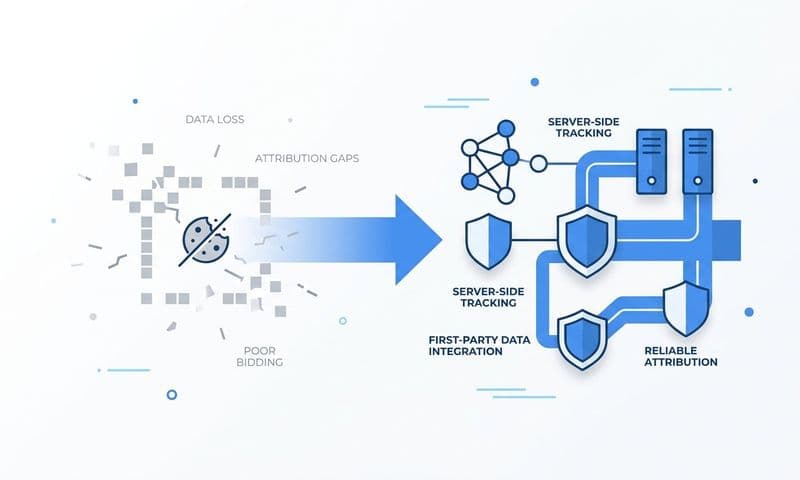
Traditional pixel-based tracking works entirely in the user's browser. When someone visits your website, JavaScript code loads and sends data to ad platforms, analytics tools, and tracking services. This all happens client-side, meaning the user's browser handles everything. That's exactly why cookie restrictions and ad blockers can shut it down. If the browser blocks the request, your tracking fails.
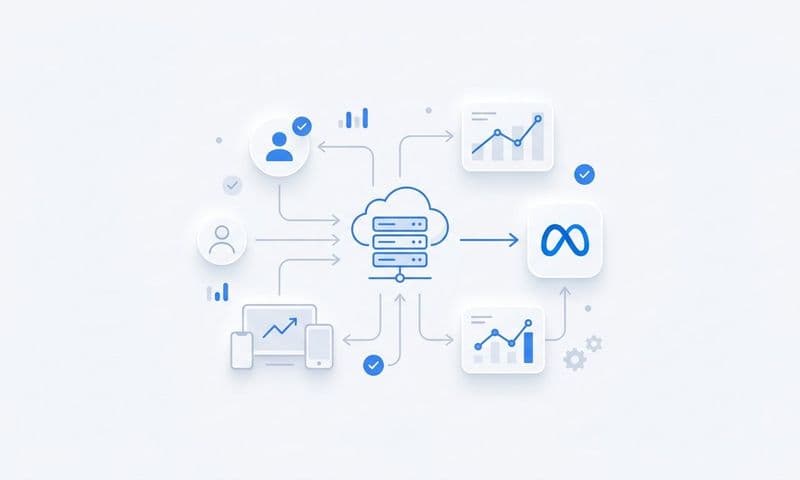
Server-side tracking flips this model. Instead of relying on browser-based pixels to send data, your server collects conversion events and sends them directly to ad platforms through their APIs. The data transmission happens server-to-server, completely bypassing browser restrictions, cookie limitations, and ad blockers. Implementing cookieless tracking for advertising has become essential for accurate measurement.
Think of it like this: browser-based tracking is like asking someone to deliver a message for you, and they might refuse or forget. Server-side tracking is like making the phone call yourself. You control the entire process, and browser restrictions can't interfere.
This approach solves multiple problems simultaneously. First, it captures conversions that browser-based tracking misses. When users have ad blockers enabled, clear their cookies, or use privacy-focused browsers, your server-side tracking still records their conversion events because the data collection happens on your infrastructure, not in their browser.
Second, server-side tracking enables you to send conversion data that occurs offline or in systems outside the browser. Did someone convert over the phone after seeing your ad? Did they complete a purchase in your CRM days after their initial website visit? Server-side tracking can capture these events and attribute them back to the original ad exposure, giving you a complete view of campaign performance.
Third, you gain control over exactly what data gets sent to ad platforms. Instead of relying on browser pixels that might fire inconsistently or send incomplete information, your server can enrich conversion events with CRM data, customer lifetime value, and other business metrics before sending them to platforms. This gives ad platform algorithms better signals to optimize against.
The technical implementation requires connecting three core systems: your website or app, your CRM or database, and the ad platforms you use. Your server acts as the central hub, collecting conversion events from all touchpoints and routing them to the appropriate platforms through their conversion APIs.
Meta's Conversions API, Google's Enhanced Conversions, and similar tools from other platforms all work on this server-side model. They're designed to receive conversion data directly from your server, bypassing browser-based tracking entirely. The platforms even recommend using server-side tracking alongside browser pixels for maximum coverage, a strategy called "redundant tracking" that ensures conversions get captured even when browser-based methods fail.
First-Party Data Strategies That Actually Work
Server-side tracking solves the technical problem of getting conversion data to ad platforms. But you still need something to track. This is where first-party data becomes your most valuable asset in a cookieless world.
First-party data is information you collect directly from your customers through interactions they have with your owned properties: your website, your app, your email list, your CRM. Unlike third-party data, which relies on tracking users across the web, first-party data comes from direct relationships. Users give you this information willingly, often in exchange for value like account access, personalized experiences, or exclusive content.
The strategy that works is building robust first-party data collection across every touchpoint where customers interact with your brand. When someone signs up for your email list, creates an account, makes a purchase, or engages with your content, you're capturing first-party data. The key is connecting all these touchpoints so you can build a unified customer profile. A comprehensive cookieless future marketing strategy depends on this foundation.
Let's say a user downloads your lead magnet, providing their email address. Later, they attend your webinar using the same email. Eventually, they create an account and make a purchase. Each of these actions generates first-party data. When you connect these events in your CRM, you can see the complete customer journey even though it spans multiple sessions and might involve different devices.
This unified first-party data becomes the foundation for accurate attribution. You're no longer dependent on cookies to track users across sessions. Instead, you're using authenticated data from logged-in users or email-based matching to connect touchpoints. This approach is both more privacy-friendly and more accurate than cookie-based tracking ever was.
Conversion APIs and server-side events let you feed this enriched first-party data back to ad platforms. Instead of just telling Facebook that someone converted, you can send detailed information about what they purchased, their customer lifetime value, and which marketing touchpoints influenced their decision. This enriched data dramatically improves how ad platforms optimize your campaigns.
Think about how ad algorithms work. They need conversion signals to learn which audiences and creative approaches drive results. When you send enriched conversion data through server-side tracking, you're giving the algorithm better information to optimize against. Instead of optimizing for any conversion, the platform can optimize for high-value conversions from customers who match your best buyer profiles.
The platforms themselves have confirmed this approach works better. Meta explicitly states that advertisers using Conversions API alongside enriched event data see improved campaign performance compared to those relying solely on browser pixels. Google's Enhanced Conversions documentation emphasizes how first-party data improves conversion measurement and bidding optimization.
Building this infrastructure requires intentional effort. You need systems to capture first-party data at every customer touchpoint, a CRM or database to unify that data, and server-side tracking to send enriched conversion events to ad platforms. But the payoff is substantial: accurate attribution, better campaign optimization, and competitive advantage in an increasingly cookieless advertising environment.
Adapting Your Attribution Model for a Cookieless World
With server-side tracking and first-party data in place, you can finally build attribution models that actually reflect reality. But the approach looks different than traditional cookie-based attribution.
The first step is moving beyond platform-reported metrics. Facebook Ads Manager, Google Ads, and other platforms will always show you conversions, but these are increasingly incomplete views of campaign performance. They only see what happens within their own tracking ecosystems. A unified attribution approach connects data from all your marketing channels, your website, and your CRM to show the complete picture. Exploring post-cookie advertising measurement strategies can help you build this comprehensive view.
This means implementing a marketing attribution platform that sits above your individual ad channels. Instead of looking at Facebook's report, then Google's report, then your email platform's report, you need a single source of truth that tracks conversions back to every touchpoint across all channels. This unified view reveals how your marketing channels work together rather than competing for credit.
Comparing attribution models becomes essential for understanding which channels truly drive revenue. Last-click attribution might show that branded search drives most conversions. First-click attribution might reveal that Facebook ads introduce most new customers. Multi-touch attribution distributes credit across all touchpoints. Each model tells a different story, and the truth usually lies somewhere in the middle. Learning about attribution modeling for paid advertising helps you choose the right approach for your business.
The smart approach is analyzing multiple attribution models side-by-side to understand the full picture. Which channels are best at introducing new customers? Which channels are best at closing deals? Which touchpoints consistently appear in high-value customer journeys? These insights only become visible when you compare different attribution approaches rather than relying on a single model.
AI-powered analysis has become increasingly valuable for identifying patterns that humans might miss. When you're tracking hundreds of campaigns across multiple channels with thousands of customer journeys, manual analysis becomes impossible. AI can identify which campaigns consistently appear in converting paths, which combinations of touchpoints drive the highest lifetime value, and which audiences respond best to specific messaging approaches.
Modern attribution platforms use machine learning to surface insights like: "Customers who see both your Facebook carousel ad and your Google search ad convert at 3x the rate of those who see only one." Or: "Users who engage with your email sequence before clicking a retargeting ad have 40% higher lifetime value." These cross-channel insights are impossible to spot in individual platform reports but become obvious with unified, AI-powered attribution analysis.
The goal isn't perfect attribution. That's never been possible and never will be. The goal is actionable intelligence about which marketing investments drive real business results. In a cookieless world, that requires moving beyond platform metrics to build unified measurement infrastructure that connects all your customer data and reveals the true impact of your advertising efforts.
Moving Forward with Confidence
Cookie deprecation has fundamentally disrupted digital advertising, but it's also created a clear dividing line between marketers who adapt and those who don't. The disruption is real. Retargeting pools have shrunk, attribution has become more complex, and the old playbooks don't work like they used to. But here's what matters: accurate measurement is now a competitive advantage.
Teams that invest in server-side tracking, build robust first-party data strategies, and implement unified attribution are seeing clearer insights into campaign performance than they ever had with cookie-based tracking. They know which campaigns actually drive revenue, not just which ones claim credit in platform reports. They can scale with confidence because their attribution reflects reality.
The technical shifts we've covered—server-side tracking, conversion APIs, enriched first-party data, unified attribution models—aren't just workarounds for cookie deprecation. They're fundamentally better approaches to marketing measurement. They're more accurate, more privacy-friendly, and more aligned with how customers actually behave across devices and touchpoints.
If you're still relying primarily on browser-based pixels and platform-reported metrics, now is the time to evaluate your tracking infrastructure. The gap between what you think is happening and what's actually driving conversions will only widen as cookie restrictions expand. The marketers who close that gap first will have a significant advantage in campaign optimization, budget allocation, and overall marketing effectiveness.
Ready to elevate your marketing game with precision and confidence? Discover how Cometly's AI-driven recommendations can transform your ad strategy—Get your free demo today and start capturing every touchpoint to maximize your conversions.