
You refresh your Meta Ads dashboard and see 50 conversions. Google Ads shows 40. Your CRM? Only 30 actual sales. The numbers don't add up, and you're left wondering which platform to trust when making budget decisions.
This isn't a glitch. It's the reality of cross platform tracking in 2026.
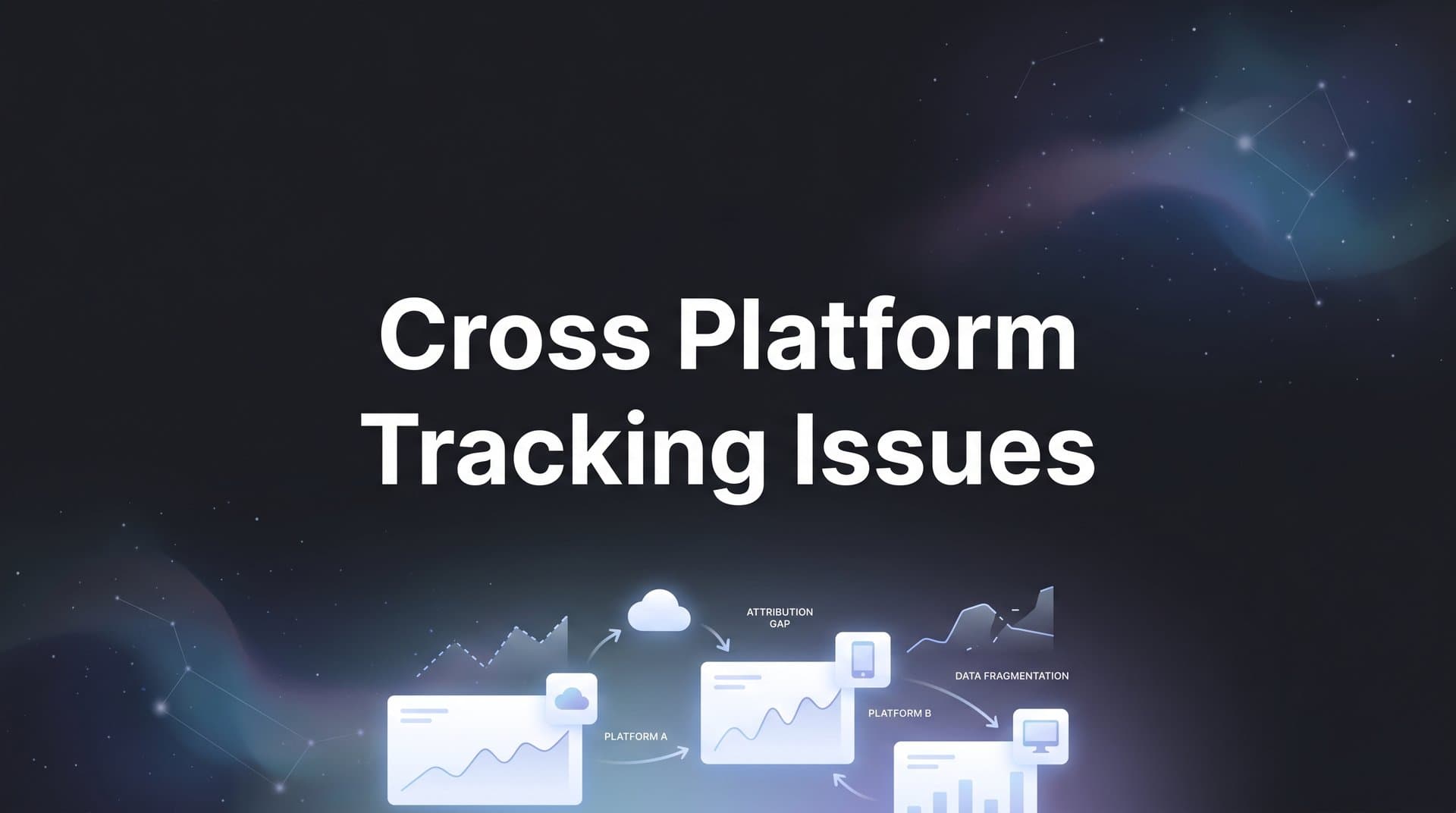
As customer journeys stretch across mobile apps, desktop browsers, social platforms, and email, tracking has become fragmented and unreliable. Each platform claims credit for conversions it may have only assisted with, or worse, had no real impact on at all. The result? Inflated metrics, wasted ad spend, and marketing decisions based on incomplete data.
This guide breaks down why cross platform tracking issues exist, how they're impacting your marketing performance right now, and practical solutions to regain data accuracy and confidence in your campaigns.
The Anatomy of a Broken Customer Journey
Picture a customer who sees your Facebook ad on their phone during their morning commute. They don't click, but they remember your brand. Later that day, they search for your product on Google from their work laptop and click a search ad. That evening, they receive your email newsletter on their tablet and finally convert on your website.
One customer. One conversion. Three devices. Multiple touchpoints.
Here's the problem: Facebook will claim that conversion because the customer saw the ad. Google will claim it because they clicked the search ad. Your email platform will claim it because they opened the newsletter before converting. Each platform only sees its own slice of the journey and assumes it deserves full credit.
Modern customers interact with brands across an average of five to eight touchpoints before converting. They move seamlessly between devices, browsers, and platforms. They might discover you on TikTok, research you on LinkedIn, compare prices on their phone, and purchase on their laptop days later. Understanding tracking customer journey across platforms has become essential for accurate attribution.
Traditional tracking wasn't built for this reality. It was designed for a simpler world where customers clicked an ad and converted in the same session on the same device. That world no longer exists.
The fundamental issue is that each advertising platform operates in its own ecosystem. Meta doesn't share attribution data with Google. TikTok doesn't communicate with LinkedIn. They're competitors, and they're incentivized to claim as much credit as possible to justify your ad spend on their platform.
This creates duplicated conversion tracking across platforms. When you add up the conversions reported by all your platforms, the total often exceeds your actual sales by significant margins. Some marketers see discrepancies of 30%, 50%, or even higher.
The result? You're making budget allocation decisions based on inflated data. You might be overspending on channels that assist conversions but don't actually drive them. Or you might be underinvesting in channels that play crucial roles earlier in the customer journey but don't get credit under last-click attribution models.
Without a unified view of the complete customer journey, you're essentially flying blind.
Privacy Changes That Shattered Traditional Tracking
If cross platform tracking wasn't challenging enough, privacy regulations and platform policies have made it exponentially harder.
Apple's iOS App Tracking Transparency framework, introduced in 2021, fundamentally changed mobile attribution. Before ATT, apps could track users across other apps and websites without explicit permission. After ATT, apps must ask users to opt in to tracking. The vast majority of users decline.
This means that when someone sees your ad in one app and converts in another, the connection between those two events is often invisible. The ad platform can't follow that user across apps, so it can't accurately report on conversions that happen outside its own ecosystem. These cross device tracking issues have become increasingly common.
Browser-based tracking faces similar challenges. Google's ongoing deprecation of third-party cookies has been phased through 2025 and into 2026, progressively limiting the ability to track users across websites. Third-party cookies were the backbone of retargeting and cross-site attribution for years.
Without them, marketers lose visibility into what users do after they leave one website and visit another. You can't easily track someone who clicks your Google ad, browses your site, leaves without converting, then returns days later through organic search to make a purchase.
Privacy regulations like GDPR in Europe and CCPA in California add another layer of complexity. These laws require explicit user consent before tracking, and many users decline or ignore consent requests. This creates regional tracking blind spots where you have limited data on significant portions of your audience.
The combined effect of these privacy changes is that traditional client-side tracking, which relies on browser cookies and device identifiers, has become increasingly unreliable. The data you're collecting is incomplete, and the gaps are growing.
Ad platforms have responded by developing their own solutions, like Meta's Aggregated Event Measurement and Google's Enhanced Conversions. But these are platform-specific fixes that don't solve the fundamental problem of cross platform attribution tracking. They help each platform track its own performance better, but they don't give you a unified view across all your marketing channels.
Five Warning Signs Your Cross Platform Data Is Unreliable
How do you know if you're dealing with serious cross platform tracking issues? Here are the red flags that signal your data isn't telling the full story.
Your platform-reported conversions exceed actual sales. Add up the conversions claimed by Meta, Google, TikTok, and any other platforms you're running ads on. Compare that total to your actual sales from your CRM or payment processor. If the platform total exceeds reality by 30% or more, you're dealing with significant duplicate counting. Each platform is claiming credit for conversions that other platforms also claim.
Campaign performance reports contradict each other. One platform shows your best-performing campaign drove 100 conversions. Another platform claims a different campaign was your top performer with 120 conversions. But when you look at your actual revenue data, neither story matches reality. These contradictions make budget allocation feel like guesswork because you can't trust which platform is telling the truth. Understanding multiple ad platforms tracking issues helps identify the root causes.
Your retargeting audiences include existing customers. You're spending money to show ads to people who already purchased from you because your tracking can't accurately identify who converted. This happens when conversions occur on different devices or browsers than where the original ad interaction happened, breaking the tracking chain.
Attribution windows show impossible timelines. A platform reports a conversion with a seven-day click attribution window, but your CRM shows that customer made their first purchase three months ago. The platform is claiming credit for a conversion that happened long before the ad was even shown, indicating broken tracking or data sync issues.
Your cost per acquisition varies wildly between platforms for the same product. One platform reports a CPA of $30 while another shows $80 for identical offers. The discrepancy isn't necessarily because one platform performs better. It's often because the platforms are measuring different things, using different attribution windows, or counting conversions differently.
If you're experiencing even two or three of these warning signs, your cross platform tracking issues are likely costing you money through misallocated budgets and wasted ad spend.
Server-Side Tracking: The Foundation of Accurate Attribution
The solution to unreliable client-side tracking is moving critical data collection to the server side.
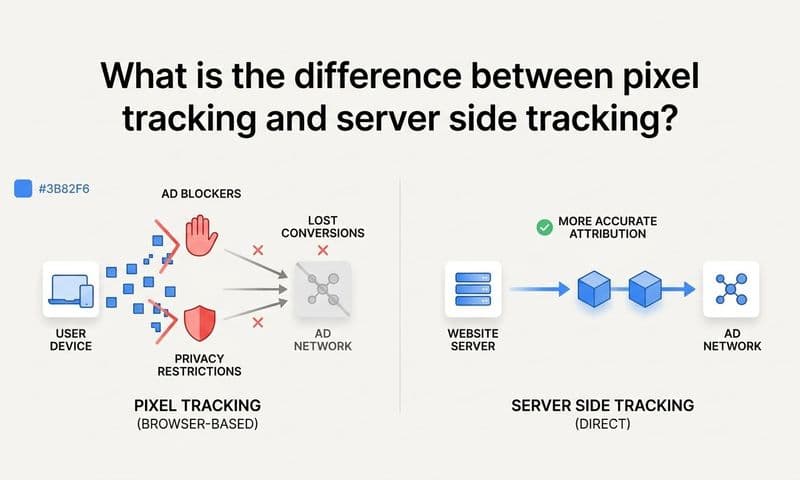
Client-side tracking relies on code that runs in the user's browser or app. When someone visits your website, pixels from Meta, Google, and other platforms fire in their browser to record the visit and any actions they take. This approach has three major vulnerabilities.
First, ad blockers prevent pixels from firing entirely. Millions of users run ad blockers, creating blind spots in your data. Second, browser privacy settings can block or limit pixel functionality, especially with third-party cookie restrictions. Third, client-side tracking depends on the user's device and browser working perfectly, which often isn't the case.
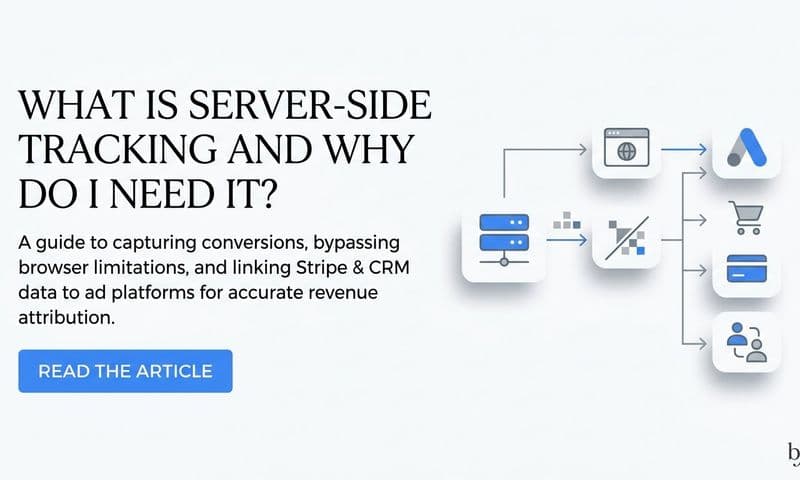
Server-side tracking bypasses all these limitations by sending data directly from your server to ad platforms. Instead of relying on browser pixels that can be blocked or fail, your server captures conversion events and transmits them to Meta, Google, and other platforms through secure API connections. A first party data tracking platform makes this implementation significantly easier.
This approach is fundamentally more reliable. Ad blockers can't prevent your server from sending data. Browser restrictions don't apply because the data never touches the browser. Device issues don't matter because the server handles everything.
Server-side tracking also enables you to send richer, more accurate first-party data. You can include customer information from your CRM, order values from your payment processor, and behavioral data from your website, all tied to specific conversion events. This enriched data gives ad platforms better signals for optimization.
When platforms receive high-quality conversion data, their algorithms can more accurately identify which types of users are likely to convert. This improves targeting, reduces wasted impressions on unlikely converters, and ultimately lowers your cost per acquisition.
The technical implementation involves setting up server-side event tracking through platforms like Meta's Conversions API and Google's server-side tagging. You configure your server to capture conversion events, match them to user sessions, and send them to ad platforms with proper attribution parameters.
This doesn't mean abandoning client-side tracking entirely. The most robust approach combines both: client-side tracking for immediate browser-based events and server-side tracking for critical conversions and enriched data. This redundancy ensures you capture data even when one method fails.
Building a Unified View of Your Customer Journey
Server-side tracking solves data collection reliability, but you still need a way to connect the dots across all your platforms and create a single source of truth.
This is where unified attribution platforms become essential. These systems integrate data from your ad platforms, CRM, website analytics, and payment processors into one centralized view. Instead of logging into five different dashboards and trying to reconcile conflicting numbers, you see the complete customer journey in one place. Implementing a cross platform conversion tracking solution addresses this fundamental need.
The key is connecting actual revenue to marketing touchpoints. When someone converts, the attribution platform matches that sale back to every ad interaction, email open, website visit, and other touchpoint that influenced the decision. You can see exactly which channels played a role and how much each contributed to the final conversion.
Multi-touch attribution models reveal the full story that last-click attribution misses. Last-click attribution gives 100% credit to whatever touchpoint happened right before the conversion. If someone clicked a Google search ad and then immediately purchased, Google gets all the credit even if they discovered your brand through a Facebook ad weeks earlier.
Multi-touch attribution distributes credit across all touchpoints based on their actual influence. Common models include linear attribution, which gives equal credit to all touchpoints, and time-decay attribution, which gives more credit to recent interactions while still acknowledging earlier ones. Choosing the right cross platform attribution software is critical for implementing these models effectively.
This matters because it changes how you allocate budget. You might discover that Facebook drives awareness and initial interest, LinkedIn nurtures consideration, and Google captures high-intent searchers ready to buy. Each channel plays a distinct role, and they work together to drive conversions.
If you only looked at last-click data, you'd overinvest in Google and potentially cut Facebook and LinkedIn, not realizing they're essential earlier in the journey. Multi-touch attribution prevents these costly mistakes.
Unified attribution also enables you to feed better data back to ad platforms. When you send enriched conversion events that include customer lifetime value, product categories, and other first-party data, platform algorithms can optimize for the conversions that actually matter to your business, not just any conversion.
This creates a positive feedback loop. Better data leads to better targeting, which leads to more qualified conversions, which generates more valuable data, which further improves targeting. Your campaigns become more efficient over time as the system learns from accurate attribution data.
Your Cross Platform Tracking Action Plan
Fixing cross platform tracking issues requires a systematic approach. Here's how to move from broken data to confident marketing decisions.
Immediate: Audit your current tracking setup. Document every platform you're running ads on and how conversions are currently tracked. Compare total platform-reported conversions to actual sales. Calculate the discrepancy percentage. Identify which platforms show the largest gaps. This audit reveals the scope of your tracking issues and prioritizes where to focus first. Our cross platform tracking setup guide provides a detailed framework for this process.
Medium-term: Implement server-side tracking. Start with your highest-volume conversion events. Set up server-side tracking for purchases, leads, or whatever conversion matters most to your business. Configure your server to send these events to your primary ad platforms through their APIs. Test thoroughly to ensure data is flowing correctly and matching client-side data where both exist.
Connect your data sources. Integrate your CRM, payment processor, and ad platforms into a unified attribution system. Map how data flows between systems. Ensure customer identifiers match across platforms so conversions can be properly attributed to the right marketing touchpoints. This connection is what transforms isolated platform data into actionable cross-platform insights.
Ongoing: Use AI-powered analysis for continuous optimization. Modern attribution platforms use AI to identify patterns in your data that humans might miss. They can spot which ad creatives drive the highest lifetime value customers, which audience segments convert at the best margins, and which channel combinations work synergistically. Use these insights to continuously refine your targeting, messaging, and budget allocation.
Monitor your attribution data regularly. Set up dashboards that show true performance metrics based on unified data, not platform-specific reports. Make budget decisions based on this single source of truth rather than trying to reconcile conflicting platform claims. Reviewing a cross platform tracking solutions comparison can help you select the right tools for your needs.
As you implement these changes, you'll notice your marketing decisions become clearer. You'll know with confidence which channels deserve more budget and which need optimization or cutting. Your cost per acquisition will become more accurate, and your return on ad spend will reflect reality rather than inflated platform numbers.
Moving Forward with Confidence
Cross platform tracking issues are not an inevitable cost of modern marketing. They're a solvable problem that requires the right infrastructure and approach.
The marketers who fix their attribution gain a significant competitive advantage. They allocate budgets based on actual performance, not guesswork. They identify winning strategies faster because their data is accurate. They scale campaigns with confidence because they know which channels truly drive revenue.
The foundation is server-side tracking that bypasses browser limitations and captures complete data. The next layer is unified attribution that connects all your data sources into a single view of the customer journey. The final piece is using that accurate data to continuously optimize your campaigns through AI-powered insights.
When you can see exactly which ads and channels drive leads and revenue across every touchpoint, you stop wasting money on duplicate conversions and misattributed performance. You start making decisions based on truth.
Ready to elevate your marketing game with precision and confidence? Discover how Cometly's AI-driven recommendations can transform your ad strategy. Get your free demo today and start capturing every touchpoint to maximize your conversions.