Data-driven marketing insights are the actionable “whys” you pull from your marketing data. They go beyond just reporting what happened and start explaining why it happened, giving you a clear path forward.
It's the difference between seeing a spike in traffic and knowing that the spike came from a specific influencer's mention, which means you should build more relationships with similar creators. In short, it’s about turning raw numbers into a story that guides smart, profitable decisions.
Why Data-Driven Marketing Insights Matter Now
In a world flooded with digital noise, the old 'spray and pray' marketing playbook is officially broken. Success isn't about reaching the most people anymore; it’s about reaching the right people with the right message at exactly the right moment. This is where data-driven marketing insights become your most valuable asset—a compass to navigate the messy, non-linear customer journey.
Without this compass, marketers are flying blind. You might cut a top-of-funnel social campaign that looks like it has a low direct ROI, not realizing it’s secretly the primary source of your highest-converting organic search traffic. Real insights prevent these kinds of costly mistakes by lighting up the hidden connections between every single marketing touchpoint.
 Unlocking Growth With Data Driven Marketing Insights
From Guesswork to Growth Engineering
Relying on intuition or vanity metrics like clicks and impressions is like trying to build a house without a blueprint. Sure, you might get a wall up, but the whole structure is fundamentally unstable.
When you shift to an insights-driven approach, you stop guessing and start engineering predictable growth. This pivot is a game-changer, allowing you to:
- Allocate Budgets Confidently: Pinpoint exactly which channels deliver the highest return on ad spend (ROAS) and move your money where it will actually work for you.
- Deepen Customer Understanding: Go way beyond basic demographics to uncover the behavioral patterns, preferences, and motivations that actually drive people to buy.
- Optimize the Entire Funnel: Find the friction points in your customer journey and make targeted fixes to boost conversion rates at every single stage.
The core promise of data-driven marketing is to transform your operations from hoping for results to creating them with precision. It’s about building a feedback loop where every action generates data, and every piece of data informs a smarter action.
The Accelerating Need for Clarity
It's no surprise that the demand for better measurement tools is exploding. The global marketing attribution software market rocketed from USD 1.8 billion in 2018 to a projected USD 3.6 billion by 2023, growing at a powerful 14.4% CAGR.
This trend is being supercharged by AI integrations that enable dynamic, real-time budget adjustments, helping performance marketers stay incredibly agile and efficient. You can explore the full market research about attribution software growth to see these trends in detail.
This guide will give you a clear roadmap to harness your data, understand the complete customer story, and make confident, profitable decisions that drive real, sustainable growth.
Decoding the DNA of Actionable Marketing Insights
Truly powerful data-driven marketing insights don’t just fall out of the sky. They’re carefully refined from raw information, almost like a chef turning simple ingredients into a gourmet dish. To get to insights that actually drive decisions, you need two key things: high-quality data sources and a smart way to give credit where it's due.
The whole process kicks off with understanding where your data comes from. In today's marketing world, relying on just one source is like trying to watch a movie with one eye closed—you miss half the picture. You need a mix of data to get a clear and accurate view, especially as the digital space shifts away from third-party cookies.
There are three main types of data you’ll be working with:
- First-Party Data: This is the goldmine of information you collect directly from your audience. Think email signups, purchase histories from your CRM, website behavior, and app usage. It's the most valuable and reliable data you have because you own it.
- Third-Party Data: This is data you buy from outside sources, which provides broad demographic and behavioral info. It can be useful for finding new audiences, but its reliability is dropping fast as privacy regulations get stricter.
- Server-Side Tracking Data: Instead of depending on a user's browser, this method sends data directly from your server to analytics platforms. It’s far more accurate, more secure, and isn't stopped by ad blockers, making it absolutely essential for a cookieless future.
Choosing the Right Attribution Model
Once you've got your data streams sorted, the next challenge is making sense of it all. This is where attribution models come into play.
Think of your marketing channels as players on a soccer team and the final conversion as the winning goal. An attribution model is just the rulebook that decides which players get credit for helping score.
A super common but deeply flawed approach is last-click attribution. This model gives 100% of the credit to the very last touchpoint before a conversion. In our soccer analogy, that’s like celebrating only the player who kicked the ball into the net, while completely ignoring the midfielders who set up the play and the defenders who got the ball in the first place. This model dangerously undervalues all the channels that build awareness and nurture leads early on.
To see the full picture, you need a model with a bit more sophistication. At the heart of decoding truly actionable insights lies a deep understanding of [the role of analytics in shaping marketing decisions](https://www.ryesing.com/post/the-role of-analytics-in-shaping-marketing-decisions).
An effective attribution model illuminates the entire customer journey, not just the final step. It recognizes that the first social media ad a customer saw is just as important as the final search ad they clicked.
This is exactly why multi-touch attribution models are so critical. They spread the credit across multiple touchpoints, giving you a far more accurate view of what’s genuinely working. By understanding how to read and act on your data, you can build a marketing strategy that's both more effective and resilient. If you're looking to go deeper, our guide on turning data into https://www.cometly.com/post/actionable-data offers more detailed steps.
To help illustrate this, let's compare some of the most common attribution models out there.
Comparing Marketing Attribution Models
Choosing the right attribution model is key to understanding your marketing performance. This table breaks down common models to help you decide which one best fits your business goals, whether you're focused on building brand awareness or closing sales.
Attribution Model | How It Works | Best For | Potential Blind Spot |
|---|---|---|---|
Last-Click | Assigns 100% of the credit to the final touchpoint before conversion. | Short sales cycles where the closing interaction matters most. | Ignores all top- and mid-funnel marketing efforts. |
First-Click | Gives 100% of the credit to the first interaction in the customer journey. | Brand awareness and demand generation campaigns. | Fails to credit channels that nurture and close leads. |
Linear | Distributes credit equally across every touchpoint. | Gaining visibility into the full customer journey. | Treats all touchpoints as equally important, which is rarely accurate. |
Time Decay | Allocates more credit to touchpoints that occur closer to conversion. | Longer B2B sales cycles where recent interactions have greater influence. | Can undervalue early-stage awareness and discovery efforts. |
Data-Driven | Uses algorithms to assign credit based on observed performance patterns. | Accurately measuring the true impact of each channel. | Requires significant data volume and advanced analytics capabilities. |
Ultimately, the right model depends entirely on your business goals. An e-commerce brand might use a Time Decay model to value recent interactions, while a SaaS company might prefer a Linear model to see the whole nurturing process. The goal is to pick a model that aligns with your strategy, turning a confusing mess of numbers into a clear, actionable story.
Building Your Data Driven Insights Engine
Turning a mountain of raw data into actual data driven marketing insights isn't about just collecting numbers—it’s about building a structured, intentional system. Think of it like building a high-performance engine. You need the right parts (data sources), a powerful ignition system (tracking and attribution), and a clean dashboard to see what’s happening. Without a cohesive engine, you’re just left with a garage full of expensive parts that aren’t going anywhere.
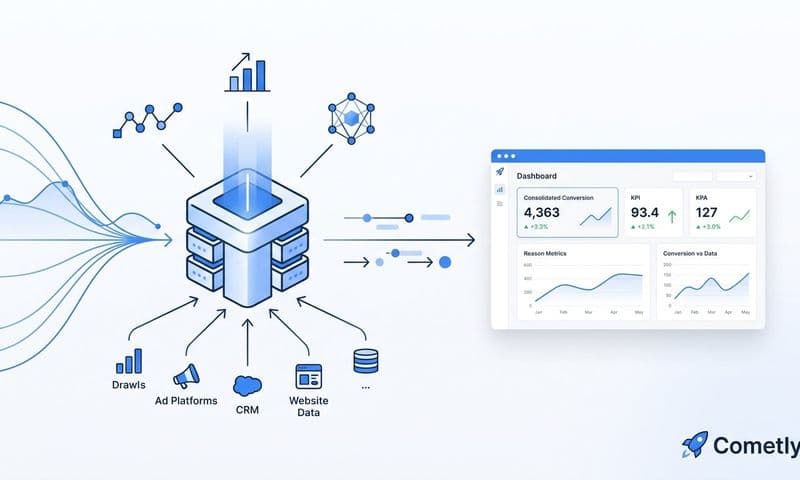
The first step is to get your data stack talking to itself. Right now, customer information is probably scattered across a dozen different platforms—your CRM, ad networks, email service, and payment processor. Leaving this data in separate silos is like trying to solve a puzzle with half the pieces missing. Real insights only pop up when you connect these different sources into a single, seamless view of the customer journey. A clear data driven marketing strategy is the blueprint you need to build this right.
Laying the Foundation with Accurate Tracking
Once you know where your data lives, the next critical layer is implementing tracking that you can actually trust. In a world of ad blockers and privacy updates, relying only on browser-based tracking is a recipe for disaster. The data will be flat-out wrong.
This is where server-side tracking becomes a non-negotiable. It sends conversion data directly from your server to your marketing platforms, making sure every critical event is captured accurately and securely. This direct line of communication bypasses the usual spots where data gets lost, giving you a much truer picture of how your campaigns are performing. This accuracy is fundamental; without it, any attribution model you use is built on a shaky foundation, leading to bad conclusions and wasted ad spend. You can learn more about how a unified approach helps in our guide on creating a data driven marketing strategy.
This concept map shows how different data sources and attribution methods work together to generate powerful marketing insights.
 Unlocking Growth With Data Driven Marketing Insights
The map drives home the point that insights aren't a one-off discovery. They’re the result of an interconnected system where clean data and smart attribution work hand-in-hand.
Choosing Your Attribution Compass
With accurate data flowing in, you can finally pick an attribution model that actually fits your business goals. Like we’ve discussed, a last-click model might be fine for a simple e-commerce store. But if you’re a B2B company with a six-month sales cycle, you need a multi-touch model like Time Decay or Data-Driven to give proper credit to every interaction along the way.
The model you choose acts as your strategic compass. It decides which channels get credit and, in turn, where you invest your budget. This single decision directly shapes your ROAS and can mean the difference between scaling a winning channel and killing an essential awareness campaign too early.
Your attribution model isn't just a technical setting; it's a declaration of what you value in your marketing mix. It tells the story of how you believe customers find and connect with your brand.
It's no surprise that small and medium businesses (SMEs) are jumping on these tools. The marketing attribution software market for this segment is set to grow at a blistering 14.5% CAGR from 2025 to 2030. And while 60% of SMEs struggle with siloed data, smarter methods like probabilistic attribution are picking up steam. This AI-powered approach clusters user behaviors in real-time, making it perfect for the short sales cycles common in e-commerce, where you have to be agile.
From Metrics to Actionable Dashboards
The final piece of your insights engine is the dashboard—your command center. A common mistake here is to cram it with vanity metrics like clicks, impressions, and likes. These numbers might feel good, but they rarely have a direct line to revenue.
Instead, your dashboard should be laser-focused on the metrics that actually matter to your bottom line. These are the indicators that tell you if your engine is running efficiently or about to stall.
Here are the key metrics to prioritize:
- Customer Acquisition Cost (CAC): What it costs you, in total, to get a new customer.
- Return on Ad Spend (ROAS): The revenue you make for every single dollar you spend on ads.
- Customer Lifetime Value (LTV): The total revenue you can expect from a single customer over time.
- LTV to CAC Ratio: A critical health metric. It shows if your customer acquisition is actually profitable in the long run.
By focusing on these core KPIs, you move from data chaos to revenue clarity. This empowers your team to make confident decisions that directly fuel growth.
Putting Your Marketing Insights Into Action
Theory is great, but the real magic happens when you use data driven marketing insights to make smarter decisions that actually grow your business. This is where the rubber meets the road—moving from just looking at data to acting on it with confidence. It’s about turning abstract numbers into tangible wins.
Let's walk through three real-world scenarios to show you what this looks like. Each story breaks down how a specific insight, found through solid analysis and attribution, led to a measurable jump in marketing performance. This is what becomes possible when you finally connect the dots across the entire customer journey.
 Unlocking Growth With Data Driven Marketing Insights
Scenario 1: Saving a Top-of-Funnel Campaign
An e-commerce brand selling sustainable fashion was about to kill its entire TikTok ad budget. At first glance, the numbers were a disaster. Their last-click attribution model showed a pathetic Return on Ad Spend (ROAS), making it look like the channel was just burning cash with zero direct sales.
But before they pulled the plug, the marketing team decided to look at the data through a multi-touch attribution lens. What they saw changed everything.
The TikTok campaigns were the single biggest source of new, high-value customers who would later convert through branded Google Search ads. TikTok was the first touchpoint that introduced the brand to its best future buyers.
Armed with this new perspective, the brand made two critical adjustments:
- They Kept the Campaign: Instead of slashing the budget, they recognized TikTok’s vital role in building awareness and feeding their best-performing channels.
- They Optimized Creatives: They doubled down on the TikTok ads that drove the most eventual Google search conversions, not just the ones that got immediate clicks.
The result? By protecting their top-of-funnel engine, they kept a steady stream of new customers flowing in. Even better, their overall ROAS from Google Ads actually went up because the quality of the incoming traffic stayed high. Last-click attribution would have tricked them into making a very expensive mistake.
If you want to get this kind of clarity, it's worth exploring how to set up effective data-driven attribution for your own marketing.
Scenario 2: Identifying High-Value Customer Segments
A fast-growing B2B SaaS startup was running webinars to generate leads. They covered a wide range of topics, from super-technical deep dives to high-level strategy sessions. Lead volume was decent, but the quality was all over the place, leaving the sales team scrambling to figure out who to follow up with.
So, they used their CRM and analytics platform to connect webinar attendance data directly to sales outcomes. They tracked which attendees turned into paying customers and—more importantly—which ones became their highest-value enterprise clients.
The insight was undeniable: attendees from their "Advanced API Integration" webinar series had a 3x higher customer lifetime value (LTV) than attendees from any other topic. This niche, technical content was attracting the exact audience ready to buy and scale with their product.
That single data point triggered a complete overhaul of their content strategy. They stopped producing broad, generic webinars and went all-in on creating more advanced, technical content for their ideal customer. This strategic shift didn't just boost lead quality; it also shortened their sales cycle because the sales team could now focus on a smaller pool of highly qualified prospects.
Scenario 3: Scaling a Winning Ad Creative
A digital marketing agency was managing ad accounts for five different e-commerce clients, all in the same niche. They were constantly testing new ad creatives—images, videos, headlines—but they were treating each account like its own island, struggling to find patterns.
By pulling all their performance data into a single dashboard, they could finally analyze creative performance across their entire client portfolio. An analyst quickly spotted something interesting: one specific user-generated testimonial video was blowing every other creative out of the water for one particular client.
They decided to run an experiment and test this "winner" with their other clients. The agency created slightly tweaked versions of the testimonial ad for each brand and launched them. The results were immediate and explosive. That testimonial-driven creative resonated powerfully across the entire niche.
Within a week, the agency had scaled the winning creative across all relevant accounts, boosting the average client ROI by 25%. This insight allowed them to stop guessing what might work and instead replicate a proven formula for success, delivering massive value for their clients.
Navigating the AI and Cookieless Future
The ground is shifting beneath marketers' feet. Two massive forces are reshaping how we gather and use data-driven marketing insights: the explosion of artificial intelligence and the fast-approaching end of third-party cookies. These aren't just minor tremors; they represent a fundamental pivot in how marketing works. Staying ahead means building a strategy that isn’t just resilient, but is actually designed to thrive in this new environment.
The good news is that these shifts are creating some incredible opportunities. AI, in particular, is upgrading marketing insights from a reactive report card to a proactive co-pilot. Instead of just telling you what happened last month, modern AI-powered tools can now predict future trends and suggest specific optimizations.
AI as Your Marketing Co-pilot
Think of traditional marketing analytics as a rearview mirror—it’s great for seeing where you’ve been. AI, on the other hand, is like a GPS navigator with live traffic updates. It analyzes real-time data to suggest the most efficient path forward, helping you avoid roadblocks before you even see them.
This capability is completely changing how decisions are made. AI can now offer proactive recommendations, such as:
- Predictive Budget Allocation: Suggesting you shift spend from a campaign showing early signs of fatigue to one that’s gaining momentum.
- Trend Forecasting: Identifying emerging customer interests or market shifts, allowing you to create relevant content before your competitors do.
- Creative Optimization: Analyzing thousands of ad variations to pinpoint which images, headlines, and calls to action drive the best results.
This evolution is a huge driver of market growth. The marketing attribution software market is projected to nearly triple, surging from USD 5.17 billion in 2025 to USD 14.55 billion by 2032. This incredible 15.9% CAGR is propelled directly by AI-driven predictive models and the urgent need for cookieless solutions. You can read more about the future of attribution software and see how these trends are shaping the industry.
Thriving in a Cookieless World
While AI offers a glimpse into the future, the end of third-party cookies forces a return to fundamentals. For years, marketers relied on these cookies to track users across the web, but privacy concerns are bringing that era to a close. By 2025, the death of third-party cookies will have pushed an estimated 80% of platforms toward more reliable data solutions.
This makes building a robust first-party data strategy an absolute necessity for survival.
In the cookieless future, the data you collect directly from your customers isn't just an asset; it's your entire foundation. Your email lists, CRM data, and website interactions are the new gold.
To make this data truly valuable, you need a reliable way to collect and unify it. This is where server-side tracking becomes essential. It creates a direct, secure connection between your website and your analytics platforms, ensuring that every conversion is tracked accurately without being blocked by browsers. To learn more about this crucial shift, you can explore our detailed guide on the importance of first-party data in modern marketing.
By embracing both AI-driven recommendations and a strong first-party data foundation, you can build a marketing strategy that is not only prepared for the future but is positioned to lead it.
Your Action Plan for Driving Growth With Data
Okay, you've seen how powerful data can be. Now it's time to turn that knowledge into real, measurable growth.
This isn't about flipping a switch and changing everything overnight. It's about taking small, deliberate steps to build a culture where every decision is backed by data. Think of this as your roadmap—a clear, no-fluff plan to get from data overload to decisive action.
The goal is to create a repeatable system where insights directly fuel optimizations. This creates a powerful feedback loop that drives sustainable growth. Let’s get started.
The Foundational Steps to Success
Before you can act on data driven marketing insights, you need a solid foundation. This is where most teams get stuck—trying to analyze messy, incomplete information. Don't skip these crucial first steps. They ensure every decision you make later is based on reality, not guesswork.
- Unify Your Data Sources: Your first job is to break down the silos. You need to connect your ad platforms, CRM, and sales data into a single, unified view. Without this, you’re trying to solve a puzzle with half the pieces missing. A central source of truth isn't just nice to have; it's non-negotiable.
- Establish Rock-Solid Tracking: Next, implement server-side tracking to capture every single conversion accurately. Browser-based tracking just doesn't cut it anymore with ad blockers and privacy updates constantly getting in the way. Clean, trustworthy data is the bedrock of any successful insights engine.
- Define Your North Star Metrics: It's time to ditch the vanity metrics. Identify the key performance indicators (KPIs) that are directly tied to revenue, like Customer Acquisition Cost (CAC), Return on Ad Spend (ROAS), and Customer Lifetime Value (LTV). These are the numbers that actually matter to the business. For a deeper look at this process, check out our guide on essential reporting and analytics.
From Insights to Optimization
With your foundation firmly in place, you can move into the ongoing cycle of analysis and action. This is where you start turning numbers into strategy.
The core of a data-driven culture isn't about having the most data; it's about consistently asking "what does this data tell us to do next?" and then having the courage to do it.
This process follows a simple but powerful loop:
- Analyze and Segment: Dive into your unified data. Identify the high-performing segments, channels, and creatives. Who are your most valuable customers? What journey did they take to get there?
- Hypothesize and Test: Based on an insight, form a clear hypothesis. For example, "We believe this ad creative resonates with our high-LTV segment, so scaling its budget should increase our overall ROAS."
- Implement and Measure: Launch your test. Then, rigorously measure the results against your baseline performance and your north star metrics.
- Iterate or Scale: If the test succeeds, it's time to scale that winning strategy. If it fails, that's not a loss—it's a lesson. Document what you learned and form a new hypothesis.
By consistently following this framework, you’ll move beyond one-off wins and build a scalable system for growth. You'll finally be turning data driven marketing insights into your most powerful competitive advantage.
Frequently Asked Questions
Jumping into the world of data-driven marketing insights usually brings up a few common questions. Let's tackle some of the big ones so you can move forward with confidence.
Analytics vs. Insights: What's the Difference?
It’s really easy to mix these two up, but they’re completely different steps in making smart decisions. Getting this distinction right is the key to unlocking real growth.
Think of it like a doctor looking at a patient's chart. Marketing analytics are the lab results—they’re just the raw numbers and facts. Analytics tells you, "Website traffic dropped by 20% last week." It’s a critical piece of information, but it only tells you what happened.
Marketing insights, on the other hand, are the doctor's diagnosis. This is where you connect the dots to figure out why it happened and what you should do next. An insight would sound more like this: "Our traffic drop lines up perfectly with a competitor's new sale, and our branded search volume took a hit. We need to launch a counter-promotion to get back in front of our audience."
In short, analytics gives you the facts. Insights tell you the story behind those facts and hand you a clear, actionable plan. One describes the problem; the other delivers the solution.
How Long Does It Take to See Results?
This is the million-dollar question, and the honest answer is: it depends. While you can get a new attribution platform like Cometly up and running in just a few hours, gathering enough data to generate meaningful insights takes a bit longer. You need to see clear patterns emerge.
For most businesses, that means letting the data cook for at least one full sales cycle. This could be a couple of weeks for a fast-moving e-commerce store, or it might be several months for a B2B company with a longer sales process.
Trying to draw conclusions from just a few days of data is like trying to call the winner of a marathon based on who’s leading after the first 100 yards. Give it time.
Is This Practical for a Small Business?
Absolutely. In fact, you could argue a data-driven approach is more critical for a small business with a tight budget. When every single dollar counts, you can't afford to waste money on channels or campaigns that aren't actually working.
Big companies might have the budget to absorb some inefficient ad spend, but a small business doesn't have that luxury. By setting up a system to track what truly drives revenue from day one, you get to stop guessing and start investing.
It lets you focus your limited resources with surgical precision, ensuring your marketing spend is an investment, not an expense. This is how you build a foundation for profitable growth right from the start.
Ready to stop guessing and start engineering growth? See how Cometly can unify your marketing data and deliver the actionable insights you need to scale with confidence. Explore Cometly today.