You've got dashboards full of data. Conversion pixels firing on every page. Reports from Meta, Google, your CRM, and your analytics platform. But when your CEO asks which campaigns actually drove revenue last quarter, you're piecing together spreadsheets and making educated guesses.
This is the paradox modern marketers face: drowning in data while starving for insights. You're collecting metrics across a dozen platforms, but you can't connect the dots between ad spend and actual revenue. You're optimizing campaigns based on platform-reported conversions that don't match what your sales team sees in the CRM. You're making budget decisions with incomplete information.
A digital analytics strategy bridges this gap. It's the systematic framework that transforms scattered data points into a clear picture of what's driving revenue. Not just tracking metrics—connecting every touchpoint in the customer journey to business outcomes. Not just collecting data—building a closed-loop system where insights flow directly into optimization decisions. This article breaks down exactly how to build that framework, from tracking infrastructure to attribution modeling to AI-powered optimization.
The Building Blocks of Effective Analytics
A digital analytics strategy is your systematic approach to collecting, analyzing, and acting on marketing data across all channels. Think of it as the operating system that powers every marketing decision—from daily budget adjustments to quarterly planning.
Here's what separates strategy from random data collection: intentionality. You're not tracking everything because you can. You're tracking specific metrics that connect directly to revenue outcomes. You're building infrastructure that captures the complete customer journey, not just isolated interactions.
The first distinction to master? Vanity metrics versus revenue-driving metrics. Impressions look impressive in a report. Click-through rates feel actionable. But neither tells you what you actually need to know: which campaigns put money in the bank.
Vanity Metrics: Impressions, clicks, page views, engagement rate. These measure activity, not outcomes. They're useful for diagnosing problems, but terrible for making budget decisions.
Revenue-Driving Metrics: Customer acquisition cost, lifetime value, true return on ad spend, cost per qualified lead, revenue per channel. These connect marketing activity directly to business results.
The shift from vanity to revenue metrics requires three foundational pillars working together.
Data Collection Infrastructure: This is your tracking foundation—the pixels, server-side events, and integrations that capture every touchpoint. Without accurate data flowing in, everything downstream falls apart. Understanding data analytics for digital marketing starts with getting this foundation right.
Attribution Modeling: This connects the dots between touchpoints and conversions. When a customer clicks three different ads, visits your site organically, and converts via email, attribution tells you how to assign credit across those interactions.
Actionable Reporting: This transforms raw data into decisions. Not 47-page reports that nobody reads. Real-time dashboards that answer specific questions: Which campaigns should get more budget today? Which audiences are converting at the lowest cost? Where are we wasting spend?
These three pillars work as a system. Accurate tracking feeds attribution models. Attribution insights power actionable reports. Reports drive optimization decisions that improve results. The cycle repeats, continuously refining your marketing performance.
Most marketers have pieces of this system. They've got Google Analytics running. They're tracking conversions in their ad platforms. But the pieces don't talk to each other, creating blind spots where revenue attribution should be crystal clear.
Mapping the Customer Journey From Click to Conversion
Picture this: A potential customer sees your Facebook ad on Monday morning. They don't click. Tuesday afternoon, they search for your product category on Google and click your ad. They browse your site but leave without converting. Wednesday, they see your retargeting ad on Instagram and click through again. Thursday, they receive your email newsletter and click a link. Friday, they type your URL directly into their browser and finally make a purchase.
Which channel gets credit for that conversion? If you're only looking at platform data, you'll get five different answers—and all of them will be wrong.
The modern customer journey is rarely linear. People bounce between devices, channels, and touchpoints before converting. They might interact with your brand seven times across four platforms before they're ready to buy. Each touchpoint plays a role, but siloed platform data can't show you the complete picture.
Meta Ads Manager shows you the conversion and claims credit because the customer clicked an Instagram ad. Google Analytics attributes it to direct traffic because that was the final session. Your email platform reports it as an email conversion. Everyone's claiming the same sale, inflating your reported ROAS while hiding which channels actually influenced the decision.
This creates three critical blind spots that undermine marketing decisions.
The Attribution Gap: You can't see which early-funnel touchpoints are priming customers for later conversions. That expensive prospecting campaign might be essential for conversions that your last-click model attributes elsewhere. Understanding what is digital marketing attribution helps you recognize these gaps in your current setup.
The Cross-Device Problem: When customers switch from mobile to desktop, or from work computer to personal device, tracking breaks. You're treating one person as multiple anonymous visitors, fragmenting their journey.
The iOS Blindspot: Apple's App Tracking Transparency framework limits what Meta and other platforms can track. Conversions happen, but your pixel doesn't see them. You're optimizing campaigns based on incomplete data.
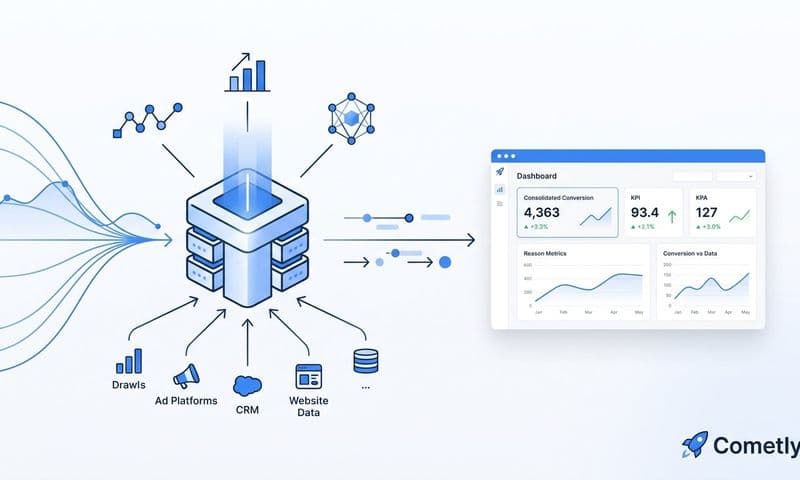
Unified tracking solves these problems by capturing every touchpoint in a single system. When someone clicks your Facebook ad, that event gets recorded. When they return via Google search, that's captured too. When they open your email and finally convert, the system connects all those dots into one coherent journey.
This isn't just better reporting. It's fundamentally different intelligence. You can see that your Facebook prospecting campaigns rarely drive direct conversions, but they're essential for warming up audiences that convert later through search. You can identify that customers who interact with both paid social and email convert at three times the rate of single-channel visitors. You can spot that your retargeting budget is wasted on people who were already planning to buy.
The technical mechanism behind unified tracking involves capturing events server-side and connecting them through persistent identifiers. When someone fills out a form, makes a purchase, or takes any conversion action, that data flows into your CRM with complete journey history attached. Every ad click. Every email open. Every site visit. All connected to the same customer record.
This creates what marketers call a "single source of truth"—one system that knows the complete story of how customers found you, what influenced them, and what finally drove conversion. No more reconciling conflicting reports from different platforms. No more guessing which channels deserve credit. Just clear visibility into what's actually working.
Choosing the Right Attribution Model for Your Business
Attribution models are the rules you use to assign credit when multiple touchpoints contribute to a conversion. Get this wrong, and you'll optimize toward the wrong channels. Get it right, and you'll know exactly where to invest your budget.
Let's break down the most common models and when each makes sense for your business.
First-Touch Attribution: All credit goes to the first interaction. If someone clicks a Facebook ad, visits your site three more times through different channels, and converts, Facebook gets 100% credit. This model favors top-of-funnel awareness channels. It's useful when you're focused on understanding how people discover your brand, but it ignores everything that happened after that initial click.
Last-Touch Attribution: All credit goes to the final touchpoint before conversion. If someone's journey involved five different channels but they converted after clicking an email link, email gets full credit. Most ad platforms default to this model because it makes their performance look better. The problem? It completely ignores the channels that built awareness and consideration.
Linear Attribution: Every touchpoint gets equal credit. Five interactions means each gets 20% attribution. This model acknowledges that multiple channels contribute, but it treats a quick retargeting click the same as the prospecting campaign that introduced your brand. It's fair, but not particularly insightful.
Time-Decay Attribution: More recent touchpoints get more credit. The logic here is that interactions closer to conversion had more influence on the decision. This works well for businesses with longer sales cycles where early touchpoints might be weeks or months old by the time someone converts.
Data-Driven Attribution: Instead of applying a fixed rule, this model uses machine learning to analyze your actual conversion patterns and assign credit based on what your data shows. It might determine that for your business, the second touchpoint is most influential, or that certain channel combinations drive higher conversion rates.
So which model should you use? It depends on your sales cycle and channel mix.
For businesses with short sales cycles—think e-commerce or low-cost SaaS—last-touch or time-decay models often work well. People discover your product and convert quickly, so recent interactions matter most.
For businesses with longer sales cycles—enterprise software, high-ticket services, complex B2B products—you need multi-touch attribution. Customers interact with your brand many times over weeks or months. First-touch tells you what's working for awareness. Time-decay or data-driven models show you the full journey.
For businesses running diverse channel mixes across awareness, consideration, and conversion stages, data-driven attribution provides the most accurate picture. It adapts to your actual customer behavior rather than imposing a one-size-fits-all rule. Exploring digital attribution analytics can help you understand which model fits your specific situation.
But here's the challenge that's transformed attribution in recent years: iOS tracking limitations and cookie deprecation have made traditional pixel-based attribution unreliable. When Apple introduced App Tracking Transparency, it gave users the power to opt out of cross-app tracking. Most did. Suddenly, Meta's pixel couldn't see conversions that happened in-app or after users switched devices.
Third-party cookies are being phased out across browsers. Google Chrome, the last major holdout, is eliminating them entirely. This breaks the tracking mechanisms that attribution models rely on.
Server-side tracking has emerged as the solution. Instead of relying on browser pixels that users can block, you capture conversion events directly on your server and send them to your attribution platform. This maintains data accuracy regardless of privacy settings, giving you reliable attribution even in a post-cookie world. The comparison between Google Analytics vs server side tracking reveals why this shift matters for accurate measurement.
The shift to server-side tracking isn't optional anymore. It's the foundation that makes any attribution model work in the current privacy landscape.
Turning Insights Into Optimization Decisions
Data without action is just noise. The point of attribution and analytics isn't building beautiful dashboards—it's making better decisions that improve campaign performance. Let's walk through how to transform insights into optimization moves that drive revenue.
Start by identifying your high-performing ads and campaigns using cross-channel data, not platform-reported metrics. Pull up your attribution dashboard and filter by true revenue generated, not just conversions tracked. Look for campaigns where the customer acquisition cost is well below lifetime value. These are your winners—the campaigns that actually put money in the bank.
Now comes the critical part: reallocating budget based on true revenue attribution. Platform-reported ROAS often misleads you. Meta might show a campaign with 3x ROAS, but when you check your CRM, those "conversions" didn't result in actual purchases. Meanwhile, a prospecting campaign showing 1.5x ROAS in Meta might be driving customers who convert later through other channels at 5x true ROAS.
This is where unified attribution changes everything. You can see that your YouTube awareness campaigns rarely drive direct conversions, but customers who watch your videos convert at twice the rate when they later click search ads. You can identify that LinkedIn generates expensive leads, but they close at three times the rate of Facebook leads. You can spot that your retargeting budget is being wasted on people who were already going to convert organically. Understanding channel attribution in digital marketing helps you make these cross-channel comparisons accurately.
Make optimization decisions based on this complete picture, not isolated platform metrics.
Budget Reallocation: Shift spend from campaigns with inflated platform-reported ROAS to campaigns with strong true revenue attribution. This often means investing more in upper-funnel awareness that doesn't get credit in last-click models but significantly improves conversion rates across all channels.
Audience Refinement: Analyze which audience segments generate the highest lifetime value, not just the most conversions. You might find that broad audiences convert at lower rates but generate customers with much higher retention and repeat purchase rates.
Creative Testing: Use attribution data to understand which ad creative drives not just clicks, but quality conversions. The ad with the highest click-through rate might attract tire-kickers while a different creative drives serious buyers.
But here's where strategy gets really powerful: feeding enriched conversion data back to ad platforms. Meta's algorithm, Google's Smart Bidding, LinkedIn's optimization—they all rely on conversion data to improve targeting and bidding. When your tracking is incomplete due to iOS limitations or cookie blocking, these algorithms optimize based on partial data. They're flying blind.
Server-side tracking captures conversions that pixels miss, then sends that complete data back to ad platforms through their Conversion APIs. Suddenly, Meta's algorithm sees all the conversions, not just the ones that happened in-browser on iOS devices that opted into tracking. Google's Smart Bidding gets accurate conversion values instead of incomplete data. The platforms' AI can optimize properly because it's working with complete information.
This creates a flywheel effect. Better data leads to better ad platform optimization. Better optimization drives more efficient conversions. More conversions generate more data to refine your strategy further. Your campaigns get smarter over time instead of hitting a performance ceiling.
Building Your Analytics Tech Stack
Your analytics strategy is only as strong as the tools that power it. Let's break down the essential components of a modern marketing analytics tech stack and how they should connect to create a single source of truth.
Tracking Implementation: This is your data collection layer. You need both client-side pixels and server-side tracking working together. Client-side pixels capture browser-based events—page views, button clicks, form starts. Server-side tracking captures conversion events that happen after form submission—purchases, sign-ups, qualified leads. The combination ensures you're not missing conversions due to ad blockers, privacy settings, or cross-device journeys.
Attribution Platform: This is the brain of your analytics stack. It receives data from all your tracking points, connects touchpoints into complete customer journeys, applies your chosen attribution model, and calculates true revenue metrics. Look for platforms that support multiple attribution models so you can compare first-touch versus time-decay versus data-driven attribution for the same campaigns. When evaluating options, understanding the difference between Google Analytics vs attribution platform capabilities helps you make the right choice.
CRM Integration: Your CRM holds the ultimate truth about which leads became customers and how much revenue they generated. Your attribution platform needs direct integration with your CRM to connect ad clicks to actual sales. This is what transforms marketing attribution from "we think this worked" to "we know exactly which campaigns drove revenue."
Reporting Dashboard: This is where insights become visible. You need real-time dashboards that answer specific questions: Which campaigns are profitable today? Where should we shift budget this week? Which audiences have the lowest CAC? The best dashboards don't just display data—they surface anomalies, highlight opportunities, and make the next action obvious. Building effective data analytics dashboards requires focusing on actionable metrics rather than vanity numbers.
These four components should connect seamlessly. When someone clicks your ad, your tracking implementation captures it. When they convert, your CRM records it. Your attribution platform connects these events into a complete journey. Your dashboard displays the results in real time. No manual data exports. No spreadsheet reconciliation. Just continuous data flow from ad click to revenue attribution.
The importance of real-time data can't be overstated. Marketing moves fast. Ad platforms adjust bids every few hours. Campaigns can burn through budget in a day. If you're making decisions based on yesterday's data, you're always one step behind. Real-time attribution lets you spot problems immediately—a campaign that's spending aggressively but not converting, an audience that suddenly stopped performing, a creative that's driving low-quality leads.
This enables agile campaign adjustments. You can pause underperforming campaigns before they waste significant budget. You can scale winning campaigns while they're hot. You can test new audiences and get quick feedback on whether they're worth pursuing. Speed matters in paid advertising, and real-time data gives you the speed advantage.
When evaluating tools for your stack, prioritize integration capabilities over feature lists. The best attribution platform with poor CRM integration is less valuable than a solid platform that connects seamlessly with your existing tools. Your tech stack should reduce complexity, not add more disconnected systems to manage. Reviewing the best marketing analytics software options helps you identify solutions that fit your specific needs.
Putting Your Strategy Into Action
Theory is worthless without execution. Let's walk through a practical roadmap for implementing your digital analytics strategy, from audit to ongoing optimization.
Phase One: Audit Current Tracking (Week 1-2). Start by documenting what you're tracking today and where the gaps are. Check if your pixels are firing correctly. Verify that conversion events are reaching your ad platforms. Test cross-device tracking by visiting your site on mobile and converting on desktop—does your analytics connect those sessions? Identify where conversions are being missed due to iOS limitations or ad blockers. This audit reveals exactly what needs fixing.
Phase Two: Implement Unified Measurement (Week 3-6). Set up server-side tracking for all conversion events. Integrate your CRM with your attribution platform so every sale connects back to marketing touchpoints. Configure your attribution models—start with last-touch for comparison to your current setup, then add time-decay or data-driven models. Test thoroughly to ensure data flows correctly from ad click through conversion to reporting. Following a structured attribution analytics implementation process prevents common setup mistakes.
Phase Three: Establish Reporting Cadence (Week 7+). Build dashboards that answer your most critical questions. Set up weekly reviews for tactical campaign adjustments and monthly reviews for strategic budget allocation. Define which metrics you'll check daily (spend, conversion volume, CAC) versus weekly (ROAS by channel, audience performance) versus monthly (customer lifetime value, cohort analysis, channel mix optimization).
Your reporting cadence should match your decision-making rhythm. For performance marketers running daily campaigns, you need daily dashboards. For brand marketers planning quarterly campaigns, weekly reviews with monthly deep dives make more sense.
Key Metrics to Review Weekly: Cost per acquisition by campaign, conversion rate by audience, daily ad spend versus budget, ROAS by channel, top performing ad creative, underperforming campaigns to pause.
Key Metrics to Review Monthly: Customer lifetime value by acquisition source, channel contribution to overall revenue, attribution model comparisons, cohort retention rates, budget allocation efficiency, forecasted CAC trends.
The most important mindset shift? Analytics strategy is never finished. It's iterative and evolutionary. You'll continuously test new attribution models to see which provides the most actionable insights. You'll refine your tracking as new platforms emerge and privacy regulations change. You'll adjust your reporting as your business priorities shift. Understanding marketing analytics strategy as an ongoing process rather than a one-time setup is crucial for long-term success.
Treat your analytics strategy like you treat your campaigns—always testing, always optimizing, always improving. The marketers who win aren't the ones with perfect setups from day one. They're the ones who continuously refine their approach based on what the data reveals.
The Competitive Edge of Complete Attribution
A digital analytics strategy isn't about collecting more data. You already have more data than you know what to do with. It's about connecting the right data to revenue outcomes—building a clear line of sight from every ad dollar spent to every dollar of revenue generated.
Most marketers are still operating in the dark, making budget decisions based on incomplete platform data and educated guesses. They're optimizing campaigns toward metrics that don't correlate with actual revenue. They're missing conversions their tracking can't see. They're feeding incomplete data to ad platform algorithms that could perform better with accurate information.
The competitive advantage goes to marketers who know exactly which ads and channels drive conversions. Not which platforms claim credit. Not which campaigns generated the most clicks. Which specific audiences, creative, and channels actually put money in the bank. That knowledge transforms marketing from a cost center into a predictable revenue engine.
When you can see the complete customer journey, you make fundamentally different decisions. You invest in upper-funnel awareness that traditional attribution ignores but your unified data proves is essential. You cut spending on channels with inflated platform-reported ROAS but weak true revenue attribution. You feed better data back to ad platforms, improving their AI optimization and driving down your acquisition costs.
This is the difference between marketing that scales and marketing that hits a wall. Without clear attribution, you can't confidently increase budget because you don't know what's actually working. With unified measurement, you can scale winning campaigns aggressively because you know exactly what returns to expect.
Take a hard look at your current analytics setup. Can you connect every conversion back to the first touchpoint that introduced your brand? Do you know which channel combinations drive the highest lifetime value? Can you feed complete conversion data back to your ad platforms? If you're answering no to any of these questions, you have attribution gaps that are costing you revenue.
Ready to elevate your marketing game with precision and confidence? Discover how Cometly's AI-driven recommendations can transform your ad strategy—Get your free demo today and start capturing every touchpoint to maximize your conversions.