Every dollar you spend on digital marketing tells a story—but are you reading it correctly? Most marketers drown in data yet struggle to extract the insights that actually matter. You've got dashboards from Google Ads, Meta, LinkedIn, your CRM, and analytics tools, each reporting different numbers that rarely align. Meanwhile, your boss wants to know which campaigns are working, where to cut budget, and how to scale what's driving revenue.
Digital marketing analysis transforms raw campaign data into actionable insights that reveal which channels drive real revenue, which ads deserve more budget, and which efforts are quietly draining resources. Without systematic analysis, you're essentially flying blind, making decisions based on gut feelings rather than evidence.
The challenge isn't lack of data—it's knowing how to organize it, what to measure, and how to translate findings into strategic moves that improve performance. This guide walks you through a proven six-step framework for conducting thorough digital marketing analysis. By the end, you'll know exactly how to gather the right data, identify meaningful patterns, and translate findings into strategic actions that improve campaign performance.
Whether you're analyzing a single campaign or your entire marketing ecosystem, these steps provide the foundation for confident, data-driven decision-making. Let's break down each step so you can start extracting real value from your marketing data.
Step 1: Define Your Analysis Goals and Key Questions
Before diving into spreadsheets and dashboards, you need clarity on what you're actually trying to learn. Too many marketers start analysis by pulling every available metric, hoping patterns will magically emerge. This approach leads to analysis paralysis and wasted time examining data that doesn't inform decisions.
Start by identifying the specific business questions driving your analysis. These should be concrete, decision-oriented questions like "Which channel delivers the lowest cost per acquisition?" or "Where are prospects dropping off in the funnel?" or "Why did our conversion rate drop 30% last month?" Each question should connect directly to a decision you need to make or a problem you need to solve.
Align your analysis objectives with broader business goals. If your company is focused on revenue growth, your analysis should prioritize metrics tied to customer acquisition and lifetime value. If efficiency is the priority, focus on cost metrics and conversion optimization. This alignment ensures your analysis actually matters to stakeholders and influences strategy.
Document three to five primary questions to keep your analysis focused and prevent data overwhelm. Write them down before you touch any data. This simple act creates guardrails that prevent you from wandering into interesting but irrelevant tangents. You can always conduct additional analysis later, but starting with clear questions ensures you'll actually finish and take action.
Common Questions That Drive Effective Analysis: Which marketing channel has the best return on ad spend? What's our true customer acquisition cost when accounting for all touchpoints? Which audience segments convert at the highest rates? How do our campaigns perform across different attribution models? Where should we reallocate budget for maximum impact?
The success indicator for this step is simple: you can clearly articulate what decisions this analysis will inform. If you can't explain how the insights will change your strategy or tactics, refine your questions until they connect to actionable outcomes.
Step 2: Gather and Centralize Your Marketing Data
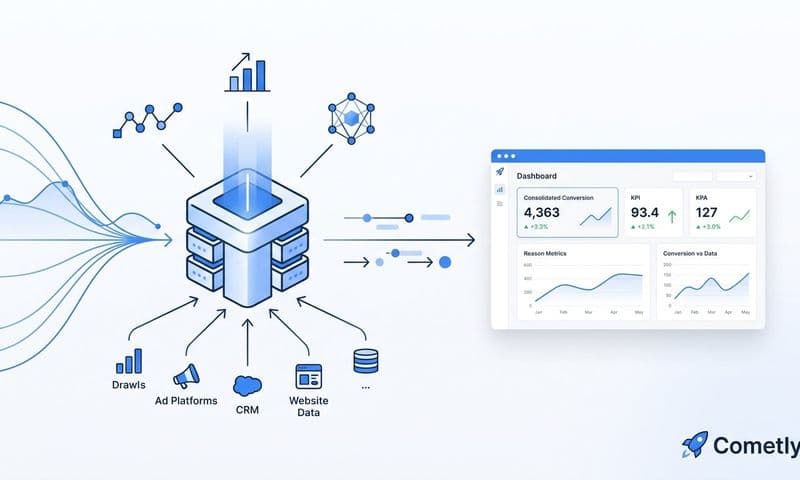
Now comes the unglamorous but critical work of data collection. The quality of your analysis depends entirely on the completeness and accuracy of your data foundation. Most marketing teams operate with fragmented data scattered across multiple platforms, each using different attribution windows and tracking methodologies.
Start by identifying all relevant data sources. This typically includes ad platforms like Meta Ads Manager, Google Ads, and LinkedIn Campaign Manager, plus website analytics tools, your CRM system, email marketing platform, and any conversion tracking tools you've implemented. Don't forget offline conversion data if you're tracking phone calls, in-store visits, or other non-digital touchpoints.
The real challenge is connecting these disparate sources to create a unified view of the customer journey from first touch to conversion. When data lives in silos, you can't see how channels work together. A prospect might click a Facebook ad, read three blog posts, receive two emails, and then convert via a Google search—but if those systems don't talk to each other, you'll miss the complete story.
Ensure your tracking is properly configured before conducting analysis. Server-side tracking has become increasingly important as browser-based methods face limitations from iOS privacy updates and cookie deprecation. Server-side tracking captures data directly from your server, bypassing browser restrictions and providing more accurate conversion data. If you're still relying solely on pixel-based tracking, you're likely missing significant portions of your conversion data.
Common Pitfall to Avoid: Relying solely on platform-reported metrics. Facebook might claim 100 conversions, Google Ads might claim 80, and LinkedIn might claim 30—but when you add them up, you get 210 conversions when your actual total is only 150. This happens because platforms use overlapping attribution windows and each claims credit for conversions it influenced. Always validate platform metrics against your source of truth, whether that's your CRM, payment processor, or analytics platform.
Consider using a centralized attribution platform that automatically pulls data from all your marketing sources and applies consistent methodology. This eliminates the manual work of exporting CSVs, combining data in spreadsheets, and trying to reconcile conflicting numbers. The time saved compounds quickly when you're conducting analysis regularly rather than as a quarterly exercise.
Step 3: Select the Right Metrics for Your Objectives
Not all metrics are created equal. The difference between effective analysis and meaningless number-crunching comes down to measuring what actually matters for your specific objectives. This step requires ruthlessly filtering hundreds of available metrics down to the handful that will inform your decisions.
Match metrics to your analysis goals based on where you are in the funnel. If you're analyzing awareness campaigns, focus on impressions, reach, and cost per thousand impressions. For engagement analysis, examine click-through rates, time on site, pages per session, and content interaction metrics. When analyzing revenue impact, prioritize return on ad spend, cost per acquisition, customer lifetime value, and revenue attribution by channel.
Learn to distinguish between vanity metrics and actionable metrics. Vanity metrics look impressive in reports but don't correlate with business outcomes. Clicks mean little without conversion context—10,000 clicks that generate zero revenue is worse than 100 clicks that generate 10 customers. Engagement rate sounds meaningful until you realize engaged users who never buy don't contribute to business growth.
Actionable Metrics to Prioritize: Cost per qualified lead, conversion rate by traffic source, revenue per channel, customer acquisition cost compared to lifetime value, return on ad spend for each campaign, and attribution-adjusted conversion rates. These metrics directly inform budget allocation and optimization decisions.
Include both leading indicators and lagging indicators in your analysis. Leading indicators like engagement trends, landing page bounce rates, and email open rates can signal future performance changes before they appear in revenue data. Lagging indicators like revenue, profit, and customer lifetime value tell you what already happened. You need both perspectives—leading indicators for early warnings and course corrections, lagging indicators for measuring ultimate success.
Build a metrics hierarchy with primary KPIs for decision-making and secondary metrics for diagnostic context. Your primary KPI might be cost per acquisition, but secondary metrics like landing page conversion rate, average order value, and channel mix help you understand why CPA is moving up or down. Understanding digital marketing performance metrics and their relationships prevents you from getting lost in data while still maintaining diagnostic capability.
Step 4: Analyze Performance Across Channels and Touchpoints
This is where analysis gets interesting. You've defined your questions, gathered your data, and selected your metrics. Now it's time to examine how your marketing actually performs across the complete customer journey. The goal is understanding not just which channels drive results, but how they work together to move prospects toward conversion.
Start by comparing channel performance using a consistent attribution methodology. First-touch attribution shows which channels are best at generating initial awareness. Last-touch attribution reveals which channels close deals. Multi-touch attribution models distribute credit across all touchpoints, providing a more nuanced view of channel contribution. Each model tells a different story, and the right one depends on your business model and sales cycle length.
Many businesses discover surprising insights when they compare attribution models. A channel that looks mediocre in last-touch attribution might be crucial for generating initial awareness. Another channel that gets minimal first-touch credit might be essential for closing deals. Understanding these dynamics prevents you from cutting channels that play important supporting roles in the customer journey. For a deeper dive into how different models work, explore attribution models in digital marketing to enhance your campaign effectiveness.
Examine the full customer journey to understand how channels work together rather than in isolation. Look at common path sequences: Do customers typically discover you via paid search, then engage with content, then convert via email? Or do they find you through social media, visit multiple times via organic search, then convert directly? These patterns reveal which channels deserve credit for assist conversions, not just final-touch conversions.
Segment your analysis by audience, campaign type, creative, and time period to uncover hidden patterns. Performance that looks mediocre in aggregate might reveal pockets of excellence when segmented. You might discover that one audience segment converts at three times the rate of others, or that certain creative themes dramatically outperform others, or that weekday performance differs significantly from weekend performance.
Critical Analysis Angles: Compare performance by device type (mobile vs. desktop often show different patterns), geographic region (some locations may have better conversion rates or lower costs), time of day (when are your highest-value conversions happening?), and customer type (new vs. returning visitors often require different strategies).
Look for attribution gaps where conversions happen but source data is missing or unclear. These gaps represent blind spots in your tracking setup. If 20% of your conversions show up as "direct" or "unknown," you're missing critical information about what's actually driving results. These gaps often indicate tracking implementation issues that need fixing before you can trust your analysis.
Pay special attention to cross-channel interactions. Does paid social performance improve when you're also running display campaigns? Do email campaigns boost organic search conversions? Mastering multi-channel attribution in digital marketing reveals these synergies that are invisible when analyzing channels in isolation but become clear when examining the complete journey.
Step 5: Identify Patterns, Anomalies, and Optimization Opportunities
With performance data organized and analyzed, you're ready to extract insights that drive action. This step transforms descriptive analysis into prescriptive recommendations. You're looking for three things: consistent patterns that reveal what's working, anomalies that warrant investigation, and opportunities to optimize performance.
Start by spotting trends over time. Is efficiency improving or declining? Are conversion rates trending up or down? Do certain channels show seasonal fluctuations? Trend analysis reveals whether your marketing is getting better or worse and helps you project future performance. A channel with steadily declining efficiency might need creative refresh or audience expansion, while improving trends suggest you've found a winning formula worth scaling.
Flag anomalies that warrant deeper investigation. A sudden performance drop might indicate tracking issues, increased competition, creative fatigue, or market changes. Unexplained spikes could reveal winning combinations worth replicating or might indicate data quality issues. Don't just note anomalies—dig into them. Often the most valuable insights come from understanding why performance deviated from expectations.
Pattern Recognition That Drives Results: Identify your highest-performing combinations of audience, channel, and creative. Maybe LinkedIn campaigns targeting director-level prospects in technology companies consistently deliver your lowest cost per acquisition. Or perhaps video ads on Facebook outperform image ads by 40% for cold audiences but underperform for retargeting. These specific insights are gold—they tell you exactly what to scale and what to change.
Quantify the opportunity cost of underperforming campaigns to prioritize optimization efforts. If Campaign A is spending $10,000 monthly at a $200 cost per acquisition while Campaign B spends $5,000 at a $100 cost per acquisition, shifting budget from A to B could double your customer acquisition. Calculate these opportunities across all your campaigns to build a prioritized optimization roadmap.
Look for efficiency frontiers—the point where increasing spend on a channel starts delivering diminishing returns. Most channels have a sweet spot where they perform optimally. Spend too little and you don't achieve scale; spend too much and efficiency deteriorates. Using marketing funnel analysis tools helps you identify these thresholds so you can allocate budget more effectively across channels.
Examine creative performance patterns. Do certain messaging themes, visual styles, or calls-to-action consistently outperform others? Creative insights often get overlooked in favor of channel and audience analysis, but creative is often the highest-leverage optimization opportunity. A 50% improvement in creative performance has the same impact as cutting your media costs in half.
Step 6: Translate Insights into Strategic Action
Analysis without action is just interesting trivia. This final step transforms your insights into concrete recommendations that improve marketing performance. The goal is creating specific, measurable actions tied directly to your findings, with clear owners and timelines.
Create recommendations that are specific enough to implement immediately. Instead of "improve Facebook performance," write "Shift 30% of Facebook budget from broad targeting to lookalike audiences based on customer email list, which shows 40% lower CPA in current tests." Specific recommendations eliminate ambiguity and make execution straightforward.
Prioritize actions by potential impact and implementation effort. Some optimizations deliver massive results with minimal work—reallocating budget between existing campaigns, for example. Others require significant effort but offer transformative potential, like implementing new tracking infrastructure. Build a prioritized roadmap that balances quick wins with strategic initiatives. A solid digital marketing strategy framework helps ensure your recommendations align with broader business objectives.
Action Framework: For each recommendation, document the insight that supports it, the expected impact (quantified when possible), the resources required, the owner responsible for execution, and the timeline for implementation and results measurement. This structure ensures accountability and makes it easy to track whether recommendations actually get implemented.
Establish a feedback loop to close the analysis cycle. Implement changes, measure results, and refine your approach based on outcomes. Marketing is iterative—your first optimization attempts might not work perfectly, but each iteration teaches you more about what drives results in your specific market. Schedule follow-up analysis to measure the impact of your changes and identify the next round of opportunities.
Document your analysis process and findings for future reference and team alignment. Create a simple template that captures your questions, methodology, key findings, and recommendations. This documentation serves multiple purposes: it creates institutional knowledge that survives team changes, it provides a baseline for future comparisons, and it helps stakeholders understand how you arrived at your recommendations. Learning how to structure a comprehensive digital marketing attribution report ensures your insights are communicated effectively.
Build regular analysis cadences into your workflow. Weekly tactical analysis helps you catch issues early and optimize campaigns in flight. Monthly strategic analysis examines broader trends and informs budget allocation decisions. Quarterly deep dives assess overall marketing effectiveness and guide strategy adjustments. Consistent analysis rhythms compound in value over time as you build deeper understanding of your marketing dynamics.
Putting It All Together: Your Digital Marketing Analysis Checklist
Effective digital marketing analysis isn't a one-time event—it's an ongoing discipline that compounds in value over time. Each analysis cycle teaches you more about your customers, your channels, and your market. The insights you extract this month inform next month's strategy, creating a virtuous cycle of continuous improvement.
Before your next analysis, run through this quick checklist: ✓ Clear questions defined that connect to specific decisions. ✓ Data centralized from all sources with consistent attribution methodology. ✓ Metrics aligned to objectives, focusing on actionable KPIs over vanity metrics. ✓ Cross-channel journey mapped to understand how touchpoints work together. ✓ Patterns and opportunities identified with quantified impact. ✓ Actions documented with specific owners, timelines, and success metrics.
The difference between good marketers and great marketers isn't access to better tools or bigger budgets—it's the discipline to consistently analyze performance and act on insights. Start small if you need to. Even basic analysis following this framework will reveal opportunities you're currently missing. As you build the habit, you'll naturally expand your analytical capabilities and sophistication. Investing time in learning digital marketing analytics accelerates this growth and helps you stay ahead of evolving best practices.
When you're ready to move beyond spreadsheet analysis and gain real-time visibility into which ads and channels actually drive revenue, platforms like Cometly can automate much of this process. By connecting your ad platforms, CRM, and website to track the complete customer journey, you eliminate the manual work of data gathering and reconciliation. The platform surfaces AI-powered recommendations for digital marketing to help you identify optimization opportunities faster than manual analysis allows.
Ready to elevate your marketing game with precision and confidence? Discover how Cometly's AI-driven recommendations can transform your ad strategy—Get your free demo today and start capturing every touchpoint to maximize your conversions.