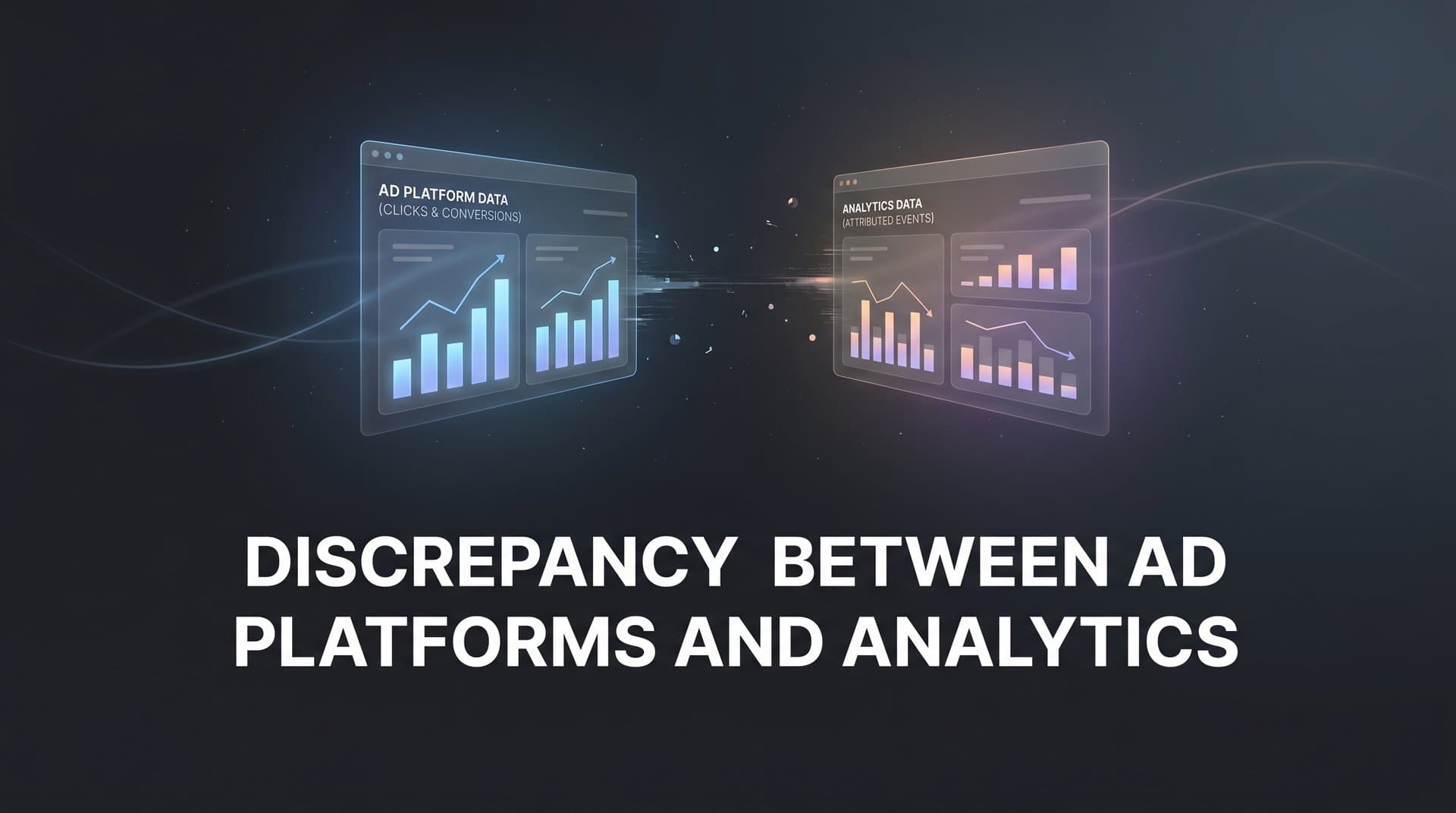
You pull up your Meta Ads dashboard and see 150 conversions for the month. You feel good. Then you open Google Analytics and the same period shows 90 conversions. Suddenly, you're questioning everything. Did the campaigns actually work? Which number do you report to your team? Which one do you trust?
Here's the truth: neither number is necessarily wrong. They're just measuring different things, through different lenses, using different rules. The discrepancy between ad platforms and analytics is one of the most common sources of confusion in digital marketing, and it trips up even experienced teams who are doing everything right.
Every platform has its own way of defining a conversion, tracking a user, and claiming credit for a sale. Meta counts things Google doesn't. Google Ads measures windows differently than Google Analytics. And none of them are fully transparent about the gaps in their own data. The result is a patchwork of dashboards that all tell a slightly different story about the same marketing reality.
This article breaks down exactly why these discrepancies exist, what's happening at a technical level, how modeling and sampling make it worse, and what you can actually do to build a more reliable picture of your marketing performance. By the end, you'll understand why the goal isn't to make every dashboard match, but to build a system you can trust.
Why Every Platform Tells a Different Story
Think of ad platforms as referees who each have their own rulebook. Meta, Google Ads, TikTok, and LinkedIn all want to show you their best performance numbers, and their measurement systems are built to do exactly that. This isn't a conspiracy. It's just the natural result of each platform optimizing for its own reporting within its own ecosystem.
The most significant driver of discrepancy is attribution windows. These define how long after an ad interaction a platform will claim credit for a conversion. Meta Ads defaults to a 7-day click and 1-day view attribution window. Google Ads defaults to a 30-day click window. Google Analytics 4 uses data-driven attribution by default, which distributes credit across multiple touchpoints using machine learning.
What this means in practice: a user clicks a Meta ad on the 1st of the month, visits your site a few more times through organic search, and finally converts on the 20th. Meta claims that conversion. Google Ads may also claim it if a Google search ad was in the mix. GA4 might split credit across several sessions. The same conversion appears in multiple dashboards, and suddenly your aggregate reported conversions look far higher than your actual sales. Understanding these ad tracking discrepancies between platforms is the first step toward better measurement.
There's also a fundamental structural difference between how ad platforms and analytics tools see the world. Ad platforms track forward from the ad click. Their pixel fires when someone clicks your ad, and they follow that user as best they can to see if a conversion happens within their attribution window. Analytics tools like GA4 work backward from the website session. They see a user arrive, track their behavior on-site, and attribute that session to a source based on UTM parameters or referral data.
These two approaches don't always agree on what happened. A user might arrive via a direct URL after clicking a Meta ad (because they typed it in later), and GA4 would attribute that session to "direct" while Meta correctly claims it as a paid conversion. Neither is lying. They're just using different methodologies to answer a slightly different question.
The incentive structure matters too. Ad platforms are not neutral parties. They benefit financially when you see strong performance numbers and increase your budget. This doesn't mean their data is fabricated, but it does mean their default settings tend to maximize the credit they claim. Understanding this helps you approach platform-reported data with the right level of healthy skepticism.
The Technical Culprits Behind Mismatched Data
Beyond attribution logic, there are real technical reasons why your analytics tool simply cannot see what your ad platform sees. The browser privacy landscape has changed dramatically in recent years, and it continues to evolve in ways that widen the gap between platform-reported and analytics-reported conversions.
Safari's Intelligent Tracking Prevention (ITP) is one of the biggest culprits. ITP caps first-party cookies set via JavaScript to seven days, and in some scenarios as little as 24 hours. This means if a user clicks your ad on a Monday, and converts the following week in Safari, your client-side analytics pixel may have lost the thread entirely. The ad platform, using its own first-party data and login-based identity graph, may still be able to connect the dots. Your GA4 setup, relying on a JavaScript cookie, cannot.
Firefox's Enhanced Tracking Protection (ETP) blocks third-party cookies by default. Google Chrome has moved toward user-choice mechanisms rather than full third-party cookie deprecation, but the direction of travel across browsers is clearly toward more privacy restrictions, not fewer. Each new restriction creates another gap between what your analytics tool can observe and what the ad platform can infer or model. This is why many teams are turning to dedicated attribution platforms over Google Analytics for more reliable measurement.
Cross-device behavior compounds the problem significantly. A user sees your ad on their phone during their commute, clicks through, browses your product, and doesn't convert. Three days later, they sit down at their work laptop, search for your brand, and buy. The ad platform may be able to connect these two events using a logged-in account (a Meta user logged into Facebook on both devices, for example). GA4 sees two separate sessions from two separate devices, and the mobile ad click gets no credit for the eventual desktop conversion.
Ad blockers are another layer of friction. When a user has an ad blocker installed, client-side tracking scripts often fail to fire entirely. The ad platform still registers the click because that happens on their infrastructure before the user ever reaches your site. Your analytics pixel, which lives on your site and depends on the browser to execute it, may never load at all. From GA4's perspective, that session may appear untracked or misattributed.
Consent management platforms (CMPs) introduce a similar issue. When a user declines cookie consent, analytics scripts are blocked from firing. The ad click still happened. The ad platform still recorded it. But your analytics tool has no record of that user's visit, creating yet another gap in the data.
Slow page loads can also cause analytics scripts to fail silently. If a user clicks through and bounces before the tracking script fires, the session goes unrecorded in analytics while the ad platform has already logged the click. These technical failure points add up, and they consistently skew analytics data lower than ad platform data.
How Conversion Modeling and Data Sampling Add to the Gap
Even if you had perfect tracking infrastructure, there would still be a gap between ad platform data and analytics data. That's because ad platforms increasingly rely on modeled conversions, statistical estimates of conversions they couldn't directly observe, to fill in the blanks created by privacy restrictions.
Meta uses Aggregated Event Measurement (AEM) and conversion modeling to estimate the conversions it believes occurred but couldn't track due to iOS privacy changes or cookie limitations. These modeled conversions appear in your Meta Ads dashboard as real numbers. They are statistically informed estimates, not verified events. Your GA4 setup, which only records what it can directly observe, has no way to validate or include these modeled numbers. This is a core reason why Meta often reports significantly more conversions than your analytics tool can confirm, a phenomenon explored in depth in our guide on Google Analytics vs Facebook Analytics discrepancy.
Google Ads applies similar conversion modeling, particularly in cases where cookies are unavailable or consent was not granted. The platform uses signals from observable data to estimate what likely happened in the unobserved cases. Again, these estimates appear as conversions in your Google Ads dashboard but are invisible to GA4.
On the analytics side, GA4 introduces its own form of data distortion through thresholding and sampling. GA4 applies thresholding to protect user privacy when audience sizes are small, which can suppress certain conversion counts from appearing in reports. When you use GA4's Explorations feature for custom analysis, the data may be sampled, meaning you're looking at a projection based on a subset of your actual traffic rather than the full dataset. For smaller sites or niche campaigns, this can meaningfully reduce the conversion numbers you see.
View-through conversions are another category that creates a structural mismatch. Ad platforms count conversions from users who saw an ad but never clicked it, then later converted through another channel. This is a legitimate signal of brand impact, but it is completely invisible to analytics tools. GA4 has no mechanism to track a user who saw a display ad and later visited your site organically. The ad platform counts that as a conversion. GA4 attributes the session to organic search. Both are technically accurate within their own frameworks, but they produce numbers that will never reconcile.
Real-World Impact: How Discrepancies Lead to Bad Decisions
Data discrepancies aren't just a reporting headache. They actively distort the decisions marketers make every day, and those distortions compound over time.
The most common mistake is over-trusting inflated ad platform numbers. When Meta reports 150 conversions and your analytics shows 90, many marketers default to the higher number because it feels better and because the platform's dashboard is right in front of them. They increase budget based on that reported ROAS, doubling down on campaigns that appear highly profitable. But if a significant portion of those "conversions" are modeled estimates or cross-platform double-counts, the real return on that spend may be far lower than it appears.
The opposite mistake is equally damaging. Marketers who rely exclusively on last-click analytics data systematically undervalue channels that contribute early in the customer journey. A top-of-funnel YouTube campaign or a LinkedIn awareness push might generate zero last-click conversions in GA4, but it could be warming up audiences that eventually convert through branded search. Understanding single source vs multi-touch attribution models helps teams avoid this trap.
Budget allocation decisions made on mismatched data create a compounding problem. In month one, you shift budget away from a channel that appears underperforming in analytics but was actually driving significant assisted conversions. In month two, your pipeline starts to thin. By month three, you're troubleshooting a revenue problem that was actually a measurement problem in disguise. Having a clear strategy for ad budget allocation between platforms becomes critical when your data sources disagree.
Teams also waste significant time trying to reconcile numbers that will never perfectly align. Hours spent in spreadsheets trying to make Meta, Google Ads, and GA4 tell the same story are hours not spent optimizing campaigns. Understanding that discrepancies are structural and expected frees your team to focus on building a system that gives you directional confidence rather than chasing perfect reconciliation.
The deeper issue is that every platform's reporting is designed to make itself look good. When you evaluate channel performance using each platform's own metrics, you're letting each vendor grade their own homework. You need an independent view of the customer journey that no single platform can provide on its own.
Practical Steps to Reconcile Your Data
You won't eliminate the discrepancy between ad platforms and analytics entirely. But you can significantly reduce it, understand what remains, and build workflows that lead to smarter decisions despite the gap.
Standardize attribution windows where possible. Start by aligning the attribution windows you use for reporting across platforms. If you're comparing Meta's 7-day click data against Google Ads' 30-day click data, you're comparing fundamentally different things. Within each platform's settings, adjust windows to a consistent standard for your comparison reports, even if you can't make them identical. Document the differences that remain so your team understands the baseline mismatch before analysis begins.
Implement server-side tracking. Client-side pixels are increasingly unreliable due to browser restrictions, ad blockers, and consent requirements. Server-side tracking sends conversion events directly from your server to the ad platform's API, bypassing browser-level limitations entirely. This approach captures more conversion events accurately, reduces data loss from ITP or ad blockers, and provides cleaner signals to ad platform algorithms. The result is a smaller gap between what your server observes and what the platforms report.
Use UTM parameters consistently and rigorously. Every paid campaign should have properly structured UTM parameters on every ad URL. This ensures that GA4 can correctly attribute sessions to their paid sources rather than misclassifying them as direct or organic. Inconsistent UTM usage is one of the most common and easily fixable sources of analytics underreporting. Learning how to connect ad platforms to analytics properly is essential for closing this gap.
Stop relying on any single platform's self-reported data. The fundamental problem with trusting Meta's dashboard or Google Ads' dashboard in isolation is that each platform has both the incentive and the technical ability to report numbers that favor itself. Instead, use a dedicated attribution platform that pulls data from all your ad platforms, your website, and your CRM into a unified view. Exploring cross-platform analytics tools can help you find the right independent measurement layer for your team.
Reconcile against revenue, not just conversions. The most reliable check on your marketing data is your actual revenue. If your ad platforms collectively report 300 conversions generating $150,000 in revenue, but your CRM shows $95,000 in closed deals from marketing-sourced leads, that gap tells you something important. Work backward from real business outcomes to calibrate how much you trust each platform's reported numbers.
Building a Single Source of Truth for Marketing Performance
The ultimate goal isn't to pick one dashboard and declare it correct. It's to build a connected system that gives you a reliable, unified view of how your marketing dollars translate into real business outcomes.
That starts with connecting your ad spend data, website analytics, and CRM into one place. When these systems talk to each other, you can see the full customer journey: which ad was the first touch, which channels contributed along the way, and which interaction preceded a closed deal. A robust customer journey analytics platform gives you this kind of end-to-end visibility that individual dashboards simply cannot provide.
Feeding accurate conversion data back to ad platforms is equally important. Ad platform algorithms optimize toward the signals you give them. If you're only sending back modeled or incomplete conversion data, the algorithm optimizes toward a distorted target. Server-side conversion sync, which sends verified, enriched conversion events from your CRM or server directly to Meta, Google, and other platforms, gives those algorithms better data to work with. The result is improved targeting, better optimization, and stronger campaign performance over time.
Multi-touch attribution is the framework that ties this all together. Rather than letting each platform claim full credit for every conversion it touched, multi-touch attribution distributes credit across all the touchpoints in a customer's journey based on their actual contribution. This means your awareness campaigns get recognized for the role they play, your retargeting campaigns don't get over-credited, and your budget decisions reflect the full picture rather than the loudest platform's self-reported numbers. Platforms that offer accurate revenue tracking through attribution make this approach practical at scale.
This is exactly what Cometly is built to do. Cometly connects your ad platforms, website, and CRM into a unified attribution system, capturing every touchpoint from the first ad click to the closed deal. With server-side tracking, it bypasses the browser-level restrictions that cause analytics tools to undercount. With multi-touch attribution, it distributes credit intelligently across the customer journey. And with AI-powered insights, it surfaces which campaigns are actually driving revenue so you can scale with confidence rather than guesswork.
Moving Forward with Confidence
The discrepancy between ad platforms and analytics is not a bug you can patch. It's a structural reality of how different systems measure the same marketing universe from different vantage points. Attribution windows differ. Tracking methods differ. Data models differ. And privacy restrictions continue to widen the gap between what each platform can observe on its own.
The marketers who navigate this well aren't the ones who find a way to make every dashboard show the same number. They're the ones who understand why the numbers differ, build systems that give them directional confidence, and make decisions based on a unified view of the customer journey rather than any single platform's self-interested reporting.
That means implementing server-side tracking, standardizing your attribution approach, connecting your ad data to your CRM, and using an independent attribution layer that no single platform controls. It means reconciling against real revenue outcomes, not just reported conversions. And it means treating platform-reported data as one input among many rather than the final word on performance.
Cometly helps marketing teams bridge this gap by bringing together ad platform data, website analytics, and CRM revenue into one clear, accurate system. With server-side tracking, multi-touch attribution, and AI-powered recommendations, it gives you the visibility to know what's actually working and the confidence to act on it.
Ready to stop guessing and start knowing? Get your free demo today and see how Cometly can give your team a clearer, more accurate view of what's really driving your marketing results.