Your Facebook ad campaign has been running for days, but the dreaded "Learning" status refuses to budge. Meanwhile, your cost per result keeps climbing, and you're watching your budget drain without the optimization you were promised.
The learning phase exists for good reason: Meta's algorithm needs time to figure out who responds best to your ads. But when campaigns get stuck, it usually signals a deeper problem with your setup, budget, or conversion volume.
The good news? Most stuck learning phase issues stem from a handful of fixable causes.
This guide walks you through a systematic approach to diagnose why your campaigns aren't exiting the learning phase and implement targeted fixes that get Meta's algorithm the data it needs to optimize effectively. By the end, you'll have a clear action plan to move your campaigns into the "Active" status where real optimization begins.
Step 1: Diagnose Why Your Campaign Is Actually Stuck
Before you start making changes, you need to understand what you're actually dealing with. Not all learning phase situations are created equal, and the fix depends entirely on the specific problem.
Start by checking how long your campaign has been in the learning phase. According to Meta's Business Help Center, the algorithm needs approximately 50 optimization events within 7 days to exit learning. If you're on day 3 with 20 conversions, you're not stuck. You're progressing normally.
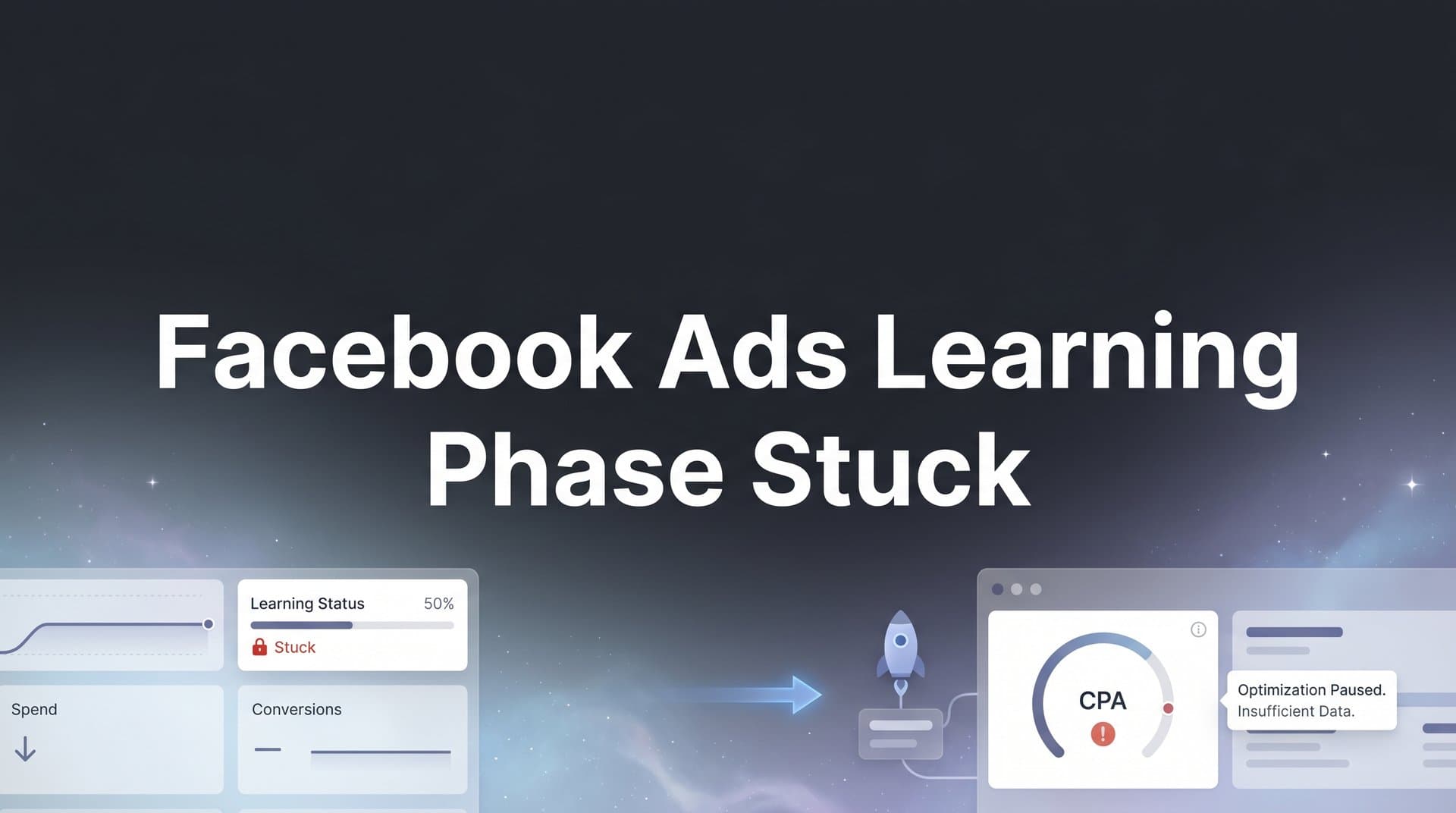
The status indicator tells you everything. Navigate to your Ads Manager and look at the delivery column. If it says "Learning," the algorithm is still gathering data and may exit soon. If it says "Learning Limited," that's your red flag. This status specifically indicates the ad set is unlikely to exit the learning phase due to insufficient conversion volume, small audience size, or budget constraints.
Open Events Manager and review your actual conversion event volume. Click on your pixel or Conversions API data source, then filter by the specific event your campaign optimizes for. Are you seeing a steady flow of events? If your campaign has been running for a week but only generated 15 conversions, you've identified the core problem.
Check your campaign's edit history. Meta resets the learning phase when you make significant changes. This includes budget adjustments over 20%, bid strategy changes, targeting modifications, new creative additions, or switching your optimization event. If you've been tweaking settings every other day, you're essentially restarting the learning process each time. Understanding how to improve Facebook ads learning phase performance starts with avoiding these common mistakes.
Look at the specific metrics. A campaign stuck at "Learning Limited" with a tiny audience size needs a completely different fix than one with adequate audience but insufficient budget. Understanding the root cause prevents you from applying the wrong solution and wasting more time.
Document what you find. Write down your current conversion volume, how long the campaign has been running without edits, your audience size estimate, and your daily budget. These baseline numbers will guide every decision you make in the following steps.
Step 2: Audit Your Budget and Bid Strategy
Budget problems are the most common reason campaigns get stuck in learning phase. If your daily budget can't realistically generate enough conversions, the algorithm will never gather the data it needs.
Here's the math that matters: your daily budget should be at least 10 times your target cost per acquisition. If you're aiming for a $50 cost per purchase, you need a minimum daily budget of $500 to give the algorithm room to optimize. This isn't arbitrary. It's based on Meta's requirement for roughly 50 conversions per week.
Calculate whether your current budget can hit that target. Take your daily budget, divide it by your current cost per result, then multiply by 7 days. If that number falls below 50, you've found your problem. A $100 daily budget with a $30 CPA will only generate about 23 conversions per week. The algorithm needs double that.
Your bid strategy might be choking your campaign. If you're using a bid cap or cost cap that's too restrictive for current market conditions, Meta can't find enough conversions at your target price. Check your bid cap against what you're actually seeing in auction insights. If your cap is $20 but the market is clearing at $35, you're essentially telling the algorithm to find something that doesn't exist.
Consider your campaign budget optimization (CBO) versus ad set budget optimization (ABO) setup. CBO distributes budget across ad sets automatically, which can help when you have multiple ad sets competing. But if one ad set is dominating all the spend while others get starved, switching to ABO gives you more control to ensure each ad set gets enough budget to learn.
Test switching your bid strategy from lowest cost to cost cap, or vice versa. Sometimes the algorithm performs better with explicit cost guidance, other times it needs full flexibility. The key is giving it enough financial runway to explore the auction space. Learning how to improve Facebook ads ROAS often starts with getting your budget strategy right.
We compare the leading options in our Facebook ads software roundup.
If increasing your budget isn't an option right now, you'll need to adjust your expectations and optimization event. You can't force 50 purchase conversions per week on a $200 budget if your product costs $100. The math simply doesn't work. Move to Step 4 to explore funnel event alternatives.
Step 3: Expand Your Audience Size Strategically
A tiny audience fragments your conversion data and limits the algorithm's ability to find patterns. Meta needs scale to optimize effectively.
Check your estimated audience size in Ads Manager. When you're on the ad set level, look at the audience definition meter on the right side. For conversion campaigns, aim for at least 1 million people in your potential reach. Anything below 500,000 significantly increases your chances of getting stuck in learning phase.
Review your targeting layers one by one. Are you stacking detailed interests, behaviors, and demographics that narrow your audience to a few thousand people? Each additional layer you add multiplies the restriction. Targeting "women, ages 25-34, interested in yoga, who recently moved, and work in healthcare" might sound precise, but you've just created an audience too small to generate meaningful conversion volume.
Related reading: our complete guide to generate ad variations with AI.
Remove the most restrictive layers first. Start with niche interests or behaviors that seemed like good ideas but are dramatically shrinking your reach. Keep your core demographic targeting if it's essential to your offer, but strip away the "nice to have" filters.
Enable Advantage+ audience expansion in your ad set settings. This allows Meta's algorithm to reach beyond your defined targeting when it identifies users likely to convert based on behavior patterns. You maintain your target audience as a starting point, but the algorithm can expand when it finds promising signals. This approach aligns with strategies for improving Facebook ads performance with data.
We cover this in more depth in our guide to AI creative for Facebook ads.
Consolidate similar ad sets that are fragmenting your audience. If you're running separate ad sets for "interested in running" and "interested in fitness," you're splitting conversion data that could be pooled. Combine them into a single ad set with broader targeting, and let the algorithm figure out which specific users convert best.
Test broad targeting with detailed creative. Instead of narrow audience targeting, use broad demographics and let your ad creative do the qualifying. An ad that speaks directly to marathon runners will naturally attract that audience without requiring you to narrow your targeting to a tiny segment.
The goal isn't to waste money on irrelevant audiences. It's to give the algorithm enough scale to identify patterns and optimize. Meta's machine learning is sophisticated enough to find your best customers within a larger pool, but it needs that pool to be big enough to work with.
Step 4: Optimize Your Conversion Event Selection
If your chosen conversion event happens too rarely, the algorithm will never gather enough data to exit learning phase. Sometimes you need to temporarily optimize for a different event.
Evaluate your current optimization event realistically. If you're optimizing for purchases but only generating 10 per week, you're asking the algorithm to optimize for an event it rarely sees. The math is simple: 50 events per week is the target, and you're hitting 20 percent of that.
Move up the funnel strategically. Instead of optimizing for Purchase, consider Add to Cart or Initiate Checkout. These events happen more frequently, giving the algorithm more data points to learn from. Once you exit learning phase and build momentum, you can create a new campaign optimizing for the lower-funnel event.
This isn't about lowering your standards. It's about meeting the algorithm where it can actually function. A campaign optimizing for Add to Cart that exits learning phase will often outperform a perpetually stuck campaign optimizing for Purchase.
Verify your pixel or Conversions API is actually firing for your chosen event. Open Events Manager, select your data source, and filter by your optimization event. Click through to see the event details. Are you seeing consistent event volume? Are the events firing on the right pages? If your Purchase event only fired 3 times this week but you know you had 15 sales, you have a tracking problem, not a campaign problem. Understanding why Facebook ads aren't tracking conversions is essential for diagnosing these issues.
Implement server-side tracking through Conversions API if you haven't already. Browser-based pixels miss conversions due to ad blockers, iOS privacy features, and cookie restrictions. Server-side tracking captures these events directly from your server, giving Meta more complete data. Advertisers using Conversions API alongside the pixel typically see improved event match quality and more reliable optimization.
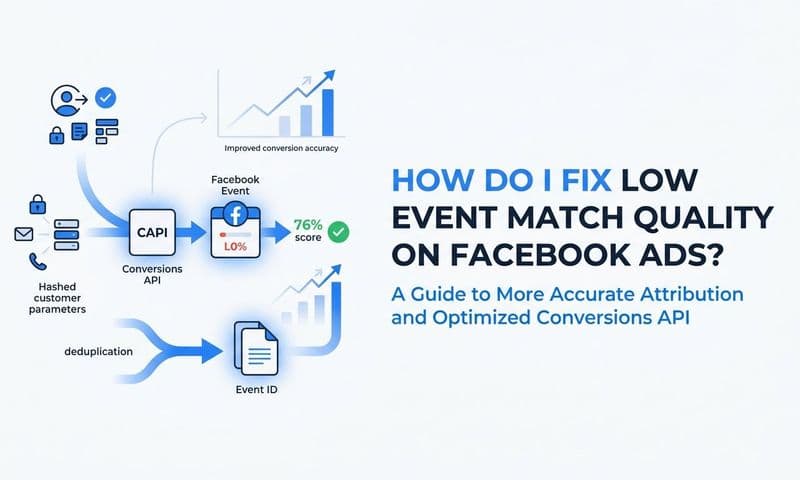
Check your event match quality scores in Events Manager. Meta shows you how well it can match your conversion events to Facebook users. Low match quality means the algorithm can't effectively use that data for optimization. Improve match quality by sending additional customer information parameters like email, phone, and address through your Conversions API implementation.
Consider your attribution window. If you're optimizing for 1-day click conversions only, you're missing conversions that happen on day 2 or 3. Expanding to 7-day click attribution captures more events, giving the algorithm more data to work with. Learn more about Facebook ads attribution window settings to optimize this correctly.
Step 5: Consolidate Ad Sets and Reduce Fragmentation
Multiple ad sets competing for the same audience fragment your conversion data. Instead of one ad set with 50 conversions, you have five ad sets with 10 conversions each. None of them exit learning phase.
Audit your campaign structure and identify redundant ad sets. Open your campaign and list out each ad set's targeting. Are you running separate ad sets for ages 25-34 and 35-44 when both groups could be combined? Are you splitting audiences by interest categories that overlap significantly?
Merge ad sets that target similar audiences. If you have three ad sets targeting different but related interests, combine them into one ad set with all three interests included. The algorithm will automatically figure out which interest segments perform best without requiring you to split them manually.
Apply the "fewer, bigger, better" principle. One ad set with a $500 daily budget will almost always outperform five ad sets with $100 budgets each, assuming they're targeting similar audiences. The consolidated ad set pools conversion data, exits learning phase faster, and gives the algorithm more budget flexibility to optimize. This principle is especially important when learning how to run Facebook ads effectively.
Reduce your active ad variations within each ad set. If you're testing 10 different ad creatives simultaneously, you're fragmenting impression data. The algorithm has to split delivery across all variations, which means none of them get enough data to identify clear winners. Start with 3-5 ad variations maximum, then add more once you've exited learning phase.
Pause underperforming ad sets rather than letting them drain budget. If an ad set has been running for two weeks with terrible results and no sign of improvement, it's stealing budget from ad sets that could exit learning phase. Pause it, reallocate that budget to your better-performing ad sets, and give them the resources to succeed.
Create a consolidation plan before you start merging. Don't just randomly combine ad sets. Map out which audiences truly overlap, which budgets should be pooled, and which ad sets serve distinct purposes that justify keeping them separate. Strategic consolidation improves performance. Random consolidation creates chaos.
Monitor performance closely after consolidating. You should see conversion volume increase in your remaining ad sets as they receive more budget and pooled data. If performance drops significantly, you may have combined audiences that were too different. Give it 3-5 days to stabilize before making additional changes.
Step 6: Improve Conversion Data Quality
Poor data quality confuses the algorithm and prevents effective optimization. Even if you're generating 50 conversions per week, low-quality data can keep you stuck in learning phase.
Open Events Manager and check your event match quality scores. Meta assigns a quality rating to each conversion event based on how well it can match that event to a Facebook user. Navigate to your data source, click on the specific event, and look for the match quality indicator. Scores below 6.0 signal problems.
Improve match quality by sending more customer information parameters. When your server fires a conversion event through Conversions API, include email, phone number, first name, last name, city, state, and zip code. The more parameters you send, the more confidently Meta can match the conversion to the right user. This dramatically improves the algorithm's ability to learn from your conversion data.
Implement server-side tracking if you're still relying solely on browser-based pixels. Since iOS 14.5 privacy changes, browser pixels miss a significant percentage of conversions. Users who block cookies, use ad blockers, or have tracking prevention enabled won't fire pixel events. Server-side tracking through Conversions API captures these conversions directly from your server, giving Meta the complete picture. If you're struggling with this, explore how to improve Facebook ads conversion tracking.
Platforms like Cometly specialize in enriching your conversion data before sending it to Meta. By capturing every touchpoint across your customer journey and feeding that enriched data back through Conversions API, you give Meta's algorithm higher-quality signals to optimize against. Better data quality means faster learning and more effective optimization.
Check for duplicate events that inflate your conversion counts artificially. If your pixel and Conversions API are both firing the same event without proper deduplication, Meta sees two conversions when only one happened. This confuses the algorithm and degrades optimization. Implement event deduplication by sending a unique event ID with each conversion.
Audit for missing conversion events. Compare your actual sales or leads from your CRM or database against what Events Manager shows. If you had 50 purchases but Events Manager only recorded 35, you're missing 30 percent of your conversion data. Investigate why events aren't firing and fix the tracking implementation. Understanding Facebook ads reporting discrepancies helps you identify these gaps.
Verify your conversion events are firing on the correct pages. Sometimes events fire on confirmation pages that users never reach, or they fire too early in the process before the conversion is actually complete. Test your complete conversion flow and watch Events Manager in real-time to confirm events fire at the right moment.
Review your attribution settings to ensure you're capturing conversions across all relevant touchpoints. If you're only tracking last-click attribution, you're missing the full customer journey. Multi-touch attribution shows you every interaction that contributed to a conversion, giving you better data to optimize against and helping Meta's algorithm understand the complete path to purchase.
Step 7: Implement a Monitoring System to Prevent Future Issues
Getting out of learning phase is only half the battle. Staying out requires systems that prevent you from accidentally resetting the learning process or creating new stuck campaigns.
Set up automated alerts for campaigns that re-enter learning phase. In Ads Manager, create a custom rule that notifies you when any campaign's delivery status changes to "Learning" after previously being "Active." This catches accidental resets immediately, before they waste significant budget.
Create a change log to track every edit you make to active campaigns. Use a simple spreadsheet with columns for date, campaign name, what changed, and why. Before making any edit, check if the campaign is in learning phase. If it is, ask yourself whether this change is urgent enough to justify resetting the learning counter.
Establish a waiting period rule before making significant edits. Once a campaign exits learning phase, commit to letting it run for at least 7 days before making major changes. This gives you clean performance data and prevents the constant tinkering that keeps campaigns stuck. Minor adjustments like pausing underperforming ads are fine. Budget changes over 20 percent, targeting shifts, or bid strategy changes should wait.
Use attribution tools to verify conversions are being tracked accurately across all touchpoints. Platforms like Cometly connect your ad platforms, CRM, and website to track the entire customer journey in real time. When you can see exactly which ads and channels drive actual revenue, you make better optimization decisions and catch tracking issues before they derail your campaigns. Explore the best attribution tool for Facebook ads to find the right solution.
Schedule weekly campaign audits. Every Monday, review your active campaigns for learning phase status, conversion volume, budget efficiency, and tracking quality. This 15-minute routine catches small problems before they become big ones. Look for campaigns approaching the 50 conversion threshold so you can celebrate wins, and identify campaigns falling behind so you can intervene early.
Document what works for your account. Every business has unique characteristics that affect learning phase performance. Maybe your audience responds better to video ads that exit learning faster. Maybe consolidated campaigns consistently outperform split tests. Keep notes on patterns you observe, and use them to inform future campaign structures.
Build a pre-launch checklist for new campaigns. Before you publish any new campaign, verify it meets your minimum standards: adequate daily budget, audience size over 1 million, realistic conversion event selection, clean tracking implementation, and streamlined structure. Campaigns that start with solid foundations rarely get stuck in learning phase.
Moving Forward with Confidence
Getting your Facebook ads out of the stuck learning phase comes down to giving Meta's algorithm what it needs: sufficient budget, adequate audience size, enough conversion volume, and clean data. Start by diagnosing whether you're dealing with a true stuck campaign or one that's "Learning Limited," then work through the steps systematically.
Quick checklist before you go: Verify your daily budget is at least 10 times your target CPA. Confirm your audience size exceeds 1 million for conversion campaigns. Check that your conversion event can realistically hit 50 events per week. Audit your tracking setup to ensure conversions are being captured accurately. Consolidate fragmented ad sets to pool your conversion data.
The campaigns that exit learning phase fastest are those with clean tracking, adequate budgets, and streamlined structures. Focus on these fundamentals, and you'll spend less time troubleshooting and more time scaling what works.
Most marketers struggle with learning phase issues because they lack visibility into what's actually driving their results. When you can't see the complete customer journey, you can't make informed decisions about budget allocation, audience targeting, or conversion event selection.
Ready to elevate your marketing game with precision and confidence? Discover how Cometly's AI-driven recommendations can transform your ad strategy. Get your free demo today and start capturing every touchpoint to maximize your conversions.