You're spending $10,000 a month on Facebook ads. Your Ads Manager dashboard shows 50 conversions this week. Your Google Analytics reports 75. Your CRM recorded 62 actual sales. Which number tells you the truth?
More importantly—which campaigns are actually driving revenue, and which ones are burning your budget?
This isn't just a reporting discrepancy. It's a data infrastructure crisis that's costing marketers thousands in wasted ad spend every single day. The problem got exponentially worse after iOS 14.5 introduced App Tracking Transparency, creating blind spots in your attribution data that traditional browser-based tracking simply can't fill.
Here's what's actually happening: Your Facebook Pixel captures what browsers allow it to see. But when users opt out of tracking, use ad blockers, or switch devices during their journey, those conversions vanish from your reports. You're making budget decisions based on incomplete data—like trying to navigate with a map that's missing half the roads.
Facebook Attribution API solves this by moving conversion tracking from the browser to your server. Instead of relying on cookies and pixels that users can block, you send conversion events directly from your infrastructure to Facebook. This server-side approach captures the complete picture: conversions that happen after users clear cookies, purchases made on different devices, and revenue that occurs days or weeks after the initial ad click.
But here's the critical part most marketers miss: implementing the API alone isn't enough. The real competitive advantage comes from connecting it to an enriched data pipeline that captures every touchpoint in the customer journey—from first ad impression through email opens, webinar attendance, sales calls, and final purchase. This complete context is what transforms basic conversion tracking into actionable attribution intelligence.
By the end of this guide, you'll have a working Facebook Attribution API implementation that captures conversions other marketers miss. You'll understand exactly how to generate secure API credentials, structure your server-side events with proper data enrichment, test your implementation to ensure accuracy, and optimize for maximum attribution quality. Whether you're a technical marketer implementing this yourself or an agency managing multiple client accounts, you'll have the complete roadmap to solve your attribution gaps.
Let's start with what you need before writing a single line of code.
Step 1: Generate Your Attribution API Access Credentials
Before you can send a single conversion event to Facebook, you need secure API credentials that give your server permission to communicate with Facebook's systems. This isn't as simple as copying your Pixel ID—you need dedicated system-level access that won't break when someone changes their password or leaves your company.
Most attribution failures trace back to this step. Marketers use personal access tokens for testing, forget to upgrade to system users for production, and three months later their tracking mysteriously stops working. Nobody connects the dots until thousands in ad spend has been wasted on blind optimization.
Here's how to set this up correctly from the start.
Create a Dedicated System User
System users are Facebook's solution for application-level API access. Unlike personal accounts, they persist through password changes, employee turnover, and account restructuring. Think of them like service accounts in enterprise software—they're designed for machines, not people.
Navigate to your Facebook Business Settings, then click Users > System Users in the left sidebar. Click the blue "Add" button and create a new system user. Name it something descriptive like "Attribution API Production" so you remember its purpose six months from now when you're troubleshooting.
Assign this system user Admin role access to your ad account and Pixel. This might feel overly permissive, but the Attribution API requires broad permissions to send events and read attribution data. Restricting permissions here creates cryptic error messages that waste hours of debugging time.
Critical mistake to avoid: Never use your personal Facebook account's access token for production implementations. Personal tokens expire when passwords change, when you enable two-factor authentication, or when Facebook's security systems detect unusual activity. System users are built to handle automated API calls without these interruptions.
Generate Your Access Token With Correct Permissions
Click on your newly created system user and select "Generate New Token." You'll see a list of permission scopes—these determine what your API calls can actually do.
You need two specific permissions: ads_management and business_management. The first lets you send conversion events to your Pixel. The second lets you read attribution reports and configure settings. Missing either permission means your API calls will fail with vague error messages about insufficient privileges.
Set your token expiration to 60 days. Yes, this means you'll need to rotate tokens regularly, but it's a security best practice that prevents compromised tokens from causing long-term damage. Add a calendar reminder now to regenerate your token in 50 days—don't wait until it expires and breaks your tracking.
When you click "Generate Token," Facebook shows your access token exactly once. Copy it immediately and store it in a secure password manager or environment variable system. Never hardcode tokens directly in your application code or commit them to Git repositories. One leaked token can expose your entire ad account to unauthorized access.
Configure Your Attribution Settings
Now navigate to Events Manager, select your Pixel, and click Settings > Attribution. This is where you define the rules that determine which ads get credit for conversions—decisions that directly impact your reported ROAS and budget allocation.
Start with industry-standard attribution windows: 7-day click and 1-day view. This means if someone clicks your ad and converts within seven days, that ad gets credit. If they see your ad but don't click, and convert within one day, the ad still gets partial credit. These windows align with how to create a successful facebook ad campaigns that balance immediate response with longer consideration cycles.
For businesses with longer sales cycles—B2B software, high-ticket coaching, enterprise services—consider extending your click window to 28 days. Your customers don't make purchase decisions in 48 hours, so your attribution shouldn't pretend they do. The key is matching your attribution windows to your actual customer journey, not Facebook's defaults.
Step 2: Build Your Server-Side Event Tracking Infrastructure
Here's where theory meets reality. You have your API credentials. Now you need to actually send conversion events from your server to Facebook. This is where most implementations either become powerful attribution engines or turn into debugging nightmares that get abandoned after three weeks of frustration.
The difference comes down to understanding what Facebook actually needs to receive. You're not just sending a notification that says "someone bought something." You're sending a structured data package that includes who converted, what they did, when it happened, and crucially—enough identifying information for Facebook to match that conversion back to the ad that drove it.
Think of it like filing an insurance claim. You can't just call and say "I had an accident, send money." You need the policy number, date and time, location, description of what happened, and supporting documentation. Facebook's Attribution API works the same way. Send incomplete data, and your events get accepted but can't be attributed. Send improperly formatted data, and they get rejected entirely.
Let's break down exactly how to structure these events so they actually work.
Understanding Facebook's Event Data Structure
Every event you send to Facebook must follow a specific JSON structure with three core components: event identification, user data, and custom parameters. Miss any required field, and Facebook returns a 400 error with a cryptic message that doesn't tell you which field was the problem.
The event identification section tells Facebook what happened and when. You need an eventname (like "Purchase" or "Lead"), an eventtime as a Unix timestamp, and an actionsource that specifies where the conversion occurred—usually "website" for ecommerce or "phonecall" for call tracking.
Here's the critical part most developers miss: Facebook has standard event names for a reason. Use "Purchase" instead of "completedorder" or "boughtproduct." Use "Lead" instead of "formsubmission" or "newcontact." Standard event names unlock Facebook's optimization algorithms and enable better reporting features in Ads Manager. Custom event names work, but you're essentially flying blind compared to using the standard taxonomy.
The user_data section is where attribution actually happens. This is how Facebook matches your server-side conversion back to the person who clicked your ad three days ago. You need to send hashed email addresses, phone numbers, and critically—the fbp and fbc parameters from the user's browser cookies.
Those cookie values are what connect your server-side event to Facebook's browser-side tracking. Without them, Facebook can only match based on email and phone, which means lower match rates and weaker attribution. This is why successful implementations capture these cookie values on your website and pass them through your conversion pipeline to your server.
Writing Your First API Call
The actual API call is an HTTPS POST request to Facebook's Graph API endpoint. You're sending to graph.facebook.com/v18.0/{yourpixelid}/events with your access token as a parameter. The body contains your JSON event data.
Before you send anything to production, use Facebook's testeventcode parameter. This makes your events appear in the Test Events tool inside Events Manager without affecting your actual attribution data. You can verify that Facebook is receiving your events, check the event structure, and see match quality scores—all without risking your production data.
If you're running facebook ads for clients, this testing phase becomes even more critical. You need to prove your implementation works before client budgets depend on it. Test with multiple user profiles, different conversion types, and various time delays between ad click and conversion to ensure your tracking handles real-world scenarios.
Step 3: Connect Your Server-Side Events to Facebook's API
You've got your credentials. Your infrastructure is ready. Now comes the critical moment: actually sending conversion events from your server to Facebook's Attribution API. This is where theory meets reality—and where most implementations either succeed brilliantly or fail quietly.
The difference isn't technical complexity. It's understanding that Facebook Attribution API isn't just an endpoint you hit with data. It's a conversation between your infrastructure and Facebook's attribution system, and like any conversation, the quality depends on what you say and how you say it.
Here's what actually happens when you send an event: Your server makes an HTTPS POST request to Facebook's Graph API endpoint with a JSON payload containing the conversion details. Facebook receives this event, attempts to match it to a real person using the identifiers you provided, then attributes that conversion back to the ad that influenced it. If your event structure is wrong, your matching parameters are incomplete, or your timing is off, Facebook either rejects the event or accepts it with poor match quality—which means weak attribution and suboptimal ad optimization.
Let's build this correctly from the start.
Structure Your First API Request
Every event you send to Facebook follows the same basic structure: a JSON object containing event metadata, user identifiers, and custom conversion data. The endpoint is always https://graph.facebook.com/v18.0/{pixel_id}/events where {pixel_id} is your Facebook Pixel ID from Business Manager.
Your request must include three critical components in the URL parameters: your access token (the one you generated in Step 1), the data payload (your JSON event object), and optionally a testeventcode for debugging. Never put your access token in the request body—it belongs in the URL parameters for proper authentication.
The JSON payload itself has four required fields: eventname (what happened), eventtime (when it happened as a Unix timestamp), actionsource (where it happened—typically "website"), and userdata (identifiers that help Facebook match this event to a real person). Miss any of these, and Facebook rejects your event with a 400 error.
Here's the critical part most developers miss: event_time must be the actual time the conversion happened, not the time you're sending the API call. If someone purchases at 2:00 PM but you send the event at 2:05 PM, use the 2:00 PM timestamp. Facebook accepts events up to 7 days old, but real-time events (sent within minutes) provide significantly better attribution accuracy.
Master the User Data Object
The user_data object is where attribution quality lives or dies. This object contains identifiers that Facebook uses to match your server-side event to the actual person who saw your ad. The more identifiers you include, the higher your Event Match Quality score—and the better your attribution accuracy.
Start with email and phone number, both hashed using SHA-256 before sending. Facebook requires hashing for privacy compliance, but here's what they don't tell you in the documentation: normalize your data before hashing. Convert emails to lowercase, remove spaces, and strip country codes from phone numbers. A mismatched hash is worthless for attribution, and normalization errors are the #1 cause of poor match quality.
Next, include clientipaddress and clientuseragent from the user's browser session. These parameters help Facebook match your event even when email or phone data is incomplete. Modern attribution software automatically captures these values from HTTP headers and passes them through your conversion pipeline, but if you're building custom infrastructure, you'll need to implement this capture logic yourself.
The fbp and fbc cookie values are your secret weapons for high match rates. These Facebook-specific identifiers directly link your server-side event to the user's browser session where they clicked your ad. Capture these cookies on your landing pages and store them with your user records so they're available when conversions happen days or weeks later.
Step 4: Send Your First Test Event to Facebook Attribution API
You have your credentials. Your server infrastructure is ready. Now comes the moment of truth: sending your first conversion event to Facebook and verifying it arrives with the right structure and data quality.
This step separates successful implementations from failed ones. Most marketers rush through testing, send events to production, and discover weeks later that their attribution data is incomplete or inaccurate. By the time they notice, they've made budget decisions based on flawed data.
Here's what makes testing critical: Facebook accepts your API calls even when the data structure is wrong. You'll get a 200 success response, but your events won't match to users or attribute to campaigns. Without proper testing, you're flying blind.
Using Facebook's Test Events Tool
Facebook provides a dedicated testing environment that shows exactly what data your server is sending and flags any issues before events hit your production data. Navigate to Events Manager, select your Pixel, and click the "Test Events" tab. You'll see a test event code—a unique identifier that routes your test events to this debugging interface instead of your live data.
Add this test event code to your API calls as a parameter. When you send events with this code, they appear in the Test Events interface within seconds, showing you the complete event structure, matched parameters, and any warnings about data quality issues.
The interface highlights critical issues in red: missing required fields, improperly hashed user data, or invalid event names. Yellow warnings indicate optimization opportunities: adding customer value data, including more matching parameters, or using standard event names instead of custom ones.
Send at least five test events covering your most important conversion types: purchases, leads, registrations. Each event should include different user data combinations to verify your hashing logic works correctly and your matching parameters are properly formatted.
Validating Event Match Quality
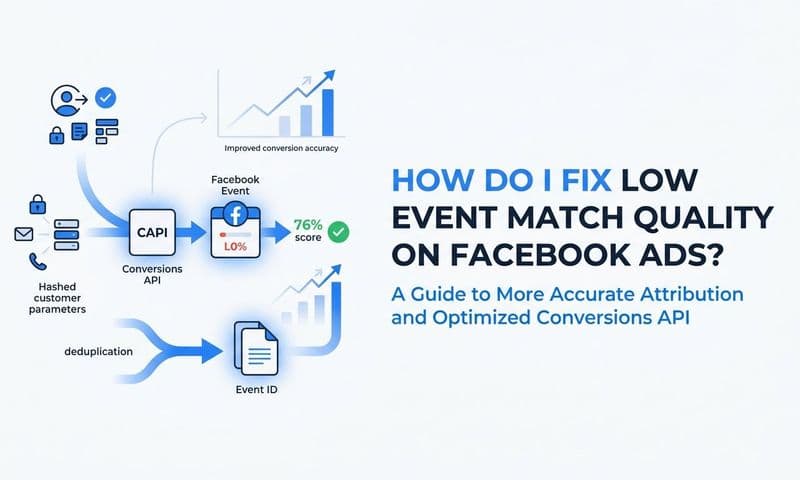
Event match quality determines how accurately Facebook can attribute your conversions to specific ads and users. Low match quality means Facebook can't connect your server-side events to the people who clicked your ads, rendering your attribution data useless.
The Test Events tool shows match quality scores for each event. Aim for "Good" or "Great" ratings by including multiple matching parameters: hashed email, hashed phone number, client IP address, user agent string, and Facebook browser identifiers (fbp and fbc cookies).
Here's the critical insight most marketers miss: the fbp and fbc parameters are what connect your server-side events to Facebook's browser-side data. Without these, Facebook treats your conversion as a completely separate event with no connection to ad clicks. Your server must capture these cookie values when users visit your site and pass them with your API calls.
Test with real user data from your CRM or database—anonymized if necessary for privacy compliance. Synthetic test data won't reveal matching issues that only appear with real-world email formats, international phone numbers, or unusual user agent strings.
Verifying Events Appear in Events Manager
After your test events show green checkmarks in the Test Events tool, remove the test event code and send events to production. Within 20 minutes, these events should appear in your Events Manager dashboard under the "Events" tab.
Check three critical metrics: event count (are all your events arriving?), event match quality (maintaining "Good" or better scores?), and attribution data (are conversions being matched to specific campaigns?). If any metric shows problems, return to the Test Events tool to diagnose the issue before scaling your implementation.
Compare your server-side event counts against your actual conversion data from your CRM or database. The numbers should match within 5%. Larger discrepancies indicate events are being lost somewhere in your pipeline—failed API calls, timeout errors, or logic bugs in your event construction code.
Step 5: Monitor Event Quality and Match Rates
Your events are flowing to Facebook. Your Test Events tool shows green checkmarks. But here's what most marketers miss: delivery doesn't equal quality. Facebook receives your events, but if they can't match them to actual users, your attribution data remains incomplete.
Event Match Quality (EMQ) is Facebook's scoring system that measures how well your server-side events can be matched to Facebook users. Think of it like a fingerprint match—the more identifying parameters you send, the higher your match rate. Low match rates mean Facebook sees conversions happening but can't attribute them to specific ads, leaving you with the same blind spots you were trying to eliminate.
Navigate to Events Manager and select your Pixel. Click on the "Overview" tab, then scroll to "Event Match Quality" section. You'll see a score from 0 to 10, with color coding: red (poor), yellow (fair), and green (good). Your goal is maintaining a score of 6.0 or higher consistently.
This score directly impacts your campaign performance. Facebook's algorithm uses match quality to determine how much it trusts your conversion data. Low scores mean Facebook treats your conversions as unreliable signals, which weakens campaign optimization and increases your cost per acquisition. High scores enable Facebook's machine learning to optimize more aggressively toward your actual business outcomes.
The most effective approach combines Facebook's native API with comprehensive software on attribution that enriches your event data before sending it to Facebook. This ensures every conversion includes maximum matching parameters and proper data normalization, consistently achieving match quality scores above 8.0.
Monitor your EMQ score daily during the first two weeks after implementation. Scores can fluctuate as Facebook processes different event types and user populations. If you see consistent scores below 6.0, audit your user_data object to identify which matching parameters are missing or improperly formatted. The most common culprits are missing fbp/fbc cookies, improperly normalized email addresses, and phone numbers that include formatting characters Facebook can't parse.
Beyond match quality, track your attribution completeness by comparing Facebook's reported conversions against your actual sales data. The gap between these numbers reveals how many conversions Facebook can't attribute to specific ads. Modern attribution tools for marketing provide this comparison automatically, highlighting attribution gaps and suggesting specific data enrichment strategies to close them.
Set up weekly reports that show: total events sent, events successfully matched, match quality score trends, and attribution coverage percentage. These metrics tell you whether your implementation is actually solving your attribution problems or just creating the illusion of better data. Real attribution improvement shows up as higher match rates AND more conversions attributed to specific campaigns—not just more events flowing through the API.
The final piece is understanding that attribution isn't a one-time implementation—it's an ongoing optimization process. As Facebook's algorithms evolve, as privacy regulations change, and as your customer journey becomes more complex, your attribution infrastructure needs continuous refinement. The marketers who win are those who treat attribution as a core competency, not a technical checkbox to complete and forget.
Ready to elevate your marketing game with precision and confidence? Discover how Cometly's AI-driven recommendations can transform your ad strategy—**Get your free demo** today and start capturing every touchpoint to maximize your conversions.