Facebook Marketing Analytics: The Complete Guide to Tracking What Actually Matters
You're staring at your Facebook Ads Manager at 11 PM, scrolling through rows of campaigns that collectively burned through $50,000 this month. The numbers look impressive: 10,000 clicks, 500 conversions, a respectable 2.3% CTR. Your boss loved the last report. But here's the question keeping you awake: which of these ads actually made the company money?
This is the uncomfortable reality every Facebook advertiser faces. The platform shows you engagement, clicks, and conversions—but it doesn't show you profit. You can have a "successful" campaign by Facebook's standards while simultaneously losing money on every customer you acquire. The disconnect between what Facebook celebrates and what your CFO cares about isn't just frustrating—it's expensive.
The problem isn't that Facebook's data is wrong. It's that the metrics Facebook optimizes for—and the ones most advertisers obsess over—rarely align with actual business profitability. A low cost per acquisition feels like a win until you calculate that your customer lifetime value is lower than your acquisition cost. High engagement looks impressive in a presentation until leadership asks how many of those likes turned into revenue.
This is where Facebook marketing analytics becomes critical—not as a reporting exercise, but as a translation layer between platform metrics and business outcomes. Real analytics means connecting ad spend to revenue, understanding which campaigns drive profitable customers (not just conversions), and making decisions based on profit, not activity. It's the difference between celebrating a 3x ROAS and realizing that 3x ROAS loses money when your profit margin is only 25%.
By the end of this guide, you'll understand exactly what Facebook marketing analytics really means, which metrics actually drive profitable decisions, how to build tracking infrastructure that works in the modern privacy landscape, and where Facebook's native analytics fall short. More importantly, you'll know how to bridge the gap between impressive-looking dashboards and campaigns that genuinely grow your business.
Before we can extract profit-driving insights from your Facebook campaigns, we need to establish what analytics actually encompasses—and why most advertisers get it completely wrong.
What Facebook Marketing Analytics Actually Means (And Why Most Definitions Miss the Point)
Ask ten marketers to define Facebook marketing analytics and you'll get ten different answers. Most will mention tracking metrics, measuring performance, or analyzing campaign data. These aren't wrong—they're just incomplete. They describe the mechanics without addressing the purpose.
Facebook marketing analytics is the systematic process of connecting advertising activity to business outcomes. It's not about collecting data—Facebook already does that. It's about transforming platform metrics into profit intelligence. The distinction matters because most advertisers drown in data while starving for insights.
The confusion starts with how Facebook itself frames analytics. The platform provides extensive reporting on impressions, reach, engagement, clicks, and conversions. These metrics answer questions like "How many people saw my ad?" and "How many clicked?" But they don't answer the question that actually matters: "Did this campaign make or lose money?"
This gap exists because Facebook's business model depends on ad spend, not your profitability. The platform optimizes for actions it can measure—clicks, conversions, engagement. Your business optimizes for profit. These objectives occasionally align, but often they don't. A campaign that Facebook considers successful (high engagement, low cost per click) might be hemorrhaging money when you factor in customer lifetime value, profit margins, and operational costs.
Real marketing analytics bridges this gap by layering business context onto platform data. It means tracking not just conversions, but revenue per conversion. Not just cost per acquisition, but customer lifetime value relative to acquisition cost. Not just campaign performance, but contribution to overall business growth.
The technical infrastructure required for this goes far beyond Facebook's native tools. You need conversion tracking that survives iOS 14+ privacy restrictions. You need attribution models that account for multi-touch customer journeys. You need revenue integration that connects ad clicks to actual purchases, including repeat purchases over time. You need profit calculations that factor in product costs, shipping, returns, and customer service.
Most importantly, you need a framework for making decisions based on profit, not activity. This is where enterprise marketing analytics becomes essential—it provides the infrastructure to track, measure, and optimize for what actually matters to your business.
Consider a concrete example. You're running two Facebook campaigns. Campaign A generates 100 conversions at $50 each ($5,000 total spend). Campaign B generates 50 conversions at $80 each ($4,000 total spend). Facebook's reporting makes Campaign A look better—more conversions, lower cost per acquisition. But when you layer in business data, the picture changes completely.
Campaign A customers have an average order value of $75 and a 15% repeat purchase rate. Campaign B customers have an average order value of $150 and a 40% repeat purchase rate. After factoring in a 30% profit margin and customer lifetime value, Campaign A loses money while Campaign B generates significant profit. Facebook's analytics would have you scale Campaign A and pause Campaign B. Real analytics tells you the opposite.
This is why defining Facebook marketing analytics correctly matters. It's not a reporting function—it's a profit optimization system. It's not about collecting more data—it's about connecting the right data to business outcomes. And it's not about what Facebook shows you—it's about what you need to know to make profitable decisions.
The implications extend beyond campaign optimization. Proper analytics infrastructure affects budget allocation, creative strategy, audience targeting, and even product development. When you know which customer segments are profitable, you can build campaigns specifically designed to attract more of them. When you understand which creative approaches drive high-value customers, you can systematically test and scale those approaches. When you can measure true customer lifetime value by acquisition source, you can justify higher acquisition costs for better customers.
The Core Metrics That Actually Drive Profitable Facebook Campaigns
Facebook's Ads Manager displays over 200 different metrics. Most of them are useless for making profitable decisions. The platform wants you focused on engagement, reach, and frequency because these metrics encourage more spending. But engagement doesn't pay your bills. Revenue does.
The metrics that actually matter fall into three categories: acquisition efficiency, customer value, and profit contribution. Everything else is either a vanity metric or a diagnostic tool for troubleshooting specific problems. Let's break down what you should actually be tracking and why.
Customer Acquisition Cost (CAC) is your starting point, but not the way Facebook calculates it. Facebook's "cost per result" metric only counts the initial conversion. Real CAC includes all costs associated with acquiring a customer—ad spend, creative production, landing page development, email follow-up sequences, and sales team time for higher-ticket offers. For most businesses, true CAC is 30-50% higher than what Facebook reports.
If you're evaluating vendors, our AI generated product images breakdown can help.
This matters because profitability calculations based on incomplete CAC data are fundamentally wrong. If Facebook shows a $50 cost per acquisition but your true CAC is $75, every profitability decision you make is based on flawed math. You'll scale campaigns that lose money while pausing campaigns that could be profitable with optimization.
Customer Lifetime Value (LTV) is the counterweight to CAC, but calculating it correctly requires data Facebook doesn't have. You need to track repeat purchases, average order values over time, retention rates, and profit margins. For subscription businesses, this means tracking monthly recurring revenue and churn. For e-commerce, it means tracking purchase frequency and average order value across multiple transactions.
The LTV:CAC ratio is your primary profitability indicator. A ratio of 3:1 or higher generally indicates a healthy, scalable campaign. Below 3:1, you're either acquiring customers too expensively or not extracting enough value from them. Below 1:1, you're losing money on every customer. Facebook's native reporting can't calculate this ratio because it doesn't have access to your revenue data over time.
Return on Ad Spend (ROAS) is the metric most advertisers obsess over, but it's dangerously misleading without context. A 3x ROAS sounds impressive until you realize your profit margin is only 25%—meaning you're losing money. A 2x ROAS might seem poor until you factor in that these customers have a 60% repeat purchase rate and an LTV that's 5x their initial purchase value.
Effective ROAS accounts for profit margins, not just revenue. If your product has a 40% profit margin, you need a 2.5x ROAS just to break even. If your margin is 20%, you need a 5x ROAS. Most advertisers don't make this calculation, which is why they celebrate campaigns that are actually losing money.
Attribution window accuracy becomes critical in the iOS 14+ era. Facebook's default 7-day click attribution window misses conversions that happen outside that window. For higher-ticket products with longer consideration periods, this can undercount conversions by 30-50%. You need tracking infrastructure that captures the full customer journey, not just what Facebook can see within its limited attribution window.
Contribution margin by campaign tells you which campaigns are actually profitable after accounting for all costs. This requires integrating Facebook data with your financial systems to track not just revenue, but profit. A campaign generating $100,000 in revenue might contribute $40,000 in profit or $5,000 in profit depending on product mix, shipping costs, and customer acquisition expenses. Without this metric, you're optimizing for revenue, not profit.
Cohort-based performance analysis reveals how customer value changes over time. Customers acquired in January might have different LTV than customers acquired in June due to seasonality, product changes, or market conditions. Tracking performance by acquisition cohort helps you understand whether your campaigns are improving or degrading in quality over time. This is particularly important for understanding the impact of content marketing analytics on long-term customer value.
Incremental conversion rate measures how many conversions wouldn't have happened without your ads. This is nearly impossible to calculate with Facebook's native tools, but it's critical for understanding true campaign impact. Some percentage of your conversions would have happened anyway—these customers were already going to buy. Incremental conversions are the ones your ads actually caused. The difference between total conversions and incremental conversions is wasted ad spend.
Channel-assisted conversions show how Facebook fits into your broader marketing mix. Most customers don't convert on their first touchpoint. They might see a Facebook ad, then search for your brand, then click an email, then finally purchase. Facebook's last-click attribution model gives Facebook credit for the entire conversion, but the reality is more complex. Understanding multi-touch attribution helps you allocate budget across channels more effectively.
Creative fatigue indicators tell you when ad performance is declining due to audience overexposure. Facebook doesn't explicitly report creative fatigue, but you can identify it by tracking frequency alongside conversion rate and cost per acquisition. When frequency rises above 3-4 while conversion rate drops and CPA increases, you're likely experiencing creative fatigue. This signals the need for new creative assets before performance completely collapses.
The common thread across all these metrics is that they require data integration beyond what Facebook provides. You need to connect Facebook's platform data with your CRM, your e-commerce system, your financial reporting, and your customer service data. This integration is what transforms basic reporting into actionable intelligence. Tools for top predictive marketing analytics can help automate this process and provide forward-looking insights.
How to Build Tracking Infrastructure That Actually Works in 2024
The iOS 14.5 update fundamentally broke Facebook's tracking capabilities. Apple's App Tracking Transparency framework gave users the ability to opt out of cross-app tracking, and roughly 75% of iOS users did exactly that. Overnight, Facebook lost visibility into a massive portion of conversion data. The platform's response—Aggregated Event Measurement and the Conversions API—helps, but it doesn't fully solve the problem.
Building tracking infrastructure that works in this new reality requires a multi-layered approach. You can't rely on Facebook's pixel alone. You need server-side tracking, first-party data collection, and attribution modeling that accounts for data gaps. Let's walk through what this actually looks like in practice.
The Facebook Pixel remains your foundation, but it's no longer sufficient by itself. The pixel is a client-side tracking script that fires when users visit your website. It captures pageviews, add-to-carts, purchases, and custom events. But iOS privacy restrictions limit what the pixel can see. For iOS users who opt out of tracking, the pixel can't follow them across websites or apps. It can only track activity on your specific domain, and even that data is delayed and aggregated.
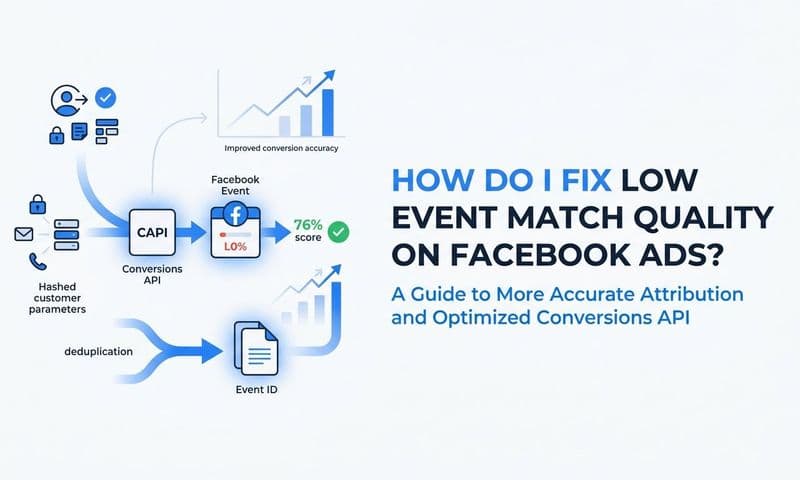
This is where the Conversions API becomes critical. CAPI is server-side tracking that sends conversion data directly from your server to Facebook, bypassing browser-based tracking limitations. When a purchase happens on your website, your server sends that conversion data to Facebook along with a hashed identifier (email, phone number, or Facebook click ID). This allows Facebook to match conversions to ad clicks even when the pixel can't track them.
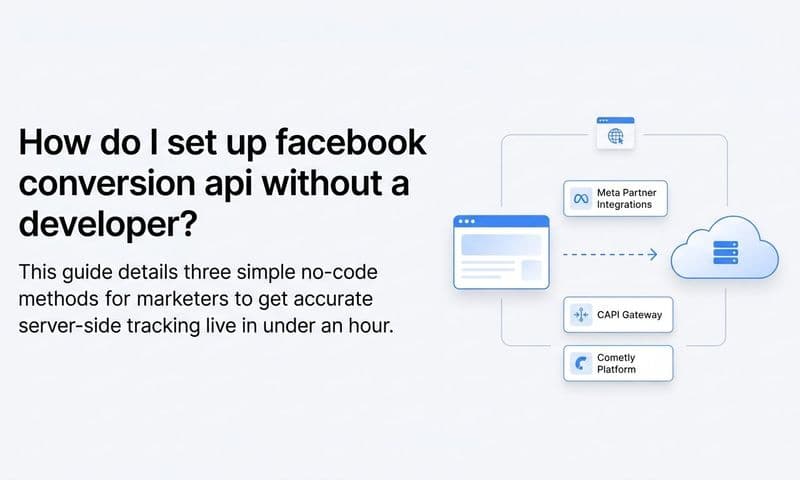
Implementing CAPI requires technical infrastructure most marketers don't have. You need server access, the ability to hash customer data, and integration between your e-commerce platform and Facebook's API. For businesses using Shopify, WooCommerce, or other major platforms, there are plugins that handle this automatically. For custom setups, you'll need developer resources to build the integration.
The real power comes from combining pixel and CAPI data. Facebook calls this "redundant tracking," and it significantly improves data accuracy. When both the pixel and CAPI send the same conversion event, Facebook can deduplicate them and use the most complete data source. When the pixel misses a conversion due to iOS restrictions, CAPI captures it. This dual-tracking approach recovers 20-40% of conversions that would otherwise be lost.
First-party data collection becomes your competitive advantage in a privacy-first world. Instead of relying on Facebook to track users across the internet, you collect data directly from customers on your own properties. This means capturing emails, phone numbers, and purchase history through your website, email campaigns, and customer accounts. This data belongs to you, isn't subject to platform restrictions, and can be used for attribution regardless of privacy settings.
The technical implementation involves creating a customer data platform (CDP) or using tools that function as one. Your CDP becomes the single source of truth for customer interactions across all touchpoints—Facebook ads, Google ads, email, organic search, direct traffic. When a customer makes a purchase, your CDP records which marketing touchpoints they interacted with before converting. This creates an attribution trail that doesn't depend on Facebook's tracking.
UTM parameters and click IDs are your bridge between Facebook and your analytics systems. Every Facebook ad should include UTM parameters that identify the campaign, ad set, and ad. Facebook's fbclid parameter automatically appends to URLs and allows you to track individual clicks. Your analytics system captures these parameters and associates them with conversion events, creating a complete picture of the customer journey.
The challenge is maintaining these parameters throughout the conversion process. If a user clicks your ad, lands on your website, then navigates to a different page before purchasing, you need to persist the original UTM parameters. This typically requires storing them in cookies or session storage and passing them through to your conversion tracking. Without this persistence, you lose attribution data and can't connect conversions back to specific campaigns.
Attribution modeling becomes more important and more difficult in a privacy-restricted environment. Facebook defaults to last-click attribution, giving full credit to the last ad a user clicked before converting. But most customer journeys involve multiple touchpoints. A user might see your ad three times, click twice, visit your website from organic search, and finally convert after clicking an email. Last-click attribution gives all credit to the email, ignoring Facebook's role in the journey.
Multi-touch attribution models distribute credit across all touchpoints in the customer journey. Linear attribution gives equal credit to each touchpoint. Time-decay attribution gives more credit to touchpoints closer to conversion. Position-based attribution emphasizes the first and last touchpoints. The right model depends on your business, but any multi-touch model is better than last-click for understanding true campaign impact.
Implementing multi-touch attribution requires tracking all customer interactions, not just conversions. You need to know when users see ads (impressions), click ads, visit your website, engage with content, and ultimately convert. This data needs to be tied to individual users (when possible) or probabilistically modeled (when not possible due to privacy restrictions). Advanced advanced marketing analytics platforms can handle this complexity and provide accurate attribution even with incomplete data.
Offline conversion tracking extends your attribution beyond digital touchpoints. For businesses with phone sales, in-store purchases, or other offline conversions, you need to connect these events back to Facebook ads. Facebook's Offline Conversions API allows you to upload conversion data from your CRM or point-of-sale system, matching it to ad interactions using customer identifiers like email or phone number.
The technical setup involves exporting conversion data from your offline systems, hashing customer identifiers, and uploading them to Facebook. The platform then matches these conversions to ad clicks and includes them in your reporting. This is particularly important for high-ticket B2B businesses where the majority of conversions happen through sales calls rather than website forms.
Testing and validation ensures your tracking infrastructure actually works. The most sophisticated setup is worthless if it's not capturing data correctly. You need to regularly test conversion tracking by making test purchases, verifying that events fire correctly, and confirming that conversions appear in Facebook's reporting. This should be part of your regular maintenance routine, not a one-time setup task.
Common tracking issues include duplicate events (when pixel and CAPI both fire without proper deduplication), missing events (when tracking scripts fail to load), incorrect event parameters (when purchase values or product IDs are wrong), and attribution gaps (when conversions can't be matched back to ad clicks). Each of these issues corrupts your data and leads to bad decisions. Regular auditing catches these problems before they cause significant damage.
Where Facebook's Native Analytics Fall Short (And What to Use Instead)
Facebook Ads Manager provides extensive reporting, but it's designed to serve Facebook's interests, not yours. The platform wants you to spend more money, so it emphasizes metrics that encourage spending while obscuring metrics that might cause you to reduce budget. Understanding these limitations is critical for building analytics infrastructure that actually serves your business.
The most glaring limitation is the lack of profit tracking. Facebook reports revenue (if you send purchase values), but it has no concept of profit margins, cost of goods sold, shipping costs, returns, or customer service expenses. You can see that a campaign generated $100,000 in revenue, but you can't see that it only contributed $15,000 in profit after all costs. This makes it impossible to optimize for profitability within Facebook's native tools.
Attribution windows create a systematic undercount of conversions. Facebook's default 7-day click, 1-day view attribution window only counts conversions that happen within those timeframes. For products with longer consideration periods—software, high-ticket services, complex B2B solutions—many conversions happen outside these windows. Facebook's reporting shows these campaigns as underperforming when they're actually driving conversions that the platform can't see.
You can adjust attribution windows in Facebook's reporting, but this doesn't solve the underlying problem. Extending to a 28-day click window helps, but it's still arbitrary. Some customers take 60 days to convert. Others take 6 months. Facebook's attribution model can't accommodate these longer journeys, which means you need external attribution tools that track the full customer lifecycle.
Cross-channel attribution is completely absent from Facebook's reporting. The platform shows you Facebook's contribution to conversions, but it doesn't show how Facebook interacts with your other marketing channels. A customer might see your Facebook ad, then search for your brand on Google, then click an email before converting. Facebook's reporting gives Facebook full credit for this conversion, ignoring the role of search and email.
This creates a systematic overcount of Facebook's impact. When you add up the conversions reported by Facebook, Google, and your email platform, the total exceeds your actual conversions because each platform claims credit for the same conversions. Without a unified attribution model that accounts for multi-touch journeys, you can't accurately assess channel performance or allocate budget effectively.
Cohort analysis is primitive in Facebook's native tools. You can see aggregate performance over time, but you can't easily track how customer cohorts perform over their lifetime. Customers acquired in January might have different LTV than customers acquired in June, but Facebook's reporting doesn't make this visible. You need to export data and analyze it externally to understand cohort-based performance trends.
This limitation becomes critical for subscription businesses and e-commerce brands with high repeat purchase rates. The quality of customers you acquire matters as much as the quantity. A campaign that acquires 100 customers with 10% retention is far worse than a campaign that acquires 50 customers with 60% retention, but Facebook's reporting treats them as equivalent if the initial conversion cost is the same.
Creative performance insights are superficial. Facebook shows you which ads get clicks and conversions, but it doesn't tell you why. You can see that Ad A outperforms Ad B, but you can't see which specific creative elements drive the difference. Is it the headline? The image? The offer? The call-to-action? Facebook's reporting doesn't break down performance by creative component, making it difficult to systematically improve creative effectiveness.
Advanced marketing analytics software can fill this gap by tagging creative elements and analyzing performance patterns. If you tag ads by headline type, image style, and offer structure, you can identify which combinations drive the best results. This transforms creative testing from random experimentation into systematic optimization.
Audience overlap and saturation aren't visible in standard reporting. Facebook allows you to target multiple audiences simultaneously, but it doesn't clearly show when these audiences overlap or when you're oversaturating an audience with too much ad exposure. You might be running five campaigns that all target variations of the same people, causing you to compete against yourself and drive up costs.
Facebook's Audience Overlap tool exists, but it's buried in the interface and doesn't integrate with campaign reporting. You need to manually check overlap between audiences and make subjective decisions about whether the overlap is problematic. A proper analytics system would automatically flag audience overlap issues and recommend consolidation strategies.
Budget pacing and spend efficiency metrics are basic. Facebook shows you daily spend and whether you're on track to hit budget targets, but it doesn't provide sophisticated pacing analysis. You can't easily see if you're spending too quickly early in the day (missing cheaper evening inventory) or too slowly (leaving budget unspent). You can't see how your bid strategy affects spend efficiency or whether you're overpaying for conversions during certain hours.
These limitations aren't accidental. Facebook's business model depends on advertisers spending more money, and sophisticated analytics might reveal that some spending is inefficient. The platform provides enough data to make you feel informed while obscuring the insights that might cause you to reduce spend or shift budget to other channels.
The solution is building a separate analytics layer that integrates Facebook data with data from your other systems. This means using tools for marketing analytics that can pull data from Facebook's API, combine it with data from your CRM, e-commerce platform, and financial systems, and provide unified reporting that shows true business impact.
This integrated approach allows you to track metrics Facebook can't or won't show you: true customer acquisition cost including all overhead, customer lifetime value across all channels, profit contribution by campaign, multi-touch attribution across your entire marketing mix, cohort-based performance trends, and creative element effectiveness. These are the insights that actually drive profitable growth, and they're invisible in Facebook's native reporting.
The technical implementation varies depending on your business size and complexity. Small businesses might use analytics platforms that integrate directly with Facebook and their e-commerce platform. Mid-size businesses might build custom dashboards using tools like Looker Studio or Tableau. Enterprise businesses might implement full customer data platforms with sophisticated attribution modeling. Regardless of scale, the principle is the same: don't rely on Facebook's reporting alone.
Making Data-Driven Decisions That Actually Improve Profitability
Having accurate data is worthless if you don't know how to act on it. The gap between analytics and action is where most Facebook advertisers fail. They build sophisticated tracking, generate detailed reports, and then make the same intuitive decisions they would have made without any data. The point of analytics isn't to create impressive dashboards—it's to change behavior in ways that improve profitability.
The decision framework starts with defining clear profitability thresholds. What LTV:CAC ratio makes a campaign worth scaling? What ROAS (accounting for profit margins) represents break-even? What customer acquisition cost is acceptable given your customer lifetime value? These thresholds should be explicit, documented, and consistently applied across all campaigns. Without them, every decision becomes a subjective judgment call.
For most businesses, a 3:1 LTV:CAC ratio is the minimum for sustainable growth. Below this threshold, you're not generating enough profit from customers to fund continued acquisition and business operations. Above 5:1, you're likely under-investing in acquisition and leaving growth on the table. The sweet spot is typically 3:1 to 4:1—profitable enough to sustain growth, aggressive enough to capture market share.
Campaign-level decisions should be based on contribution margin, not ROAS. A campaign with 2x ROAS might be highly profitable if your product has 60% margins. A campaign with 4x ROAS might lose money if your margins are only 20%. The decision to scale, maintain, or pause a campaign should be based on whether it's contributing positive profit after all costs, not whether it hits an arbitrary ROAS target.
This requires integrating profit data into your reporting. You need to know your fully-loaded cost of goods sold (including production, shipping, payment processing, and returns), your operational overhead allocation, and your customer service costs. When you subtract these from revenue, you get contribution margin. Campaigns with positive contribution margin should be scaled. Campaigns with negative contribution margin should be optimized or paused.
Audience segmentation decisions should prioritize customer quality over acquisition volume. It's better to acquire 100 high-value customers than 500 low-value customers, even if the cost per acquisition is higher for the high-value segment. This means analyzing performance not just by campaign, but by customer segment. Which audiences generate customers with the highest LTV? Which audiences have the best retention rates? Which audiences are most profitable after accounting for all costs?
This analysis often reveals counterintuitive insights. Broad audiences might generate more conversions at lower cost, but narrow audiences might generate higher-quality customers with better retention. Lookalike audiences based on purchasers might perform worse than lookalikes based on high-LTV customers. Interest-based targeting might acquire customers cheaper than behavioral targeting, but those customers might have lower repeat purchase rates.
Creative optimization should be systematic, not random. Most advertisers test creative by launching new ads and seeing what works. This approach is inefficient because it doesn't isolate variables or build cumulative knowledge. A better approach is structured testing that isolates specific creative elements—headlines, images, offers, calls-to-action—and measures their individual impact on performance.
This requires tagging creative elements in your tracking system and analyzing performance patterns across multiple ads. If you test 20 ads with different combinations of 4 headlines, 5 images, and 2 offers, you can identify which specific elements drive performance. Maybe emotional headlines outperform rational headlines. Maybe lifestyle images outperform product images. Maybe discount offers outperform value-based offers. These insights allow you to systematically improve creative effectiveness rather than randomly testing variations.
Budget allocation should be dynamic, not static. Most advertisers set campaign budgets at the beginning of the month and leave them unchanged regardless of performance. This is inefficient because campaign performance fluctuates based on seasonality, competition, creative fatigue, and audience saturation. A better approach is weekly or even daily budget reallocation based on current performance.
This means shifting budget from underperforming campaigns to outperforming campaigns in real-time. If Campaign A is generating conversions at $50 CAC while Campaign B is at $100 CAC, you should be moving budget from B to A until either A's performance degrades (due to scale) or B's performance improves (due to reduced competition for the same audience). This dynamic allocation ensures you're always investing in your most efficient acquisition channels.
Bid strategy optimization requires understanding the trade-off between volume and efficiency. Lowest cost bidding maximizes conversion volume but often at higher cost per conversion. Cost cap bidding controls cost per conversion but limits volume. Target ROAS bidding optimizes for return but may miss profitable conversions that fall slightly below target. The right strategy depends on your business stage and goals.
Early-stage businesses prioritizing growth might use lowest cost bidding to maximize volume, accepting higher acquisition costs in exchange for faster customer acquisition. Mature businesses prioritizing profitability might use cost cap or target ROAS bidding to maintain efficiency. The key is aligning bid strategy with business objectives and adjusting as those objectives change.
Attribution model selection affects how you evaluate channel performance. Last-click attribution overvalues bottom-of-funnel channels like retargeting and branded search while undervaluing top-of-funnel channels like Facebook prospecting. First-click attribution does the opposite. Linear attribution gives equal credit to all touchpoints. Time-decay attribution emphasizes recent touchpoints. Position-based attribution emphasizes first and last touchpoints.
There's no universally correct attribution model. The right choice depends on your customer journey and business model. For impulse purchases with short consideration periods, last-click attribution might be appropriate. For complex B2B sales with long cycles and multiple touchpoints, multi-touch attribution is essential. The important thing is choosing a model deliberately and applying it consistently rather than defaulting to whatever Facebook reports.
Incrementality testing reveals true campaign impact beyond correlation. Just because conversions increase when you run Facebook ads doesn't mean the ads caused those conversions. Some customers would have converted anyway. Incrementality testing uses holdout groups to measure the difference between conversions with ads and conversions without ads. This is the only way to know whether your ads are actually driving incremental revenue or just taking credit for sales that would have happened regardless.
Running incrementality tests requires splitting your audience into test and control groups, showing ads only to the test group, and measuring the conversion difference. If the test group converts at 5% and the control group converts at 3%, your ads are driving 2% incremental conversions. This means 40% of your reported conversions (2% out of 5%) are incremental, while 60% would have happened anyway. This insight dramatically changes how you evaluate campaign performance and allocate budget.
The ultimate goal of all these decisions is improving profit per dollar spent. Every optimization should be evaluated against this metric. Does this change increase profit per dollar spent? If yes, implement it. If no, don't. This simple framework cuts through the complexity of Facebook advertising and focuses attention on what actually matters—generating more profit from your marketing investment.
Conclusion: From Data Collection to Profit Optimization
Facebook marketing analytics isn't about collecting more data—you're already drowning in data. It's about transforming platform metrics into profit intelligence. The gap between what Facebook shows you and what you need to know to make profitable decisions is enormous, and bridging that gap requires infrastructure, discipline, and a fundamental shift in how you think about campaign performance.
The advertisers who win in the post-iOS 14 landscape aren't the ones with the biggest budgets or the most sophisticated creative. They're the ones who built tracking infrastructure that works despite privacy restrictions, who integrated Facebook data with their broader business systems, who defined clear profitability thresholds and made decisions based on contribution margin rather than vanity metrics. They're the ones who understand that a 3x ROAS means nothing without context about profit margins, customer lifetime value, and operational costs.
Building this capability isn't easy. It requires technical implementation of pixel and Conversions API tracking, integration between Facebook and your CRM and e-commerce systems, attribution modeling that accounts for multi-touch customer journeys, and a decision framework that prioritizes profit over activity. But the alternative—making decisions based on incomplete data and platform-biased reporting—is far more expensive.
The specific tools and platforms you use matter less than the principles you apply. Whether you're using sophisticated marketing analytics tools or building custom dashboards, the goal is the same: connect advertising activity to business outcomes, measure what actually matters, and make decisions that improve profitability rather than just increasing spend.
Start by auditing your current
Ready to elevate your marketing game with precision and confidence? Discover how Cometly's AI-driven recommendations can transform your ad strategy—**Get your free demo** today and start capturing every touchpoint to maximize your conversions.