You're tracking clicks, impressions, conversions, and cost per acquisition across Meta, Google, TikTok, and your email platform. Your CRM shows leads coming in. Your website analytics counts visitors. But when your CEO asks which campaigns are actually driving revenue, you're stuck piecing together conflicting reports from five different dashboards.
This is the modern marketer's paradox: drowning in data while starving for clarity.
The problem isn't that you lack information—it's that your data lives in isolated silos, each platform telling a different version of the same story. Meta claims credit for conversions that Google also counts. Your CRM attributes deals to sources your ad platforms never tracked. And somewhere in that mess, you're making budget decisions based on incomplete pictures.
Data analytics doesn't just organize these numbers into prettier dashboards. It fundamentally transforms how you understand customer behavior, allocate marketing spend, and predict what will work before you scale. The marketers winning in 2026 aren't necessarily spending more—they're seeing more clearly. They know which touchpoints actually matter, which campaigns genuinely drive revenue, and where to double down versus cut losses.
This guide breaks down exactly how data analytics turns fragmented marketing data into strategic advantage. We'll move beyond surface-level metrics to explore what your data actually reveals about customer journeys, how to attribute revenue accurately across channels, and how to build a system where every marketing decision is backed by complete, reliable insights.
Understanding What Your Marketing Data Really Reveals
Think of your marketing data as breadcrumbs showing how prospects become customers. But most marketers only see a few scattered crumbs instead of the complete trail.
Behavioral Data: This tracks how people interact with your content—which ads they click, which pages they visit, how long they stay, what they download. It reveals intent and interest patterns that demographics alone can't capture.
Transactional Data: Purchase history, order values, repeat purchase rates, and lifetime value calculations. This shows not just who bought, but how much they're worth to your business over time.
Engagement Data: Email opens, video watch time, social interactions, and content consumption patterns. This indicates how deeply prospects are connecting with your brand before they convert.
Attribution Data: The complete sequence of touchpoints a customer encountered before converting—from first awareness through final purchase. This is where most marketing data falls apart, because platforms don't talk to each other.
Here's where it gets interesting: the metrics you're probably watching most closely might be the least valuable for strategic decisions.
Vanity metrics look impressive in reports but don't connect to business outcomes. A campaign with 50,000 impressions and 2,000 clicks sounds successful until you realize it generated zero qualified leads. Meanwhile, a smaller campaign with 500 clicks might have driven ten high-value customers—but if you're only looking at click volume, you'd scale the wrong one.
Actionable insights answer specific questions that drive decisions: Which traffic sources bring customers who actually buy? What content moves prospects from awareness to consideration? Which campaigns contribute to conversions even when they're not the final click? Understanding types of marketing analytics helps you identify which data sources matter most for your specific goals.
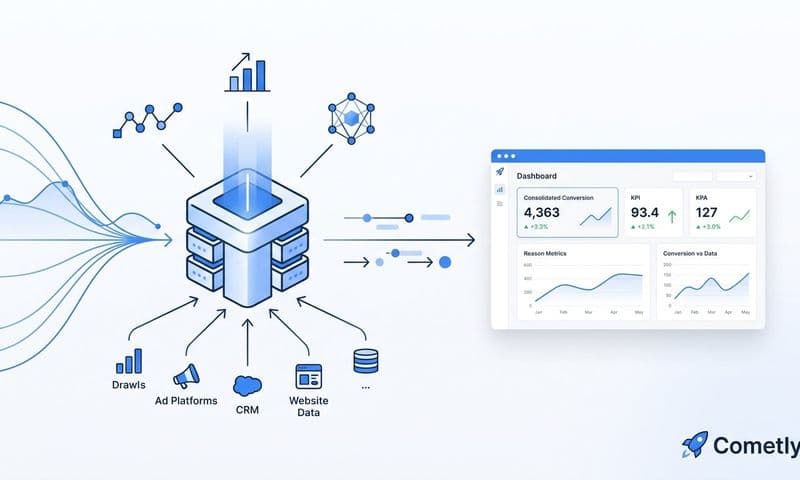
The transformation happens when you connect these data sources. Your ad platforms show initial touchpoints. Your website analytics reveals engagement patterns. Your CRM tracks when prospects become leads, then customers. When these systems communicate, you see the complete journey—not just isolated moments.
This connected view reveals patterns invisible in siloed data. You might discover that prospects who engage with your educational content convert at 3x the rate of those who only see ads. Or that customers acquired through one channel have twice the lifetime value of another, even though both show similar initial conversion rates. These insights fundamentally change where you invest resources.
Tracking the Complete Path to Purchase
Last-click attribution is like giving the closer on a sales team credit for every deal while ignoring the prospecting, qualification, and nurturing that made the close possible. It's simple, but it's wrong.
Here's what actually happens: A prospect sees your Facebook ad but doesn't click. Three days later, they search your brand name on Google and visit your site. They leave without converting. A week later, they click an email link, browse your pricing page, and still don't buy. Finally, they return through a retargeting ad and complete a purchase.
Last-click attribution credits that final retargeting ad with the entire conversion. But without the Facebook ad creating awareness, the Google search establishing credibility, and the email maintaining engagement, that retargeting ad would have fallen flat.
Multi-touch attribution distributes credit across the entire journey. Different models weight touchpoints differently, but they all recognize that conversions result from multiple interactions, not single moments. Many teams struggle with attribution challenges in marketing analytics because their data sources remain disconnected.
First-Touch Attribution: Credits the initial interaction that brought someone into your ecosystem. Useful for understanding which channels drive awareness and new prospect discovery.
Linear Attribution: Spreads credit equally across all touchpoints. This acknowledges every interaction's role without prioritizing any particular stage of the journey.
Time-Decay Attribution: Gives more credit to touchpoints closer to conversion, recognizing that recent interactions often have stronger influence on final decisions.
Position-Based Attribution: Weights the first and last touchpoints more heavily while still crediting middle interactions. This model recognizes that both discovery and closing matter most.
The right model depends on your business and sales cycle. But any multi-touch model beats last-click for understanding what actually drives revenue.
This matters for budget decisions. When you see that your educational blog content consistently appears in conversion paths—even though it's rarely the final click—you understand why cutting content marketing to fund more retargeting ads would be strategic suicide. The retargeting only works because the content built trust and authority first.
You also identify campaigns that look successful but aren't. A channel might show strong last-click conversions because it's good at capturing demand that other channels created. If you scaled it aggressively while cutting the awareness-building channels, your overall conversions would drop because you'd be harvesting demand without planting new seeds.
The marketers who understand complete conversion paths make fundamentally different decisions than those fixated on last-click metrics. They invest in the full funnel, not just the bottom. They recognize that some channels build value even when they don't get conversion credit. And they avoid the trap of optimizing for metrics that look good but don't reflect reality.
Optimizing Spend Based on True Performance
Most marketers review campaign performance monthly, make adjustments, and hope next month looks better. By the time you realize a campaign isn't working, you've already spent weeks of budget on it.
Real-time analytics changes this completely. You see performance as it happens, identify problems within hours instead of weeks, and shift budget toward what's working while it's still working.
But real-time visibility only matters if you're measuring the right things. Platform-native metrics tell you how campaigns perform within that platform—but they don't show how those campaigns contribute to actual business outcomes across your entire marketing ecosystem.
This is where connecting your data sources becomes critical. When your analytics platform can see both ad performance and downstream revenue, you identify true ROI, not just proxy metrics like click-through rates or cost per click. Learning how to improve campaign performance with analytics starts with measuring what actually matters to your bottom line.
Let's say you're running campaigns on Meta and Google. Meta's dashboard shows Campaign A has a lower cost per click than Campaign B. Google shows similar patterns for its campaigns. Based on platform metrics alone, you'd increase budget for the lower-cost campaigns.
But when you connect this data to actual revenue, you discover Campaign B drives customers with 40% higher lifetime value. Suddenly, paying more per click becomes smart strategy because each click is worth more. Without revenue-connected analytics, you'd have optimized for the wrong metric.
Here's where it gets even more interesting: feeding better conversion data back to ad platforms improves their algorithmic targeting and optimization.
Ad platforms use machine learning to identify which audiences are most likely to convert. But they can only optimize based on the conversion data you send them. If you're only tracking immediate purchases, the algorithm optimizes for customers who buy instantly—missing high-value customers with longer consideration cycles. Understanding how ad tracking tools can help you scale ads using accurate data reveals why complete conversion tracking matters so much.
When you send enriched conversion data—including lead quality scores, lifetime value indicators, and downstream revenue events—the platforms learn to find better prospects. Their algorithms get smarter because they're optimizing for business outcomes, not just immediate actions.
This creates a compounding advantage. Better data leads to better targeting, which drives better results, which generates more data to improve targeting further. Marketers who feed platforms complete conversion data see their cost per acquisition drop while conversion rates climb—not because they changed their creative or targeting, but because the platform's AI learned to find better prospects.
Budget allocation becomes straightforward when you see complete performance data. You're not guessing which channels deserve more investment—you're responding to clear signals about what drives revenue and what doesn't.
Building Segments That Drive Conversions
Demographics tell you who someone is. Behavioral data reveals what they actually care about.
Traditional audience segmentation divides people by age, location, job title, or company size. These segments are easy to create but often miss what actually drives purchase decisions. A 35-year-old marketing director in New York and a 42-year-old agency owner in Austin might share nothing demographically but exhibit identical buying behaviors.
Behavioral segmentation groups people by actions: which content they consume, how they engage with your site, what problems they're trying to solve, and where they are in their buying journey. This approach identifies prospects based on intent signals, not assumptions.
Analytics reveals these behavioral patterns at scale. You might discover that prospects who view your pricing page three times without converting are highly qualified but need a specific objection addressed. Or that visitors who spend time on case studies convert at 5x the rate of those who only read feature descriptions. Implementing marketing data accuracy improvement methods ensures your segmentation reflects actual customer behavior rather than tracking errors.
These insights let you create segments based on real behavior patterns, then tailor messaging to match where prospects are mentally and emotionally in their journey.
High-Intent Researchers: Multiple site visits, extended time on product pages, pricing page views. These prospects are actively evaluating solutions. They need proof and differentiation, not awareness content.
Problem-Aware Browsers: Consuming educational content, reading blog posts, engaging with how-to guides. They know they have a problem but haven't committed to a solution category yet. They need frameworks and strategic thinking.
Solution-Aware Evaluators: Comparing features, reading reviews, checking integrations. They've decided what type of solution they need and are now choosing between options. They need competitive comparisons and specific capability proof.
Ready-to-Buy Deciders: Repeated visits to pricing, demo requests, sales conversations. They're past education and into decision-making. They need reassurance, risk reduction, and clear next steps.
When you segment based on these behavioral patterns, your messaging resonates because it matches where prospects actually are, not where you assume they should be.
Analytics also reveals your most valuable customer profiles—not just who spends the most initially, but who stays longest, refers others, and generates the highest lifetime value. You can then build lookalike audiences that share characteristics with these high-value customers, focusing acquisition efforts on prospects most likely to become valuable long-term customers.
This approach transforms targeting from spray-and-pray to surgical precision. You're not showing the same ad to everyone within a broad demographic. You're delivering specific messages to specific segments based on their demonstrated behavior and intent level.
Removing Guesswork From Testing and Scaling
Every marketing decision is a hypothesis: "We believe this message will resonate with this audience through this channel." Data analytics turns these hypotheses into experiments with measurable outcomes.
The difference between random testing and strategic experimentation comes down to what you measure and how you interpret results. Running A/B tests on ad creative is common. Running them with proper statistical significance, clear success metrics, and connected revenue data is rare.
Analytics removes the guesswork by showing not just which variation won, but why it won and whether that win translates to business outcomes that matter. An ad might generate more clicks but fewer qualified leads. A landing page might convert at a higher rate but attract lower-value customers. Without complete data, you'd scale the wrong winner.
AI-powered marketing analytics takes this further by identifying patterns humans miss. Machine learning algorithms can analyze thousands of variables across campaigns to surface insights about what's working and why—then recommend specific actions to improve performance.
These recommendations might reveal that campaigns perform significantly better on specific days of the week, that certain audience segments respond to particular messaging angles, or that combining specific channels in sequence creates outsized results compared to running them independently.
The key is having enough data volume and quality for the AI to identify genuine patterns rather than noise. This is where connected data sources become critical—the more complete your data picture, the more accurate the AI's pattern recognition and recommendations.
When you identify a winning campaign, the natural question becomes: How do we scale this without destroying what made it work? Data analytics answers this by showing you which elements of success are transferable and which are context-dependent.
Maybe a campaign works because it targets a specific audience segment that's nearly exhausted. Scaling it means finding similar segments, not just increasing budget on the same audience. Or perhaps success comes from a specific message-market fit that won't translate to other regions or demographics.
The marketers who scale successfully use data to understand the underlying mechanics of their wins, not just the surface-level results. They test methodically, measure completely, and scale strategically based on what the data reveals about why something works.
This creates a continuous improvement loop: test new approaches, measure complete results, identify what works, understand why it works, scale what's proven, then test new variations to improve further. Each cycle generates more data, which produces better insights, which inform smarter decisions.
The compound effect is massive. Marketers who improve campaign performance by 5% each month through data-driven optimization see 80% improvement over a year. Those gains don't come from single breakthrough moments—they come from consistent, incremental improvements guided by accurate data and clear insights.
Implementing a Data-Driven Marketing System
Understanding how data analytics improves strategy is different from actually implementing it. The gap between knowing and doing trips up most marketing teams.
Start by connecting your data sources. Your ad platforms, website analytics, CRM, and any other tools that touch customer data need to communicate. This doesn't mean manually exporting CSVs and building spreadsheets—it means establishing automated data flows so information moves seamlessly between systems. Choosing the right marketing data analytics software makes this integration significantly easier.
Next, define meaningful KPIs that connect to business outcomes. Track metrics that inform decisions, not just metrics that are easy to measure. Revenue per channel, customer acquisition cost by source, lifetime value by acquisition campaign, and contribution margin by marketing activity all tie directly to profitability and growth.
Establish attribution modeling that reflects your actual customer journey. If you have a long sales cycle with multiple touchpoints, last-click attribution will mislead you. Choose a model that appropriately weights the touchpoints that matter most for your business.
The biggest pitfall is analysis paralysis—tracking everything but understanding nothing. More data doesn't automatically mean better decisions. You need focused measurement on the metrics that actually drive your strategy, not exhaustive tracking of every possible data point. Following best practices for using data in marketing decisions helps you avoid common implementation mistakes.
Another common mistake is trusting incomplete data. If your tracking only captures 60% of conversions because of technical limitations or privacy restrictions, your optimization decisions are based on partial information. Server-side tracking and proper implementation become critical for data reliability.
Many marketers also fall into the trap of optimizing for platform metrics rather than business outcomes. Improving your Quality Score or Relevance Score might feel like progress, but if it doesn't translate to better ROI or lower customer acquisition costs, you're optimizing for the wrong thing.
The competitive advantage belongs to marketers who make decisions based on complete, accurate data rather than assumptions, gut feelings, or platform-native metrics that don't tell the full story. When you see the complete customer journey, understand true attribution, and can measure real business impact, you make fundamentally better decisions than competitors flying blind.
This advantage compounds over time. Better data leads to better decisions, which generate better results, which produce more data to refine your approach further. Marketing teams that commit to data-driven decision making don't just perform better this quarter—they build systems that continuously improve while competitors keep guessing.
The Strategic Edge of Complete Marketing Intelligence
Data analytics transforms marketing from educated guessing into strategic science. The difference between marketers who scale successfully and those who plateau comes down to visibility—seeing the complete customer journey, understanding what actually drives revenue, and making decisions based on reliable insights rather than platform-reported vanity metrics.
The modern marketing landscape demands this approach. With rising ad costs, increasing competition, and privacy changes limiting tracking capabilities, the margin for error keeps shrinking. Marketers who waste budget on campaigns that look good but don't drive business outcomes can't compete with those who see clearly and act decisively.
Your competitive advantage isn't having more data—it's having better insights from the data you already collect. It's knowing which campaigns contribute to revenue even when they're not the final click. It's understanding which audience segments deliver the highest lifetime value. It's feeding enriched conversion data back to ad platforms so their algorithms find better prospects.
The marketers winning in 2026 aren't necessarily spending more. They're seeing more clearly, deciding more confidently, and optimizing more effectively because they've built systems that turn fragmented data into strategic advantage.
Ready to elevate your marketing game with precision and confidence? Discover how Cometly's AI-driven recommendations can transform your ad strategy—Get your free demo today and start capturing every touchpoint to maximize your conversions.